Food & Beverage
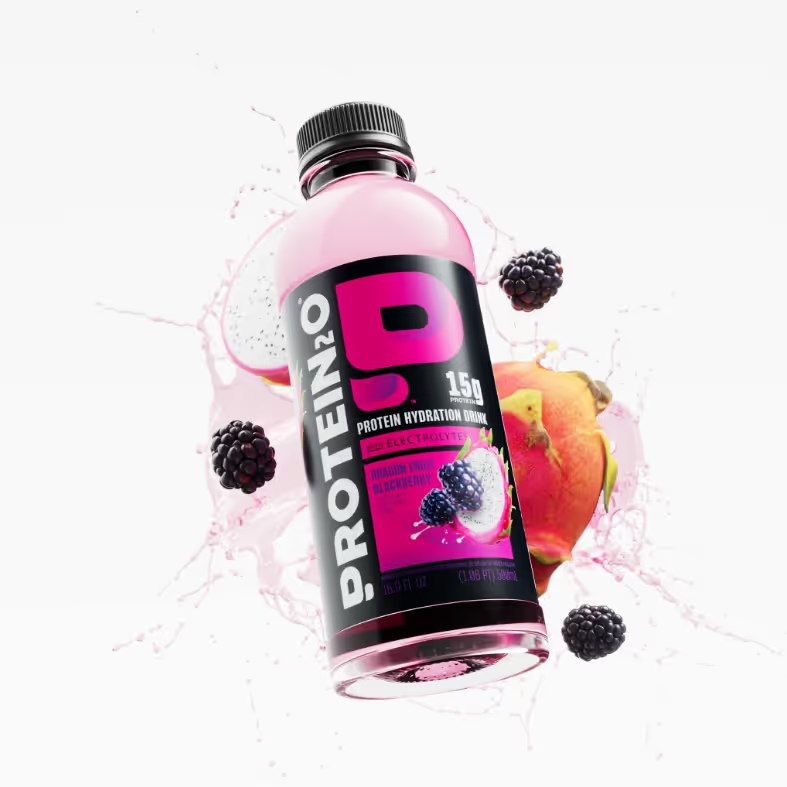

Food & Beverage Marketplace Management: From Specialty Foods to National Grocery Distribution
The food and beverage category has fundamentally transformed through ecommerce, accelerated by pandemic-driven online grocery adoption. Platforms like Instacart now process 7.7+ million orders daily, while Amazon Fresh and Whole Foods integration gives CPG brands unprecedented access to digital-first consumers. For food and beverage brands, marketplace success requires balancing shelf-stable product requirements, competitive pricing dynamics, subscription models, and multi-retailer distribution strategies.
Our food and beverage expertise covers specialty foods (artisan, organic, international), snacks and confections, beverages (ready-to-drink, concentrates, functional drinks), pantry staples and cooking ingredients, supplements and functional foods, and meal kits and subscription boxes. We understand category-specific compliance including FDA labeling requirements, allergen declarations, and nutrition facts optimization.
Food & Beverage Services


FAQ
Pet food doesn’t need FDA approval to sell on Amazon, and “FDA approved” is technically the wrong phrase for pet food entirely. The FDA regulates pet food under the same framework as human food (safe ingredients, accurate labeling, FSMA-compliant facilities) but doesn’t “approve” it the way it approves human drugs. What Amazon requires is category ungating, business documentation, product images, and sometimes a facility address. Medical-claim labeling is what gets products pulled, not the absence of FDA approval.
To advertise a CPG brand on Instacart, run Sponsored Product ads through Instacart Ads Manager (self-serve for smaller brands) or Instacart’s enterprise sales team for larger spends. Instacart serves shoppers buying from grocery retailers like Kroger, Wegmans, Sprouts, and Publix. You need to be a participating CPG brand with SKUs already stocked at Instacart-partnered retailers. Instacart can’t sell what its retailer partners don’t carry. Most CPG brands start at $5K–$15K/month and scale based on attribution clarity.
Amazon FBA requires food products to maintain at least 110 days of remaining shelf life or they’re removed from the warehouse, and inbound shipments need at least 90 days of shelf life from the day Amazon receives them. Products with less than 50 days of shelf life at receipt are rejected outright. Practical rule: if your product has a 12-month shelf life at production, you have roughly 4–6 months of FBA window before removal becomes mandatory. For shorter-shelf-life products (fresh baked, refrigerated), FBA is rarely viable. Consider MCF with Amazon Fresh enrollment instead.
Amazon Saver, Happy Belly, 365 by Whole Foods, and Aplenty now compete directly with emerging brands across most commodity categories. Amazon's private labels typically price 20–30% below the dominant national brand at launch and get subsidized ad placement. For emerging brands, the strategic response isn't to match Amazon's price. You'll lose. Instead: differentiate on specific ingredient profiles, certification claims (organic, non-GMO, specific nutritional targets), or consumption contexts that commodity private label doesn't address. Position in the top 30% of category pricing with meaningfully better formulation, not in the bottom 30% trying to compete on cost.
Don’t compete with Amazon’s private labels (Amazon Saver, Happy Belly) on price. That’s their game and they’ll outlast you. Compete on specific ingredient or sourcing claims private labels don’t make, niche dietary targets generic labels can’t credibly serve, and flavor or format differentiation where generic labels stay mainstream. Specifically: (1) organic, single-origin, or specific regional sourcing claims; (2) niche dietary positioning (keto, Whole30, AIP, specific allergen profiles); (3) flavor or format differentiation outside the mainstream. Price at 20–30% premium to private label with defensible quality differences. Brands that position in the bottom 30% of category pricing facing Amazon’s private labels almost always lose margin to no upside.
Amazon's Prime member-exclusive discounts on its own private label (typically 10–15% off Amazon Saver and Happy Belly) effectively price those SKUs 30–40% below equivalent national brands for Prime members. For emerging brands, this resets category price expectations in Amazon-captive consumer mental models. Margin benchmark adjustment: expect category contribution margin to compress 3–5 percentage points in Amazon-heavy CPG categories over the next 24–36 months as Amazon private labels expand. Brands that can't hold premium positioning (clear differentiation, brand loyalty, specific use case) may see gross margin erode from 45% to 38–40% without operational changes.
Yes. Instacart powers eCommerce for 1,400+ retailer banners in North America. When you advertise on Instacart, your ads appear on every retailer's storefront within Instacart, so a single campaign reaches Kroger.com shoppers, Wegmans Instant Delivery shoppers, and Publix Quick Picks shoppers simultaneously. The exception: some retailers have negotiated retailer-exclusive ad inventory that isn't available to all advertisers. For most CPG brands, the multi-retailer reach is the biggest reason to choose Instacart Ads over individual retailer media networks.