Pet Supplies
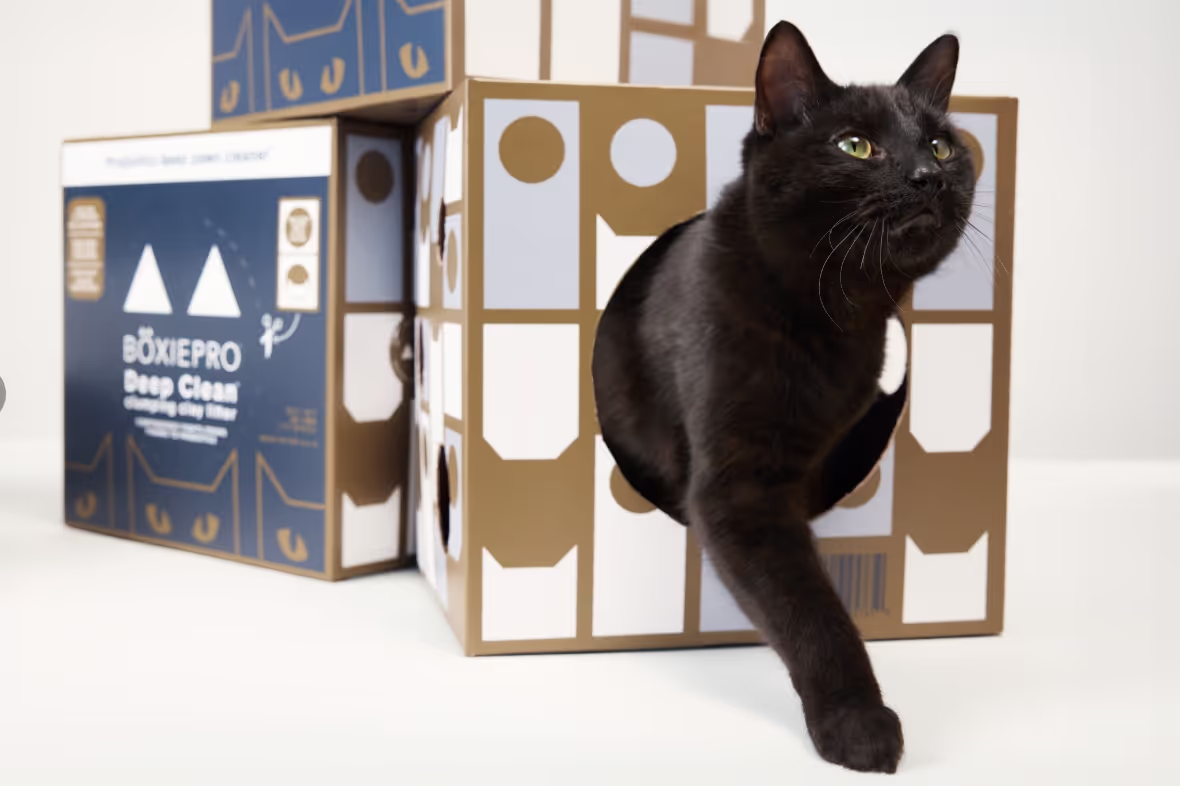

Pet Supplies Marketplace Management: Reaching America's 90+ Million Pet-Owning Households
The pet supplies industry has exploded online, with 67% of US households owning pets and spending over $136 billion annually on pet care. Amazon's pet category generates $8+ billion in sales, while specialized platforms like Chewy have built loyalty that rivals any ecommerce brand. Pet parents research extensively, read reviews religiously, and prioritize their pets' health and happiness - making pet supplies one of the most emotionally-driven purchase categories online.
Our pet category expertise spans dog and cat food (including raw, freeze-dried, and specialty diets), treats and chews, toys and enrichment products, grooming supplies, pet tech and GPS trackers, and health supplements (probiotics, joint support, calming aids). We understand the unique compliance requirements like AAFCO nutritional adequacy statements for pet food and FDA regulations for pet health supplements.
Pet Supplies Services


FAQ
Pet food doesn’t need FDA approval to sell on Amazon, and “FDA approved” is technically the wrong phrase for pet food entirely. The FDA regulates pet food under the same framework as human food (safe ingredients, accurate labeling, FSMA-compliant facilities) but doesn’t “approve” it the way it approves human drugs. What Amazon requires is category ungating, business documentation, product images, and sometimes a facility address. Medical-claim labeling is what gets products pulled, not the absence of FDA approval.
Chewy and Amazon serve different jobs for pet brands. Chewy wins on loyalty (Autoship runs roughly 70% of revenue versus Amazon’s Subscribe & Save mix of 25–40% for comparable pet SKUs), while Amazon wins on discovery and ad-driven launch velocity. Chewy’s category team hand-merchandises; Amazon is algorithmic and pay-to-play. Most growing pet brands sell on both, starting on Amazon for volume and layering Chewy to protect margin as Autoship subscribers compound. Treating the two as interchangeable is the most expensive mistake in pet eCommerce.
A rule of thumb: Amazon for discovery and ad-driven volume, Chewy for loyalty and margin protection, retailer.com (PetSmart, Petco) for category credibility, DTC for first-party data and LTV. For a $20M pet brand a reasonable revenue split is 50% Amazon / 25% Chewy / 15% retailer.com / 10% DTC, but the right number depends on whether your hero SKU is impulse (favor Amazon) or subscription (favor Chewy). The mistake we see is treating each channel as an ROI competition rather than a portfolio. Amazon's role is often to fund retailer-parity pricing, not to maximize its own margin.
Subscribe & Save orders are roughly 60–75% non-incremental. Those shoppers would have repurchased via Subscribe & Save or direct search without your ads. That matters because a 25% ACOS looks very different when only 30% of ad-attributed sales are truly new. The real number you want is ACOS on new-to-brand customers, which AMC exposes cleanly. Most pet brands are overpaying for ads by 20–30% because their ACOS math bakes in loyal-customer rebuys they didn't need to pay for.
Three layers. Brand Registry plus Project Zero enrollment gives you takedown authority without going through Amazon support. Utility patents on product form factor protect the product itself if distinct enough. Design patents are weaker on Amazon. A defensive search-term strategy — bidding on your brand's modifier keywords ("[brand] + dog food grain free") — prevents cloners from harvesting your branded long-tail. What doesn't work: trying to out-compete on price, or filing cease-and-desists without Brand Registry enforcement behind them. Private-label cloning is a playbook; your counter needs to be a playbook, not a reaction.
Chewy operates both models. A 1P wholesale relationship (similar to Amazon Vendor Central, Chewy buys inventory and resells it under their listing) and a 3P drop-ship marketplace (you fulfill orders directly to shoppers using Chewy’s branding). Most pet brands use 1P wholesale for hero SKUs (better placement, Chewy-driven merchandising) and drop-ship for long-tail or oversize SKUs that don’t economically work in Chewy’s warehouses. Decisions about which model fits which SKU are negotiated SKU-by-SKU during onboarding.
Structure/function claims describe how a supplement supports normal body function (“supports joint health,” “promotes immune response”). Disease claims assert that a product treats, cures, or prevents a specific disease (“treats arthritis,” “cures insomnia”) and require FDA drug approval. Which supplements cannot make. Structure/function claims are legal if truthful and not misleading. Disease claims cannot be made by supplements at all. The line matters because a single wrong word on an Amazon listing triggers suppression and potentially an FDA warning letter.