What the Fastest-Growing Amazon Brands Do Differently
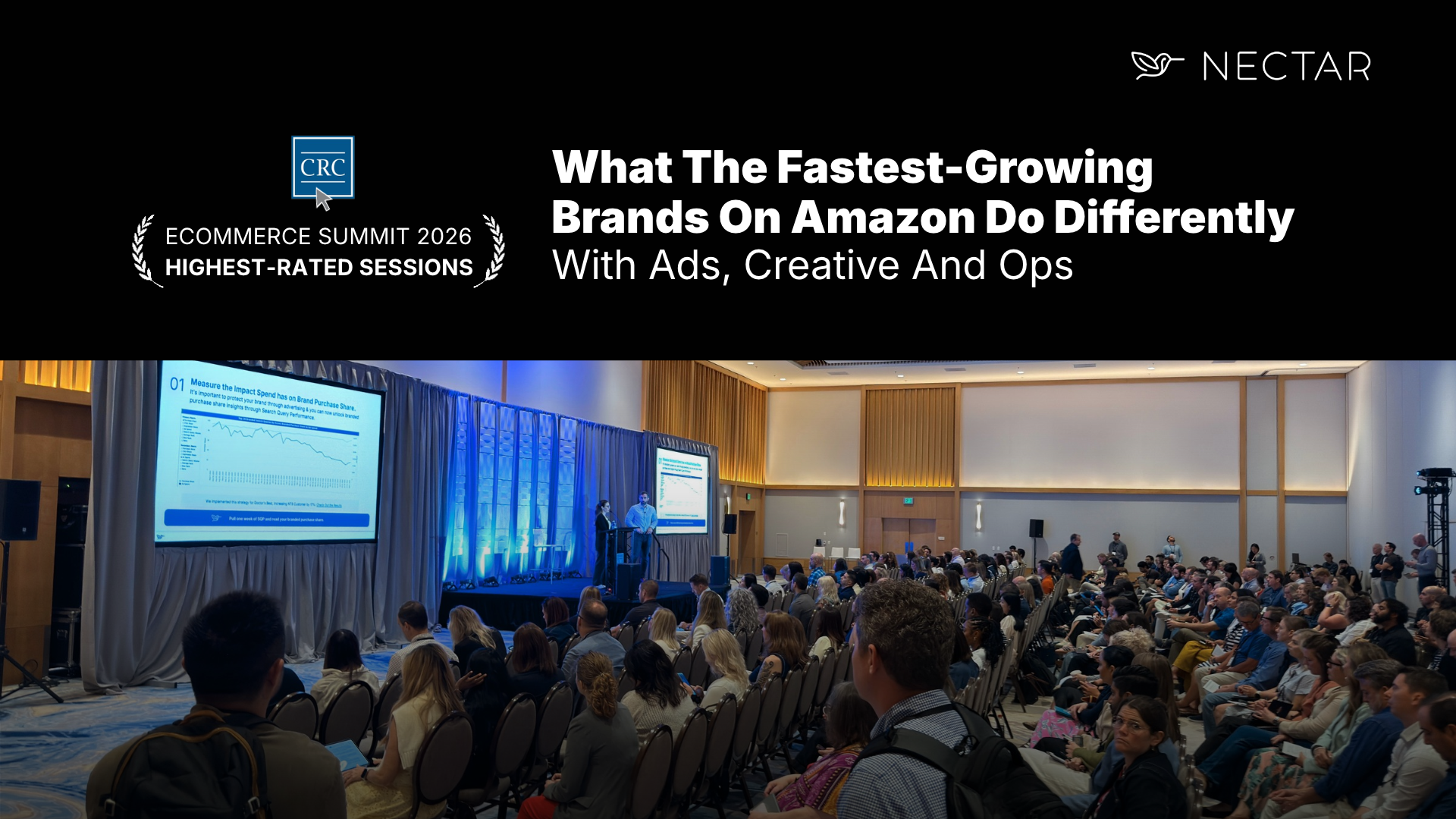
One of the highest-rated main-stage presentations at the CRC 2026 eCommerce Summit in San Diego, now open to everyone who wasn't in the room.
October 28, 2026
12:00 ET



What the Fastest-Growing Amazon Brands Do Differently With Ads
Nectar webinar, October 28, 2026
Speakers: Jason Landro (Co-Founder and Co-CEO), Harriet Carson (VP of Advertising)
[0:05] Jason Landro:
Oops. Alright. Welcome. We're excited to dive into this today, Harriet and I, really enjoyed presenting this in San Diego a couple months ago, and we were a little rushed then, so I think we're gonna have more time today, which is exciting, to go a little bit deeper. We'll get started in about a minute or so. We'll do some introductions, and then dive right in. This will be very actionable. You'll be able to walk away with tips, tricks, whatever you want to call it, that you can implement in your business. And a lot of them are really relevant for Q4, and with the advent of AI, you can actually make progress on them pretty quickly. So, yeah, we're really excited. This was well received at CRC, which is why we wanted to present it again. And, yeah, we're gonna go pretty deep here, so if you have questions, just pop them in, as we, as we work through it. So, I'm Jason Landro, I'm one of the founders and co-CEO of Nectar, we're a digital marketing agency, and my background is we start while I was a lawyer, and then started selling on Amazon, and then we, morphed into an agency, and I will turn it over to Harriet to introduce herself.
[1:31] Harriet Carson:
Yeah, everyone, thanks so much for joining today. I'm Harriet Carson, I'm the VP of Advertising at Nectar. I'm excited to be here with Jason. I've been in the retail media landscape, specifically working in Amazon ads for about 13 years now, so, have seen kind of it evolve over the years, and We did present a lot of what we're gonna run through today at Cleveland Research Conference, earlier in this year, and We had some pretty great conversations coming out of it, so we're excited to just bring it to a broader audience today. We're gonna walk through, kind of, what we're seeing in the Amazon landscape, how brands should be thinking about their ad investments, and just some of the strategies we are using, and… In our day-to-day to really drive more incremental growth. So, you know, our goal is to give you some actionable takeaways that you can bring back to your own business. So, yeah, I think we can… Jump in if…
[2:17] Jason Landro:
Yeah, and so the genesis for this was, based on the account audits, as well as the accounts we manage, what are we seeing? What are the trends that are leading to hypergrowth? And then what are we seeing that are holding people back? Just for some reference, you know, we have over 100 brands under management, we're managing, actually, it's more, hundreds of millions of dollars in annual ad spend, and we manage billions in marketplace revenue, so we have a lot of context in terms of. of the ad spend and revenue scale to see these trends. And… I think the macro view is that we see that the brands that are most successful are working on everything holistically. And that sounds really simple, but what we often see is that companies get hyper-focused on one or two areas, and they try to fix those things, and then move on to the next thing, and it actually ends up holding them back. So if you're able to move along different… aspects or silos of the business at the same time and level them up, that's going to lead to compounding growth. And that sounds really simple. But it's often very, very hard to execute, because it's different departments that you have to connect together, and those different departments only own one little piece that affects your Amazon business. So, like, the content team might also do D2C, and they might do brick-and-mortar retail, and Amazon's a little tiny piece of that. Or the social team is driving some traffic to Amazon, but they're mainly driving traffic to your website and other activations, right? So… It can be very, very challenging to get everybody aligned and working together, but the companies that do are the ones that are seeing that hyper growth, and they're also able to pivot to what is working best right now or today, so to speak. So I think it's also important to kind of zoom out, and think about how Amazon itself has evolved, as well as the ecosystem around it. You know, if you look back to the early days with ads. and even reviews, you could only… it was the Wild West, right? So it was all just about… you could basically seed reviews, unverified reviews, it was quite easy. And then the ads were just to get visibility, and they were pretty limited, mostly search-based. DSP was kind of coming into play and maturing. And then around 2019, 2020, Amazon hit a maturation point and made a clear pivot towards its advertising business and investing and scaling it. And it's kind of… what we know of Amazon ads today started around that time, where it became this full funnel advertising, Product, let's call it. And there was a lot more that you could connect between upper funnel demand generation and lower funnel conversions. I think the biggest challenge in Era 2 was the silos. You know, there's Amazon, and there's a walled garden between Amazon and every other e-retailer, your own website, in-store. And so now that we've come into Era 3, we're seeing those walled gardens, really come down, with measurement products like AMC and its kind of full… maturation point, where you can upload offline sources from your D2C site, other channels, in-store retail, etc, and even AMC can unlock, you know, paid data sets with some of those things, and Nielsen, and other insights. And… You know, we're also seeing social commerce really blossoming, and being part of the upper engine funnel to, to… sorry, the upper funnel demand generation engine, to drive more traffic. So, we're seeing this more interconnected commerce, and how that… and brands that are able to leverage that are obviously the ones that are seeing those large gains, right? It's no surprise that some of the biggest spenders on TikTok in each category are having a lot of success on Amazon, and you might say, oh yeah, well, they're spending millions of dollars, or tens of millions of dollars every month. true, but, you know, that leads to compounding growth in other areas. And you don't need to start out with, you know, shooting a cannon of money at TikTok, that we're not advocating for that as much as, you know, you can scale it up and make it work. to really get those compounding results. So… kind of diving in, what we see… at Nectar, what we encourage brands to do is move… is focus on incrementality and growth. not just… we constantly call it… a lot of brands are stuck in ROAS jail. So we'll get into… the brands that are focusing on true incremental growth are able to actually capitalize on that growth, and then reinvest more money in driving more growth. Brands that are anchoring to a ROAS are not, and so, we're gonna dive into that, next about… what are those KPIs that are actually going to drive incrementality? So, Harriet, how do… what are you… what are the trends that you're seeing, and how do we approach this?
[7:32] Harriet Carson:
Yeah, so piggybacking off your point, I think, you know, one of the biggest challenges we encourage brands to make, or biggest changes, I guess, is shifting how they define success. So instead of looking exclusively at, you know, ad efficiency, we need to understand whether the advertise, whether the advertising is actually growing the business and propelling your organic growth. So, I want to start here, because I think this is probably one of the bigger opportunities that we see when we're auditing Amazon accounts. it's really the difference between optimizing ad performance and optimizing the actual business. I think most brands are very comfortable talking about ROAS and ACoS and ad-attributed sales and, you know, those are important metrics. We obviously need to understand how our campaigns are performing, but… The problem is really, strong when you're stuck in ROAS jail, as Jason said. ROAS doesn't necessarily mean your business is growing, and And I'll give you an example. Let's say… you're spending a significant portion of your ad budget on branded search terms. These are shoppers who are already searching for your brand by name, they know who you are, they're familiar with your products, and, you know, in many cases, they're already pretty far along in their purchase decision. Naturally, those campaigns, they're gonna have a stronger conversion rate and a higher ROAS. That campaign's targeting shoppers who have never heard of your brand will likely have, you know, a lower conversion rate and a lower ROAS. So, if we're only optimizing towards ROAS, I could shift more and more of my budget towards branded traffic in this situation, and my ad efficiency would probably look fantastic. But what I'm… you know, what am I actually accomplishing? Am I bringing new customers into the business? Am I increasing my share of the category? Am I, you know, growing organic shares? Or am I just, you know, paying Amazon to capture purchases that probably would have happened anyways? And that's the distinction I want everyone to kind of think about. When we're evaluating ad performance, we're looking at total sales, organic sales, tacos. contribution margin, we're tying it to your bottom line. New-to-brand customers, market share. You know, ultimately, we don't just want to know whether, you know, our ads are generating advertising-attributed sales, but I want to know whether the business is in a better position because of the money that we invested. And you'll see that come up throughout the rest of the presentation, too.
[9:41] Jason Landro:
Yeah, and we're gonna give you ways that you can actually measure these things in terms, you know, like, whether your ad spend is driving incremental growth and customer lifetime value, so, we're not gonna just… Say how you should do it, we'll show you how to do it.
[9:57] Harriet Carson:
A great segue into this next slide. How do we actually measure that? So there's two tools within Amazon that I think that are very, very valuable, and they are still significantly underutilized today, even though, like, everyone's probably heard of Amazon Marketing Cloud, it's a buzzword, you know, these days. And, the second is search query performance, or SQP. So. I like to think about these as answering two different questions. Search query performance is going to tell me where I have an opportunity to grow my market share. Amazon Marketing Cloud helps me understand how my ads are influencing my customer journey. So. let's start with, search query performance, or SQP. So, Amazon is essentially giving us visibility into the actual search terms customers are using to find your products. And more importantly, what percentage of those searches, or clicks, or card ads, or purchases your brand is capturing. It also ranks those search terms from 1 to 1,000. By most relative, and like… Typically, what's driving most sales on a search term level, but it also gives you the search volume, so you can kind of understand the weight that you should be, assessing those terms. So, instead of seeing that, you know, my sales increased on a particular keyword, I can actually see whether I'm gaining or losing share of that demand. That's a very different way to evaluate performance. You can also tie it to spend, so you can understand, as I'm spending more, and am I gaining more of the purchase share, which is an indication of, you know, spend is driving market share. Then we have AMC. AMC allows us to look beyond, you know, an individual campaign and understand how shoppers are really interacting with our ads across multiple touchpoints. For example, someone may see a streaming TV ad on Prime Video, and then a display ad on, like, ESPN.com, and then searches for our brand a week later and purchases through a sponsored product campaign. If I'm only looking at, you know, the final ad interaction. I might give credit to sponsored products, but, you know, AMC allows me to understand the broader journey. We can also look at newborn customers over a much longer periods. Amazon, you can now go back 5 years. You can see audience overlap, purchase behavior, and just how different ad tactics kind of work together. And what's really exciting is that Amazon's been making AMC much more accessible. Historically, you really need someone comfortable writing SQL queries to really get a lot of value out of it. Now, between, you know, templated reporting and AI-assisted capabilities, the technical barrier is getting significantly lower, so these are tools that should really only be used by brands that… or they're not tools that should only be used by brands with large analytic teams. These are very accessible tools that really any brand can access. They're tools I think every brand should be incorporating into your ad strategy. We'll walk through specific examples of how to use both. You just want to add search query performance. If you are on 3P, you can find it in Brand Analytics. Under search query performance. And then, for 1P, they did just roll out a more limited version of SQP, where you don't get purchase share, but you do get, like, total purchases that came in through a specific search term. It's not… as valuable without the share. Ideally, they'll roll it out. We do have a way of getting that data, for 1P Brands, though, at Nectar.
[13:10] Jason Landro:
Which is, you have to get it through Seller Central, you can unlock it through a seller account, you don't actually have to activate an offer for a product, so there is a workaround to get the data, we use it, it's kosher, and it's a huge advantage. And if you're not using it today, you should be using it. I would say the biggest challenge is it doesn't court the… the report itself doesn't correlate ad spend at all, so you really need to have a mechanism to correlate ad spend. We do that in our analytics platform, iDrive. Obviously, it's not the only way to do that. You could do it through, you know, AI tools, but it'll be harder to trend it, for all those terms. And again, we're gonna get into specific use cases for both SQP and Amazon Marketing Cloud that you can take back and implement in your business. I think a lot of what we see is that Everyone knows that ads are super impactful on Amazon, and often the biggest way to drive growth, but we audit so many accounts that have major foundational issues, and they're a huge blocker. to growth, right? We see everything from packaging… instructions on packaging, not matching the content, to operational issues with listing, compliance, inventory management, etc. And the reasons run the gamut from large, complex operational catalogs to teams not talking to each other, but… if you're seeing that in your business, or you don't even know whether it's occurring, that's a problem. And you'd really need to work towards being able to identify those issues, so having a mechanism to audit and diagnose them, and then having a mechanism to fix them. Everyone is familiar with the concept of the flywheel. I think what is so… You know, what you don't often… think about until it's happening is the impact when one of these things goes wrong on everything else. Because it, you know, if you don't have inventory, you can't sell product, or if your listing's suppressed, it's gonna slow down, you know, if one of your top-selling listings is suppressed due to a compliance issue or customer complaints. it's gonna slow down your growth and your ability to meet your sales goals. So, part of it is the brands that have a system to be on top of all these things, it's not to say that they don't face issues, challenges, problems, rather. they have… they're on top of them. They're not overstocking product, or just fulfilling bulk buys because they're going to want to recognize the revenue right away, right? They're being more strategic about how they approach the business, how they approach inventory management, ensuring that they have their best sellers in stock, for example. So we see that a lot of businesses… there's kind of two paths, or even three. One is there really isn't proper ownership of these foundational issues. Two, they just deal with them as they come up. And then three, the more kind of proactive approach on being on top of it. And, you know, what we're talking about here, and I've kind of touched on, throughout is, you know, obviously having stock and buy box. We've seen that Amazon has shifted to a model where they seem, on both… obviously, for Seller Central, there's inventory limits, you can, you know, try to get more inventory bid for it, but essentially, they want you to manage your inventory as best as possible. To be more or less just in time. On Vendor Central, it also seems like they have shadow account limits, where if you overstock inventory, they just will stop ordering or draw down their weeks of cover until you right-size that. So it's really important to make sure that you're prioritizing your best-selling products from an inventory perspective, and leaving room to To, you know, send more in, and then on the other side, you know, not… just mindlessly fulfilling POs, especially for products that aren't best-selling, because, you know, if they don't sell through, they're taking up your, kind of. allocated account-level inventory. Another challenge of Vendor Central is Amazon will fulfill out of one warehouse and not transfer the inventory, and won't let you send inventory to specific warehouses. Just seems like a gap in their… system. So, you know, that can put you behind the eight ball, and there's almost nothing you can do about it, so being… managing your inventory better will ensure that you're still selling through, and leaving room for them to order more. Content is obviously ever important. If you ever get the SDQ reports from Amazon, you'll see that they… that's a report that they give you from the Strategic Account Services, or your ABS, where they basically score your list… every single listing on a variety of factors. So it's very, very clear that their algorithm is grading every single listing At a minimum, on a binary scale of whether or not you even have content. So, like, if you don't have a brand story on your listings, or some of your listings are missing A+, you're shooting yourself in the foot, and minimizing your visibility in the algorithm. Everyone knows that reviews and ratings are so impactful, you know, and showing 4.5 stars is kind of that gold standard. titles, you know, mobile is the way that people shop now, so… Yeah, you need to have your titles and main image optimized for the mobile experience. Also, Amazon obviously just changed their, the way that they, you know, reduced the titles to 75 characters, which is to optimize for mobile. We actually released a tool on our website that you can find to check your listings and make sure they're up-to-date and optimized for that change. It's a free tool. And then variations and offers. You know, how you drive traffic, how you cross-sell, upsell, and build basket size really does matter. There's ways to do that on the PDP and on the brand store that we'll get into later today, but ultimately. You know, if you're not doing these things well, it's going to impact your media efficiency and effectiveness. Because you're, you know, if you're driving a bunch of traffic, and your conversion rate isn't as strong as it should be, or was, because, you know, you have the wrong content, or lack in you know, you're getting worse reviews because the content is wrong, or not cutting off the wrong buyers, right? It's gonna lead to these kind of cascading consequences. So often. what we see is brands are too reactive. It's… they don't have a system to check reviews, and are we getting bad reviews? Has something changed? Is there a product issue? Or is… are we not educating people on how to apply this product properly? Or… I remember we sold a product And it was, like, improperly classified as kosher, and it wasn't, right? And it's like, so sometimes you need to cut off the wrong buyer. And so that that person doesn't have a bad experience and leave a bad review. AI makes this so, so much easier, right? You could have, you know, at least your top-selling listings analyzed every week, is, you know, is there something wrong? And, you know, get the trend, get the report, get the new reviews, etc. So, Harriet, you know, assuming that the, the base is in order, can you kind of walk us through what you expect to see as a practitioner on, you know, as it relates to the, the media?
[21:11] Harriet Carson:
Yeah, I mean, I think that the slide illustrates kind of why retail readiness is so important. You can, you know, you can have two products receiving essentially the same ad investment, but you can get very different results depending on how they're set up for success, so… say one product has weak content, you know, pricing friction, or inventory issues. You know, traffic arrives, conversions are low, pretty low, and the team starts reducing spend because the campaign looks inefficient. The other product might have, like, really strong retail fundamentals, but with the same ad investment, it's gonna generate more conversions, you know, potentially improved, best sellers rank or sales velocity, and creates an opportunity to expand that into additional keywords and audiences. Advertising's gonna amplify the condition of the retail experience, it doesn't replace it. I think that one thing I want to emphasize is you know, we've audited a lot of Amazon accounts, and I mean, this is true for anywhere you're advertising, not just Amazon specifically, it's just retail media, but… You know, I would say I see this issue across, really, every size brand. A lot of brands will come to us, and they… They want to know what's wrong with their ad strategy, because sales have come to a halt, or they're not seeing it be efficient, and… after doing a little bit of digging, you know, sometimes I'll tell brands, your ad strategy, yeah, there's, like, minor tweaks we can make, but the biggest issue is you don't have the right creative, or, you know, you're having out-of-stock or buy box issues, and your ads aren't building the momentum that they're supposed to be doing. Sometimes I'm recommending, until you have better stock issues, or you can, like, you might be better putting this budget into, like, the creative piece that's gonna last forever and, like, build those foundational elements that are gonna make ads work, so I think that, you know, these two things really do work hand-in-hand, and you need to really be looking at both when you're analyzing ad performance.
[22:59] Jason Landro:
And so here's… one example, you know, the brand store is a great way to have intentional merchandising, so you can curate content on your homepage where you can cross-sell and upsell, or build a basket size. Amazon's own data for Brand Store shows that optimized brand stores have a higher average order value in units per order than the account as a whole, and that's because you can build it like a D2C website. And you can strategically place products next to each other, and you can make those products shoppable. Whereas on the PDP, you're really limited to the products that are listed on that page, and then… you know, you have to hope that they make it down to the A-plus content, and you have to make that shoppable. So the more that you can curate the shopping experience, the more you can drive sales. And… Amazon's own research shows that consumers that are familiar with the brand have more of a tendency to go and explore the brand store for more. We've also have clients that have done focus groups to confirm that. So, there's a lot of potential, especially the more revenue scale that you have on your brand store. We see that, Brandsource should drive at least 10% of the overall revenue of the account as a whole. So… and Amazon has released a bunch of new features that are really exciting, that are more kind of personalized, where you can customize the store based on, the certain behavioral characteristics of the audience that Amazon's identified, like past purchasers. So, this is a great way where you can really fuel your revenue growth by being more strategic about how you merchandise the content, and a lot of these concepts apply to A-plus as well. A lot of brands are super focused on just the product, but you… especially for your higher volume listings, you're getting a ton of traffic, you're getting a ton of visibility. Use it as a chance, at least in part, to upsell. And… kind of in line with that back to the PDP, you know, feature clarity can go a long way. You know, just a 4… this is actually a 4% basis point increase. Just from having better features. But also, what we see a lot is that Even for larger, more established brands and their categories, they still treat content as an afterthought, or they borrow it from other places, when it needs to be customized to the digital shelf and for Amazon. In addition, it needs to be commensurate with the price point. If you have a premium product, you need to have content that looks premium, because it's a heuristic mismatch. Otherwise, you're asking people to… you're saying to consumers, buy this product, it's premium, but it looks like you know, it doesn't look premium. That's… that's not reinforcing the objective and the ultimate, messaging that you're trying to… to achieve. And so we still see that as a big gap. I think also brands don't think… don't always design content for the sandbox that is Amazon. You know, there's certain limitations on Amazon that you have to follow that you don't have to follow on your D2C site. Also, there's a lot more customers that are in aisle on Amazon. versus your own website. So what we see often is brands have a more kind of minimalistic approach on their website, less infographics and information about the product and the content, because consumers generally, they've seen, like, a social media ad, or they're aware of the brand already. On Amazon, people are looking for a hair… hair dryer, right? They're not… because Amazon is essentially, like, a big mall, whereas your brand site is not. So, you know, you need to… your content needs to recognize that reality, and a lot of brands don't think about it that way, which is a miss. So, you know, in addition, these are kind of, we just want to hit on some of the big vendor, gaps that we see. Advertising in an ASIN with unconfirmed or short-chip POs, You have to have a mechanism to tie the two together, and these are often run by different teams, where some… one team is owning inventory, the other team is owning advertising management, so you… you know, it's not just… as simple as fixing the problem, right? You need to have a process in place to make sure that there's communication when these issues arise, and the ability to diagnose it. And no days of cover, threshold related to ad pacing, so you don't want to spend money just to stock out. Chargebacks and shortages, too. We see a lot of brands have large volumes of chargebacks. really, you should be taking… what is… you should be analyzing why you're getting those chargebacks and working towards a solution. Too often, it seems that… The people that are dealing with the chargebacks are very… disconnected from the people that would be in charge… are in charge of Kind of diagnosing and implementing root cause solutions. And it's something that's pretty easy to bridge, and you really should… e-commerce is just going to continue to grow. If the root cause of your chargebacks is due to operational… I mean, because your products are built for brick-and-mortar retail and not online. You need to figure out a way to evolve that and fix that in your org. It may not be an immediate solution, but it could be something you work towards as an organization. But the point is, you have to build a plan and then execute against it. And a lot of orgs are not doing that. And then cost increases are never passed through. Obviously it's a huge struggle, and everyone wishes you could just push a button and get a cost increase. The reality is there's so much that goes into it. Having price parity across all channels and part of that is, you know, ensuring you don't have a rogue reseller network that's… or the reseller network that's out of control, I guess I should say. You know, you need to… make sure that you're designing products that are optimized for shipping through e-commerce so that Amazon's margin isn't impacted, because they're not really passing that through to you. They aren't passing that through to you on Vendor Central, but they're measuring that when you're asking them for a cost increase. So, you know, you really need to think about that holistically and plan. It's not as simple as just asking for a cost price increase. You need to build leverage and a business case. So, part of that is, what are you doing holistically in your business to make sure that Amazon can meet its margin targets? And then, how are you… like, you also need to build narratives around that, in terms of, we're making these investments and getting more visibility to these products. this is… which will lead to X, Y and Z results for you, Amazon, this is why you should agree to this, right? You need to… you need to align your ask to their best interests, and that takes, planning ahead of time. Hey, Amazon made it harder to watch, suppressions and lost buy boxes. You need some automation to be aware of that, because obviously it can be hugely impactful to your sales, and, you know, you're obviously… You know, you build a budget to, to… spend against, and that impacts your top-line revenue goals. If you're losing Buy Box on the sponsored ad side, you're not going to be able to continue to spend. So, that's going to impact your revenue, targets and achieving them. So… This, we're gonna get into the meat and potatoes on the ad side, diving into some tactics, about how to really make your ad dollars incremental, make sure to drop any questions that you have, and we'll try to get to them at the end. So, Harriet, can you take us a little bit deeper into what, the, the search query performance is?
[31:16] Harriet Carson:
Yeah, absolutely. So, search query performance, we did touch on this briefly, but I want to go through some use cases. So, this is probably one of my favorite reports on Amazon, and, you know, I really can't emphasize enough just how valuable it is. I always say, from an ads perspective, I think it's… you know, some of the most valuable data Amazon's released since Amazon Marketing Cloud. So, my team's in here weekly and really using it to make real-time decisions and, you know, bid optimizations and to understand the incrementality, you know, of advertisements. And… You know, Amazon's literally giving brands visibility into their market share at the search term level, and it's free. I want to emphasize, it's at the search term level, because not all traffic comes through search. Some comes through DSP, or off-Amazon attribution, or, you know, influencer activations, but search is still where the majority of discovery and purchases do happen on Amazon today. So I should mention, search port performance, it's not just advertise… advertising data, it's advertising and organic data, so it's total search volume, your total purchase share, your total click share. So you're able to really connect What you're doing on the ad side to what's happening organically and how it's impacting that. If you're not familiar with SQP, you can access it, again, through Brand Analytics. What I recommend is starting with the simple view. You don't… you don't need to overcomplicate this with the comprehensive view. The, you know, simple view gives us the information that we really need to start making. strategic decisions. So, you know, what we're looking at is the customer journey across 4 different stages. First, you know, impressions. of all the impressions generated for a particular search term, for your brand, or you can look at it on a product level, you know, what percentage did my brand or my product capture? Then clicks, you know, of the shoppers clicking on products for that search term, what percentage clicked on mine, and then cart ads, you know, and then finally, purchases. The purchase metric is where I spend a lot of my time, because let's say I'm looking at A high-volume category term, and my brand has 15% of the purchases. Now, let's say I increase ad investment on that same term over the next month. my ad sales might increase, but what I really want to know is whether that 15% purchase share moved to 17, 18, or, you know, 20, because if I'm spending significantly more money. but my purchase share is not moving, I need to understand why. Maybe I'm simply replacing organic sales with paid sales. maybe, you know, competitors are investing more aggressively, maybe my price or conversion rate is limiting my ability to gain that share, but at least now I have a way to evaluate, that ad investment against, really, the broader market and what's happening, organically. And, you know, this is why I think SQP should be a regular part of, you know, every brand and every agency's ad reports, not just something you look at once a quarter. Again, my, you know, my team, I want them looking at it weekly, and they are. Just understand where they're getting share, where they're, you know, losing it, and, you know, using that information to really drive where the next ad dollar should go.
[34:04] Jason Landro:
Yeah, and two things, so… For those of you who are totally unfamiliar with SQP, it's an extension of brand analytics data, so Brand Analytics gives you the top, 3 converting ASINs and top 3 clicked ASINs for the top 2 million terms on Amazon. SQP is the extension of that data for any brand registered brand. for all your ASINs for the top 2 million terms, regardless of whether those, terms… whether your ASINs are in the top 3 for the top 2 million terms in either click share or conversion share. So, this is really, really powerful data about your performance and search for all, you know, the top 2 million terms on Amazon, which are the ones that matter. And you can use them to do a whole host of things. I think the other challenge that Harriet touched on, which you're not going to really see today visually, is that Amazon… you can get this data through the API, it comes in weekly. monthly and quarterly views. So you have to trend it to really get the most out of it. So you have to have a mechanism to… to trend it, and then you need… you really need to marry it up with your ad spend at the search term level to get the absolute most out of it, which takes… data cleaning. You can't, Because you have to associate the ad spend at the ASIN level, which rolls up from sponsored products. As well as sponsor brands, potentially a little bit of sponsored display. So, there's… that being said, it doesn't mean you can't… just downloading the reports and looking at them will give you good insights about your purchase share. You can run tests on individual ASINs, but it's very, very hard to scale your use of SQP. without having, either not… like, transparently, we have iDerive, which is our analytics platform that does all of what I just said and more. There's other competitive products that have that. In theory, you could build a lot of this, through generative AI. Probably would take a lot of time, but to get the most out of it, you need to have automation in place. Okay, so, Harriet, can you walk us through an example of how you can use SQP to measure the impact of your branded purchase share and ad spend?
[36:25] Harriet Carson:
Yeah, so I think, you know, one of the most common opportunities we find when we're auditing accounts is, how much you're investing in branded keyword spend. So, I want to be very clear here, because, you know, I'm not suggesting that brands should, you know, completely stop advertising on their own branded terms, there's absolutely a reason to protect branded traffic, especially in competitive categories where, you know, other advertisers are actively targeting your brand. But I do think a lot of brands are spending significantly more than they need to, and the reason this happens is because, you know, brand campaigns tend to perform extremely well from a ROAS perspective, or, you know, your Broad match for auto campaigns are picking up branded traffic that you're not aware of. You know, if someone searches for your brand by name. they already have some level of awareness or purchase intent. So, you know, of course those campaigns are going to convert better, but the question I always ask is, if we weren't paying for that click, would we still have gotten the sale? And that's where SQP becomes really valuable. You know, let's say your brand is capturing 98% or 99% of purchases on its branded search terms. And, you know, let's say you're spending a significant amount of money defending those search terms. Then you cut that budget in half for a month, and your brand purchase share stays at 98% to 99%. Sure, you know, your impression share might go down, but are less people actually purchasing, when searching for your project specifically? It's… if not, it's, you know, is all that investment really necessary, or can you shift it to more incremental terms? You know, the opportunities to take dollars that might unnecessarily, you know, concentrate or be concentrated on existing demand, and move them toward category terms where we can introduce the brand to shoppers who aren't already looking for it. And, you know, that's how we start shifting from capturing demand to actually growing the business. And on the next slide, we're gonna walk through a use case that you guys can actually implement, ideally today, if you have, surgical performance. So, Cure Thought actually approached this, and this is something you can take back to your ad team and start testing next week, so… The first step is establishing your baseline. I want to know how much we're currently spending on branded ads, what our branded purchase share looks like, and how much organic visibility we have on those search terms. And I also want to understand the competitive environment, right? So, because if you're in the category where competitors are aggressively bidding on your brand, that's going to influence how much defense you really need. The second step is really making a controlled reduction on those terms. I usually recommend starting somewhere around 15%. If you're a brand with very strong brand purchase share and limited competitive pressure, you might be able to test more aggressive, branded spend reduction, but the point is that we're not just shifting everything overnight, we're making, you know, a deliberate adjustment and really measuring what happens next. The third step is going to be Going into SQP and looking at your brand purchase share. Let's say I reduce branded spend by that 15%, my brand purchase share goes from 99% to 98%, now I would make a final decision based off one week of data? Probably not, but that's an interesting result. If I'm spending meaningfully less on my share and, you know, my purchases is barely changing, that suggests a lot of those ad investments may not have been necessary. You likely were going to get that sale organically anyways. And then the fourth is just continuing to test, until we find the point where reducing spend starts to negatively affect the business. And then the fifth step, which I think is really important, is looking at organic visibility. You know, there's not enough data to say, you know, ad-attributed sales declined. Of course, they're going to decrease if we're spending less on branded terms. What I want to know is whether those sales were replaced by organic purchases. If, you know, total sales are holding, purchase shares holding, organic sales are increasing, that's a much more meaningful outcome than You know, looking at branded campaigns, return on ad spend alone. And, you know, then we can take those dollars and reinvest them into you know, non-branded category terms to, you know, acquire new customers, or put them towards products where we have real opportunity to actually gain share. You know, that's the objective. We're not trying to eliminate branded advertising at all. We're trying to identify the minimum, you know, effective investment needed to really protect the business. And I will say, search query performance, it's not gonna really tell you How much investment you should be putting towards defending your product detail pages with product targeting, and that is a really important piece where just a little tip here, a lot of the time, I'll… I'll take some of that branded investment that wasn't necessary, and I'll put it towards protecting my product detail page, because if you're spending money to acquire people and get them over to your page, you don't want to lose them at the consideration phase of the purchase journey to, you know, a competitor, targeting you.
[40:50] Jason Landro:
The one thing that I want to add is this isn't one and done. You should kind of come back to this, and revisit it periodically. But I think, you know, what we're saying is if you continue to, reduce your spend and your purchase share isn't moving, it's a very, very strong indication that it's not incremental. and can be used to fuel incremental growth in other areas. There can be other factors that lead to that, obviously, but if you continue to reduce it, to further test the theory and it doesn't move, it, you know, it further reinforces that indication, so… This is, essentially, we're advocating for a methodology, it is not a precise science. Everybody wants certainty, but, there's almost, you know, no certainty in everything, and so there… I'm also addressing some of the questions that have been popped in. You know, reducing is going to… cutting ad spend and seeing if purchase share… whether purchase share falls off is going to give you better results about… better indications about whether it's incremental as opposed to increasing, because there's more that can happen when you increase spend, like competitive dynamics. It's true that people can pull off at the same time that you pull off, much less likely. So… I just want to reiterate that this is a methodology framework that is very, you know, it works really well, because we get really good results using it, but it's also not perfect or foolproof. Foolproof.
[42:23] Harriet Carson:
Yeah, and I think, you know, really quickly, the other piece is… you have to constantly be evaluating these things. You might see after a couple of weeks that your branded purchase share hasn't flowed down, but you should still revisit that, because it could impact it eventually. Same with the opposite. If you're spending on a term and you're seeing your purchase shares going up, that's great. There might be a cap where, you know, you're spending more and your purchase share stops going up. That's where you've kind of hit that cap, and you might want to shift that spend into other terms, and you've kind of found that sweet spot of where you need to be spending at that moment, to maximize, you know, your, your share.
[42:57] Jason Landro:
Yeah, and so we just got a question about… the, SQP to measurement of incremental sales versus cannibalized sales. I don't really think that's… and then an increment… incrementality score based on that,
[43:14] Harriet Carson:
Technically, it gives you… technically, searchpoint performance will give you total purchases, so it's not going to break it out by paid and organic. You do get paid purchases on a search term level, so you can… you can create that, and then you can understand, like, what the organic lift was. It'll give you the ASP on a search term level, so you can… you can quantify it. I will say, I've… I've always found that when I've QA'd the data, share typically always matches up. Sometimes the purchases are… Not within, like, the 10% of what I would expect, so I'm a little bit… I'm a little bit less trusting of the… of the purchase data, knowing that it's… it's just coming in from that search room, right? And sales can… can occur elsewhere. But, Yeah, I think that there are absolutely models that you can develop, and incrementality analysis you can do to understand, you know. how many sales are occurring from spending a certain amount on a term, right? And same with reducing spend from branded. You can kind of understand how much budget was cannibalizing, and then how is that budget that I'm shifting to more incremental terms, really, driving more organic growth.
[44:19] Jason Landro:
Yeah, and in terms of the cannibalization percentage, the only way you can really measure that is by running these quasi-holdout tests, or spend reduction tests. You can do it increasing as well, but there's more risk there in terms of correlation not equaling causation. I think the better use case of an incrementality score is actually what we've done in IDRI very recently, which is we're aggregating cohorts of related terms, showing you your aggregate purchase share across those terms. overlaying your ad spend for those terms. So, you know, let's say… We talk about a water bottle, and you have a water bottle, insulated water bottle, you know, water bottle… handheld water bottle, right? Those are all related terms that you'd want to understand how they function, and then you would want to understand in the aggregate what is your purchase share, and how much are you spending against it. If it's, you know, you're not spending a lot of money, but you have a strong purchase share. That there's a strong indication there that you should spend more money to drive your purchase share up, right? So that's where I think looking at incrementality is much more powerful than trying to estimate the cannibalization percentage Similarly, we have that reporting where you're spending a lot of money, but your conversion share is low, it's not working, right? So, that's where you should be pulling off, or one of the use cases where you should be pulling off. So, obviously, there's different ways to approach this, but I think the important thing is using this as a proxy, not the Bible, because it's a very good… very good and strong proxy. We're gonna keep going, but these are great questions, keep them coming, we'll try to get to them.
[46:12] Harriet Carson:
Okay, I'm gonna be mindful of time and move through the next couple of slides. more quickly, you know, the second opportunity, and one of the first things I look at also when auditing an ad account is how much money is being spent on terms that have never, you know, generated a conversion? The, you know, not search terms with just a low return on ad spend, not even looking at keywords, but actual search terms, and not just search terms that are slightly underperforming, but talking about actual customer searches, where we've spent money, and we've generated clicks, and we have not generated a single order over a period that we're analyzing. The numbers are pretty surprising. They can be pretty high. I see… you know. somewhere between, like, 20% and 60%. 20%, I would say within normal range, 60% is pretty high. One question you might get is, but how… with the attribution on Amazon, how many of these users click, and then they come back at a later date, and they end up purchasing? We can track all of that through AMC, by having a longer look-back period, so we do look at that as well, but… These are ad dollars that you can be shifting into really highly searched, like. search terms that you want to increase your share of voice for that have proven to be incremental. You know, there's typically, with the majority of audits that I see, at least some, refinements that we can do in order to shift some of that budget and make it more incremental.
[47:38] Jason Landro:
Yeah, and so we got a great question that ties into this, as well as… and what you just said, as well as SQP, which is… Molly asked, continuously received pushback from her internal media team around right-sizing brand keyword spend, with the basis being loss of relevancy. Have you seen relevancy impacted with the pullback of sponsored products brands? I think, one, you… you know, what Harriet said about Step 5 in this last slide is measuring your organic share of voice, right? So having a tool to measure that, but you can also look at your total impressions, and clicks, right? And if they're not changing, that is a… if not a strong indication… I mean, it's almost conclusive, if not highly, strong indication that it's not incremental, right, if that's not changing. In addition, you know, if you're reinvesting that into generic terms, and getting more impressions and Clicks and conversions, then ultimately you're actually increasing, your, your share of voice, because you're more, more visible. Right, Harriet?
[48:45] Harriet Carson:
Yeah, I mean, the answer for me is, if it's your brand, you're typically gonna have a very high relevancy score. That's why it's so hard to rank organically on competitor search terms, even if you are bidding against them, because there is that relevancy factor. One thing I forgot to mention is. we do scrape the Amazon search results for your top terms, and we do pull in organic rank next to all this SQP data, next to your spend, so we're also measuring that piece as well.
[49:12] Jason Landro:
Yeah, and, I've had conversations with people on Amazon's… directors on Amazon's data science team, and they actually essentially penalize brands for bidding on competitors' terms, I guess that's one way to phrase it, is a penalty, in that you have to pay… More, because they know that consumers, when they're running a branded search, want to see… the brand. So they're not trying to aggravate or add friction to the buying process, unless the term is a genericized term, like Kleenex or Tide for detergent, because because again, Amazon is… even though they're in the business making money, they're customer-centric, right? So they don't want to frustrate customers for finding products they want to see. And sometimes you'll see, when, like, when I run… branded searches, like, when I'm shopping on Amazon, there are often times where I don't even see ads, or the only ads I'll ever see are from the brand itself. So, you know, I think Amazon recognizes that to a degree, and… And how they surface, branded… branded ads, and that experience.
[50:23] Harriet Carson:
Yeah, so I think that, you know, identifying the problem is one thing, but the next question is, how do we actually prevent this from happening, like, continuously? And this is where I think having clear optimization guardrails and ad management platforms are very, very important. So one simple rule. You can use it as a starting point, look at search terms that have generated at least, you know, we can start with 10 clicks over a 30- or 60-day period. Without any conversions, you can even put, like, a spend, number on it if you want to say, I've also spent over $100. When that happens, we typically will reduce bids by about 50%, then we'll give it, you know, another couple weeks. We're still seeing not… no conversions, and we're using AMC to ensure that people aren't coming back. We evaluate, really, whether that term should be paused or excluded. I do want to emphasize, this is a starting point. 10 clicks isn't necessarily enough data to make a statistically, like, competent decision in every category, especially if you're a premium product. Sometimes it's going to take more. If you're, you know, selling an expensive product with a longer consideration period, your thresholds, you know, may look differently. Principle is that we don't want to allow the same search term to continue consuming budget, like, really indefinitely without some sort of intervention. Sometimes this can also happen when your PDPs aren't aren't conveying that the product actually is relevant to that search term, so it ties it back to, you know, making sure your products in your detail page are retail-ready. Sometimes it's a conversion issue. you know, I don't necessarily want to always pod an entire keyword, because it may be driving, you know, valuable traffic. That's why we look at this on the search term level, not just the keyword, because there's match types where different search terms can pull in. But instead, if I want to identify the specific searches that aren't performing, and add them as negative targets where appropriate. This is how we preserve, you know, the discovery opportunity while eliminating unnecessary spend, and ideally, this isn't something that an ad manager is, you know, doing manually. They should be, you know, rules in place to ensure that you have harvesting and you have guardrails in place to negate some terms.
[52:19] Jason Landro:
Yeah, and if your products are expensive, you probably need to adjust that click threshold, so we'd encourage you to look at averages in your account and start there. These are, like, you know, we're giving one example here, don't take this as the gospel, but the point is you need a framework to address it.
[52:37] Harriet Carson:
And then the third opportunity is campaign structure, and specifically how much budget's going towards, you know, auto campaigns and different match types, like broad and phrase. Now, I want to be clear, these match types, they absolutely have a place in your ad strategy. They're very valuable for discovery. The issue is when discovery campaigns become kind of permanent spending buckets without any process for really taking what we've learned and using it to improve the account. Or, you know, without the proper guardrails to reduce these inefficiencies. And this is something we see all the time. A brand launches auto campaigns when a product first goes live. That product starts generating conversions. A year later, they're still running with significant budgets, but nobody's gone back to really identify which search terms are actually driving that performance. You know, essentially the account will continue to pay for discovery without necessarily graduating proven terms into a more controlled structure, like in the manual campaigns. What we want to see is a clear process. We use auto-broad phrase to really identify relevant customer searches, to cast a wider net, and then once we have enough evidence that a search term's converting, and and is a winning keyword, we move it to exact maps, where we can manage it more intentionally. Now, you know, we have better control over the bid, the budget, and, you know, what product I'm prioritizing. And then, you know, this becomes really important when we're trying to gain market share and analyzing SQP as well, because when you're targeting keywords, you're not necessarily knowing what the customer's searching for. Another thing we commonly find is branded traffic leaks through, like, broad match campaigns, so brand might think that branded advertising is about 10% of its spend, could be 50. You have to really look at that report. And that's why campaign naming and campaign level reporting aren't typically enough. You need to understand the actual searches you're paying for. Biggest takeaway here is that, you know, every match type should have a specific purchase. purpose. And, discovery campaigns, they should be discovering. Proven terms should have a clear, really, path in the structure where we can scale them intentionally and use search warrior performance to, Analyze and optimize.
[54:37] Jason Landro:
And this also controls your wasted spend. So, you know, moving, moving to the fourth Harriet, How should brands be looking at the correlation between ad spend and organic sales?
[54:55] Harriet Carson:
Yeah, I mean, this is one of my favorite ways to evaluate whether an ad strategy is actually working. I look at this view all the time, and we break this down on a product level as well, and, you know, I think it's something that gets overlooked when brands are focusing too heavily on, you know, ad-attributed performance, or just total sales, and not really breaking it out. I want you to look at, really, three things together, which is ad spend, organic sales, and then tacos. If I'm increasing ad investment, I should be looking for some indication that the business is becoming stronger as a result. There's 3 different scenarios illustrated here. The first is what we essentially want to see, ad spend increases, organic sales increase, and then total sales increase. That's a very healthy growth pattern, you know, we're investing in ads, we're generating more demand, and over time, we're seeing stronger organic performance. Then there's a second scenario, which is more saturation. Ad spend, you know, continues to increase, but organic sales are relatively flat. because we're spending without generating, you know, a proportional total business growth, tacos starts to increase. That's a signal that we may be approaching, you know, diminishing returns. And then the third is where things become a little bit concerning, where we're spending more money, you know, ad sales may look strong, but total sales are not really moving, or are decreasing. In that situation. we really need to investigate whether paid sales are just replacing those organic sales. Now, looking at these trends, it doesn't automatically prove incrementality or cannibalization. You know, though there can be factors influencing Performance, but it gives us a much better starting point, rather than just looking at grow as an isolation, because ultimately, you know, I want ads to help build a business that becomes stronger organically over time. I don't want, you know, to create a situation where every ad dollar of sales requires another dollar of, you know, ad investment, and that's why we need to really connect ad decisions back to the, you know, total business performance.
[56:45] Jason Landro:
Okay, and I think this is our last, in this section. We're not gonna get to everything today, maybe we'll run a part two. But, yeah, a lot of brands say, what do I focus on first?
[56:57] Harriet Carson:
Yeah, I think the fifth opportunity is really about, you know, what do I prioritize? This is something that becomes very important when brands have particularly long, like, large catalogs, and I think there's a tendency to want to kind of advertise every product and, you know, every keyword, and I understand why you want visibility across the catalog, you want to support all your products, and you don't want to miss opportunities. But the reality is that ad budgets are not typically unlimited, and organic ranking is competitive, so it's pay-to-play on Amazon. So, if I'm spending, and spreading my budget across, like, 30 different products and hundreds of keywords, I may not be generating enough sales volume or velocity on any opportunity to meaningfully improve that organic visibility. Instead, you know, I might want to identify the products that are actually positioned to win or that are going to move the needle. You can also monitor Halo sales to see how ad spend on one product is impacting your entire catalog. You know, once we've identified the winning products, we can then prioritize the focused set of keywords, and instead of spreading our investment thinly across really everything, we can fund those opportunities more aggressively, which is gonna have a larger impact on organic rank, typically, which is gonna move the flywheel, rather than, you know, spreading yourself too thin, where you're not spending enough on anything to really Move your organic rank up.
[58:14] Jason Landro:
So… We have a couple more sections. We've kind of run out of time. I think maybe what we'll do is run a part two. I guess we had a lot more to say about this. Our presentation at CRC was, I think, only 35 or 40 minutes, and we've taken almost the full hour here to only get through part of it. But there are a lot of great questions here. I would say if you have more questions, please send them to us. We'll make sure to do a part two to… to finish this out, and we'll probably add a little bit more to it. But yeah, if you're struggling with how to implement SQP, or you need a tech solution for that, you know. feel free to reach out to us. We do have iDrive that really helps automate a lot of this, to give you those insights that you can either take back to your agency or implement in-house, or we can help point you in the right direction. Happy to answer any questions. You can reach us on our website, www.thinknector.com, or on LinkedIn. I'd love to hear from you. If you have topic ideas, I'd love to hear those, too. We're continuing to do this every couple weeks, and Harriet, thank you very much for joining me and, presenting today.
[59:25] Harriet Carson:
Yeah, thanks, everyone.
[59:28] Jason Landro:
Thank you.
Why Now
One of the highest-rated sessions at the CRC 2026 eCommerce Summit in San Diego came down to a single idea: the fastest-growing brands on Amazon run media, retail and creative off one scorecard, and everyone else runs them separately.
It ran once, for the people in the room. We are running it again, with the two people who built it answering questions live.
There is a second reason to take the hour now. Amazon's first-party signals in Amazon Marketing Cloud are free to query through December 31, and most brands have not used the window.
- $250M+ ad spend managed
- $3B+ in annual marketplace sales
- 120+ brands across CPG, beauty, pet, home, apparel
What We'll Cover
- One scorecard: Why demand, media, conversion, retail and economics have to sit on one page, and what breaks when five people own five of them.
- Measuring growth, not ROAS: The business metrics that move the wrong way while ROAS looks fine, and the two free Amazon tools that show it.
- Retail readiness and vendor ops: The six levers on the page that decide what the same media budget returns, plus the operations failures that look like ad failures.
- Spend that is actually incremental: How to read branded purchase share in one week of SQP, and how to find the spend that has never converted.
Session Format
Live webinar (30–45 minutes)
Real-world examples and frameworks
Time for questions at the end
Replay available after the session
Who's Talking
Jason is the Co-Founder and Co-CEO of Nectar. With deep expertise in retail media and Amazon sales operations, along with creative, Jason helps brands break through growth ceilings by shifting their focus from top-line vanity metrics to highly profitable, incremental market share gains.
Harriet Carson brings over a decade of expertise in retail media, with a proven track record of scaling consumer brands profitably on Amazon. Specializing in strategic media planning and full-funnel campaign execution, Harriet bridges the gap between data-driven decision-making and performance strategy to help brands maximize advertising ROI.