Role of Split Testing in E-Commerce Growth
.webp)

What makes one product listing outperform another on Amazon or Shopify? For American e-commerce marketing managers, making changes based on gut instinct can lead to costly missteps. Split testing offers a proven, data-driven way to optimize listings by directly comparing what works best for your audience. Discover how strategic A/B testing empowers brands to make confident decisions and turn real user behavior into measurable sales growth.
Key Takeaways
PointDetails
Effective Split Testing
A/B testing enables e-commerce brands to make data-driven decisions by comparing variations of digital elements to enhance user engagement and sales outcomes.
Statistical Significance
Ensure tests run long enough and have sufficient sample sizes to draw valid conclusions; premature conclusions can lead to misguided strategies.
Testing MethodsUtilize various testing strategies like A/B testing, multivariate testing, and split URL testing based on specific optimization goals and available resources.
Continuous Improvement
Treat split testing as an ongoing process; consistently analyze results to iterate and refine e-commerce strategies for better performance.
Split Testing Defined for E-Commerce Brands
Split testing, also known as A/B testing, is a powerful data-driven strategy for e-commerce brands to systematically improve their online performance. A/B testing compares two versions of a digital element to determine which drives better customer engagement and sales outcomes.
At its core, split testing involves creating two variations of a specific webpage, email, ad, or product listing and randomly presenting each version to different segments of your audience. This method allows e-commerce brands to make informed decisions based on actual user behavior rather than assumptions or gut feelings.
Statistical significance is critical in split testing. This means ensuring your test runs long enough and reaches enough users to confidently determine which variant genuinely performs better. Small sample sizes can lead to misleading conclusions that might harm rather than help your e-commerce strategy.
Pro tip: Start with testing one variable at a time to clearly understand which specific change drives performance improvements in your e-commerce strategy.
Key Variations: A/B, Multivariate, and Split URL
E-commerce brands have multiple sophisticated testing strategies to optimize their digital performance. Different testing methods offer unique insights into user behavior and conversion optimization, each with specific applications and benefits.
A/B testing represents the most straightforward approach, comparing two versions of a single element to determine which drives better results. Typically, this involves changing one variable like a headline, button color, or product description to understand its direct impact on user engagement.
Multivariate testing takes complexity a step further by analyzing multiple elements concurrently. Unlike standard A/B testing, this method helps brands understand how different combinations of variables interact. For instance, a multivariate test might simultaneously evaluate headline text, image placement, and call-to-action button design to find the most effective configuration.
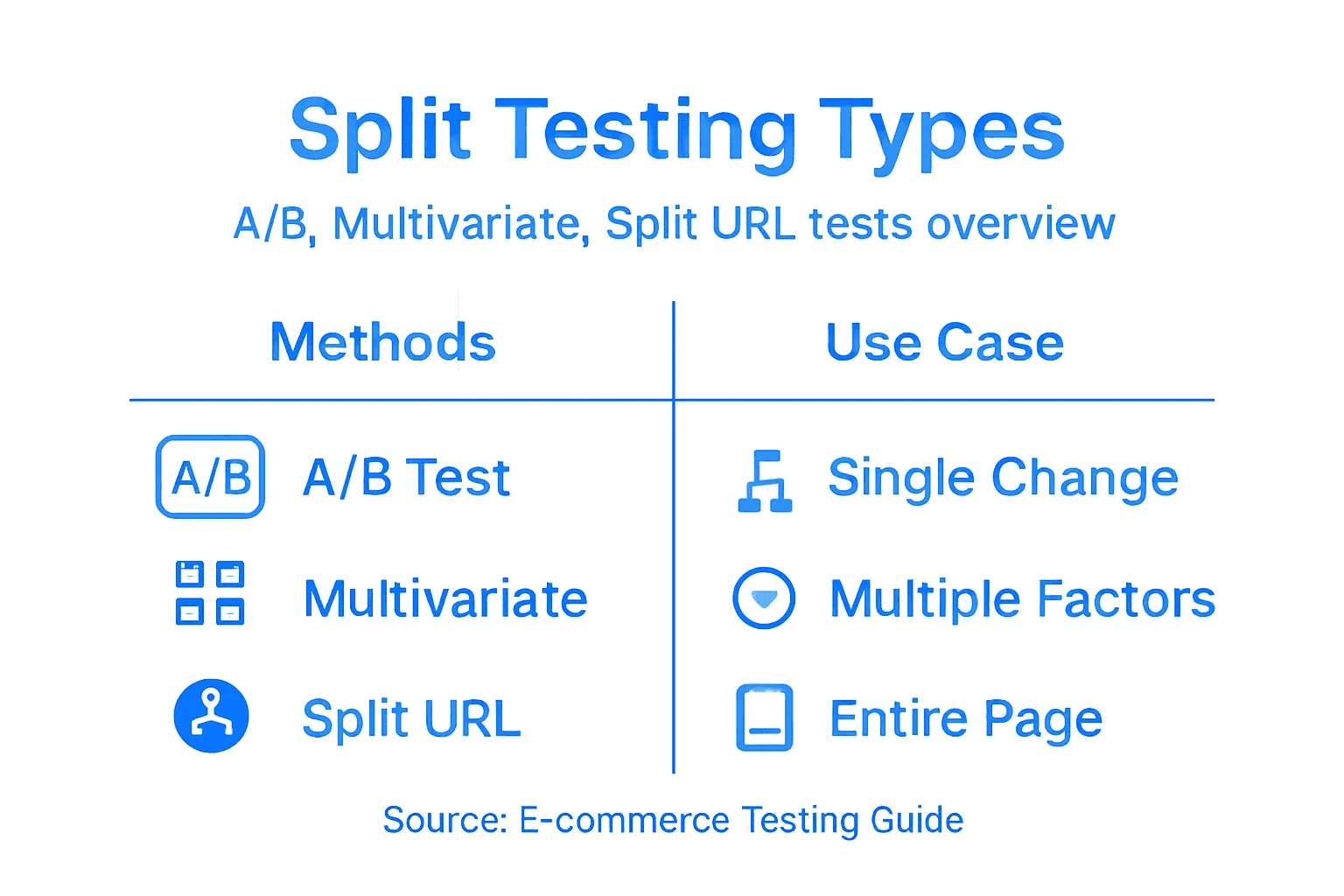
Split URL testing differs significantly from traditional A/B testing. Instead of modifying a single page element, this approach involves creating entirely different webpages and redirecting users to compare overall page performance. This method is particularly useful when brands want to test radical design changes or completely different page layouts.
Here’s a comparison of split testing methods and their ideal applications for e-commerce:
Testing MethodBest Use CaseAnalysis ComplexityTypical Impact on ROIA/B TestingSingle variable tweakLowQuick incremental gainsMultivariate TestingMultiple elementsMediumReveals optimal combinationsSplit URL TestingEntire page redesignsHighMajor strategic improvements
Pro tip: Choose your testing method based on your specific optimization goals and available resources, starting with simpler A/B tests before advancing to more complex multivariate approaches.
How Split Testing Improves Listings and ROI
E-commerce brands can dramatically enhance their performance by implementing strategic split testing methodologies. A/B testing systematically measures the impact of specific changes on user engagement, conversion rates, and overall return on investment. By methodically testing different variations of product listings, brands can uncover precise insights that translate directly into improved business outcomes. This might involve experimenting with product descriptions, image layouts, pricing strategies, or call-to-action button designs to understand exactly what resonates with potential customers.

Quantifiable Benefits emerge when split testing is implemented strategically. Research suggests that well-executed split tests can improve conversion rates by up to 30%, representing a significant potential boost in revenue. The process transforms marketing from a hit-or-miss approach to a precise, measurable science where every design decision is validated through empirical evidence.
The most successful e-commerce brands view split testing as an ongoing process of continuous improvement. Rather than making sweeping changes based on intuition, they rely on incremental, data-backed modifications that systematically enhance user experience and drive more effective customer interactions.
Pro tip: Start with low-risk, high-impact elements like button colors or headline text when beginning your split testing journey, and always ensure you have statistically significant sample sizes before drawing conclusions.
Steps to Execute Winning Split Tests
Successful e-commerce split testing requires a strategic and methodical approach. Executing split tests involves careful data management and precise experimental design to generate meaningful insights that drive business growth.
Before launching any test, e-commerce brands must establish concrete goals. This means identifying specific metrics like conversion rate, average order value, or click-through rate that will determine the test’s success. Precise objective setting prevents ambiguous results and ensures that every test provides actionable insights.
Successful split testing demands patience and scientific rigor. Brands must resist the temptation to draw conclusions prematurely and instead allow sufficient time and traffic to generate reliable data. Statistical significance typically requires hundreds or thousands of interactions, depending on current traffic volumes and conversion rates.
Pro tip: Start with low-stakes, high-impact elements like button colors or headline text, and always allocate at least 95% confidence interval when determining test outcomes.
Common Mistakes and How to Avoid Them
E-commerce brands frequently encounter significant challenges when implementing split testing strategies. A/B testing pitfalls can dramatically undermine the validity and effectiveness of experimental results, making it crucial to understand and proactively address common mistakes.
One of the most prevalent errors is drawing conclusions from statistically insignificant data. Many e-commerce managers terminate tests too early, believing they’ve discovered a meaningful insight when in reality, the sample size is too small to generate reliable conclusions. Patience is key - tests must run long enough to accumulate sufficient interactions and provide genuinely actionable information.
Another critical mistake involves treating the entire user base as a homogeneous group. Different customer segments may respond dramatically differently to the same variations. Sophisticated split testing requires nuanced segmentation, considering factors like demographic characteristics, purchase history, and browsing behaviors to generate truly meaningful insights.
Pro tip: Implement a systematic review process where test results are independently evaluated by multiple team members to minimize individual bias and ensure comprehensive analysis.
Unlock E-Commerce Growth with Expert Split Testing Support
Split testing plays a vital role in elevating your e-commerce listings by providing data-driven insights to improve conversions and reduce risk. If you struggle with interpreting complex test results or achieving statistically significant outcomes, Nectar offers a solution tailored to your needs. We know that managing variables like headline text, button colors, and entire page redesigns can feel overwhelming. Our fully managed services combine creative excellence in photography, videography, and design with advanced analytics to transform your product listings into high-converting powerhouse storefronts.

Take control of your e-commerce growth today by partnering with a premier agency that understands the nuances of split testing and its impact on ROI. Explore how our proprietary iDerive analytics platform and full-funnel strategies can help you scale smarter and maximize profits. Visit Nectar and discover why leading Amazon, Walmart, and Shopify brands rely on us to optimize their listings. Start your journey toward data-backed success now and leave guesswork behind with Nectar’s expert services.
Learn more about how we can help you drive profitable growth through rigorous split testing and creative innovation.
Frequently Asked Questions
What is split testing in e-commerce?
Split testing, also known as A/B testing, is a methodology used by e-commerce brands to compare two versions of a webpage, email, or ad to determine which one results in better customer engagement and sales outcomes.
How does split testing improve conversion rates?
By systematically testing different variations of an element, such as product descriptions or button colors, e-commerce brands can identify what resonates best with customers, leading to increased conversion rates and ultimately higher revenue.
What are the key components of an effective split test?
Key components include defining clear objectives, identifying specific testable variables, developing meaningful test variations, determining the appropriate sample size, ensuring statistical significance, conducting the test, and analyzing the results comprehensively.
What common mistakes should be avoided during split testing?
Common mistakes include ending tests prematurely, tracking too many metrics at once, ignoring behavior differences among customer segments, failing to control external variables, and misinterpreting data results due to insufficient sample size.












.png)