What Is Ad Retargeting and Why It Matters
.webp)
Every marketer has seen it happen—a shopper explores your Amazon or Shopify store, shows intent to buy, then slips away without finishing checkout. That lost opportunity stings, especially when you’ve invested in driving the right traffic. Understanding ad retargeting is an online advertising method that allows you to recapture potential customers who visited your site, showed genuine interest in your products, but left without making a purchase is key to turning missed moments into meaningful revenue. This overview clarifies how smart retargeting campaigns keep your brand visible and relevant, ensuring your best prospects convert instead of disappearing.
Key Takeaways
PointDetails
Ad Retargeting Efficiency
Ad retargeting significantly lowers customer acquisition costs by targeting previous visitors who have shown intent to purchase.
Segmentation is Crucial
Effective retargeting requires segmenting audiences to tailor messaging for different behaviors, enhancing engagement and conversion rates.
Creative Variation Matters
Regularly updating ad creatives and using varied messaging prevents audience fatigue and maintains high engagement levels.
Respect Consumer Privacy
Implement frequency caps and prioritize first-party data strategies to prevent brand perception issues and maintain trust.
Ad Retargeting Defined for E-Commerce Brands
If you’ve ever browsed a product on one website and then seen ads for that exact product follow you across the internet, you’ve experienced ad retargeting firsthand. Ad retargeting is an online advertising method that allows you to recapture potential customers who visited your site, showed genuine interest in your products, but left without making a purchase. Rather than letting those interested visitors disappear into the digital void, retargeting keeps your brand visible as they continue browsing elsewhere.
Here’s how it actually works: When someone lands on your Shopify store or Amazon listings, a pixel of code tracks their behavior, whether it’s visiting specific product pages, adding items to their cart, or spending time reviewing your content. This data becomes the foundation for serving customized ads across the websites, social media platforms, mobile apps, and email inboxes they visit afterward. Retargeting uses display advertising to re-engage people who showed interest in your brand, moving them back toward a purchase decision. Think of it as a gentle nudge. You’re not being aggressive; you’re simply reminding a warm prospect that your product exists and matches what they were looking for. For e-commerce managers at mid-sized brands, this distinction matters enormously because you’re spending marketing dollars on people already predisposed to buy from you, not cold audiences with zero context.

What makes retargeting so powerful for your bottom line is its efficiency. Your abandoned cart visitor already knows your value proposition. They’ve already seen your product images, read descriptions, and made it partway through checkout. A retargeting campaign doesn’t need to educate them about who you are or why they should care. Instead, it addresses the specific friction point that stopped the purchase, whether that’s price anxiety, decision paralysis, or simple distraction. The result is a dramatically lower cost per conversion compared to acquiring completely new customers. For brands managing multiple SKUs across Shopify and Amazon, retargeting becomes a critical tool for maximizing ROI from traffic you’ve already paid to drive.
Why this matters specifically for your business: Most e-commerce managers understand that acquiring new customers costs 5 to 25 times more than retaining existing ones. Retargeting occupies the middle ground. These aren’t your loyal repeat buyers, but they’re far more valuable than cold prospects because they’ve already demonstrated purchase intent. When you combine retargeting with strategies that craft compelling ads focused on click-through rates and conversions, you create a two-pronged attack: relevant creative paired with targeted audiences who are primed to convert. This combination is what separates brands that scale profitably from those that burn through marketing budgets chasing vanishing traffic.
Pro tip: Segment your retargeting audiences by behavior—cart abandoners, product page viewers, and past purchasers should see different messaging. Cart abandoners respond best to discount offers and urgency, while product browsers need more social proof and feature-focused creative.
How Ad Retargeting Works Across Platforms
The mechanics of ad retargeting rely on a deceptively simple foundation: tracking. When a visitor lands on your Shopify store or browses your Amazon listings, a small piece of code called a pixel records their actions. This pixel tracks everything from the pages they visit to the products they view, whether they add items to their cart, and how long they spend on specific product listings. This behavioral data becomes the foundation for everything that happens next. The pixel doesn’t identify people by name or personal details, but rather creates an anonymous profile of their interests and intent. That data is then stored and matched against retargeting platforms, allowing you to serve ads to that same visitor across the wider internet.
Once the data is collected, platforms like Google Ads, Facebook, and Amazon DSP use that information to display personalized ads across multiple channels. When your tracked visitor browses a news website, scrolls through social media, watches YouTube videos, or checks their email, they see your ads. The platform’s artificial intelligence works in real time to optimize which ads to show, when to show them, and on which channel they’re most likely to convert. This is where cross-platform retargeting strategies become powerful for mid-market brands. Rather than limiting yourself to a single channel, you can coordinate retargeting efforts across Google Display Network, Facebook and Instagram, Amazon DSP, and even email platforms. A visitor who abandoned their cart on your Shopify store might see a retargeting ad on Facebook today, then encounter a display ad on a news site tomorrow, and receive an email reminder the next day. This multi-touch approach keeps your brand top-of-mind throughout their decision-making process.
What makes cross-platform retargeting particularly effective is precision targeting. You’re not showing the same generic ad to everyone. Instead, you can segment audiences based on specific behaviors. Visitors who viewed a particular product category see ads featuring that category. People who added items to their cart but didn’t check out receive different messaging than those who simply browsed your homepage. Advanced retargeting even allows you to show dynamic ads that feature the exact product the person viewed, with real-time inventory and pricing data. For Amazon sellers specifically, leveraging Amazon DSP and streaming TV channels expands your retargeting reach beyond traditional display ads into premium video placements. This matters because different audiences respond to different formats. Some convert better on static display ads, while others engage more with video content or sponsored product placements within Amazon itself.
The real advantage of understanding how retargeting works across platforms is recognizing that this isn’t about annoying people with repetitive ads. It’s about reaching the right person with the right message at the right moment. When someone visits your product page but leaves without buying, they may have had objections that weren’t addressed. A retargeting ad highlighting free shipping, customer reviews, or a limited-time discount addresses those specific objections. When someone adds an item to their cart but abandons checkout, they may have gotten distracted or encountered unexpected shipping costs. A reminder email or retargeting ad with a discount code removes that friction. The data shows that these warm, familiar audiences convert at dramatically higher rates than cold traffic, which is why retargeting delivers some of the best ROI in digital marketing.
Pro tip: Create separate retargeting campaigns for different audience segments and use different creative for each. Cart abandoners need urgency and incentives, while product browsers need social proof and detailed specs. This segmentation approach typically increases conversion rates by 30 to 50 percent compared to one-size-fits-all retargeting.
Types of Ad Retargeting: Pixel, List, and Social
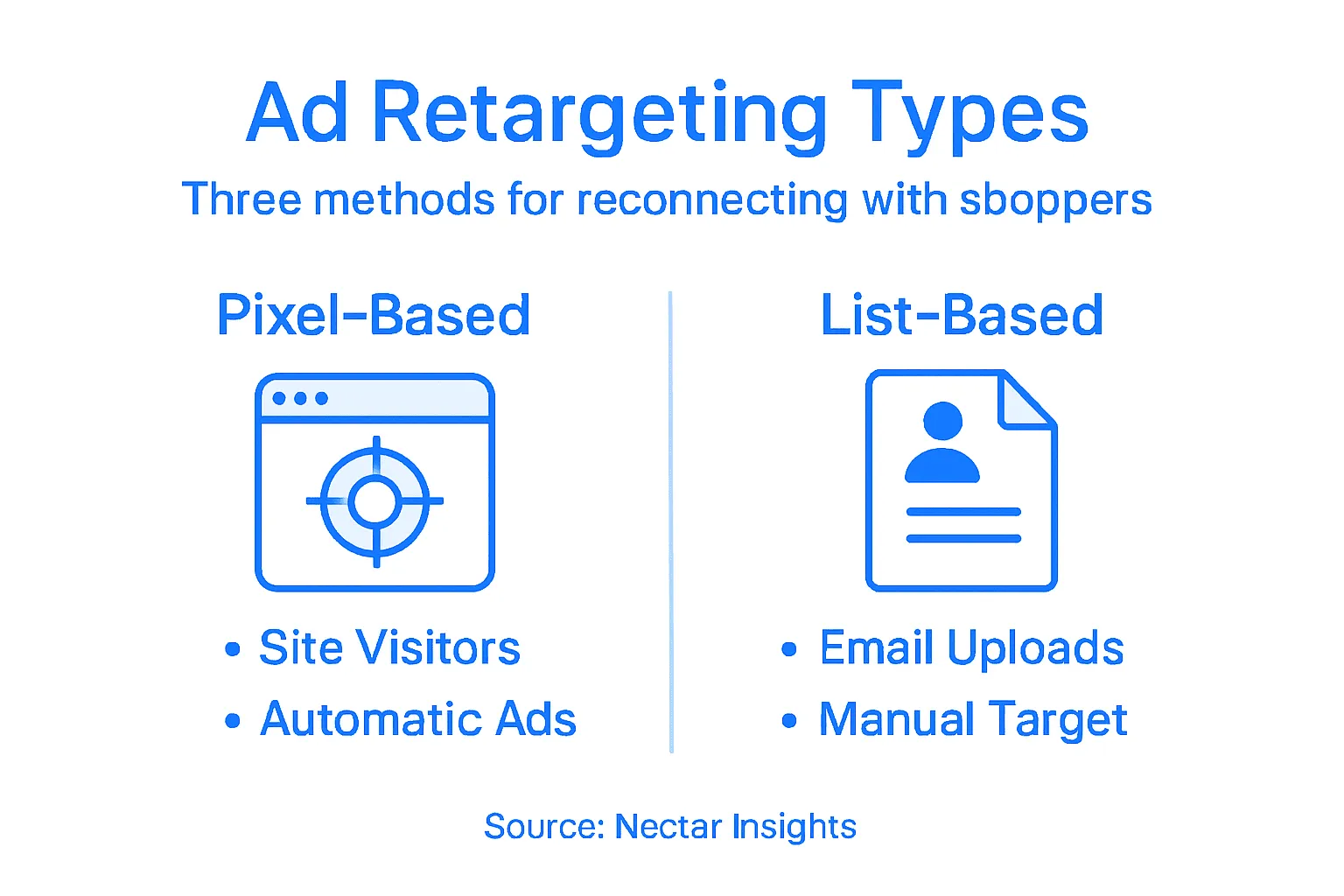
Not all retargeting approaches are created equal. As an e-commerce manager, you have three primary methods at your disposal, each with distinct strengths and optimal use cases. Understanding which type works best for your specific situation will dramatically improve your campaign performance. The three main types are pixel-based retargeting, list-based retargeting, and social retargeting. Each operates through a different mechanism and reaches audiences at different stages of their customer journey.
Pixel-Based Retargeting
Pixel-based retargeting is the most common approach and works through a straightforward mechanism. When a visitor lands on your Shopify store or Amazon listings, a small JavaScript code snippet (the pixel) drops a cookie in their browser. This cookie tracks their behavior silently: which product pages they visit, how long they spend viewing items, whether they add anything to their cart. The magic happens when that same visitor leaves your site and browses the broader internet. Retargeting platforms read that cookie and recognize them as someone interested in your products. Then ads follow them across Google Display Network, news websites, YouTube, and other partner sites. The advantage here is scale and precision. You’re reaching people based on actual behavior, not assumptions. A visitor who spent eight minutes reviewing your premium product should see different ads than someone who merely glanced at a category page. Pixel-based retargeting captures this nuance automatically through the tracking data. However, there’s a limitation: it only works for people who visited your site. If someone never made it to your store, pixel-based retargeting can’t reach them.
List-Based Retargeting
List-based retargeting solves that problem through a completely different approach. Instead of relying on website cookies, you upload your own customer data to advertising platforms. This could be your email list, phone numbers, or customer IDs from your Shopify database or Amazon seller account. The platform then matches your uploaded data against its user database. When a match is found, that person sees your retargeting ads on Facebook, Instagram, Google Ads, or other channels. This method is incredibly powerful for three reasons. First, you can target people who never visited your website but are already in your CRM because they signed up for your newsletter or made a past purchase. Second, list-based retargeting enables precise audience matching using your highest-value customer segments. Third, it works even for privacy-conscious users who block cookies. The tradeoff is that it requires having an existing customer list. A brand-new store without email subscribers won’t have much data to work with initially. Additionally, list uploads typically show results more slowly than pixel-based campaigns because the matching process takes time.
Social Retargeting
Social retargeting deserves its own category because it operates differently from both methods above. Social platforms like Facebook and Instagram have their own user data and retargeting capabilities. Social retargeting can work two ways. The first method uses pixels embedded on your website, but instead of serving ads across the entire display network, those pixels feed data specifically into Facebook and Instagram’s retargeting system. You see your ads in the platforms where your audience already spends time scrolling. The second method uses list-based data uploaded directly into platforms like Facebook’s Custom Audiences, allowing you to retarget known customers on social. Social retargeting is particularly effective because it operates on platforms where people already engage with friends, content, and entertainment. Your ad doesn’t interrupt their web browsing; it appears naturally in their feed among other content they consume. For e-commerce managers, social retargeting often delivers the highest engagement rates because the native format feels less disruptive than display ads scattered across random websites.
Here’s a quick comparison of the main ad retargeting methods for e-commerce brands:
MethodHow It WorksBest ForLimitationPixel-Based RetargetingTracks site behavior via browserRecent visitors, cart abandonersCannot reach outside visitorsList-Based RetargetingMatches uploaded data to platformPast buyers, email subscribersRequires existing customer listSocial RetargetingUses social platforms’ audience dataEngaged users on Facebook/InstagramDepends on social usage habits
Choosing Your Retargeting Strategy
The most effective approach typically combines all three methods. Your pixel tracks every site visitor and serves display ads to warm audiences across the web. Your customer list retargets existing subscribers and past buyers specifically on social platforms. And your social audience data creates lookalike audiences of similar high-value prospects. When paired with data-driven advertising strategies, these methods create overlapping touchpoints that keep your brand visible throughout the customer journey. Someone might see a display ad on Tuesday, encounter a Facebook ad on Wednesday, and receive an email on Thursday, all reinforcing the same message with slightly different creative. That repetition across channels is what converts hesitant visitors into paying customers.
Pro tip: Start with pixel-based retargeting on your website immediately, then layer in list-based campaigns targeting your best customer segments on Facebook. Add social retargeting last once you have sufficient data to create effective audiences. This staggered approach allows you to optimize each channel individually before combining them into a unified strategy.
Best Practices for Amazon and Shopify Retargeting
Retargeting only works when you execute it strategically. The difference between a retargeting campaign that generates 300% ROI and one that wastes budget comes down to implementation details. For e-commerce managers running on both Shopify and Amazon, the stakes are high because your audience crosses platforms constantly. They browse your Shopify store on their phone, check Amazon reviews on desktop, scroll Instagram on their commute. Your retargeting strategy needs to meet them wherever they are with the right message at the right moment.
Implementation Foundations
Start with the basics: proper pixel installation. This sounds simple but it’s where most brands fail. Your tracking pixel needs to be installed on every page of your Shopify store, not just the homepage or product pages. Cart pages, thank you pages, category pages, collection pages, all of it. Similarly, if you’re using Amazon DSP or other Amazon advertising tools, you need the appropriate tracking installed in your Amazon seller account. Without comprehensive tracking, you’re flying blind. You’ll miss cart abandoners because the pixel never fired on checkout. You’ll misclassify audiences because key pages didn’t trigger tracking. Spend the time upfront to verify your pixel is firing correctly on every single page. Use browser developer tools or free pixel debugging software to confirm. This foundation determines everything that comes later.
Once tracking is solid, audience segmentation becomes your competitive advantage. The tempting mistake is treating all retargeting visitors the same way. They’re not. Someone who abandoned a cart in the last 24 hours needs different messaging than someone who browsed a product page three weeks ago. Segmenting audiences by specific interaction behavior allows you to craft messaging that actually resonates. Cart abandoners should see ads highlighting what they left behind, with urgency elements like countdown timers or stock scarcity messaging. Product browsers who never added anything to their cart need social proof, customer testimonials, or detailed product specs to address their hesitation. Past purchasers should see complementary products or loyalty incentives. These segments often behave completely differently. A visitor who spent 12 minutes reading reviews likely has a different objection than someone who clicked through instantly. Segment accordingly.
Creative and Frequency Strategy
Your creative matters enormously, but not in the way most marketers think. Generic ads perform worse than specific ones. Instead of a broad ad saying “Shop Our Spring Collection,” show the exact product someone viewed with their specific price, current reviews, and shipping information. Dynamic retargeting ads pull real-time product data into your ad creative automatically. If someone viewed a red hoodie priced at $49.99 with 4.7 stars, that exact product appears in their retargeting ad. This specificity drives conversions because there’s zero friction between what they saw and what they’re reminded about.
Frequency capping deserves explicit attention because ad fatigue kills retargeting campaigns. Show someone the same ad 15 times and they stop seeing it. Then they start resenting your brand. Instead of one ad creative running repeatedly, test three to five variations and rotate them. Show the same visitor different creative depending on how many times they’ve seen your ads. Someone who’s seen your ad twice might respond to a discount offer. Someone who’s seen it eight times needs a different angle entirely, perhaps a comparison to competitors or a unique value proposition they haven’t considered. For Shopify stores, most platforms allow you to set frequency caps at 3 to 5 impressions per day per user. For Amazon campaigns, similar controls exist within your campaign settings. Use them.
Platform-Specific Optimization
Shopify and Amazon retargeting have overlapping principles but require different tactics. On Shopify, you’re primarily retargeting through Google Display Network, Facebook, Instagram, and email. This means your audience sees your ads across news sites, social feeds, and inboxes. Your creative needs to work in all these contexts. On Amazon, retargeting happens through Sponsored Products, Sponsored Brands, and Amazon DSP. When someone who visited your store searches for related keywords on Amazon, your products appear. This is search-based retargeting. Strategic Amazon advertising approaches involve coordinating your Amazon ads with your broader retargeting efforts. Someone who abandoned your Shopify store might then search on Amazon and encounter your Sponsored Product ads. That reinforcement across platforms dramatically increases conversion probability.
Testing and optimization separate winning campaigns from mediocre ones. Run A/B tests on your ad copy, creative, landing pages, and offers. Test whether discount offers convert better than free shipping. Test whether video creative outperforms static images. Test whether shorter ad copy (10 words) outperforms longer copy (30 words). Most importantly, continuously monitor your cost per acquisition and return on ad spend. When ROAS dips, investigate why. Did frequency increase too much, causing ad fatigue? Did you broaden your audience segment too wide? Did seasonal trends shift? Regular analysis ensures your retargeting campaigns improve over time rather than stagnate.
Pro tip: Create a separate retargeting campaign for cart abandoners with a 15 to 20 percent discount offer, and run it for only 48 hours. This combination of specificity, incentive, and urgency recovers more abandoned carts than generic long-running campaigns. Once that window closes, switch those cart abandoners into a longer-term brand awareness campaign.
Risks, Costs, and Common Pitfalls to Avoid
Retargeting sounds like a guaranteed win, but executed poorly, it becomes a budget drain and brand liability. As an e-commerce manager, you need to understand where retargeting fails and what mistakes cost the most money. The difference between a profitable retargeting program and one that hemorrhages budget often comes down to avoiding preventable errors. Most of these mistakes fall into predictable categories, and knowing them upfront lets you sidestep years of accumulated learning.
Ad Fatigue and Frequency Mistakes
The most common retargeting failure is showing the same ad to the same person too many times. It feels counterintuitive because conventional wisdom says repetition drives conversions. That’s true up to a point. Show someone an ad twice, and they notice it. Show them the same ad 12 times in three days, and you’ve shifted from marketing to annoyance. Ad fatigue occurs when viewers see your ads so frequently that they stop processing them, then start actively resenting your brand. What happens next is brutal for your metrics. Click-through rates plummet because people scroll past your ads instinctively. Cost per click increases because the platform detects declining engagement and charges you more for the same placement. Worse, people often click just to close the ad or report it as irrelevant, tanking your account quality scores.
The financial impact is severe. Brands that ignore frequency capping often spend 40 to 60 percent more per conversion than those using proper caps. Frequency capping isn’t optional complexity; it’s baseline hygiene. Set your frequency caps conservatively, typically between 3 and 5 impressions per user per day. Monitor performance weekly. If click-through rates drop below historical benchmarks, reduce frequency further. If cost per click climbs unexpectedly, your first instinct should be checking whether your audience is seeing too many impressions.
Segmentation and Targeting Failures
Poor audience segmentation wastes approximately 30 percent of retargeting budgets according to industry analysis. Brands often create one retargeting audience for “everyone who visited our site” and show the same ads to everyone. This treats a casual homepage visitor identically to someone who spent 15 minutes studying your premium product. These are completely different prospects with completely different conversion probability. Someone who viewed your homepage briefly might need broad brand awareness messaging. Someone who added a product to their cart and abandoned checkout needs a specific incentive to complete purchase. These people should never see the same ads.
Avoiding poor targeting and audience segmentation mistakes requires intentional campaign structure from day one. Create separate audiences for cart abandoners, product page viewers, category browsers, past customers, and high-value prospects. Yes, this creates more campaigns to manage. That complexity pays for itself immediately through dramatically improved ROAS. A well-segmented retargeting program typically achieves 2x to 3x better conversion rates than broad-audience approaches.
Creative Staleness and Irrelevance
Showing the same creative forever kills retargeting performance. Your audience gets used to it. They stop noticing it. Then your cost per conversion climbs as the platform works harder to drive engagement. Creative rotation is non-negotiable. Maintain at least three to five different ad variations running simultaneously. Rotate new variations in every two to three weeks. Test different messaging angles: discount-focused, social proof-focused, scarcity-focused, feature-focused. Different audience segments respond to different angles. What converts cart abandoners (urgency and incentive) doesn’t convert product browsers (detailed specs and reviews).
Another critical mistake is showing outdated offers. If you ran a promotion that ended three weeks ago, but your retargeting ads still mention it, you’re training people to distrust your brand. When someone sees an offer they know has expired, they don’t think “This brand made a small mistake.” They think “This company doesn’t know what’s current. Why would I trust them?” Update your creative weekly at minimum. Synchronize your retargeting ads with your current promotional calendar. If your main promotion ends Friday, pause those ads Friday evening.
Cost Management and Budget Leaks
Retargeting costs vary dramatically based on audience quality and bidding strategy. A poorly managed retargeting campaign might spend $15 per conversion while a well-optimized one spends $3. The difference isn’t luck. It’s segmentation, creative quality, and disciplined budget allocation. One hidden cost trap is retargeting audiences that will never convert. If you’re retargeting people who visited your site six months ago and never engaged further, you’re probably wasting money. Set explicit audience windows. Retarget cart abandoners for 7 to 14 days. Retarget product page viewers for 30 days. Retarget browsing visitors for 14 days. After that window closes, the conversion probability drops so steeply that spending continues being wasteful. Move expired audiences into broader brand awareness campaigns where lower conversion rates are acceptable, or pause them entirely.
Another cost leak is not pausing underperforming campaigns. Brands often set retargeting campaigns running and ignore them for weeks. That campaign with a 10x cost per acquisition keeps spending money because nobody checked it. Establish a weekly review cadence. Any campaign with ROAS below your profitability threshold gets paused immediately. Test a new creative variation instead. Sometimes a single campaign underperforms because the creative is wrong, not because the audience is bad. Always diagnose before simply turning off spend.
Below is a summary of common retargeting pitfalls and their consequences:
PitfallTypical ImpactSuggested SolutionAd fatigueRising costs, user annoyanceApply frequency caps, rotate adsPoor segmentationWasted spend, low conversionSegment by behavior and recencyStale/irrelevant creativeDrop in engagement, mistrustUpdate ads and sync with promosBudget leaksOverspending, low ROILimit audience windows, pause bad adsIgnoring privacy signalsBrand damage, lost trustRespect privacy, use first-party data
Privacy and Brand Risk
Third-party cookies are declining. This is creating genuine technical headaches, but the deeper issue is privacy regulation. Consumers increasingly understand that cookies track them, and many resent it. When your retargeting ads feel intrusive or omnipresent, you damage brand perception. The classic case is someone viewing a product at 9 p.m., then seeing retargeting ads for that exact product at 7 a.m. the next morning, then again at lunch, then again in the evening. That person feels watched. Some brands lose customers because their retargeting campaigns feel creepy rather than helpful.
The solution is restraint. Use frequency caps. Respect privacy settings. Transition toward first-party data strategies using email lists and customer databases. These approaches work as well as cookies while respecting consumer privacy concerns. Your retargeting strategy should feel like helpful reminder, not surveillance.
Pro tip: Implement a “retargeting pause window” after purchase. Don’t retarget someone for 14 days after they buy. This prevents showing ads for products they already own, which actively damages the customer experience. Resume retargeting after 14 days with relevant cross-sell recommendations instead.
Unlock the True Power of Ad Retargeting for Your E-Commerce Brand
Understanding the challenges of ad retargeting like avoiding ad fatigue, creating precise audience segmentation, and delivering relevant creative is crucial to turning warm leads into loyal customers. This article highlights just how complicated and nuanced running effective retargeting campaigns across platforms like Shopify and Amazon can be. If you are wrestling with fragmented strategies and wasted ad spend, know that you are not alone.
At Nectar, we specialize in resolving these exact pain points by harmonizing data-driven advertising strategies with creative excellence, backed by our proprietary iDerive analytics platform. This allows us to transform your underperforming listings into highly converting storefronts with targeted pixel-based, list-based, and social retargeting campaigns that speak directly to segmented audiences with dynamic, compelling creative.
Ready to stop wasting budget on broad retargeting and instead win the hearts of your most valuable prospects across Amazon, Walmart, and Shopify?

Discover how Nectar’s fully managed services can optimize your retargeting with precision segmentation and creative that converts. Visit our website now and take the first step toward scaling smarter and maximizing your long-term ROI. Explore more about our approach to data-driven advertising strategies and learn why Nectar is trusted by mid-sized and enterprise brands eager to grow.
Start your journey to profitable retargeting today with Nectar.
Frequently Asked Questions
What is ad retargeting?
Ad retargeting is an online advertising method that enables brands to reconnect with potential customers who have shown interest in their products but left without making a purchase. It uses tracking pixels to serve customized ads across various platforms, reminding users of the products they viewed.
How does the retargeting process work?
Retargeting works by tracking visitor behavior on an e-commerce site through a pixel, which collects data about the products viewed or added to the cart. This data is then used to display personalized ads to those visitors across different online platforms and social media, keeping the brand top-of-mind as they browse the internet.
Why is retargeting important for e-commerce brands?
Retargeting is crucial because it targets users who have already expressed interest, making them more likely to convert compared to cold audiences. By addressing specific objections that may have caused them to abandon their cart, brands can efficiently recover lost sales and maximize their return on investment.
What are the different types of ad retargeting?
The three main types of ad retargeting are pixel-based retargeting, which uses tracking cookies; list-based retargeting, which utilizes customer data uploaded to advertising platforms; and social retargeting, which incorporates social media platforms’ built-in retargeting capabilities. Each type has unique strengths and applications depending on the audience and marketing goals.




































































.webp)