Brand protection online: Safeguard your e-commerce reputation
.webp)
TL;DR:
Online brand protection involves proactively safeguarding intellectual property and removing brand abuse across digital channels before it harms customer trust and revenue.
Implementing a closed-loop operating model—covering rights registration, continuous monitoring, swift enforcement, and ongoing measurement—is essential for effective management.
Counterfeits, hijacked listings, and brand impersonators cost brands billions every year, and the damage goes far beyond lost sales. When a customer buys a knockoff of your product through an unauthorized seller on Amazon or Walmart, your brand takes the reputational hit, not the bad actor. Mid-sized and enterprise brands are just as exposed as smaller sellers, and in many cases more so, because their products carry enough recognition to be worth faking. This guide walks you through what online brand protection actually means, how the major platforms handle it, and what your team needs to do right now to stop reactive firefighting and start winning.
Key Takeaways
| Point | Details |
|---|---|
| Brand protection essentials | Effective brand protection combines legal, technical, and operational actions to prevent abuse on e-commerce platforms. |
| Closed-loop process | A four-step model—rights, monitoring, enforcement, review—ensures brand safety stays proactive and agile. |
| Platforms need partnership | While marketplaces deploy strong tools, your ongoing participation is necessary for optimal protection. |
| Avoid common pitfalls | Success comes from clear measurement, continuous improvement, and adapting tactics—not just chasing takedown numbers. |
| Actionable steps | A practical plan empowers any brand to start building a robust online brand protection system today. |
What is online brand protection?
Online brand protection is not simply filing takedown requests when you spot a fake. It goes much deeper. Online brand protection is the coordinated effort to safeguard a company’s brand and intellectual property rights, and to remove brand abuse such as unauthorized product listings, counterfeit goods, impersonation, and misuse of brand assets before it harms customers, revenue, or reputation.
For e-commerce brand managers, this definition is a mandate, not a formality. Brand abuse on digital channels shows up in several distinct forms:
-
Counterfeit products listed on major marketplaces using your brand name, images, and product descriptions
-
Unauthorized resellers selling your genuine products outside of approved channels, often undercutting your pricing and MAP (minimum advertised price) policies
-
Impersonation accounts creating storefronts or social profiles designed to mislead customers into thinking they are buying directly from your brand
-
Asset misuse, including unauthorized use of your logos, photography, and copy in third-party listings or ads
-
Keyword hijacking, where bad actors use your brand name in their product titles or ad copy to redirect your traffic
Each of these forms of abuse erodes something different. Counterfeits damage customer trust and product perception. Unauthorized sellers undercut your pricing strategy. Impersonation creates confusion and liability. Together, they threaten every pillar of your brand equity, and the damage compounds over time.
Failing to act early accelerates the problem. Counterfeit sellers and unauthorized resellers replicate successful tactics. If one bad actor discovers your brand is lightly monitored, others follow quickly. This is why a strong brand positioning process needs to be paired with active protection. Building brand equity without defending it is like filling a bucket with a hole in the bottom.
Stat to know: Studies estimate global losses from counterfeiting and piracy could reach $4.2 trillion by 2022, and marketplace-based counterfeiting has continued to accelerate since then. The e-commerce channel is the primary growth driver.
The core components: A closed-loop operating model
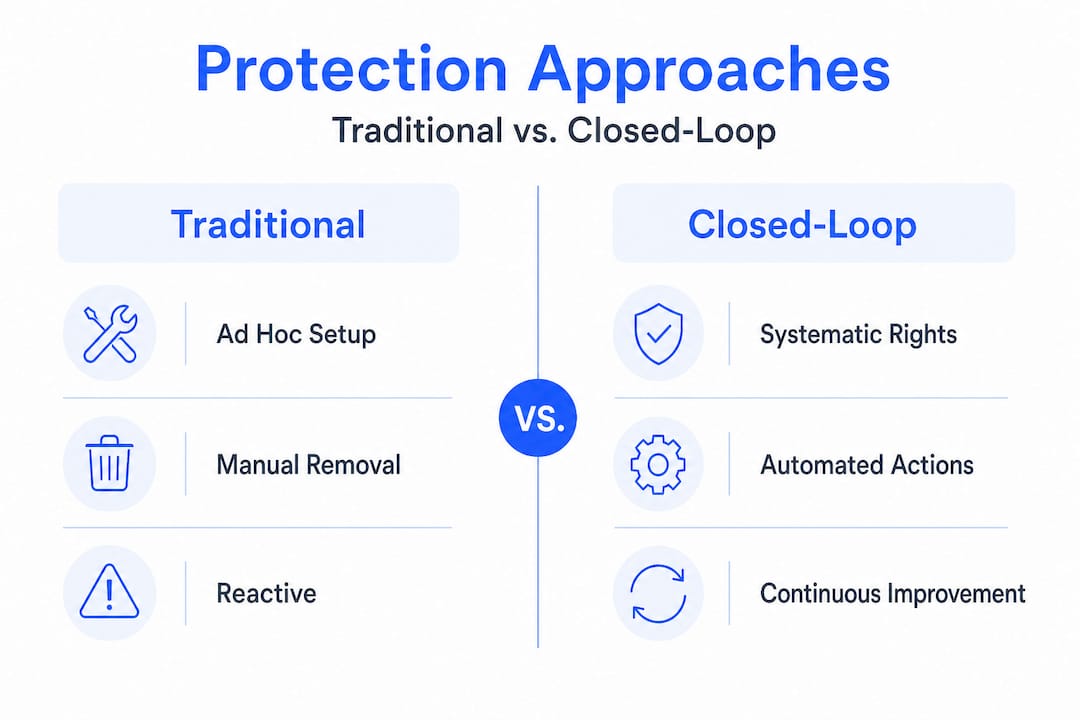
Understanding what brand protection means is the first step. Operationalizing it is the real challenge. The most effective approach follows a closed-loop operating model: define authority (legal rights and authorization), gain visibility (monitoring and detection), disrupt and remove (takedowns and enforcement), and build evidence and metrics to sustain enforcement at scale.
Breaking this into phases makes implementation manageable:
-
Identify and secure legal rights. Register your trademarks in every market where you sell. This is the foundation. Without registered rights, your enforcement options on platforms are significantly limited. If you sell in the US, EU, and Canada, you need registrations in each jurisdiction. Many brands skip this step, then find themselves unable to file formal infringement claims.
-
Monitor and detect abuse. Set up continuous monitoring across all relevant platforms: Amazon, Walmart, Shopify stores, Google Shopping, social media, and domain registrations. Manual monitoring does not scale. Invest in technology that can alert your team to new listings, unauthorized use of your brand name, or domain registrations that closely mirror yours.
-
Take enforcement action. Once abuse is confirmed, act fast. Use platform-specific mechanisms: Amazon’s Brand Registry, Walmart’s IP Infringement Reporting, and Shopify’s brand reporting tools. For systematic infringers, escalate to cease-and-desist notices and, where warranted, legal action. Your marketplace operations management strategy should include clear escalation protocols so the team knows exactly who does what and when.
-
Measure and improve. Track response time, recurrence rates, and how quickly abuse is removed. This feeds back into step one and helps you refine both your monitoring scope and your enforcement playbook. Strong branded content strategies also play a role here, since authoritative, well-optimized listings make it harder for unauthorized sellers to rank above you.
| Factor | Traditional “notify-and-take-down” | Closed-loop model |
|---|---|---|
| Rights setup | Ad hoc | Systematic, pre-registered |
| Monitoring | Reactive | Continuous, automated |
| Enforcement | Case-by-case | Scaled, documented |
| Measurement | Volume of removals | Risk reduction and response quality |
| Outcome | Whac-a-Mole | Sustainable deterrence |
Pro Tip: Document every enforcement action, including screenshots, dates, seller identifiers, and platform responses. This evidence base is critical if you need to escalate to a legal claim or show a pattern of infringement to a platform’s trust and safety team.
How e-commerce platforms operationalize brand protection
Platforms are not passive. Amazon, Walmart, and Shopify all have formal systems for brand protection, but they vary significantly in how they work and what they require from you.
Amazon leads with Brand Registry, which gives enrolled brands access to automated protections, A+ Content, and a direct reporting pipeline for IP violations. Amazon uses machine learning to proactively identify and remove suspected counterfeits, and their Transparency program lets brands apply unique codes to individual units so customers can verify authenticity. Learn more about Amazon brand management to understand how to fully leverage the tools available to enrolled brands.

Walmart has invested heavily in its own enforcement infrastructure. Multi-layered AI and human-overseen enforcement for marketplace counterfeits illustrates that large retailers operationalize brand protection through both tooling and Trust & Safety operations rather than relying solely on brand-owner reports. This is an important distinction. Walmart’s systems will catch some issues automatically, but brand managers who wait for the platform to act on their behalf will always be behind. Follow Walmart Marketplace best practices to make sure your own listings are structured in ways that are harder to duplicate or hijack.
Shopify operates differently because it powers independent stores rather than a single centralized marketplace. Brand protection on Shopify involves monitoring for stores using your brand name, unauthorized use of your product images, or fraudulent domains that closely mimic your URL. Shopify’s reporting mechanisms for IP violations exist, but the brand owner needs to identify and report the offending store first.
Here is a comparative view:
| Platform | Primary tool | AI enforcement | Brand owner role |
|---|---|---|---|
| Amazon | Brand Registry + Transparency | Yes, proactive | Enroll, monitor, report |
| Walmart | Seller Trust & Safety + IP reporting | Yes, multi-layered | Report, follow protocols |
| Shopify | IP Infringement Reports | Limited | Identify and report |
The limits of relying on platform mechanisms alone are real. Platforms optimize for their own marketplace integrity, not exclusively for your brand’s interests. Your team needs independent monitoring, documented evidence, and clear enforcement workflows. Copycat detection strategies, including reverse image search and listing audits, should run continuously, not just when someone on your team spots something suspicious.
“Platform protections are a floor, not a ceiling. Brands that treat Amazon Brand Registry or Walmart’s reporting tools as the complete solution will consistently underestimate their exposure.”
Common pitfalls in online brand protection
Even brands with active protection programs make costly mistakes. Knowing the failure modes helps you avoid them.
-
Measuring success by takedown volume. Filing 200 takedowns a month sounds like strong enforcement. It might actually signal poor upstream monitoring, because you are catching problems late rather than preventing them. Effective measurement should reflect risk reduction and response quality rather than takedown volume alone. Ask yourself: are the same sellers reappearing after removal? Are new infringers entering faster than you can remove them?
-
Failing to document enforcement actions. Every takedown, every seller report, every cease-and-desist should be logged with timestamps and seller identifiers. Without this record, you cannot establish a pattern of infringement if you need to escalate legally, and you lose insight into which infringers are recurring offenders.
-
Neglecting risk assessment and monitoring gaps. Many brands monitor Amazon but ignore Walmart, social commerce, and emerging channels like TikTok Shop. Bad actors migrate to the path of least resistance. Your protection program needs to cover every channel where your products or brand name appear.
-
Over-relying on platforms. Platforms have broad responsibilities across millions of sellers. Your brand is one of thousands filing reports. That is not a criticism; it is reality. Use platform tools, but do not make them your entire strategy.
-
Failing to use data to scale your protection approach. A protection program that does not feed insights back into your broader business strategy is operating in a silo. Data from brand abuse incidents can reveal which product categories attract the most counterfeiting, which geographies are highest risk, and which channel gaps your team needs to close.
Pro Tip: Schedule a quarterly brand protection audit. Review monitoring coverage, enforcement response times, recurring offenders, and any new channels where your brand is appearing without authorization. Threats evolve, and your tactics need to evolve with them.
Practical steps: Building a resilient online brand protection system
Here is a concrete action plan your team can start implementing today, regardless of where your current program stands.
-
Audit your registered rights. List every trademark, copyright, and patent your brand holds and check that registrations are current and cover all active selling markets. If you have gaps, prioritize filing immediately.
-
Set up continuous monitoring. Use a combination of platform-native tools and third-party monitoring software to track unauthorized use of your brand name, product images, ASINs, and domain variations. Automate alerts so your team is notified in real time, not after the fact.
-
Build an enforcement playbook. Define exactly what triggers each type of response: a platform report for a new unauthorized listing, a cease-and-desist for a recurring seller, and legal escalation for systematic infringers. Include response time targets. Every day an unauthorized listing stays live is lost revenue and potential customer damage.
-
Leverage platform-specific programs fully. Enroll in Amazon Brand Registry if you have not already. Make sure your Walmart seller profile is optimized and your IP is documented in their reporting system. Marketplace optimization in 2026 requires treating brand protection and listing quality as two sides of the same coin.
-
Train your team. Your marketing, legal, and e-commerce operations teams need to understand the brand protection workflow. Assign clear ownership for monitoring, enforcement, and escalation. Protection programs fail when everyone assumes someone else is watching.
-
Track outcomes, not just activities. Per the closed-loop model principle, ensure rights are identified and registered, monitor continuously to detect abuse and vulnerabilities, and take swift enforcement action via platform mechanisms once concerning content is identified. Then measure recurrence rates, resolution speed, and risk reduction over time.
-
Allocate budget proportionally to risk. If 60% of your counterfeiting risk comes from Amazon, that is where the bulk of your monitoring and enforcement resources should go. Risk-weight your investment rather than spreading resources evenly across all channels.
Our take: Why brand protection is evolving—and how you can stay ahead
Here is something most brand protection guides will not tell you: the “report and wait” mindset is not just inefficient, it is a strategic liability. Brands that treat protection as a compliance task rather than a growth enabler are leaving serious value on the table.
We see this regularly with brands that invest heavily in building a strong product catalog and marketing presence, then watch unauthorized sellers undercut their pricing and erode their customer relationships. The intellectual property damage is real, but the customer trust damage is harder to recover. A buyer who purchases a counterfeit version of your product and has a bad experience does not blame the counterfeiter. They blame your brand.
The brands winning at protection in 2026 are integrating it with their overall growth strategy. They use brand abuse data to identify market vulnerabilities. They connect enforcement outcomes to pricing strategy, advertising spend, and customer acquisition costs. They understand that a clean, well-protected marketplace presence directly improves conversion rates and reduces return rates. Strong e-commerce retention strategies depend on customers trusting that what they receive matches what they ordered.
The other shift worth noting is the move from reactive enforcement to proactive deterrence. Brands that register their rights systematically, maintain authoritative and well-optimized listings, and engage actively with platform trust and safety teams are harder targets. Bad actors follow the path of least resistance. Make your brand that path more difficult to exploit, and many of them will move on.
Brand protection is not a set-it-and-forget-it function. It requires the same continuous improvement mindset you apply to your advertising campaigns or your inventory planning. The threat landscape changes. Platform tools change. Your protection program needs to change with it.
How Nectar can help you build bulletproof brand protection
Protecting your brand across Amazon, Walmart, and Shopify requires more than a checklist. It requires expertise, technology, and a team that understands how each platform’s enforcement mechanisms actually work in practice.
Nectar works with mid-sized and enterprise brands to build and manage robust brand protection programs alongside full-funnel growth strategies. Whether you need to strengthen your Shopify brand protection, maximize your presence as an Amazon growth partner, or want to explore the full scope of what’s possible, our brand growth services are built to protect what you have built while accelerating what comes next. Our proprietary iDerive analytics platform gives you the visibility to act on threats before they compound. Let’s build something worth protecting.
Frequently asked questions
What are the most common types of online brand abuse?
The most common types are unauthorized listings, counterfeit goods, brand impersonation, and misuse of brand assets such as logos, photography, and product descriptions.
How does brand protection differ between Amazon, Walmart, and Shopify?
Each platform uses its own mix of automated tools and human review, but all require proactive action from brand owners. Amazon offers the most mature self-service tools, while Walmart’s enforcement relies on multi-layered AI and Trust & Safety teams, and Shopify depends heavily on brand-owner identification and reporting.
Is volume of takedowns a good measure of brand protection success?
No. True success should be measured by risk reduction, response speed, and recurrence rates. Effective measurement reflects risk reduction and response quality rather than how many takedowns were filed in a given period.
Can small brands afford online brand protection?
Yes. A prioritized, stepwise approach makes protection scalable for smaller teams and budgets. Start with trademark registration and monitoring on your highest-volume channels, then expand coverage as your program matures.
What should I do if I find a counterfeit or unauthorized listing?
Immediately document the listing with screenshots, gather all seller details, and take swift enforcement action through the platform’s reporting mechanism, then monitor for similar incidents from the same or related sellers.
Recommended





















































.webp)