Why Global Ecommerce Expansion Drives Growth
.webp)

Stepping into global e-commerce means tackling much more than simply listing products for sale outside the United States. The process now involves managing digital transformation, creating new business models, and tapping into complex technological infrastructures. For American brands on platforms like Amazon, Walmart, or Shopify, understanding the true scope of global e-commerce is key to avoiding costly mistakes and uncovering fresh growth opportunities. This article clarifies what global expansion really involves and what today’s most successful strategies look like.
Key Takeaways
PointDetailsGlobal E-commerce is MultifacetedIt extends beyond mere product sales to include digital infrastructure, payment systems, and innovative business models, fundamentally transforming commercial interactions.Strategic Benefits for US BrandsGlobal expansion offers access to new markets, enhanced brand visibility, and opportunities for operational efficiencies while mitigating domestic market risks.Market Entry Models VariedDifferent models range from direct exports to localized partnerships, each with varying risk levels and investment requirements, necessitating tailored strategies.Challenges of Localization and ComplianceBusinesses face significant challenges with cultural adaptation, tax regulation, and logistics, requiring comprehensive strategies to navigate these complexities effectively.
Global ecommerce expansion defined and debunked
Global e-commerce expansion represents far more than simply selling products across international borders. It’s a complex digital transformation that fundamentally reshapes how businesses interact, trade, and create value in an interconnected world. Policy research highlights that this concept encompasses innovative approaches to cross-border commerce beyond traditional online selling.
Official OECD guidelines underscore that global e-commerce is not just about selling, but about transforming commercial interactions through digital technologies. This means businesses can now engage with international markets using unprecedented precision, speed, and scalability.
The misconception that global e-commerce is simply about listing products online completely misses its transformative potential. Modern global e-commerce strategies involve complex integrations of technology, logistics, cultural understanding, and data analytics. Successful expansion requires businesses to think beyond traditional geographical limitations and embrace a truly interconnected digital marketplace.
Pro tip: Develop a comprehensive digital infrastructure that can adapt to multiple international market requirements before launching your global e-commerce strategy.
Core benefits for US e-commerce brands
US e-commerce brands are discovering remarkable opportunities through global expansion, transforming traditional market limitations into strategic growth platforms. Research indicates that international digital commerce offers unprecedented pathways for brands seeking substantial competitive advantages.
By expanding beyond traditional geographical boundaries, US brands can leverage digital technologies for productivity and market penetration. This approach allows companies to overcome domestic market saturation, embedding themselves in global value chains with unprecedented agility and strategic flexibility.

The transformative potential of global e-commerce extends far beyond simple international selling. Modern US brands can now create sophisticated, data-driven strategies that enable precise market targeting, adaptive pricing models, and culturally nuanced customer engagement. These capabilities represent a quantum leap from traditional export models, offering dynamic, real-time market responsiveness that was impossible just a decade ago.
Pro tip: Conduct comprehensive market research and develop a flexible digital infrastructure before launching international e-commerce initiatives to maximize global expansion success.
Variations in global market entry models
E-commerce brands seeking international expansion face a complex landscape of market entry strategies, each with unique advantages and challenges. Global market entry models represent sophisticated approaches to cross-border digital commerce that require careful strategic planning and execution.
E-commerce internationalization strategies range from minimal investment cross-border sales to comprehensive market-specific ecosystem development. Brands must carefully evaluate their risk tolerance, operational capabilities, and long-term growth objectives when selecting an appropriate market entry approach.
The degree of market control varies significantly across different entry models. Some strategies, like indirect platform selling, offer low-risk market exploration with minimal upfront investment. Others, such as establishing local subsidiaries, provide maximum control but require substantial financial and operational commitments. Successful global expansion demands a nuanced understanding of each model’s strengths and potential limitations.
Here is a comparison of global e-commerce market entry models by risk, investment, and control:
Entry ModelRisk LevelInitial InvestmentMarket ControlDirect digital exportsLowMinimalLimitedPlatform-based sellingLow to ModerateLowShared with platformLocal partnershipModerateMediumShared with partnerLocal subsidiaryHighSignificantFullThird-party marketplaceLowMinimalLess than direct modelsFranchising operationsModerate to HighMedium to HighDepends on agreement scope
Pro tip: Conduct thorough market research and pilot testing before committing to a specific global market entry model to minimize financial risks and optimize international growth potential.
Challenges: localization, tax, and logistics
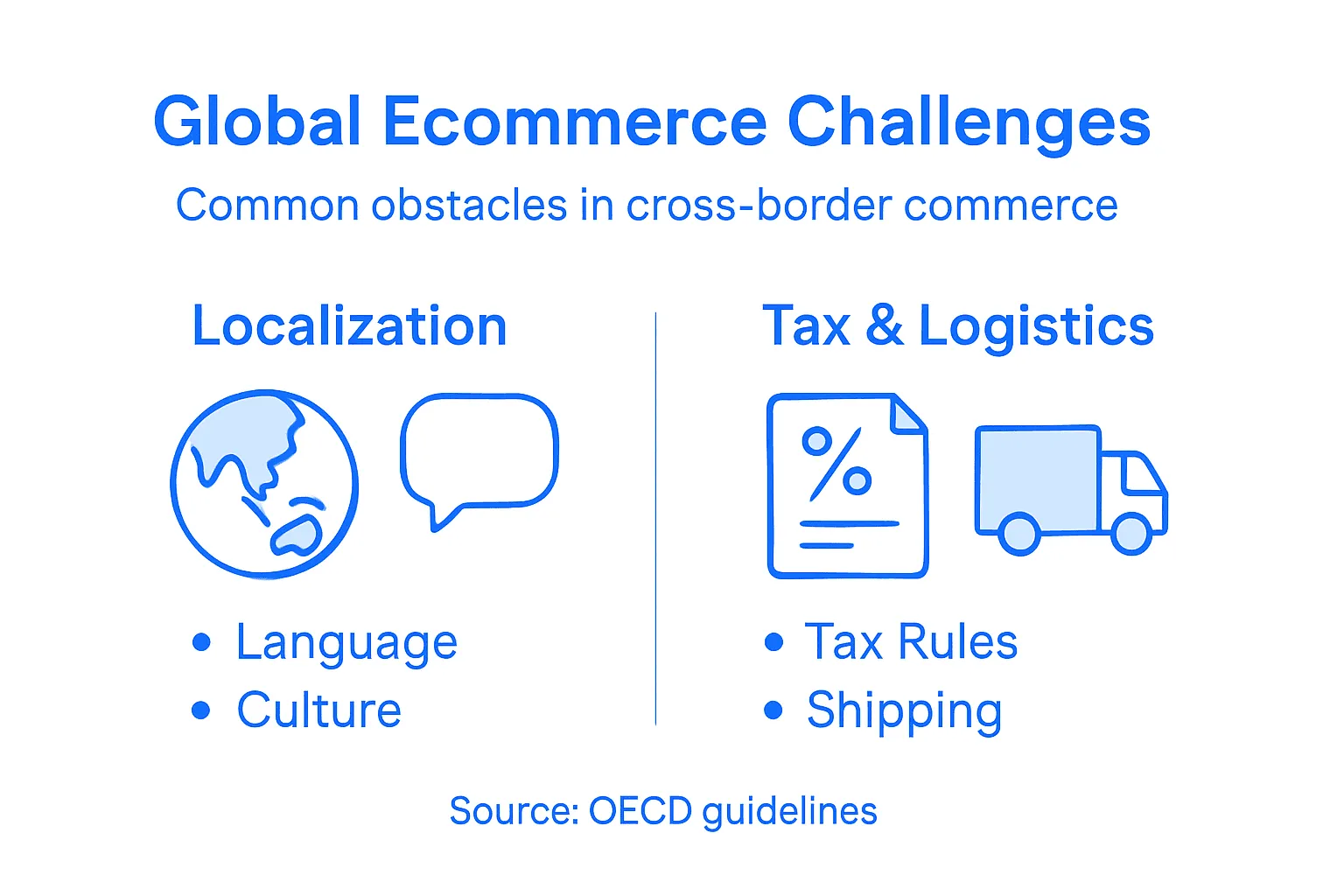
Global e-commerce expansion introduces a complex web of challenges that demand sophisticated strategic approaches. Global e-commerce challenges encompass far more than simple cross-border transactions, requiring businesses to navigate intricate regulatory, cultural, and operational landscapes.
nternational expansion strategies reveal that successful global e-commerce requires deep understanding of local market nuances. Companies must invest substantial resources in developing flexible infrastructures that can rapidly adapt to diverse regulatory environments, consumer expectations, and technological ecosystems.
Tax compliance represents one of the most complex challenges in global e-commerce. Different countries maintain unique VAT structures, customs regulations, and reporting requirements that can quickly overwhelm unprepared businesses. Successful brands develop comprehensive tax strategies that leverage local expertise, automated compliance tools, and scalable financial management systems to mitigate potential risks and penalties.
Pro tip: Develop a comprehensive compliance checklist and invest in specialized international tax and logistics consulting to navigate complex global e-commerce regulatory landscapes.
Legal compliance and international regulations
Navigating the complex landscape of international e-commerce regulations requires a sophisticated understanding of global legal frameworks. Legal compliance standards represent critical foundations for sustainable global digital commerce, demanding meticulous attention to evolving regulatory environments.
International e-commerce legal frameworks reveal profound complexity across different jurisdictions. Businesses must develop robust compliance strategies that adapt to varied regulatory landscapes, understanding that legal requirements can differ dramatically between countries and regions.
Data protection represents a particularly nuanced challenge in global e-commerce. Regulations like the European Union’s General Data Protection Regulation (GDPR) impose strict requirements on how businesses collect, store, and manage customer information. Successful international brands invest in comprehensive compliance infrastructures that prioritize transparent data handling, secure customer information, and maintain rigorous documentation of their privacy practices.
Pro tip: Engage specialized international legal counsel and implement flexible compliance management systems to proactively address regulatory variations across different markets.
Cost drivers and common expansion mistakes
Global e-commerce expansion demands strategic financial planning and sophisticated understanding of hidden cost structures. Cost drivers in international commerce represent complex financial challenges that can quickly overwhelm unprepared businesses.
Global expansion strategic planning reveals that most businesses dramatically underestimate the financial complexity of cross-border commerce. Successful brands anticipate potential expenses by developing comprehensive financial models that account for both direct and indirect costs associated with international market entry.
The most expensive mistakes often stem from inadequate market research and premature scaling. Companies frequently underestimate the costs of localization, assuming that a single strategy can be uniformly applied across diverse markets. In reality, each international market requires nuanced, tailored approaches that consider unique cultural, regulatory, and consumer behavior dynamics.
Below is a summary of hidden cost drivers and how they impact global e-commerce expansion:
Cost DriverFinancial ImpactCommon MistakeTechnology integrationHigher ongoing expensesUnderestimating updatesLocalization & adaptationExpensive for multiple regionsOne-size-fits-all approachTax & regulatory complianceFines and legal feesIncomplete researchInternational logisticsIncreased shipping costsNot planning for delaysCurrency/payment processingConversion lossesUsing only one providerLegal consultationMandatory but costlyDelaying legal reviewData protection systemsCostly breaches possibleWeak cybersecurity budget
Pro tip: Create a detailed financial contingency plan with at least 30% buffer funding to accommodate unexpected costs and market adaptation challenges during global expansion.
Unlock Global Growth with Expert Ecommerce Expansion Support
Expanding your ecommerce brand globally means facing complex challenges like localization, tax compliance, and logistics management. As the article highlights, succeeding in international markets requires more than just listing products online. It involves building adaptable digital infrastructure and harnessing detailed data-driven insights to navigate diverse market demands, consumer preferences, and regulatory frameworks.
Nectar specializes in transforming these challenges into growth opportunities. By combining creative services such as in-house photography and videography with powerful advertising strategies powered by the iDerive analytics platform, we help mid-sized and enterprise brands scale smarter across global marketplaces like Amazon, Walmart, and Shopify. Our full-funnel management approach gives you the precision and flexibility required to increase market share and maximize profits amid evolving international ecommerce landscapes.
Ready to convert global ecommerce complexities into strategic wins?
Elevate your global ecommerce expansion today with Nectar’s proven ecommerce solutions. Discover how you can leverage customized growth strategies tailored specifically for international markets by connecting with our experts now at https://thinknectar.com.

Frequently Asked Questions
What are the key components of global e-commerce expansion?
Global e-commerce expansion includes digital transaction platforms, cross-border payment systems, AI-powered commerce interfaces, subscription-based services, and integrated global supply chains.
How can U.S. e-commerce brands benefit from global expansion?
U.S. e-commerce brands can access billions of new customers, reduce reliance on domestic markets, increase brand visibility, achieve economies of scale, and diversify revenue streams.
What are the primary challenges businesses face in global e-commerce?
Challenges include language and cultural adaptation, tax compliance complexities, international shipping and logistics management, payment system integration, and ensuring regulatory compliance across different markets.
What are common mistakes companies make when expanding globally in e-commerce?
Common mistakes include underestimating the costs of localization, inadequate market research, and prematurely scaling their operations without understanding local market nuances
.png)