Why brands need agile marketing for faster growth in 2026
.webp)

Most e-commerce brands still operate marketing campaigns on rigid quarterly plans, requiring 8 to 12 weeks from concept to launch. Meanwhile, customer preferences shift weekly, competitors pivot overnight, and platform algorithms change without warning. This mismatch between planning speed and market reality costs brands millions in missed opportunities and wasted ad spend. Agile marketing offers a proven solution, cutting campaign development time by over 60% while improving customer focus and ROI. This guide explains why agile marketing is essential for mid-sized and enterprise e-commerce brands competing in 2026’s fast-moving digital landscape.
Key takeaways
PointDetailsSpeed advantageAgile marketing reduces campaign times by 62%, freeing capacity for more strategic initiatives and faster market response.Revenue impactEnterprise brands implementing agile frameworks see ROI improvements exceeding 150% through better resource allocation and customer-centric campaigns.Framework fitHybrid approaches like Scrumban balance structure with flexibility, addressing marketing’s unique mix of planned projects and reactive demands.Quick winsStarting with cross-functional pilot squads and measuring flow metrics over velocity creates sustainable momentum without disrupting ongoing operations.Market necessity2026’s e-commerce environment demands iterative testing and data-driven decisions to maintain competitive positioning and customer relevance.
What is agile marketing and why does it matter now
Agile marketing applies iterative, collaborative workflows to campaign development, replacing rigid annual plans with flexible sprint cycles. Instead of locking creative direction and channel strategy months ahead, teams work in short bursts of focused activity, testing assumptions quickly and adjusting based on real performance data. This approach originated in software development but translates naturally to marketing’s need for responsiveness and continuous optimization.
Traditional marketing planning assumes stable market conditions and predictable customer behavior. You might spend three months developing a product launch campaign, only to discover the messaging misses the mark or a competitor launches first. Agile marketing flips this model by treating every campaign as a hypothesis requiring validation. You launch smaller tests, gather feedback within days instead of months, and scale what works while cutting what doesn’t.
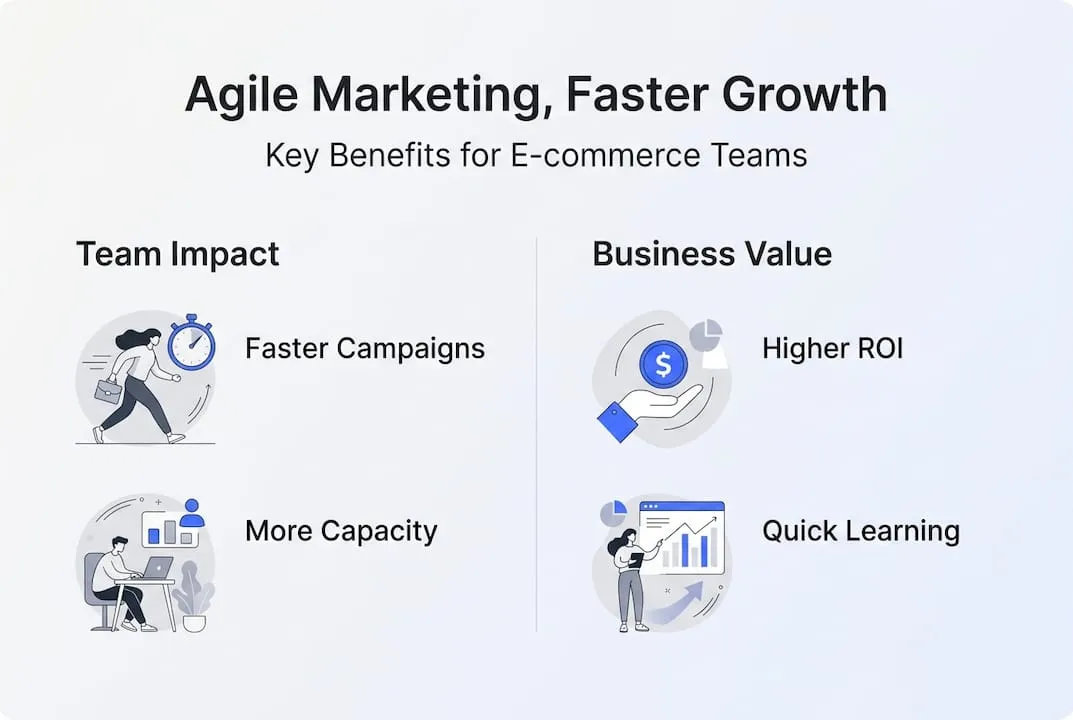
The benefits show up immediately in campaign metrics and team capacity. Brands adopting agile marketing reduce campaign development time by 62%, creating bandwidth for more experiments and faster response to market shifts. Customer focus improves because teams incorporate feedback continuously rather than waiting for quarterly reviews. This matters especially for 2025 ecommerce marketing where platform changes and consumer trends evolve weekly.

The 2026 e-commerce landscape makes agility non-negotiable. Algorithm updates on Amazon and Meta happen without warning. Supply chain disruptions require immediate messaging pivots. Competitors launch price wars overnight. Your marketing team needs the capability to respond within days, not quarters. Enhanced responsiveness through agile methods keeps campaigns relevant and budgets efficient.
Core agile marketing principles include:
These principles create a foundation for teams to move faster without sacrificing quality. Leveraging ecommerce data becomes easier when your workflow expects constant measurement and adjustment rather than treating analytics as an afterthought.
Core agile marketing frameworks and how they fit e-commerce
Three primary frameworks dominate agile marketing adoption. Scrum organizes work into fixed sprints of one to four weeks, with daily standups and sprint reviews creating rhythm and accountability. Kanban visualizes workflow stages and limits work in progress to prevent bottlenecks, offering more flexibility than Scrum’s time-boxed approach. Scrumban combines both, using Kanban’s visual flow management within Scrum’s sprint structure to balance planning with adaptability.
Each framework serves different team needs and work patterns. The table below compares key attributes:
FrameworkSprint LengthKey MeetingsFlexibilityBest FitScrum1-4 weeks fixedDaily standup, sprint planning, review, retrospectiveLower, requires stable workloadTeams with predictable project workKanbanContinuous flowOptional standups, regular reviewsHigher, adapts to interruptionsTeams handling many reactive requestsScrumban1-2 weeks flexibleDaily standup, periodic planningHighest, balances both modesMarketing teams mixing projects and requests
Pure Scrum struggles in marketing environments because it assumes stable sprint commitments. Your team plans two weeks of creative development, then the CEO requests an urgent campaign for a product recall. Scrum’s fixed sprint model treats this as a failure rather than normal business reality. Marketing work includes both planned projects and interrupt-driven requests, creating tension with Scrum’s predictability focus.
Scrumban’s hybrid approach solves this by maintaining sprint cadence for planning while allowing Kanban-style flow for reactive work. You protect capacity for strategic initiatives while acknowledging that urgent requests will always arrive. This matches how ecommerce strategy actually works, where you balance long-term brand building with immediate promotional needs.
Choose your framework based on these guidelines:
Pro Tip: Protect 30% of team capacity for business-as-usual work during initial agile adoption. This buffer prevents sprint failures when urgent requests arrive and builds confidence in the new workflow before expanding agile practices across all activities.
The framework matters less than consistent practice. Teams succeeding with agile marketing focus on transparency, regular feedback, and continuous improvement regardless of whether they call it Scrum or Scrumban. What matters is moving faster than competitors while maintaining quality and team morale. Understanding how to structure ecommerce ad budgets within agile sprints creates better resource allocation than annual planning cycles.
Real-world benefits: faster time to market, higher ROI, and team productivity
Enterprise brands adopting agile marketing report measurable improvements across every key performance indicator. The data shows consistent patterns regardless of industry vertical or team size:
MetricImprovementSourceTime to market53% of teams shorten launch cyclesAgile marketing case studiesProduct relevance80% of CMOs report better outcomesCMO surveysROI uplift156% improvement in enterprisesEnterprise implementationsTeam satisfaction96% positive experiencesPractitioner feedback
These improvements compound over time as teams refine their agile practices. SEMrush provides a concrete example, using agile methods to acquire 500,000 new users within eight months through rapid testing and iteration. Their marketing team ran dozens of small experiments weekly instead of betting on a few large campaigns quarterly, discovering winning formulas faster than competitors.
Top benefits realized by brands include:
Pro Tip: Measure flow efficiency by tracking work in progress limits rather than fixating on velocity metrics. Marketing output quality matters more than quantity, and flow metrics reveal capacity constraints without encouraging teams to rush work or inflate estimates.
“The majority of marketing teams adopting agile frameworks report positive experiences and see ROI improvements averaging 67%, with enterprise implementations achieving gains exceeding 150% through better alignment and faster execution.”
Cross-functional squads accelerate these benefits by eliminating handoff delays. When your creative designer, copywriter, and media buyer work together daily instead of passing projects between departments, you cut approval cycles from weeks to days. This structure works especially well for increasing ecommerce ROI because testing cycles compress and winning strategies scale faster.
Pilot sprints provide low-risk proof points before full transformation. Select one campaign or channel, run agile sprints for 6 to 8 weeks, and measure results against traditional approaches. Most teams discover they can double output while improving quality, creating organizational momentum for broader adoption. Tracking the right performance metrics in ecommerce during pilots ensures you capture both efficiency gains and business impact.
The productivity gains extend beyond campaign velocity. Teams using agile marketing report better work-life balance because transparent workflows prevent last-minute fire drills. Everyone sees what’s coming, capacity constraints surface early, and realistic commitments replace heroic efforts. This sustainability matters for retaining top talent in competitive markets. Applying these methods to remarketing in ecommerce creates systematic testing programs instead of one-off experiments.
How to start implementing agile marketing in your brand
Successful agile adoption follows a clear sequence that minimizes disruption while building momentum. Start by identifying a pilot project with clear outcomes, manageable scope, and executive visibility. Product launches work well because they have defined timelines and measurable success metrics. Avoid choosing your most critical campaign for the first sprint, but don’t pick something so trivial that results won’t matter.
Form a cross-functional squad of 5 to 7 people including creative, strategy, media buying, and analytics roles. This team should have authority to make decisions without constant approval chains. Dedicate them full-time to the pilot for 6 to 8 weeks, protecting their capacity from other demands. Half-hearted pilots with people splitting time across multiple initiatives rarely succeed because context-switching destroys the productivity gains agile promises.
Critical success factors include:
Measure flow metrics rather than velocity to track realistic improvements. Count how many campaigns move from concept to launch each sprint, but focus more on cycle time and work in progress limits. Enterprise e-commerce teams tracking flow discover bottlenecks in approval processes or creative review that velocity metrics miss entirely.
Manage cultural change proactively by communicating benefits before problems arise. Marketing teams fear agile will mean more meetings and less creative freedom. Address this by showing how standups replace status emails and how sprint planning creates protected time for deep work. Coach team members on new practices rather than expecting instant expertise. Most marketers have never worked in sprints or participated in retrospectives, so budget time for learning.
Implementation steps:
Pro Tip: Start with two-week sprints regardless of framework choice. One-week sprints create too much planning overhead for marketing work, while four-week sprints lose the rapid feedback benefits that make agile valuable.
Protect ongoing work by limiting agile adoption to the pilot squad initially. Your broader marketing team continues current workflows while the pilot proves value. This reduces organizational resistance and creates internal advocates who can share real experiences rather than theoretical benefits. Once the pilot succeeds, expand gradually by converting one additional team or campaign type per quarter.
Applying agile methods to your brand growth strategy creates systematic experimentation replacing guesswork. The same principles improve Shopify advertising workflow by shortening the gap between creative concepts and performance data. Understanding why optimize ad creative becomes obvious when you can test variations weekly instead of quarterly.
Partner with Nectar to grow your e-commerce brand
Transforming your marketing operations requires both methodology expertise and execution capability. Nectar combines agile marketing frameworks with full-service creative and media buying to accelerate your brand’s profitable growth across Amazon, Walmart, and Shopify. Our cross-functional teams operate in sprint cycles, delivering rapid testing and optimization that traditional agencies can’t match.
We help mid-sized and enterprise brands implement agile workflows tailored to e-commerce’s unique demands. Our services include:
Pro Tip: Partner with agencies experienced in agile transformation to compress your learning curve and avoid common adoption pitfalls that derail internal initiatives.
Explore our profitable brand growth services to see how we’ve helped brands scale smarter. Review our Perfect Shopping Trip case study showing agile methods in action. Discover our creative ecommerce services delivering the rapid production cycles agile marketing requires.
Frequently asked questions about agile marketing
What distinguishes agile marketing from traditional marketing?
Agile marketing uses iterative sprints and continuous testing instead of annual plans and quarterly campaigns. Teams work in cross-functional squads, adjust strategies based on real-time data, and prioritize customer feedback over internal assumptions. Traditional marketing locks creative and channel strategy months ahead, while agile treats every campaign as a hypothesis requiring validation.
How quickly can we expect results after adopting agile methods?
Most brands see measurable improvements within the first 6 to 8 weeks of pilot sprints. Campaign development cycles typically shorten by 30% to 40% in the initial phase, with further gains as teams refine practices. Full transformation delivering 60% time reductions and 150% ROI improvements usually requires 6 to 12 months of sustained adoption.
What are common challenges when starting agile marketing and how to overcome them?
Cultural resistance from teams accustomed to traditional workflows creates the biggest obstacle. Overcome this through executive sponsorship, dedicated pilot squads, and transparent success metrics. Protecting capacity for ongoing work prevents sprint failures that undermine confidence. Starting small with one campaign type and expanding gradually builds momentum without overwhelming the organization.
Can agile marketing work for large enterprise e-commerce brands?
Enterprise brands actually benefit most from agile marketing because they have complex approval chains and departmental silos that slow execution. Cross-functional squads eliminate handoff delays, while sprint cadence creates accountability that matrix organizations often lack. The 156% ROI improvements cited in research come primarily from enterprise implementations where efficiency gains compound across larger budgets.
Which agile framework is best suited for marketing teams?
Scrumban works best for most marketing environments because it balances planned projects with reactive requests. Pure Scrum assumes stable workloads that marketing rarely has, while pure Kanban lacks the planning rhythm that strategic campaigns need. Start with Scrumban’s hybrid approach and adjust based on your team’s specific work patterns and constraints.
Recommended



































































.webp)