E-commerce managers juggling Amazon, Walmart, and Shopify operations face mounting pressure to maintain accuracy while scaling growth. Manual workflows create bottlenecks that limit your brand’s potential, with automation reducing order errors by up to 67% compared to manual processing. Strategic automation transforms these challenges into competitive advantages, enabling precise inventory management, dynamic pricing, and seamless multi-channel synchronization that drive both efficiency and profitability.
Key takeaways
The complexities of multi-platform e-commerce management
Managing sales across Amazon, Walmart, and Shopify simultaneously creates operational nightmares that drain resources and limit growth. You’re constantly balancing inventory levels, updating product listings, adjusting prices, and coordinating fulfillment across platforms with different requirements and interfaces. Each platform has unique listing formats, advertising structures, and reporting dashboards that force your team to master multiple systems.
Manual workflows compound these challenges exponentially. When you update inventory in one system, you risk creating discrepancies in another, leading to overselling or missed sales opportunities. Price changes require multiple logins and data entries, making competitive responses slow and error-prone. Order fulfillment coordination becomes a puzzle as you try to optimize shipping costs while meeting different marketplace policies.
Scaling these manual processes hits a wall quickly. Adding more SKUs or expanding to new categories means hiring additional staff just to maintain current service levels. Your team spends valuable time on repetitive tasks instead of strategic initiatives that actually grow revenue. Enterprise ecommerce partnerships become essential when internal resources can’t keep pace with operational demands.
Data consistency issues create the most insidious problems. A product description updated on Shopify might not match Amazon’s version for weeks. Inventory counts drift out of sync, causing customer service headaches and negative reviews. Marketing campaigns run with outdated pricing information, eroding trust and profit margins simultaneously.
Key operational pain points include:
Why automation is essential for e-commerce efficiency
Automation eliminates the human error factor that plagues manual e-commerce operations. Automated systems reduce data entry errors by 90% compared to manual workflows, directly impacting your bottom line through fewer returns, cancellations, and customer complaints. Your team can finally trust that inventory numbers are accurate across all platforms simultaneously.
Inventory automation prevents the costly imbalances that kill profitability. When stock levels update in real time across Amazon, Walmart, and Shopify, you eliminate overselling situations that damage seller ratings and customer trust. Understocking becomes less frequent as automated reorder triggers maintain optimal inventory levels based on actual sales velocity and seasonal patterns.

Multi-channel synchronization improves operational flow dramatically. Product information, pricing, and promotional data propagate instantly across platforms without manual intervention. You can launch new products or adjust strategies knowing all channels reflect changes within minutes instead of days. This agility becomes your competitive edge in fast-moving markets.
Ecommerce performance metrics become more reliable with automated data collection and reporting. You gain visibility into which products perform best on each platform, where advertising spend delivers maximum ROI, and how fulfillment efficiency trends over time. These insights drive smarter decisions faster.
Automation BenefitManual Process TimeAutomated Process TimeEfficiency GainInventory updates across 3 platforms45 minutes daily2 minutes daily95% reductionPrice adjustments for 100 SKUs3 hours15 minutes92% reductionOrder processing per transaction8 minutes90 seconds81% reductionPerformance reporting6 hours weekly30 minutes weekly92% reduction
Pro Tip: Prioritize automation tools with real-time API connections rather than batch processing systems. Real-time integration prevents the data lag that causes most multi-channel operational failures.
Boosting sales and profitability through automation
Dynamic pricing automation turns your pricing strategy into a revenue engine. Algorithms monitor competitor pricing, demand signals, and inventory levels to adjust prices automatically within your defined parameters. Brands using dynamic pricing see profit margins increase by 25% on average while maintaining competitive positioning. Your products stay priced optimally without constant manual monitoring.
Automated listing optimization improves product discovery and conversion rates substantially. A/B testing runs continuously on titles, descriptions, and images to identify winning combinations. Search term harvesting and keyword optimization happen automatically based on actual customer search behavior. These improvements compound over time as algorithms learn which elements drive sales for your specific products.
Advertising campaign automation enhances targeting precision and budget efficiency simultaneously. Shopify advertising automation enables rule-based bid adjustments that respond to performance in real time. Your ad spend shifts toward high-performing keywords and audiences automatically while reducing waste on underperforming segments.
Key sales-driving automation capabilities include:
Marketing automation transforms customer engagement. Email sequences trigger based on specific behaviors like browsing without purchasing or repeat customer milestones. SMS campaigns reach customers at optimal times with relevant offers. These touchpoints happen automatically while maintaining personalization that drives conversions.
Ecommerce ad budget structuring becomes more effective with automated allocation. Budgets shift between campaigns and platforms based on performance thresholds you define. Underperforming campaigns pause automatically while winners receive additional funding, maximizing ecommerce ROI without constant manual intervention.
Pro Tip: Use AI-driven tools that optimize advertising bids and adjust campaigns based on predictive analytics, not just historical performance. This forward-looking approach captures emerging opportunities faster than reactive optimization.
Common misconceptions about e-commerce automation
The biggest myth about automation is the set-it-and-forget-it fantasy. Automation requires ongoing human monitoring, adjustment, and strategic oversight to deliver sustained results. Algorithms need parameter tuning as market conditions change. Integration points require maintenance as platforms update their APIs. Thinking automation eliminates human involvement leads to performance degradation and costly failures.
Automation doesn’t replace human judgment in strategic decisions. While systems excel at executing repetitive tasks and analyzing large datasets, they can’t understand nuanced brand positioning or anticipate market shifts requiring strategic pivots. Your team’s expertise becomes more valuable, not less, as you focus on high-impact decisions rather than operational grunt work.
Integration gaps cause more problems than most managers anticipate. When automation tools don’t communicate properly with your platforms or each other, data silos emerge. Orders might process automatically but fail to update inventory correctly. Marketing automation could target customers with out-of-stock products. These failures damage customer experience and brand reputation quickly.
Common automation pitfalls include:
Overestimating automation capabilities leads to rushed deployments with inadequate testing. Brands launch automated pricing or inventory systems without thorough scenario testing, only to discover costly bugs in production. Customer-facing errors multiply quickly when automation fails without proper safeguards. Ecommerce automation oversight prevents these disasters through staged rollouts and continuous monitoring.
Maintenance costs get underestimated regularly. Automation tools require updates, staff training, and occasional troubleshooting. Platform changes can break integrations unexpectedly. Budgeting only for initial setup costs without planning for ongoing maintenance creates sustainability problems down the road.
Comparison framework for selecting automation tools
Selecting the right automation tools starts with defining your operational priorities clearly. Are inventory synchronization errors causing the most pain? Is pricing competitiveness your biggest challenge? Or do advertising inefficiencies drain your budget? Your highest-impact problem should drive tool selection, not feature lists or vendor marketing.
Integrated platforms reduce data silos and streamline workflows more effectively than point solutions. Tools that connect directly to Amazon, Walmart, and Shopify through native integrations prevent the data lag and synchronization issues that plague API-only connections. Look for solutions offering unified dashboards that surface insights across all channels simultaneously.
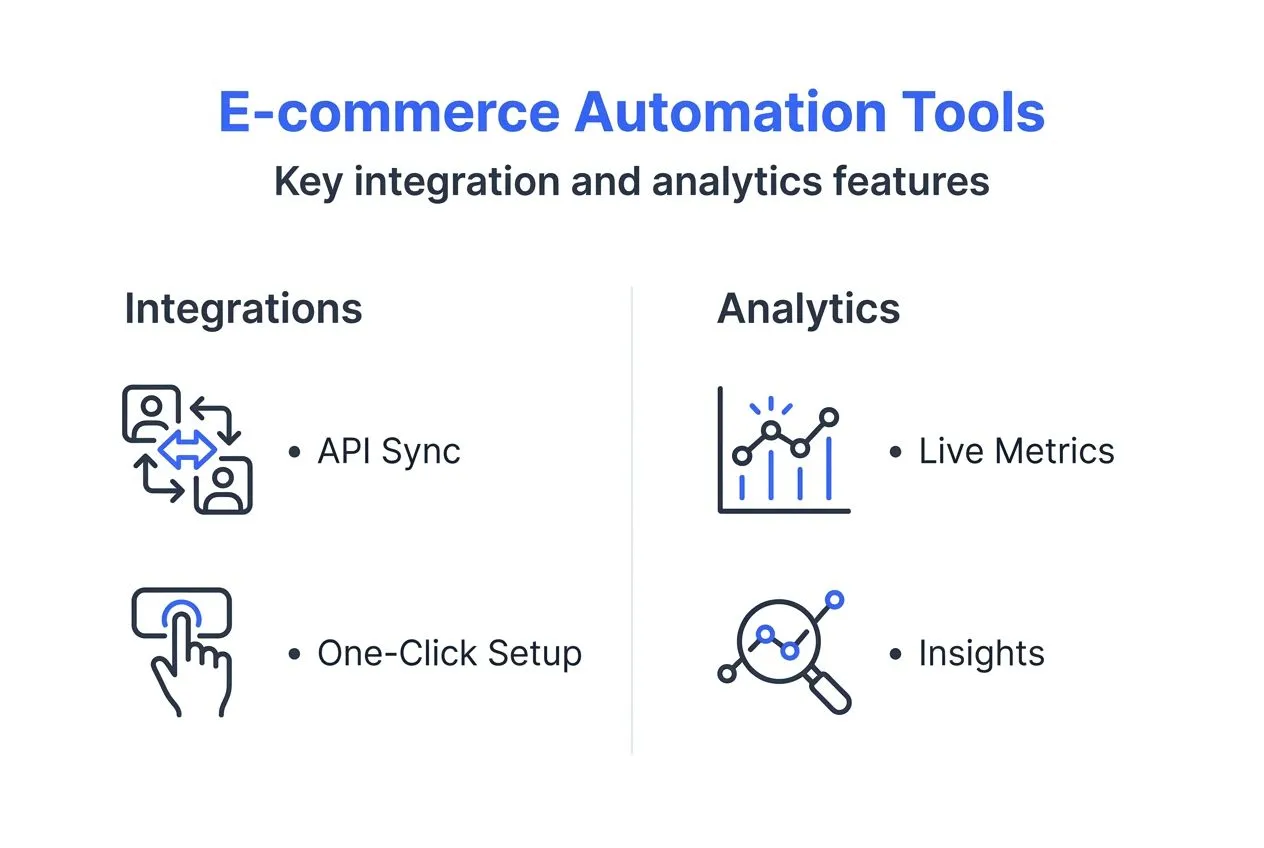
Platform-specific tool selection matters because marketplace structures differ significantly. Amazon automation tools must handle FBA inventory complexities, advertising campaign types, and content requirements unique to that ecosystem. Walmart tools need to navigate different fulfillment models and advertising platforms. Shopify automation focuses more on direct-to-consumer marketing and theme integration.
Tool CategoryBest ForKey Integration FeaturesAnalytics DepthInventory managementMulti-channel stock accuracyReal-time sync across all platforms, automated reorderingSKU-level velocity trackingPricing optimizationCompetitive positioningCompetitor monitoring, rule-based adjustmentsMargin impact forecastingAdvertising automationCampaign efficiencyPlatform-native API connections, bid optimizationAttribution modelingListing optimizationConversion improvementA/B testing, keyword research integrationPerformance by element testing
Evaluation criteria should emphasize practical implementation factors over feature counts. Ease of use determines whether your team will actually leverage advanced capabilities. Support quality matters when integrations break or you need strategic guidance. Scalability ensures tools grow with your business without forcing platform migrations.
Ecommerce data tools deliver maximum value when they provide actionable insights, not just reports. Look for analytics that highlight specific improvement opportunities and track progress toward defined goals. Custom reporting capabilities let you focus on the metrics driving your unique business model.
Implementing automation strategically for scalable growth
Successful automation implementation follows a structured approach that minimizes disruption while maximizing adoption. Start by assessing your current workflows to identify the most time-consuming, error-prone processes. These become your priority targets for automation, delivering quick wins that build momentum and stakeholder buy-in.
Phased deployment reduces risk dramatically compared to big-bang implementations. Starting with inventory automation on your highest-volume platform lets you learn the tool’s capabilities and limitations in a controlled environment. Success there builds confidence for expanding to pricing automation or additional platforms.
Integration and testing stages require more time than most managers allocate initially. Platform APIs change regularly, creating unexpected compatibility issues. Edge cases that seemed unlikely during planning appear quickly in production. Allowing buffer time for troubleshooting prevents launch delays and maintains team morale.
Continuous monitoring establishes baselines and catches performance drift early. Set up alerts for key metrics like inventory sync delays, pricing anomalies, or order processing failures. Weekly reviews of automation performance identify optimization opportunities and ensure rules remain aligned with business strategy.
PPC campaign guide principles apply equally to advertising automation, where gradual optimization beats aggressive initial settings. Start with conservative bid caps and budget limits, then expand as you gain confidence in algorithm performance. Email automation benefits compound over time as customer data enriches segmentation and personalization capabilities.
Pro Tip: Plan realistic timelines that account for vendor onboarding, staff training, and iterative refinement. Rushed deployments create technical debt and team resistance that undermine long-term automation success.
Maximizing e-commerce growth through thoughtful automation
Automation stands as the cornerstone of modern e-commerce efficiency, enabling brands to scale operations without proportional cost increases. The strategic advantage comes not from automation itself, but from thoughtful implementation that balances technological capability with human oversight. Your competitive edge emerges when automated systems handle operational execution flawlessly while your team focuses on strategic initiatives that drive differentiation.
Continuous optimization separates automation leaders from those who merely adopt tools. Markets evolve, customer behaviors shift, and competitive landscapes change constantly. Your automation strategy must adapt accordingly through regular parameter reviews, integration health checks, and performance analysis. This ongoing attention ensures sustained results rather than temporary improvements.
Choosing and implementing the right tools strategically unlocks growth potential that manual operations simply cannot achieve. The efficiency gains fund further innovation and expansion. The data insights reveal opportunities competitors miss. The operational reliability builds customer trust that translates directly to revenue growth and market share expansion.
Elevate your ecommerce growth with Nectar
Scaling your e-commerce operations across multiple platforms demands expertise that combines strategic vision with hands-on execution. Nectar delivers both through tailored services designed specifically for mid-sized to enterprise brands ready to maximize automation’s potential. Our team has driven measurable results for brands facing the exact challenges you’re navigating now.

Our profitable brand growth services integrate automation strategy with creative excellence and data-driven advertising management. We don’t just recommend tools; we implement comprehensive solutions powered by our proprietary iDerive analytics platform. This approach delivered transformative results in our Amazon catalog overhaul case study, where strategic automation and listing optimization generated substantial revenue growth. Similarly, our Shopify shopping experience work demonstrates how automation enhances customer journey while improving conversion rates. Let’s discuss how we can apply these proven strategies to accelerate your brand’s growth trajectory.
FAQ
What common mistakes should be avoided when automating ecommerce?
Neglecting ongoing monitoring and maintenance creates the most frequent automation failures. Systems require regular parameter tuning as market conditions evolve. Choosing tools without robust multi-channel integration leads to data silos and synchronization errors. Rushing setup phases and skipping thorough testing results in customer-facing bugs that damage brand reputation. Automation common mistakes typically stem from underestimating the human oversight automation still requires for sustained success.
How long does it typically take to see ROI from ecommerce automation?
Most brands achieve measurable ROI within 3 to 6 months after proper deployment. Timeline depends heavily on implementation quality and which processes you automate first. Inventory and pricing automation typically show faster returns than advertising optimization. Phased implementation with adequate testing accelerates ROI by preventing costly failures that require remediation.
Which automation tools work best across Amazon, Walmart, and Shopify?
Tool selection should align with your primary revenue platform and specific operational challenges. Prioritize solutions offering native integrations across all three platforms for seamless data synchronization. Multi-channel inventory management tools like ChannelAdvisor or Sellbrite excel at preventing stockouts. Pricing automation requires platform-specific tools due to different competitive dynamics. Match tool capabilities to your defined automation goals rather than selecting based on feature breadth alone. Selecting ecommerce automation tools effectively requires evaluating integration quality and support resources alongside core functionality.
Can small teams manage multiple automation tools effectively?
Small teams can absolutely manage automation effectively by starting focused and expanding gradually. Begin with one high-impact area like inventory synchronization rather than implementing multiple systems simultaneously. Choose tools with intuitive interfaces and strong vendor support to minimize learning curves. Establish clear ownership and monitoring responsibilities within your team. Success comes from deep utilization of fewer tools rather than superficial adoption of many systems.
How does automation impact customer experience on different platforms?
Automation improves customer experience by ensuring consistent, accurate product information and reliable fulfillment across all platforms. Inventory accuracy prevents overselling situations that lead to cancellations and negative reviews. Dynamic pricing maintains competitiveness while protecting margins. Automated customer communications provide timely updates throughout the purchase journey. The key is balancing efficiency with personalization, so automated touchpoints still feel relevant and brand-appropriate to customers on each platform.











.png)