{
"@type": "Article",
"image": {
"url": "https://csuxjmfbwmkxiegfpljm.supabase.co/storage/v1/object/public/blog-images/organization-10884/1774068247928_Brand-manager-reviewing-Amazon-ads-dashboard.jpeg",
"@type": "ImageObject",
"caption": "Brand manager reviewing Amazon ads dashboard"
},
"author": {
"url": "https://thinknectar.com",
"name": "Thinknectar",
"@type": "Organization"
},
"@context": "https://schema.org",
"headline": "Master Amazon advertising for profitable brand growth",
"publisher": {
"url": "https://thinknectar.com",
"name": "Thinknectar",
"@type": "Organization"
},
"inLanguage": "en-US",
"articleBody": "Learn how to master Amazon advertising with strategic bidding, campaign structures, and metrics that drive profitable brand growth for mid-sized and enterprise e-commerce companies.",
"description": "Learn how to master Amazon advertising with strategic bidding, campaign structures, and metrics that drive profitable brand growth for mid-sized and enterprise e-commerce companies.",
"datePublished": "2026-03-21T04:44:22.671Z"
}
Master Amazon advertising for profitable brand growth
.webp)
Most brand managers treat Amazon Advertising like a simple PPC platform, but its auction system factors in relevance and performance history alongside bids, fundamentally changing how you should allocate spend. Unlike traditional search ads, your bid alone doesn’t determine placement. Amazon’s algorithm rewards campaigns that convert well with lower costs and better positions, creating a compounding advantage for strategically optimized accounts. This guide breaks down the ad types, bidding tactics, and metrics you need to transform scattered campaigns into a cohesive growth engine that scales profitably while protecting your bottom line.
Key Takeaways
| Point | Details |
|---|---|
| Auction factors | Amazon ads are governed by a pay per click auction where bid amount, expected click through rate, and historical conversion performance determine ad rank. |
| Ad type variety | Sponsored Products, Sponsored Brands, and Sponsored Display serve different funnel stages and objectives. |
| Layered funnel approach | A full funnel strategy should layer ad types by brand size and growth stage, using video for awareness and bottom funnel products for direct conversions when appropriate. |
| Smart bidding and placement | Dynamic bidding offers down only and standard with up to a 100 percent bid increase for likely conversions, while placement modifiers boost top of search up to 100 percent and product page placements by 20 to 50 percent. |
Understanding Amazon advertising and its core ad types
Amazon Advertising operates as a pay-per-click auction system where your ad rank depends on three factors: your bid amount, your ad’s expected click-through rate, and its historical conversion performance. This means two advertisers bidding the same amount will pay different costs per click based on their campaign quality scores. Your relevance to the search term and past performance create advantages that persist across campaigns, making optimization a compounding investment rather than a one-time fix.

The platform offers three primary ad products, each serving distinct funnel stages. Sponsored Products appear in search results and product pages, capturing high-intent shoppers actively comparing options. These bottom-funnel placements drive immediate conversions and typically deliver your lowest cost per acquisition. Sponsored Brands display at the top of search results with custom headlines and multiple products, building awareness while directing traffic to your storefront or a curated landing page. Sponsored Display extends beyond Amazon, retargeting shoppers across the web and reaching audiences based on interests or competitor product views.
Choosing the right ad type depends on your marketing objective and customer journey stage. Use Sponsored Products when you need direct sales from purchase-ready shoppers searching specific product terms. Deploy Sponsored Brands to introduce your catalog to new customers researching category solutions. Reserve Sponsored Display for retargeting cart abandoners or reaching cold audiences who’ve browsed competitor listings. Amazon’s ad revenue reached $58 billion in 2025 and projections show continued growth, making strategic ad placement increasingly competitive and valuable for brands seeking market share.
Your full funnel amazon ads approach should layer these ad types based on your brand size and growth stage. Smaller brands benefit from awareness-focused Sponsored Brand Video campaigns that build recognition before conversion-focused Sponsored Products. Established brands can allocate more budget to bottom-funnel Sponsored Products while using Display ads to defend against competitor conquesting. The key is aligning ad spend with where your potential customers sit in their buying journey, not simply chasing the lowest cost per click across all placements.
Effective bidding strategies and budget allocation on Amazon
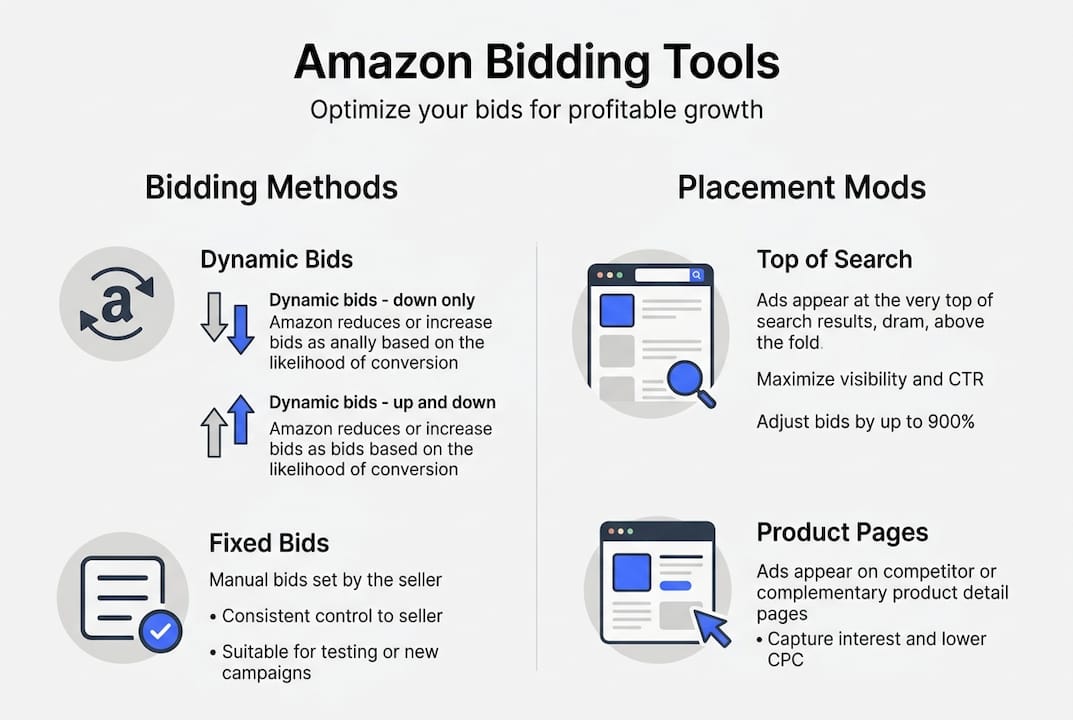
Dynamic bidding gives Amazon permission to adjust your bids in real time based on conversion likelihood. The down-only option reduces your bid when a click seems unlikely to convert, protecting you from wasted spend on low-intent traffic. This conservative approach works well for brands prioritizing profitability over aggressive growth. Standard dynamic bidding allows Amazon to increase bids up to 100% for likely conversions, capturing high-value opportunities but requiring careful monitoring to prevent runaway costs.
Placement bid modifiers let you increase bids for specific ad positions without changing your base bid. Top-of-search placements convert 2-3x better than other positions, justifying modifier increases up to 100% for competitive keywords. Product page placements typically warrant 20-50% increases, while rest-of-search positions rarely justify modifiers above 10%. Test these incrementally, measuring conversion rate lift against cost increases to find your optimal modifier for each placement type.
Adjust bids weekly rather than daily to allow sufficient data accumulation for meaningful analysis. Daily changes introduce volatility and prevent you from identifying true performance trends versus random fluctuations. Third-party dayparting tools enable bid increases up to 20% during peak conversion hours, typically evenings and weekends for consumer products. This tactical approach concentrates spend when your target customers actively shop, improving efficiency without requiring larger overall budgets.
Budget allocation should reflect your brand size and strategic priorities. Small brands building awareness should emphasize Sponsored Brand Video to establish market presence before optimizing for conversions. Medium brands generating consistent revenue benefit from balancing tactical campaign optimization with strategic TACoS protection. Large enterprises need sophisticated segmentation separating brand defense spending from growth initiatives, ensuring you don’t sacrifice profitability while expanding into new categories or keywords.
Average cost per click on Amazon increased 12% from 2024 to 2025, with projections showing continued upward pressure as more brands compete for limited ad inventory. Plan 2026 budgets assuming 8-10% CPC inflation, especially in competitive categories like supplements, electronics, and home goods. This cost pressure makes bidding efficiency and conversion rate optimization more critical than ever for maintaining acceptable returns on ad spend.
Pro Tip: Set separate budgets for brand defense keywords (your brand name and product terms) versus conquest keywords (competitor brands and generic categories). This prevents conquest campaigns from consuming budget needed to protect your branded search traffic, which typically converts at 3-5x higher rates than non-brand terms.
Interpreting advertising metrics: ACoS vs TACoS for smart optimization
Advertising Cost of Sales measures your ad spend divided by attributed ad sales, showing campaign-level efficiency. A 25% ACoS means you spent $25 in ads for every $100 in sales those ads directly generated. This metric helps you optimize individual campaigns by identifying which keywords, products, or ad types deliver acceptable returns. Most brands target ACoS between 15-35% depending on profit margins, with lower targets for mature products and higher thresholds for new launches building market share.
Total Advertising Cost of Sales divides your total ad spend by total sales including organic, revealing how advertising impacts your entire business profitability. ACoS and TACoS measure tactical versus strategic performance, with TACoS protecting against scenarios where improving ACoS actually reduces total profitability. A campaign showing excellent 20% ACoS might be cannibalizing organic sales, resulting in higher overall TACoS that signals declining business health despite strong campaign metrics.
Optimizing solely for ACoS creates three dangerous pitfalls. First, you might pause profitable campaigns that generate incremental sales beyond what you’d achieve organically, sacrificing growth for apparent efficiency. Second, aggressive ACoS targets can force you into only the most competitive, high-intent keywords where you’re bidding against every competitor, missing awareness opportunities that drive future organic sales. Third, focusing exclusively on direct attribution ignores the halo effect where ads increase organic ranking and visibility, compounding returns beyond immediate conversions.
Monitor both metrics jointly to balance revenue growth with profitability protection. Improving ACoS while TACoS remains stable or increases suggests you’re optimizing away incremental sales, essentially paying less to generate sales you’d have captured anyway. Conversely, accepting higher ACoS that maintains or improves TACoS indicates you’re driving truly incremental growth that expands your total business rather than just shifting attribution from organic to paid channels.
Align your metric focus with your growth phase and margin structure. New product launches should tolerate 40-60% ACoS for 60-90 days while building reviews and ranking, monitoring TACoS to ensure total business economics remain viable. Established products in mature markets should target ACoS at or below your profit margin while keeping TACoS 5-10 percentage points lower than ACoS, confirming ads drive incremental rather than cannibalized sales. High-margin products can sustain higher ACoS than low-margin items, but TACoS provides the ultimate profitability guardrail regardless of margin structure.
| Metric | Calculation | Primary Use Case | Risk of Sole Focus |
|---|---|---|---|
| ACoS | Ad Spend ÷ Ad Sales | Campaign optimization | Ignores organic impact |
| TACoS | Ad Spend ÷ Total Sales | Strategic profitability | Less actionable for tactics |
Pro Tip: Calculate TACoS weekly but make strategic decisions monthly. Weekly tracking spots emerging trends early, but monthly analysis provides sufficient data to separate signal from noise when evaluating whether advertising drives incremental growth or cannibalizes organic sales.
Structuring campaigns and practical tips to optimize Amazon advertising success
Granular campaign structures with separate campaigns for each product or small keyword groups were standard practice through 2024, giving advertisers maximum control over bids and budgets. This approach let you isolate performance by product and keyword, making optimization decisions straightforward. However, it starves Amazon’s machine learning algorithms of the data volume they need to identify patterns and optimize delivery, resulting in higher costs and slower performance improvements compared to consolidated structures.
2026 favors fewer campaign structures that pool related products and keywords into unified campaigns, providing Amazon’s algorithms with sufficient conversion data to optimize effectively. Consolidated campaigns typically show 15-25% better cost efficiency after 30 days as machine learning identifies which products and placements drive conversions. The tradeoff is reduced granular control, requiring you to trust algorithmic optimization over manual bid management for individual keywords.
Implement these five steps to optimize your Amazon advertising systematically:
-
Analyze search term reports weekly to identify high-performing keywords for bid increases and negative match low-converters wasting budget
-
Adjust placement modifiers monthly based on conversion rate data, increasing top-of-search modifiers for campaigns showing 2x+ conversion lift in those positions
-
Test new ad creative quarterly, rotating product images and brand messaging to combat banner blindness and creative fatigue
-
Review campaign structure biannually, consolidating granular campaigns that underperform due to insufficient data volume
-
Audit negative keyword lists monthly to ensure you’re not blocking relevant traffic while preventing spend on irrelevant searches
Balance short-term profitability against long-term growth by accepting higher ACoS during launch phases. New products need 30-60 days of aggressive advertising to accumulate reviews and ranking signals that drive future organic sales. A 50% ACoS during launch might seem unprofitable, but it’s an investment in market position that pays dividends through reduced future advertising dependency. Monitor TACoS to ensure your total business remains profitable even while individual campaigns show elevated costs.
Avoid the common pitfall of optimizing for revenue growth over TACoS amazon advertising ROI protection. Revenue increases mean nothing if they come at unsustainable ad costs that erode profitability. Many brands celebrate 50% revenue growth while TACoS climbs from 12% to 22%, not realizing they’re spending their way to unprofitable scale. Set TACoS guardrails based on your profit margins, pausing growth initiatives if TACoS approaches levels that threaten business viability.
Incorporate organic SEO improvements alongside paid advertising for holistic growth. Optimize product titles, bullet points, and descriptions with high-performing keywords from your ad campaigns. Enhanced content and A+ pages improve conversion rates, reducing your cost per acquisition across both paid and organic channels. This integrated approach compounds returns, with paid ads driving initial visibility and conversions that boost organic ranking, which then reduces future advertising dependency.
| Campaign Structure | Data Volume | ML Effectiveness | Control Level | Best For |
|---|---|---|---|---|
| Granular (many small campaigns) | Low per campaign | Limited | High | Small catalogs, testing |
| Consolidated (fewer large campaigns) | High per campaign | Strong | Moderate | Large catalogs, efficiency |
| Hybrid (strategic segmentation) | Balanced | Good | Balanced | Enterprise brands |
Pro Tip: Create a strategic amazon advertising guide document that defines your TACoS targets, ACoS thresholds by product category, and decision rules for when to scale versus pause campaigns. This framework prevents emotional decision-making during performance fluctuations and ensures consistent strategy execution across your team.
Grow your Amazon brand with Nectar’s proven services
Transforming scattered Amazon campaigns into a cohesive growth engine requires more than tactical knowledge. You need strategic partners who understand how advertising, creative, and analytics work together to drive profitable scale. Nectar delivers profitable brand growth services tailored to mid-sized and enterprise e-commerce brands, combining data-driven advertising strategies with high-impact creative that converts browsers into buyers.
Our proprietary iDerive analytics platform provides the granular insights you need to optimize TACoS while scaling revenue, ensuring every advertising dollar contributes to sustainable growth rather than short-term vanity metrics. From ecommerce creative services that transform underperforming listings into high-converting storefronts to full-funnel campaign management across Amazon, Walmart, and Shopify, we harmonize every element of your e-commerce presence. See how we helped brands achieve breakthrough results in our Shopify shopping trip case study, then contact us to discuss how we can accelerate your Amazon growth.
Frequently asked questions
What types of Amazon ads are best for brand growth?
Sponsored Products excel at capturing bottom-funnel conversions from shoppers actively comparing purchase options, delivering your lowest cost per acquisition. Sponsored Brands build awareness and consideration among mid-funnel researchers exploring category solutions. Sponsored Display extends reach through retargeting and competitor audience targeting, recapturing lost opportunities and defending market share. Brand size influences strategy, with smaller brands prioritizing awareness through Sponsored Brand Video before conversion optimization, while larger brands can allocate more budget to bottom-funnel Sponsored Products.
How often should bidding strategies be adjusted on Amazon?
Adjust bids weekly rather than daily to accumulate sufficient conversion data for meaningful analysis and avoid performance volatility from premature changes. Monthly placement modifier reviews ensure you’re capitalizing on high-converting positions without overpaying for placements that don’t justify increased bids. Use dynamic bids with down-only settings to protect against wasted spend, testing standard dynamic bidding only after establishing baseline performance and confirming you have budget flexibility to capture high-value conversion opportunities.
What’s the difference between ACoS and TACoS, and which should I prioritize?
ACoS measures direct ad spend versus attributed sales, making it ideal for tactical campaign optimization and identifying which keywords or products deliver acceptable returns. TACoS versus ACoS reveals the critical distinction: TACoS includes organic sales in the denominator, showing how advertising impacts total business profitability rather than just paid channel efficiency. Prioritize TACoS for strategic decisions about overall ad spend levels and growth sustainability, while using ACoS for tactical optimization of individual campaigns and keywords.
Should I prioritize profitability or growth in my Amazon campaigns?
Balance depends on your brand lifecycle and competitive position. New product launches should accept 40-60% ACoS for 60-90 days to build reviews and ranking that drive future organic sales, treating high initial ad costs as market position investments. Established products in mature categories should protect TACoS at levels 5-10 percentage points below ACoS, confirming advertising drives incremental growth rather than cannibalizing organic sales you’d capture anyway. Monitor both metrics jointly, adjusting your profitability versus growth emphasis quarterly based on market conditions and business cash flow needs.
Recommended
























































.webp)