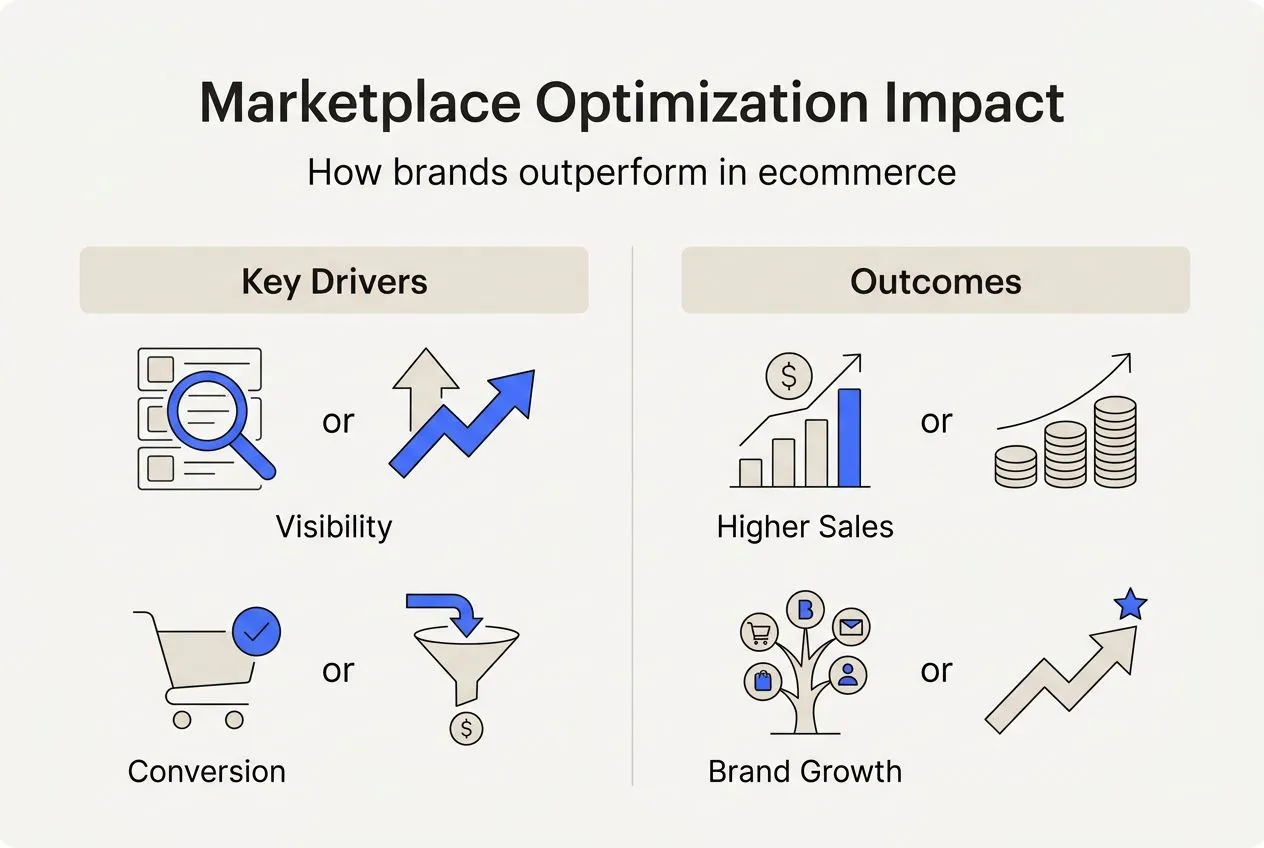
Ecommerce brands often assume that great products automatically translate into strong marketplace performance. Yet data reveals a different story: Best Choice Products achieved a 50% increase in total sales revenue through strategic marketplace optimization alone. The difference between mediocre and exceptional marketplace results rarely comes down to product quality. Instead, it hinges on how well you optimize listings, advertising, pricing, and customer engagement across platforms like Amazon, Walmart, and Shopify. This guide explains why marketplace optimization has become essential for ecommerce growth in 2026 and shows you exactly how to leverage it for measurable gains in conversions, ROAS, and revenue.
| Point | Details |
|---|---|
| Revenue impact | Marketplace optimization can drive up to 50% increases in total attributed sales revenue through strategic improvements. |
| ROAS improvement | Data-driven optimization strategies consistently deliver 20-30% improvements in return on ad spend. |
| Conversion gains | Focused optimization efforts typically yield 15-20% increases in marketplace conversion rates. |
| Platform specificity | Each marketplace requires tailored optimization approaches based on unique algorithms and customer behaviors. |
| Continuous testing | Sustained competitive advantage requires ongoing A/B testing and performance monitoring across all marketplace touchpoints. |
Marketplace optimization encompasses the systematic improvement of every element that influences your brand’s performance on ecommerce platforms. This includes refining product listings with compelling titles and descriptions, enhancing visual assets, calibrating pricing strategies, managing inventory levels, optimizing advertising campaigns, and cultivating positive customer reviews. The role of marketplaces in retail strategy has evolved dramatically, making optimization a critical driver of competitive advantage rather than an optional enhancement.

The business impact of marketplace optimization extends far beyond superficial improvements. Brands that commit to systematic optimization see measurable gains across three critical performance dimensions: Return on Ad Spend (ROAS), conversion rates, and total sales revenue. These metrics directly correlate with profitability and market share growth. When Best Choice Products partnered with Walmart Connect to optimize their marketplace presence, they experienced a 27% increase in ROAS alongside substantial gains in other key performance indicators.
The core components of effective marketplace optimization work together as an integrated system:
Successful optimization requires understanding that marketplace algorithms reward relevance, customer satisfaction, and conversion performance. Brands that optimize product listings for higher sales gain algorithmic advantages that compound over time, creating a virtuous cycle of improved visibility and increased conversions.
Marketplace optimization is not a one-time project but an ongoing discipline that separates market leaders from competitors struggling to gain traction.
The strategic value becomes clear when you consider that most ecommerce brands compete in saturated categories where product differentiation alone cannot guarantee success. Optimization creates competitive separation by ensuring your offerings appear prominently, communicate value effectively, and convert browsers into buyers at superior rates.

Ecommerce brands must track specific performance metrics to evaluate optimization effectiveness and guide strategic decisions. The three most critical KPIs are conversion rates, ROAS, and total sales revenue. Conversion rates measure how effectively your listings turn visitors into customers. ROAS quantifies advertising efficiency by comparing revenue generated against ad spend. Total sales revenue captures the overall business impact of your marketplace presence. Together, these metrics provide a comprehensive view of marketplace performance and highlight optimization opportunities.
Proven strategies for improving these metrics include:
The 70/20/10 resource allocation framework provides a disciplined approach to marketplace optimization. Allocate 70% of resources to proven tactics that consistently deliver results, 20% to promising experiments that could become new best practices, and 10% to innovative tests that might unlock breakthrough performance. This balanced approach ensures stability while maintaining the flexibility to capitalize on emerging opportunities.
Best Choice Products demonstrates the power of focused optimization efforts. Beyond their ROAS gains, they achieved a 17% increase in conversions by systematically improving listing quality and advertising precision. Their success illustrates how strategic resource allocation and disciplined execution compound to drive meaningful business outcomes.
| Metric Category | Primary KPIs | Optimization Levers |
|---|---|---|
| Conversion Performance | Conversion rate, add-to-cart rate | Listing quality, pricing, reviews, product imagery |
| Advertising Efficiency | ROAS, CPC, impression share | Targeting precision, bid strategy, creative testing |
| Revenue Growth | Total sales, average order value | Product assortment, cross-sell tactics, promotional strategy |
Pro Tip: Focus initial optimization efforts on your top 20% of SKUs by revenue, as improvements here typically deliver 80% of total performance gains while requiring less resource investment than optimizing your entire catalog.
Brands seeking to boost Amazon conversion rates should prioritize mobile optimization, as mobile traffic now represents the majority of marketplace sessions. Ensuring fast load times, clear product information hierarchy, and prominent calls to action on mobile devices directly impacts conversion performance across all major platforms.
Amazon, Walmart, and Shopify each present distinct optimization challenges and opportunities shaped by their unique algorithms, customer demographics, and seller tools. Understanding these platform-specific nuances enables brands to customize strategies rather than applying generic tactics that underperform across different marketplaces.
Amazon’s A9 algorithm prioritizes product titles, backend search terms, and customer reviews when determining search rankings. Success on Amazon requires meticulous keyword research, comprehensive product catalogs with detailed attributes, and aggressive review generation programs. The platform’s massive customer base and sophisticated advertising tools make it ideal for brands seeking maximum reach, but intense competition demands constant optimization to maintain visibility.
Walmart emphasizes price competitiveness and product availability in its ranking algorithm while offering less saturated categories than Amazon. The platform attracts value-conscious shoppers who prioritize fast shipping and competitive pricing. Walmart’s advertising platform provides strong ROAS potential for brands willing to invest in sponsored products and display ads. The Q4 ecommerce strategy guide highlights how Walmart’s unique positioning creates opportunities during peak shopping seasons.
Shopify operates differently as a direct-to-consumer platform where brands control the entire customer experience. Optimization focuses on website user experience, page load speed, checkout flow, and integrated marketing campaigns across email, social media, and paid advertising. Shopify enables deeper customer relationships and higher margins but requires more sophisticated marketing capabilities than marketplace selling.
| Platform | Primary Algorithm Focus | Key Optimization Priorities | Ideal Brand Profile |
|---|---|---|---|
| Amazon | Keyword relevance, conversion history | Product titles, backend keywords, reviews, A+ content | Established brands seeking maximum reach |
| Walmart | Price competitiveness, availability | Competitive pricing, inventory levels, sponsored products | Value-focused brands with strong logistics |
| Shopify | User experience, marketing integration | Site speed, checkout optimization, email/social campaigns | DTC brands building customer relationships |
Best Choice Products’ 50% increase in total sales revenue resulted partly from recognizing Walmart’s unique characteristics and tailoring their approach accordingly. They emphasized competitive pricing and strategic advertising rather than simply replicating their Amazon tactics.
Pro Tip: Implement platform-specific A/B testing programs to identify which optimization tactics deliver the strongest results on each marketplace, as best practices often vary significantly across platforms.
Successful multi-platform brands develop distinct optimization playbooks for each marketplace while maintaining consistent brand messaging and product quality. This balanced approach maximizes total marketplace revenue without diluting brand identity or operational efficiency.
Transforming marketplace optimization from concept to reality requires a structured implementation approach that prioritizes high-impact activities while building sustainable processes for continuous improvement. Begin with a comprehensive audit of your current marketplace presence across all platforms where you sell.
Your audit should evaluate:
After completing your audit, prioritize optimization opportunities based on potential impact and required resources. Quick wins like correcting listing errors or adjusting obviously inefficient ad bids should be addressed immediately. Larger initiatives such as comprehensive product photography or advertising strategy overhauls require careful planning and phased rollouts.
Data analytics form the foundation of effective optimization. Establish clear baselines for key metrics before implementing changes, then track performance continuously to measure impact and identify new opportunities. Modern analytics platforms enable granular analysis of customer behavior, competitive dynamics, and campaign performance. Brands that leverage these insights consistently outperform competitors relying on intuition or outdated data.
Continuous A/B testing accelerates optimization by providing empirical evidence about what works. Test product titles, main images, pricing strategies, ad copy variations, and promotional tactics systematically. Even small improvements compound over time when applied across large product catalogs or significant ad budgets. Crafting compelling ecommerce ads becomes more effective when informed by testing data rather than assumptions.
Competitor analysis reveals emerging opportunities and threats before they impact your performance. Monitor competitor pricing changes, new product launches, promotional strategies, and review patterns regularly. This intelligence informs proactive adjustments rather than reactive scrambling after market share declines.
Pro Tip: Partner with specialists offering expert creative services to elevate product photography, videography, and listing design beyond what internal teams can typically achieve, as visual presentation directly impacts conversion rates across all marketplaces.
The Best Choice Products case study demonstrates how disciplined execution of optimization fundamentals delivers measurable business results. Their success resulted from systematic implementation rather than sporadic efforts or reliance on single tactics. Brands seeking to maximize PPC efficiency should study their approach to integrated optimization across listings, advertising, and pricing.
Sustaining optimization momentum requires embedding it into regular business processes rather than treating it as a special project. Establish weekly or monthly optimization reviews, assign clear ownership for different marketplace functions, and create feedback loops that translate performance data into actionable improvements. This operational discipline separates brands that achieve temporary gains from those building lasting competitive advantages. The optimizing ad spend case study illustrates how systematic optimization drives profitability even in highly competitive markets.
Marketplace optimization demands specialized expertise across creative development, advertising strategy, and platform-specific tactics. Nectar delivers comprehensive ecommerce services tailored to brands selling on Shopify, Amazon, and Walmart. Our approach combines high-impact creative assets with data-driven advertising strategies to transform underperforming listings into revenue-generating storefronts.


Our proven track record includes helping brands achieve breakthrough performance through integrated optimization. The Shopping Trip Shopify case study demonstrates how our strategic approach drives conversions and customer engagement. We offer end-to-end ecommerce creative services including professional photography, videography, and listing design that elevate brand presentation across all marketplaces. Our proprietary iDerive analytics platform provides the granular insights mid-sized and enterprise brands need to make informed optimization decisions and maximize long-term ROI. Explore our full range of profitable brand growth services to discover how Nectar can accelerate your marketplace success in 2026.

Marketplace optimization is the systematic process of enhancing product listings, advertising campaigns, pricing strategies, and customer engagement tactics on platforms like Amazon, Walmart, and Shopify to increase sales and return on investment. It involves continuous testing, analyzing key performance metrics such as conversion rates and ROAS, and tailoring approaches to the specific algorithms and customer behaviors of each marketplace. Effective optimization results in higher visibility, improved conversion rates, better advertising efficiency, and increased total sales revenue.
Most brands observe initial improvements within 2-4 weeks of implementing basic optimizations like correcting listing errors, improving product images, or adjusting advertising bids. More substantial gains from comprehensive optimization programs typically emerge over 8-12 weeks as algorithmic improvements compound and customer behavior patterns shift. Sustained optimization delivers cumulative benefits that continue growing over time, making it a long-term competitive advantage rather than a quick fix.
ROI varies based on starting performance levels and optimization scope, but data from successful programs shows ROAS improvements of 20-30% and conversion rate increases of 15-20% are achievable for most brands. Best Choice Products demonstrated the upper range of potential with a 27% ROAS increase, 17% conversion improvement, and 50% total sales revenue growth. Brands with significant optimization gaps often see even stronger initial returns, while already-optimized sellers achieve more modest but still meaningful gains.
Begin with your highest-revenue marketplace to maximize immediate business impact and develop optimization expertise before expanding to additional platforms. Once you establish effective processes and see measurable results on your primary marketplace, extend proven tactics to secondary platforms while adapting for platform-specific differences. This phased approach prevents resource dilution and builds organizational capabilities systematically rather than spreading efforts too thin across multiple platforms simultaneously.
Basic optimization is possible using native platform tools and manual processes, but specialized analytics platforms, keyword research tools, and competitor monitoring software significantly enhance effectiveness and efficiency. Advanced tools enable deeper insights, faster testing cycles, and more sophisticated optimization strategies that manual approaches cannot match. The investment in proper tools typically pays for itself through improved performance, especially for brands managing large catalogs or significant advertising budgets across multiple marketplaces.