{
"@type": "Article",
"image": {
"url": "https://csuxjmfbwmkxiegfpljm.supabase.co/storage/v1/object/public/blog-images/organization-10884/1775092624942_Woman-plans-ecommerce-strategy-at-kitchen-table.jpeg",
"@type": "ImageObject",
"caption": "Woman plans ecommerce strategy at kitchen table"
},
"author": {
"url": "https://thinknectar.com",
"name": "Thinknectar",
"@type": "Organization"
},
"@context": "https://schema.org",
"headline": "How seasonality shapes e-commerce strategy and sales",
"publisher": {
"url": "https://thinknectar.com",
"name": "Thinknectar",
"@type": "Organization"
},
"inLanguage": "en-US",
"articleBody": "",
"description": "Learn how seasonality drives 20-40% revenue swings in e-commerce and how to use it to optimize inventory, campaigns, and growth on Amazon, Walmart, and Shopify.",
"datePublished": "2026-04-02T01:17:13.542Z"
}
How seasonality shapes e-commerce strategy and sales
.webp)

E-commerce isn’t always on in the way many brands assume. Sales can swing by up to 40% between low and high seasons depending on your category, and brands that treat every month as equal are leaving serious revenue on the table. Seasonality is one of the most powerful and underused levers in digital retail. This guide breaks down what seasonality really means, how it reshapes consumer behavior, and what you can do right now to anticipate demand, protect margins, and run high-impact campaigns across Amazon, Walmart, and Shopify.
Key Takeaways
| Point | Details |
|---|---|
| Seasonality drives sales | Timely uplift or slowdown in ecommerce is directly tied to holidays, weather, and events. |
| Consumer behavior shifts | Shoppers’ priorities and search patterns evolve with the calendar and context. |
| Plan and adapt early | Effective inventory, marketing, and analytics planning is crucial for capitalizing on seasonal demand and avoiding missteps. |
| Analytics provide the edge | Advanced data tools help forecast, refine, and learn from every season’s performance. |
Why seasonality matters in ecommerce
Seasonality in e-commerce refers to predictable patterns in consumer demand tied to the time of year, holidays, weather cycles, and cultural events. It’s not a vague trend. It’s a measurable, recurring force that directly affects your revenue, inventory, and ad spend efficiency.
Online retailers can see 20-40% revenue swings due to seasonal shifts, and that variance compounds when you factor in increased competition and rising ad costs during peak periods. If you’re not planning for it, you’re reacting to it, and reacting is expensive.
Some categories feel this more intensely than others. Toys and games spike dramatically in Q4. Apparel surges during back-to-school and spring. Beauty brands see strong momentum in spring and summer launches. Even fragrance seasonality follows a clear pattern, with heavier scents trending in fall and winter. Tracking your seasonal sales metrics over time reveals these patterns with clarity.
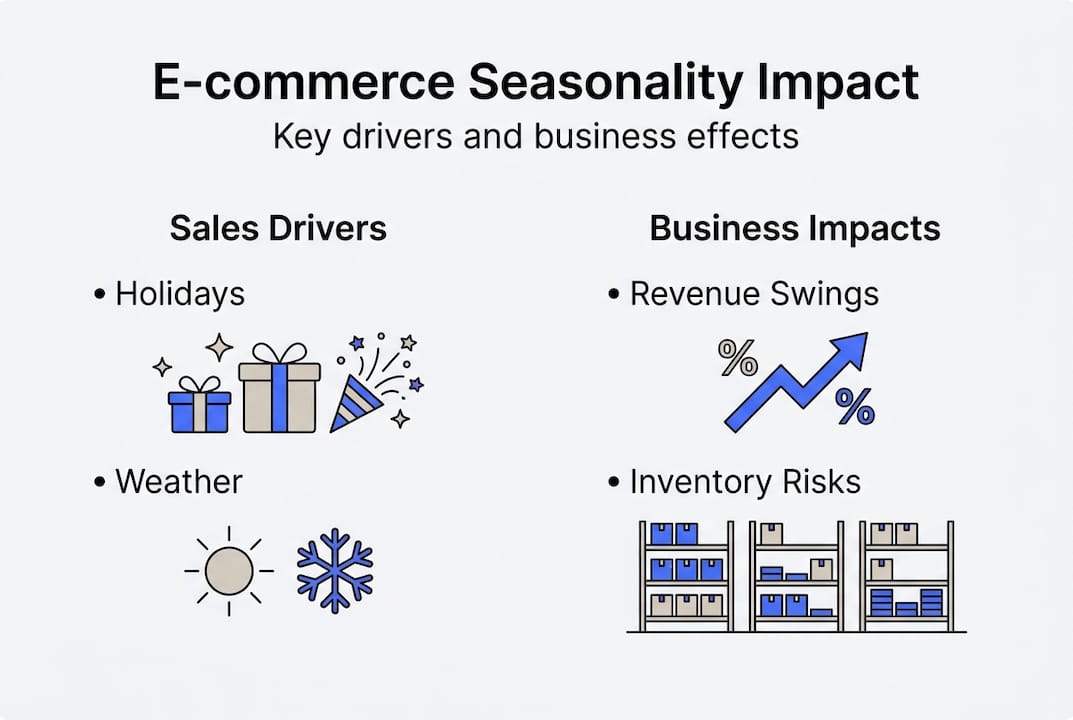
Main drivers of seasonality in e-commerce:
-
Major holidays (Christmas, Black Friday, Valentine’s Day, Mother’s Day)
-
School calendars (back-to-school, graduation, spring break)
-
Cultural and sporting events (Super Bowl, summer Olympics)
-
Weather patterns (winter apparel, outdoor furniture, sunscreen)
| Category | Peak season | Estimated sales uplift |
|---|---|---|
| Toys and games | Q4 (Oct–Dec) | 35–50% |
| Apparel | Back-to-school (Aug–Sep) | 20–30% |
| Beauty and skincare | Spring/Summer (Mar–Jun) | 15–25% |
| Outdoor and garden | Spring (Apr–May) | 25–40% |
| Electronics | Q4 and Prime Day | 30–45% |
These aren’t just interesting numbers. They represent the difference between a profitable quarter and a missed opportunity. Brands that understand their category’s seasonal curve can plan campaigns, stock inventory, and allocate ad budgets with precision instead of guesswork.
How seasonality shapes consumer behavior
Understanding the scale of seasonal swings is important, but it’s just as critical to dig into how and why customers change what, how, and when they buy.
Consumer mindset shifts dramatically throughout the year. In Q4, shoppers are in gifting mode, prioritizing value, speed, and trust. In January, they pivot to self-improvement, driving demand for fitness, wellness, and organization products. Summer unlocks outdoor purchases, travel gear, and entertaining essentials. These aren’t subtle shifts. They’re category-defining moments.
Search behavior reflects this clearly. Holiday-related keywords surge weeks before peak dates. Urgency-driven queries like “same-day delivery” and “last-minute gift” spike in the final days before major events. Retailers need to monitor shopping behavior shifts through digital analytics to anticipate changing demand before it peaks, not after.
Behavioral triggers that drive seasonal buying:
-
FOMO (fear of missing out on limited-time deals or sold-out items)
-
Urgency created by countdown timers and flash sales
-
Cultural moments that create shared shopping motivation
-
Promotions that align with emotional purchase drivers (gifting, self-care, celebration)
“Ecommerce data reveals that holiday urgency can double conversion rates for gift categories.”
Leveraging ecommerce customer data allows you to build predictive models that flag when your audience is entering a buying mindset. Pair that with seasonal analytics strategies and you can align product recommendations, creative assets, and promotional offers with exactly what your customers are ready to buy.
The brands that win aren’t just reacting to seasonal demand. They’re engineering it by showing up with the right message, at the right moment, on the right platform.
Inventory and operations: Adapting to seasonality’s demands
Seasonal demand doesn’t just impact marketing. It demands a nimble approach to inventory and fulfillment.

Effective inventory management for seasonality can increase profits and reduce excess backstock, two outcomes that directly protect your margins. The challenge is knowing how much to stock, when to stock it, and how to move excess inventory after a season ends.
Two common approaches exist, and each has tradeoffs:
| Approach | Best for | Risk |
|---|---|---|
| Just-in-time inventory | Fast-moving categories with reliable suppliers | Stockouts if demand exceeds forecast |
| Pre-season bulk ordering | High-volume, predictable seasonal items | Overstock and storage costs if demand drops |
Most enterprise brands use a hybrid model, reserving bulk orders for proven top sellers and staying lean on new or trend-sensitive SKUs.
Steps to prepare operationally for peak and low seasons:
-
Audit last season’s sell-through rates and identify gaps
-
Forecast demand using historical sales data and market signals
-
Procure inventory with enough lead time to avoid rush shipping costs
-
Staff up or activate automation in seasonal operations to handle volume spikes
-
Monitor sell-through rates in real time and adjust promotions to clear slow movers
Pro Tip: Regional differences matter more than most brands realize. A winter coat campaign that works in Minnesota in October may underperform in Texas until December. Segment your campaigns and FBA inventory best practices by geography to reduce waste and improve conversion.
Maximizing revenue: Marketing strategies for every season
Once operations and inventory are aligned with anticipated demand, it’s time to maximize visibility and revenue with seasonal marketing programs.
The single biggest mistake brands make is starting too late. By the time peak season arrives, ad costs are already elevated, placements are competitive, and your creative hasn’t been tested. Marketers can time promotions for maximum impact by building promotional calendars six to eight weeks ahead of key dates and locking in fulfillment resources before the rush.
Top revenue-driving seasonal tactics:
-
Flash sales with countdown timers to drive urgency
-
Limited-edition seasonal bundles that increase average order value
-
Retargeting campaigns that re-engage shoppers who browsed but didn’t convert
-
Loyalty rewards tied to seasonal purchases to build repeat behavior
-
Early access offers for email subscribers ahead of public sales
Platform strategy matters too. Amazon Lightning Deals can drive massive short-term volume during Prime Day and Q4. Shopify’s theme customization lets you build immersive seasonal storefronts that reinforce your brand story. Walmart’s featured spots offer visibility to a value-conscious audience that responds strongly to seasonal promotions.
Your Q4 ecommerce strategy should be its own dedicated plan, not a footnote in your annual calendar. And your data-driven ecommerce growth approach should feed insights from each season into the next.
Pro Tip: A/B test your creative and copy during the two weeks leading into a peak event. Even small changes in headline framing or image style can produce meaningful conversion lifts when traffic is at its highest.
Tools and analytics: Predicting and learning from seasonal trends
To make these tactics truly work at scale, marketers need to turn to the right tools, platforms, and analytics.
Retailers rely on analytics to predict seasonal demand surges and optimize marketing spend before budgets are wasted. The key is knowing what to measure and when to act on it.
| KPI | Why it matters seasonally |
|---|---|
| Traffic by channel | Reveals which sources surge before peak periods |
| Conversion rate by week | Flags when urgency is driving purchase decisions |
| Cart abandonment rate | Identifies friction points during high-intent moments |
| Inventory turn rate | Signals whether stock levels match actual demand |
| Campaign ROI by period | Shows which seasonal tactics deliver real returns |
Machine learning tools are increasingly useful for demand forecasting. They can analyze years of sales history, external signals like weather and search trends, and real-time marketplace data to generate more accurate projections than manual methods alone. Platforms like WooCommerce analytics and enterprise ERP systems offer dashboards that surface these signals continuously.
Post-season analysis is just as important as pre-season planning. After each peak period, run a structured review: what sold, what didn’t, which campaigns overperformed, and where you left money on the table. These insights are the foundation for ecommerce analytics for seasonality that compound over time.
Why most brands underestimate seasonality—and what actually works
Here’s the uncomfortable truth: most brands treat seasonality as a checklist item rather than a strategic discipline. They run a Black Friday promotion, maybe a back-to-school push, and call it seasonal planning. That’s not strategy. That’s calendar awareness.
The brands that consistently outperform their categories do something different. They treat every off-peak month as an opportunity to learn. They run experiments in low-traffic periods when the cost of failure is low. They build retrospective analysis into their operating rhythm so that last season’s data becomes next season’s competitive edge.
There’s also a mindset issue. Most teams focus intensely on peak season execution and then decompress afterward. But the window right after a peak is when your most valuable data is fresh. What did your best customers buy? What did they search for? What did they abandon? Those answers shape your next campaign.
Using data-driven ecommerce strategies year-round, not just during peaks, is what separates category leaders from brands that are always playing catch-up. Seasonality isn’t a sprint. It’s a cycle, and the brands that win are the ones who never stop learning from it.
Pro Tip: Invest in retrospective analysis as much as campaign planning. Your last-season learnings are your next season’s unfair advantage.
Accelerate seasonal growth with Nectar’s ecommerce services
Ready to leverage every season for maximum growth and profit?
At Nectar, we specialize in designing and executing seasonality-driven strategies for brands on Amazon, Walmart, and Shopify. From demand forecasting and inventory planning to campaign execution and analytics dashboards powered by our iDerive platform, we give mid-sized and enterprise brands the tools and expertise to turn seasonal peaks into sustained growth.

Whether you’re preparing for Q4, optimizing a spring launch, or building a year-round seasonal playbook, our ecommerce growth services are built to deliver results. Explore our Amazon optimization and Shopify strategies to see how we can help you capture more revenue in every season.
Frequently asked questions
How can I identify which products are most affected by seasonality?
Analyze your sales data over the past several years to find patterns in spikes or drops that align with holidays, weather, or key retail events. Seasonal demand analytics make these patterns far easier to spot and act on.
What’s the biggest operational risk of ignoring seasonality?
Ignoring seasonality risks inventory shortages, missed sales windows, or costly overstocks that erode profit margins. Effective inventory management during high seasons directly protects your bottom line.
What tools help forecast seasonal e-commerce demand?
Analytics dashboards, ERP systems, and AI-based forecasting tools can track historical trends and predict future demand with strong accuracy. The right ecommerce analytics platform surfaces these signals before you need to act on them.
How early should you start planning for peak sales seasons?
Begin strategy and inventory planning three to six months ahead to secure products and develop effective campaigns. Planning ahead of peak seasons is the single most reliable way to maximize results when demand arrives.
Recommended