Streamline your creative content process for results
.webp)

TL;DR:
Disjointed e-commerce creative workflows lead to profit leaks, but data-driven and AI-enhanced processes can improve ROI.
Building strong infrastructure, clear roles, and performance metrics aligned with revenue enables scalable, high-impact content production.
Disjointed creative workflows are one of the biggest profit leaks in e-commerce marketing, and most teams don’t see it until a quarter goes sideways. Briefings get lost in email threads, review cycles spiral, assets publish without performance benchmarks, and the whole thing repeats. The irony is that data-driven buyer intent mapping and hybrid AI/human workflows deliver measurable creative ROI, yet most mid-sized and enterprise brands still operate on ad hoc processes built for smaller teams. This guide walks you through exactly what to put in place, step by step, to build a content creation engine that produces high-converting assets at scale.
Key Takeaways
| Point | Details |
|---|---|
| Foundation matters | Success starts with the right team structure, frameworks, and tools aligned to your growth goals. |
| Velocity plus quality | Best-in-class creative teams blend AI, SOPs, and human expertise to ship impactful content at scale. |
| Measure what counts | Tie creative ROI to revenue and conversions, not just traffic or volume. |
| Optimize relentlessly | Regularly review, revise, and prune content based on performance data every three to six months. |
What you need before you start: Setting the foundation
Before you overhaul your approach, it’s essential to lay the right groundwork. The top e-commerce teams don’t just hire more creatives and buy more tools. They build deliberate infrastructure that connects creative output to business outcomes before a single brief is written.
Clarify your team structure first. The in-house versus agency decision shapes everything downstream. In-house teams offer speed and brand intimacy. Agency partners offer scale, specialized skill sets, and often access to better E-commerce marketing strategies tooling. For most enterprise brands, the answer is a hybrid: a core in-house team handles strategy and review while an agency manages volume production. Either way, every team needs clearly defined roles: creative lead, content strategist, copywriter, designer, and data analyst at minimum.
Balance your content portfolio across the funnel. Balancing portfolio stages like discovery, evaluation, decision, and post-purchase, along with topic clusters, is the structural backbone for authority and engagement. Too many brands stack up bottom-funnel product content while ignoring the discovery and evaluation stages where future buyers actually make up their minds. Map your existing asset inventory against these stages and identify the gaps.
Here’s a simplified breakdown of the content types your portfolio should include at each stage:
| Funnel stage | Content types | Primary KPI |
|---|---|---|
| Discovery | Blog posts, social video, brand story | Impressions, reach |
| Evaluation | Comparison guides, reviews, A+ content | Time on page, return visits |
| Decision | PDPs, bundles, promo assets | Conversion rate, add-to-cart |
| Post-purchase | Email flows, unboxing content, loyalty | Repeat purchase, LTV |
Set up your core tools before production begins. You need an editorial calendar that the whole team can see and update in real time. You need templates for briefs, scripts, and review checklists. You need AI platforms for ideation and drafting acceleration. And you need an analytics dashboard that connects content activity to actual sales data, not just traffic.
Pro Tip: Before buying new tools, audit what you already have. Most enterprise stacks are underutilized. Many teams have access to robust analytics capabilities inside their existing platforms and never configure them for content attribution.
The data-driven creative strategies that separate top performers from the middle of the pack always start with this foundation work. Original research, proprietary data, and topic cluster planning are what build lasting authority and keep organic traffic compounding over time. Get these structures in place before you build velocity.
Step-by-step creative content creation process
With your foundation in place, you can execute a repeatable, scalable creation process at the speed today’s e-commerce demands. The best creative teams don’t wing it. They run a tight, documented process that allows for speed without sacrificing quality.
Here’s the production sequence that high-output teams use:
-
Buyer intent mapping. Before any brief is written, map the search queries, review language, and competitor gaps that define what your audience actually wants at each funnel stage. This is where AI tools earn their keep: pulling patterns from large datasets quickly.
-
Brief creation. A complete brief includes the target audience, funnel stage, primary keyword or message, format, visual direction, required claims, and the specific business goal the asset supports. Vague briefs are the single biggest source of revision waste.
-
Scripting and asset creation. Writers and designers work from the brief. AI drafts accelerate first versions, especially for product description pages and ad copy. Human writers refine for tone, accuracy, and conversion focus.
-
Internal review. A designated reviewer (not the creator) checks against the brief, brand guidelines, and compliance requirements. This step should take no more than 24 hours with a proper checklist.
-
QA and final approval. Quality assurance checks all technical specs: image dimensions, copy character limits, link integrity, mobile rendering. A final sign-off from the creative lead closes the loop.
-
Publish and tag. Every asset goes live with proper UTM tagging or tracking parameters so performance data flows back to your attribution model immediately.
-
Measure and iterate. Performance data at 7, 30, and 90 days informs the next production cycle. Assets that underperform get flagged for revision or removal.
The velocity point here matters. Top teams ship 50 to 70 creatives per week using a hybrid AI/human model, and this throughput is only possible with tight SOPs at every stage. Without documented processes, every new creative project starts from scratch, which is a hidden tax on your team’s time and focus.

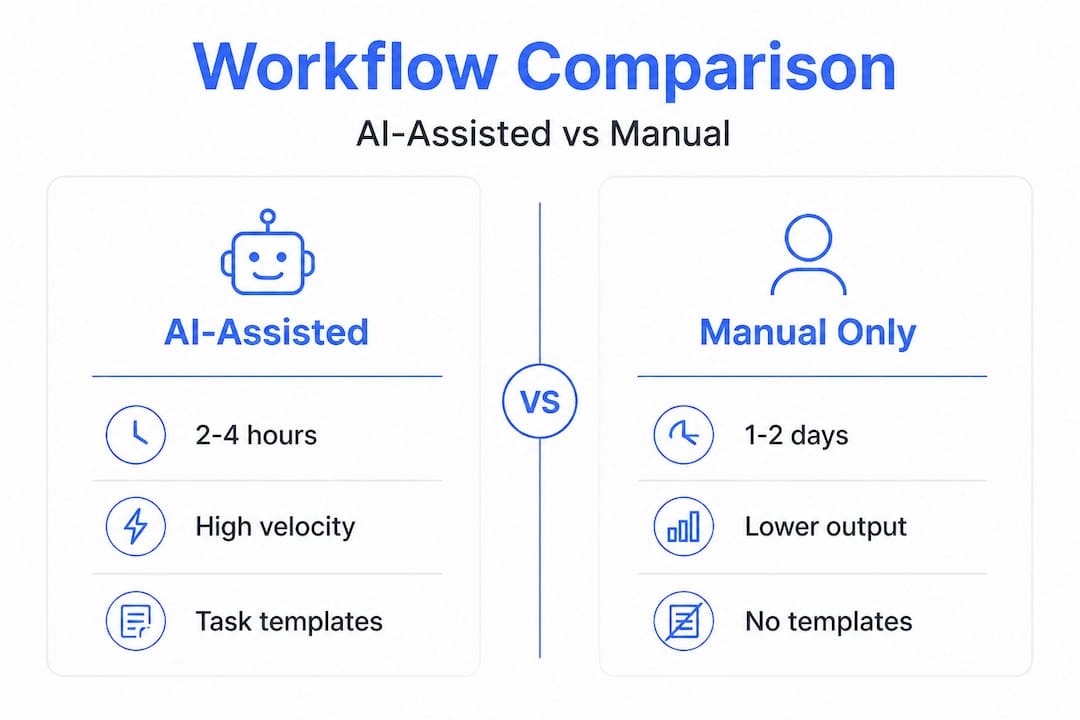
Here’s a quick comparison of AI-assisted versus fully manual workflows:
| Workflow element | AI-assisted | Manual only |
|---|---|---|
| First draft speed | 2 to 4 hours | 1 to 2 days |
| Consistency | High (template-driven) | Variable |
| Human review required | Always | Always |
| Best for | Volume, repetitive formats | Complex brand narratives |
| Risk | Generic output without oversight | Bottlenecks at scale |
Review our e-commerce creative services checklist to validate whether your current process covers every required production step. It’s easy to miss critical quality gates when volume increases.
Pro Tip: Build your SOP documentation directly into your project management tool as task templates. This way, the process is enforced by the system, not just remembered by individuals. Teams that do this cut onboarding time for new creatives by 40% or more.
Understanding the full range of types of ecommerce content also helps you diversify your production mix and avoid the common trap of over-indexing on a single format, such as static images, while ignoring video and interactive content that often converts at a higher rate.
Common pitfalls and troubleshooting for content teams
Even with strong systems, common missteps can sap ROI. Leading creative directors aren’t necessarily the ones with the biggest budgets or the largest teams. They’re the ones who systematically eliminate the friction points that slow output and dilute impact.
The volume trap. Chasing raw asset count is a seductive KPI because it feels productive. But quality vs. volume tension is real. Publishing 200 mediocre assets produces less return than publishing 50 tightly crafted, data-informed ones. The brands that win at scale combine volume with a rigorous quality floor, which is why the review and pruning steps in your process are not optional.
The most common pitfalls to watch for include:
-
Over-reliance on AI output. AI-generated drafts that go live without human review often lack specificity, miss brand voice, and sometimes include factual errors. Every AI-generated asset needs a human pass before it touches your product pages or ad accounts.
-
Under-reliance on data. Teams that create by gut instinct and never look at which assets actually drive conversion are flying blind. Regular performance reviews are non-negotiable.
-
Siloed teams. When creative, marketing, and performance advertising teams don’t share data and goals, assets get made that look great but are built around the wrong message for the wrong audience.
-
Unclear metrics. If every stakeholder has a different definition of “success” for a content initiative, you’ll never build consensus around what to produce next or what to cut.
“Regular review and pruning of content, combined with a clear distinction between in-house speed and agency scale, is what keeps creative operations from becoming a liability instead of an asset.”
When conversion impact stalls, resist the instinct to just produce more. Instead, audit your last 30 days of assets against performance data. Look at which funnel stages are underperforming. Check whether your top-performing formats from six months ago are still delivering at the same rate. Markets shift, algorithms update, and creative fatigue sets in faster than most teams expect.
The decision to invest in branded content is also informed by understanding where your current content is failing. Original, brand-specific content consistently outperforms generic category content on both trust and conversion metrics, especially on Amazon and Walmart where differentiation is harder to achieve through product alone.
Pairing content optimization with data-driven advertising strategies closes the loop between organic and paid creative, which is where attribution clarity often breaks down for growing brands.
How to verify, measure, and optimize creative content performance
Measuring and optimizing are what separate creative busywork from strategic, profitable content operations. Most teams measure traffic. The best teams measure revenue.
Effective brands measure beyond traffic to attribute content directly to revenue outcomes and refresh data every 3 to 6 months to keep the portfolio relevant and high-performing. This requires both the right KPIs and the right reporting infrastructure.
| KPI | What it measures | Review cadence |
|---|---|---|
| Conversion rate by asset | Direct impact on purchase | Weekly |
| Cost per creative | Production efficiency | Monthly |
| Revenue attribution | Business value of content | Monthly |
| Engagement rate | Audience resonance | Weekly |
| Return on ad spend (ROAS) | Paid creative efficiency | Weekly |
Here’s the optimization sequence top teams run on a rolling basis:
-
Weekly performance pulls. Review conversion rate, ROAS, and engagement for all active assets. Flag anything underperforming against benchmarks.
-
Monthly deep reviews. Analyze which content formats, funnel stages, and product categories are driving the most revenue. Reallocate production resources accordingly.
-
Quarterly portfolio audits. Review every published asset against current performance data. Prune low performers. Refresh high-value pieces with new data or updated creative.
-
Annual strategy reset. Reconnect your entire content strategy to current business objectives, market conditions, and competitor positioning.
“The single most expensive mistake creative teams make is continuing to produce content without a feedback loop that connects to revenue. You end up optimizing for output instead of outcomes.”
Accurate advertising attribution for e-commerce ROI is what makes this measurement possible at scale. Without clean attribution, you can’t tell which assets are pulling their weight and which are draining budget. Setting up proper UTM structures, matching them to your CRM and ad platforms, and reviewing e-commerce performance metrics consistently gives your creative decisions a factual basis instead of a political one.
Why conventional content operations still miss the mark
Here’s the perspective that experience in this space makes unavoidable: most content operations at mid-sized and enterprise e-commerce brands are optimized for process compliance, not business outcomes. Teams build elaborate briefing templates, rigorous review queues, and detailed editorial calendars, and then wonder why the creative still doesn’t move the needle.
The process isn’t the problem. The metrics driving it are.
When your creative team’s success metric is “number of assets shipped” or “content calendar adherence,” you get exactly what you measure: volume with no accountability to revenue. The shift that actually changes results is forcing every asset decision back to a single question: what is this piece expected to do for revenue, and how will we know if it worked?
Tying creative metrics to revenue rather than traffic or engagement is the competitive edge that most mid-market and enterprise brands still underuse. It requires more uncomfortable conversations, because revenue attribution reveals which content investments are genuinely paying off, and which are just keeping teams busy.
The other underused lever at scale is original research. Brands that commission or conduct their own market studies, customer surveys, or proprietary data analyses create content assets that no competitor can replicate. It builds authority, generates press, earns backlinks, and gives your performance advertising team differentiated claims to work with. Yet most teams at this level still rely entirely on third-party data and category-level research.
Finally, consider the rigidity trap. Detailed process templates are valuable up to a point. Past that point, they become a substitute for judgment. The brands that consistently outperform their categories tend to run agile feedback loops: tight production sprints, rapid testing of new formats, and willingness to kill underperformers fast rather than defending past decisions. Boosting e-commerce ROI over the long term requires a creative culture that values learning from data more than it values defending a plan.
Want to accelerate your creative content results?
Implementing the frameworks above takes time, expertise, and the right production infrastructure. Nectar works with mid-sized and enterprise brands that are ready to move past piecemeal content production and into a fully integrated, revenue-focused creative operation.
Our e-commerce creative services cover every stage of the funnel, from discovery content to high-converting product detail pages, built around your specific marketplace and audience data. Our full creative studio handles photography, videography, design, and copy under one roof so your brand message stays consistent and your production velocity scales without sacrificing quality. If you’re ready to connect your creative process directly to measurable marketplace growth, we’d like to show you what’s possible.
Frequently asked questions
What are the must-have roles for a scalable creative content team?
A modern team requires a creative lead, content strategist, copywriter, designer, and data analyst. Balancing specialist and generalist roles improves creative efficiency, and flexible access to specialized freelancers or agency partners covers volume and skill gaps.
How often should content be reviewed or updated?
Review and refresh your entire portfolio every 3 to 6 months. A 3 to 6 month refresh cycle keeps your portfolio high-performing by pruning low performers and optimizing assets for new trends and algorithm changes.
What metrics prove the impact of creative content?
Beyond traffic, focus on conversion rate, cost per creative, and direct attribution to sales revenue. Content tied to ROI rather than vanity metrics gives leadership a clear picture of where creative investment is paying off.
How does AI fit into modern content creation?
AI accelerates ideation, drafting, and data analysis, but human oversight is non-negotiable for engagement and conversion impact. A hybrid AI/human workflow improves both efficiency and the quality of creative output at scale.
What sets high-ROI creative teams apart?
They align every asset with buyer intent, use performance data to guide revisions, and connect content efforts directly to revenue. Linking content to revenue goals rather than traffic or engagement metrics is the clearest differentiator between teams that grow and teams that just produce.
Recommended




































































.webp)