Marketplace SEO: Win on Amazon, Walmart, and Shopify
.webp)

TL;DR:
Marketplace SEO differs from traditional SEO by focusing on product visibility within platform-specific algorithms that prioritize conversion and operational performance over relevance and backlinks.
Success requires continuous optimization, cross-functional coordination, and strategic management of taxonomy, offer quality, and real-time performance signals.
Most e-commerce teams assume that what works for Google will translate neatly into marketplace success. Run keyword research, stuff those terms into your title, and watch the sales roll in. That assumption is costing brands real revenue. Marketplace optimization is the practice of improving product listing and seller page visibility inside a platform’s own internal search system, not Google’s. Amazon, Walmart, and Shopify each operate their own ranking engines with their own rules, and brands that fail to understand the distinction often invest heavily in the wrong levers.
Key Takeaways
| Point | Details |
|---|---|
| Marketplace SEO focus | It optimizes your products for search and sales within specific marketplaces, not Google. |
| Platform-specific factors | Factors like content quality, offer competitiveness, and performance history drive marketplace rankings. |
| Taxonomy matters | Product category placement is critical—one wrong move can bury your listing in search. |
| Continuous improvement | Marketplace SEO is not a one-time project, but an ongoing practice combining content, offer, and operational adjustments. |
Marketplace SEO explained: How it differs from traditional SEO
Traditional web SEO is built around one core objective: earn visibility in Google’s search results by winning on relevance, authority, and technical site health. The playbook is familiar. Create content, build backlinks, optimize page speed, and target informational keywords that attract organic traffic over time.
Marketplace SEO operates in a fundamentally different environment. When a shopper searches “wireless earbuds” on Amazon or Walmart, they are not looking for a blog post. They are ready to buy. That intent shapes everything about how these platforms rank products. Marketplace algorithms prioritize purchase outcomes, meaning conversion rates, fulfillment reliability, offer competitiveness, and sales velocity carry far more weight than keyword density or external link profiles.
The table below captures the most critical differences between the two disciplines:
| Factor | Traditional web SEO | Marketplace SEO |
|---|---|---|
| Primary search engine | Google, Bing | Amazon A9/A10, Walmart, Shopify search |
| Ranking signals | Links, content, technical health | Conversion, offer quality, performance |
| Content goal | Inform and attract traffic | Convert and drive purchase |
| Audience intent | Informational and commercial | High purchase intent |
| Key metrics | Organic traffic, impressions | Sales rank, conversion rate, BSR |
| Update frequency | Algorithm updates every few months | Near real-time performance signals |
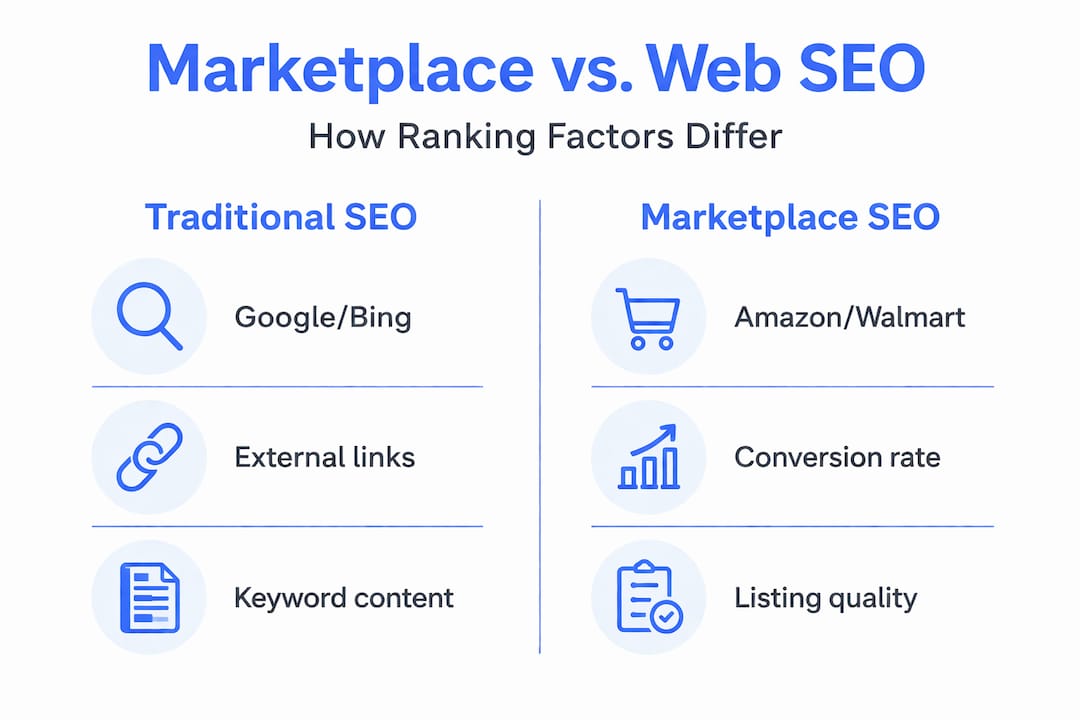
The structural gap between these two disciplines is also why brands that are strong on Google still struggle on marketplace roles in retail. The skills, data sources, and team structures needed for each are genuinely different. Understanding that is the first step toward building a strategy that actually works inside these platforms.
Key elements that are unique to marketplace SEO include:
-
Taxonomy mapping: Placing your product in the correct category within the marketplace’s classification system
-
Offer quality signals: Price competitiveness, shipping speed, and in-stock rate
-
Performance history: Click-through rate, add-to-cart rate, and purchase conversion
-
Listing content completeness: Titles, bullets, descriptions, and backend search terms structured around shopper intent
-
Seller and fulfillment metrics: Return rates, late shipment rates, and customer feedback scores
Each of these elements feeds the marketplace’s algorithm and influences whether your listing surfaces on page one or page ten.
Key elements that drive marketplace SEO performance
Once you understand how marketplace SEO differs from traditional web strategies, you can start building listings that actually move the needle. The ranking signals vary by platform, but the underlying logic is consistent: algorithms reward listings that convert shoppers efficiently and fulfill orders reliably.
Here is a breakdown of the primary ranking factors across the three major platforms:
| Platform | Core ranking factors | Unique signals |
|---|---|---|
| Amazon | Title, bullets, images, pricing, sales velocity | A9/A10 algorithm, backend search terms, Prime eligibility |
| Walmart | Content score, discoverability, offer, ratings/reviews | O-Score, Listing Quality Score (0-100) |
| Shopify | On-site search, category structure, product metadata | App integrations, theme structure, site speed |
Amazon places heavy emphasis on listing content quality paired with conversion performance. Amazon SEO strategies include optimizing titles and descriptions, improving image sets, and staying price-competitive. But here is what most teams underestimate: Amazon’s algorithm watches what happens after a shopper clicks. If your listing generates clicks but not purchases, that negative conversion signal actively hurts your ranking.
Walmart makes quality measurement more transparent. Walmart’s Listing Quality Score is a programmatic 0-100 score built across five explicit dimensions: Content, Discoverability, Offer, Ratings, and Reviews. You can query this score through Walmart’s API at both the catalog and item level. That kind of visibility is genuinely powerful for brands managing hundreds or thousands of SKUs because it turns a vague optimization goal into a measurable performance target.
Shopify operates differently from Amazon and Walmart. Its internal search depends more on metadata structure, collection architecture, and product tagging than on a sophisticated ranking algorithm. The opportunity on Shopify is ensuring that your listing optimization essentials are tight across all three channels so that your product content stays consistent and discoverable regardless of where shoppers land.
Follow these steps to make any listing more visible across marketplace platforms:
-
Start with keyword research specific to the platform. Tools like Helium 10 for Amazon or Walmart’s own search suggest data reveal how shoppers actually phrase their queries inside each marketplace, which differs from Google keyword data.
-
Build a title that balances readability with searchability. Lead with your brand name and primary keyword, follow with key product attributes like size, color, and material, and keep the full title under the platform’s character limit.
-
Write bullets that sell, not just describe. Each bullet should address a shopper concern or purchase driver, not just list features. Think about why someone would choose your product over the one listed next to it.
-
Invest in imagery. On both Amazon and Walmart, the main image drives click-through rate, which feeds directly into the ranking signal. On Shopify, image quality influences on-site engagement metrics that surface in collections.
-
Price competitively within your category. Marketplace algorithms favor listings that represent strong value relative to alternatives on the same page.
Pro Tip: Cross-reference your listing content against why listing optimization matters for your specific category. Generic keyword strategies often miss the nuanced shopper language that converts at the highest rates within a given product vertical.
Why taxonomy mapping and offer quality are marketplace game changers
Most brands spend the majority of their optimization time on copy and creative. Those matter. But two underappreciated factors often have a larger impact on visibility: getting your category placement right from the start, and maintaining the offer quality that algorithms reward.

Wrong taxonomy mapping can heavily penalize a listing’s visibility. On Walmart in particular, correct initial product mapping to the marketplace’s taxonomy is critical because the algorithm indexes and ranks products within their assigned categories. A supplement listed under “General Merchandise” instead of “Vitamins and Supplements” will be invisible to the shoppers most likely to buy it, regardless of how well-optimized the content is.
Common taxonomy mistakes and their consequences:
-
Using a broad parent category instead of the most specific subcategory: Reduces relevance signals and limits the algorithm’s ability to surface your product for targeted searches
-
Misclassifying product type during initial setup: Can be difficult to correct retroactively and may require re-listing the item entirely
-
Inconsistent category mapping across platforms: Creates catalog management complexity and makes performance analysis harder when you’re trying to diagnose ranking issues
-
Ignoring category-specific required attributes: Many categories on Amazon and Walmart have mandatory fields that, if left blank, cap your listing quality score regardless of how strong the copy is
Pro Tip: If you manage a large SKU catalog, Walmart’s Listing Quality Score and item-level quality metrics APIs are built precisely for this challenge. These APIs let your analytics team track quality dimensions across your entire catalog programmatically, so you can identify and prioritize the listings with the greatest opportunity impact rather than guessing.
Offer quality is the other side of this equation. Marketplace algorithms are not just evaluating your content. They are watching whether shoppers can actually get your product at a fair price, in a reasonable timeframe, in stock. The offer dimensions of Walmart listing optimization and similar frameworks on Amazon directly connect supply chain reliability to search visibility.
“The brands winning at marketplace SEO in 2026 are not the ones with the best copy. They are the ones whose content, pricing, inventory, and fulfillment are all optimized simultaneously.”
Offer quality signals that affect ranking include in-stock rate, competitive price position within category, shipping speed and Prime or TwoDay delivery eligibility, seller feedback score, and return rate. These are operational metrics, not marketing metrics. That distinction has major implications for how you staff and resource your marketplace program. Connecting your Amazon growth features strategy to your supply chain team is not optional. It is a ranking requirement.
Marketplace SEO as a continuous discipline: Beyond on-page tweaks
Many brands treat marketplace optimization as a project with a start and end date. Rewrite the listings, update the images, and move on to the next initiative. That approach will get you a temporary rankings bump at best. The platforms that matter most to your business, Amazon and Walmart especially, update their algorithms continuously based on real-time performance signals.
True marketplace SEO success requires what we call a continuous optimization loop, and it looks like this:
-
Audit your current listings against platform-specific quality standards. For Walmart, pull your Listing Quality Scores via API. For Amazon, review content scores in Seller Central and flag listings below threshold.
-
Prioritize by revenue impact. Not every listing deserves equal attention. Focus on your top revenue SKUs first, then address the items with the biggest gap between quality score and potential sales volume.
-
Make targeted content improvements. Update titles, bullets, or backend terms based on current keyword data. Avoid changing everything at once because you will lose the ability to attribute performance changes.
-
Monitor conversion and ranking changes. Give each change two to four weeks to settle into the algorithm before evaluating impact. Conversion rate, click-through rate, and organic rank are your primary signals.
-
Feed operational data back into the loop. If an item consistently loses the Buy Box or has a low in-stock rate, that information needs to flow back to your inventory and pricing teams, not just your marketing team.
-
Repeat on a defined cadence. Monthly audits for top SKUs, quarterly reviews for the broader catalog. Build this into your team’s operating rhythm, not as an exception but as standard practice.
Pro Tip: AI-powered Amazon SEO tools are evolving quickly in 2026. Platforms that surface real-time keyword opportunity and competitive gap data can significantly accelerate this loop. Pair them with your internal performance data for the most accurate picture of where to act. Also review Amazon SEO best practices for 2025 to benchmark your current approach against what the algorithm actually rewards.
The most important insight from Amazon’s own SEO guidance is that marketplace SEO is a combined discipline. It requires listing quality, offer strength, and operational performance to work together simultaneously. Focusing on just one dimension while ignoring the others will limit your ceiling regardless of how much effort you put in.
The uncomfortable truth most brands miss about marketplace SEO
Here is what we observe repeatedly across brands of all sizes: the companies that follow all the right tactical steps and still underperform on marketplace search share one common failure. They treat SEO as a marketing function when it is actually a cross-functional business discipline.
Content teams optimize copy without visibility into pricing decisions. Inventory teams manage stock levels without understanding how stockout events crater organic rankings. Analytics teams measure sessions and ad revenue but never connect those numbers back to listing quality scores or organic rank movement. Everyone is working in their own lane, and the algorithm sees the combined result of all those disconnected decisions.
Winning brands resource marketplace SEO differently. They connect marketing, supply chain, and data teams around shared marketplace performance goals. A great listing that regularly goes out of stock will consistently lose ground to an average listing with reliable availability. That is not a creative problem. It is an operational one.
The brands we see dominating competitive categories on Amazon and Walmart are not necessarily the ones with the most polished copy or the biggest ad budgets. They are the ones with the fastest feedback loops. They know within days when a ranking drops, they understand why, and they can act on it across content, offer, and operations simultaneously. Building toward better product listing strategies is the foundation, but the real competitive advantage is organizational responsiveness.
Ask yourself honestly: Is your team structured to detect ranking signals and respond across all three dimensions within a week? If the answer is no, that is your real marketplace SEO gap.
Take your marketplace SEO further with Nectar’s expertise
Marketplace SEO rewards brands that combine strategic content, operational discipline, and real-time analytics into a single integrated program. That is exactly what Nectar is built to deliver.

Nectar’s fully managed approach covers every dimension of marketplace performance, from listing creation and creative production to algorithmic monitoring and offer optimization, across Amazon, Walmart, and Shopify. Powered by the proprietary iDerive analytics platform, Nectar gives your team real-time visibility into listing quality, ranking changes, and conversion performance at the SKU level. If your brand is ready to move beyond one-time listing refreshes and build a marketplace SEO program that compounds over time, connect with Nectar to start with a diagnostic review of your current catalog performance.
Frequently asked questions
How is marketplace SEO different from traditional SEO?
Marketplace SEO focuses on optimizing product listings within platforms like Amazon or Walmart, targeting internal search and conversion-driven outcomes rather than broader Google search rankings. The ranking signals, tools, and team skills required are fundamentally different.
What are the top ranking factors for Amazon and Walmart product listings?
Core factors include listing content quality, offer competitiveness, category placement, and positive performance signals like ratings and fulfillment reliability. Amazon SEO strategies emphasize titles, descriptions, images, and pricing, while Walmart uses a multi-dimension O-Score and Listing Quality Score system.
Why does category or taxonomy mapping impact marketplace SEO so much?
Marketplace algorithms index and rank products within their assigned categories, so incorrect placement creates an immediate visibility penalty. Wrong taxonomy mapping can make a listing invisible to its most relevant shopper segments regardless of content quality.
How do you measure marketplace SEO performance over time?
Monitor search ranking, conversion rate, and offer quality alongside platform-specific tools. Walmart’s Listing Quality Score APIs provide catalog-level and item-level quality tracking directly mapped to search and merchandising objectives.
Recommended
-
Nectar Blog | Listing optimization checklist: Boost sales on Amazon, Walmart, Shopify
-
Nectar Blog | Walmart Marketplace best practices: optimize listings and sales
-
Nectar Blog | Marketplace Strategies: 70/20/10 Resource Split for 2025
-
Amazon Keyword-Integration: Sichtbarkeit und Umsatz steigern – BSR









































































.webp)