{
"@type": "Article",
"image": {
"url": "https://csuxjmfbwmkxiegfpljm.supabase.co/storage/v1/object/public/blog-images/organization-10884/1775272322378_Manager-reviewing-brand-positioning-in-workspace.jpeg",
"@type": "ImageObject",
"caption": "Manager reviewing brand positioning in workspace"
},
"author": {
"url": "https://thinknectar.com",
"name": "Thinknectar",
"@type": "Organization"
},
"@context": "https://schema.org",
"headline": "Brand positioning process: step-by-step guide for e-commerce",
"publisher": {
"url": "https://thinknectar.com",
"name": "Thinknectar",
"@type": "Organization"
},
"inLanguage": "en-US",
"articleBody": "Learn the step-by-step brand positioning process for e-commerce brands. From research to execution, discover how to stand out, win loyalty, and grow revenue.",
"description": "Learn the step-by-step brand positioning process for e-commerce brands. From research to execution, discover how to stand out, win loyalty, and grow revenue.",
"datePublished": "2026-04-04T03:12:13.250Z"
}
Brand positioning process: step-by-step guide for e-commerce
.webp)

TL;DR:
Effective brand positioning differentiates your brand from competitors, increasing revenue and customer loyalty.
Conduct thorough research on customers, competitors, and your brand to inform positioning strategies.
Positioning is an ongoing process requiring regular updates and alignment across all channels for success.
Most e-commerce brands lose customers not because their product is inferior, but because their message sounds identical to every competitor in the feed. When shoppers can’t distinguish your brand from three others in the same category, price becomes the only deciding factor. That’s a race you don’t want to win. Strong positioning correlates with higher revenue, repeat purchase rates, organic traffic, and ROAS improvements. This guide walks you through every phase of the brand positioning process, from foundational research to full-channel activation, so your brand earns the mental real estate that drives lasting, profitable growth.
Key Takeaways
| Point | Details |
|---|---|
| Frameworks simplify decisions | Using perceptual maps and clear positioning statements provides clarity for your brand and your team. |
| Research drives relevance | Regular customer, competitor, and brand audits are essential to effective positioning. |
| Execution is multi-channel | Operationalize your positioning across your website, content, search, and ad campaigns. |
| Adaptation prevents stagnation | Ongoing, evidence-based updates keep your brand relevant and ahead of the competition. |
Understanding brand positioning: Core concepts and frameworks
Brand positioning is the specific place your brand occupies in a buyer’s mind relative to alternatives. It’s not your tagline or your logo. It’s the answer to one question every shopper asks unconsciously: Why this brand and not the other one? Getting that answer right is the difference between a brand people seek out and one they scroll past.
To build that clarity, you need the right frameworks. Key methodologies include perceptual mapping, positioning statements, and value proposition frameworks. Each serves a different purpose, and knowing when to use which one saves significant time.
| Framework | Best used when | Output |
|---|---|---|
| Perceptual mapping | You need to visualize competitive gaps | A 2x2 grid showing brand clusters |
| Positioning statement | You’re aligning internal teams | A single-sentence strategic declaration |
| Value proposition canvas | You’re refining customer-facing messaging | A structured benefit and pain-point map |
Perceptual mapping plots your brand and competitors across two axes (for example, price vs. quality, or functional vs. emotional) to reveal white space. It’s a fast way to show leadership teams exactly where differentiation opportunities exist. A positioning statement, on the other hand, is an internal tool. It forces you to commit to a specific audience, category, benefit, and reason to believe in one sentence.
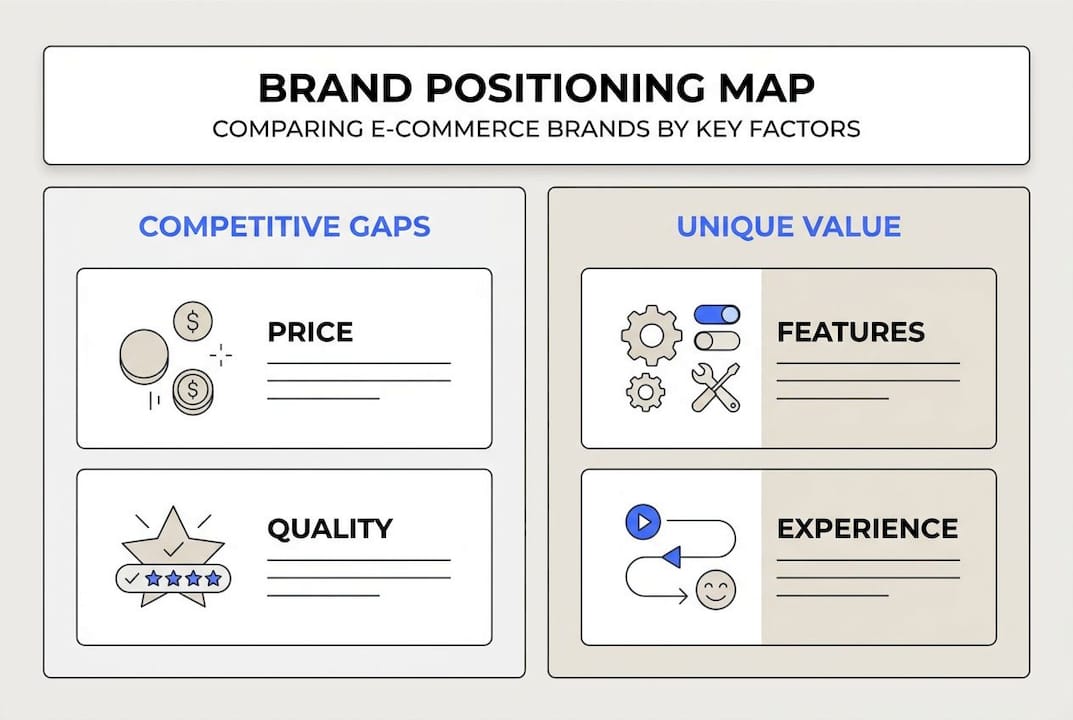
Points of Parity (POPs) are the table-stakes features your category demands. Points of Difference (PODs) are what make you the only logical choice. Strong brands don’t just maximize PODs. They strategically satisfy POPs while amplifying the one or two PODs that matter most to their core customer.
Here’s why this matters at scale. Brands with clear, differentiated positioning see measurable outcomes:
-
23% higher revenue growth compared to undifferentiated competitors
-
40% increase in organic site traffic driven by consistent brand signals
-
Higher customer lifetime value through reduced price sensitivity
-
Stronger ROAS because ad creative aligns with a single, clear message
For deeper context on how narrative connects to positioning, the brand storytelling guide from Nectar is worth reviewing. Positioning and storytelling are two sides of the same coin. One defines the strategy; the other brings it to life. Brand positioning research from Harvard Business School reinforces that clarity of category and benefit is what drives consumer choice at scale.
Preparation: Research, insights, and market analysis
Once you grasp the theory, the next step is thorough research because strong positioning begins with hard data. Intuition about your customer is not enough. You need triangulated intelligence from three directions: your customers, your competitors, and your own brand.

HBS emphasizes a triad analysis covering consumers, company, and competitors. This structure prevents the common mistake of over-indexing on one source and building a position that doesn’t hold up in the market.
Here’s how to collect that intelligence in sequence:
-
Customer research: Run surveys, analyze reviews, and conduct interviews to map purchase motivations, language patterns, and unmet needs.
-
Competitor audit: Catalog competitor messaging, pricing tiers, creative tone, and category claims to identify gaps and overcrowded positions.
-
Internal brand audit: Assess your current perception through Net Promoter Score data, customer support logs, and repeat purchase behavior.
-
Secondary research: Pull category trend reports, search volume data, and social listening insights to validate primary findings.
-
Synthesis: Organize everything into a single executive summary that highlights perception gaps and differentiator opportunities.
Once collected, structure your insights into a clean data table for rapid executive review:
| Research area | Key question | Data source | Insight type |
|---|---|---|---|
| Customer personas | Who buys and why? | Surveys, CRM | Primary |
| Competitor messaging | What are rivals claiming? | Ad libraries, SEO tools | Secondary |
| Brand perception | How are we seen today? | NPS, reviews | Primary |
| Market demand | What’s growing fast? | Search trends, reports | Secondary |
For teams already using analytics to scale, the data-driven scaling framework and guidance on ecommerce data for ROI show how to operationalize this research into actionable strategy.
Pro Tip: Set a calendar reminder to repeat this research cycle every quarter. E-commerce category dynamics shift fast, and a positioning built on 18-month-old data can quietly become irrelevant without anyone noticing until revenue dips.
Execution: Crafting your brand positioning strategy and statement
With insights and frameworks in hand, here’s how to translate your findings into a potent positioning statement and actionable strategy.
Follow these steps in order:
-
Distill your insights into the top three customer pain points your brand solves better than anyone else.
-
Choose your strategic territory: Pick the single category frame where your PODs are strongest and most credible.
-
Articulate your POPs and PODs side by side so your team can see what you must match and what you must own.
-
Draft your positioning statement using a proven formula.
-
Pressure-test it against your research. Does it resonate with your core customer? Does it hold up against competitor claims?
-
Cascade it across every customer touchpoint: homepage headlines, product descriptions, ad copy, and email flows.
The positioning statement formula follows this structure: For [audience], [brand] is the [category] that [benefit] because [reason to believe]. It sounds simple. It’s not. Every word is a strategic choice.
Here’s a practical example for an e-commerce brand selling premium pet nutrition:
For health-conscious dog owners, BarkPure is the premium pet nutrition brand that delivers veterinarian-formulated meals because every recipe is backed by clinical feeding trials.
Notice what this statement does. It names a specific audience, stakes a category claim, articulates a clear benefit, and provides a reason to believe that competitors can’t easily copy.
Once your statement is locked, align your digital channels with it. Your homepage headline should echo the core benefit. Your SEO content should target the language your customers use to describe that benefit. Your brand storytelling should make the reason to believe feel real and human.
Pro Tip: Avoid over-differentiation. Brands that chase hyper-niche positions sometimes paint themselves into a corner where the addressable market is too small to sustain growth. Test your position against market size before committing.
For a broader brand positioning guide that covers advanced statement refinement, Brand Master Academy’s resource is a solid reference point.
Implementation and evaluation: Bringing positioning to life and measuring success
The final leg is successfully launching and verifying your new positioning strategy across every channel and touchpoint.
Rolling out a new position is not a single campaign launch. It’s a systematic update across every place your brand speaks:
-
Website messaging: Update hero copy, about pages, and product descriptions to reflect the new positioning language.
-
SEO and content: Align pillar content and metadata with the category language your positioning owns.
-
Paid campaigns: Rewrite ad creative to lead with your POD, not generic category claims.
-
Product experience: Packaging, unboxing, and post-purchase emails should all reinforce the same promise.
-
Customer service: Train support teams on the brand voice so every interaction feels consistent.
Once live, track these metrics to measure impact:
Strong positioning in e-commerce can deliver tangible results: +62% ROAS improvements and repeat purchase rates rising 22 to 35% within 12 months of consistent execution.
Beyond ROAS and repeat rates, monitor organic share of voice, branded search volume growth, and customer sentiment scores from review platforms. These are leading indicators that tell you whether the market is absorbing your new position before revenue numbers confirm it.
Common pitfalls to avoid:
-
Repositioning too rapidly, which confuses loyal customers and erodes hard-won brand equity
-
Failing to update all channels simultaneously, which creates a fragmented brand experience
-
Neglecting ongoing research, which lets the position drift out of alignment with market reality
For omnichannel growth tactics and ecommerce marketing tips that support positioning rollout, Nectar’s blog covers both in depth. Review your metrics quarterly and treat early warning signs as data, not failure. Adapt your execution without mutating your core brand DNA. The risks of repositioning are real, but so are the rewards when it’s done with discipline.
Pro Tip: Build a positioning scorecard with five to seven KPIs and review it in every quarterly business review. This keeps positioning visible at the leadership level, not buried in a brand guidelines document nobody reads.
Our perspective: Why brand positioning is a living, evolving asset in e-commerce
Most guides treat positioning as a deliverable. You do the research, write the statement, update the website, and move on. We think that’s the wrong mental model entirely.
Positioning is not static. It’s a direction requiring constant adaptation, with research prioritizing centrality and distinctiveness as market conditions shift. The fastest-growing e-commerce brands we work with don’t revisit positioning once a year. They treat it as a living system, testing messaging variants, monitoring competitor moves, and updating their perceptual maps every quarter.
The compounding effect of this discipline is significant. Brands that adapt their positioning with evidence and rigor build loyalty that’s genuinely hard for competitors to replicate. Brands that ignore it often experience a slow, quiet decline in market relevance that looks like a product problem but is actually a positioning problem.
If you’re serious about scaling, partnering with experienced e-commerce specialists who treat positioning as an ongoing practice rather than a one-time project is one of the highest-leverage decisions you can make.
Take your brand positioning to the next level with Nectar
Understanding the brand positioning process is one thing. Executing it consistently across Amazon, Walmart, and Shopify while managing campaigns, creative, and analytics is another challenge entirely.
Nectar’s fully managed approach covers every phase of the positioning journey, from research and strategy through creative production and channel activation. Our proprietary iDerive analytics platform gives your team the granular data needed to track positioning impact in real time. Whether you’re launching a new brand identity or repositioning an existing catalog, our growth services for brands and marketplace expansion services are built to translate strategic clarity into measurable revenue growth.
Frequently asked questions
What is the first step in the brand positioning process?
The first step is conducting thorough research on your target customers, competitors, and your own brand to map your current market landscape. HBS recommends analyzing all three factors simultaneously to avoid blind spots.
How often should an established brand revisit its positioning?
Revisit your positioning at least quarterly in fast-evolving markets, or annually for stable categories. Quarterly research is recommended for high-growth firms where category dynamics shift rapidly.
What are common mistakes in the brand positioning process?
The most common mistakes are repositioning too rapidly, losing brand equity, or failing to adapt to shifting customer needs. Repositioning risks are real when change is not gradual and evidence-based.
Which metrics track brand positioning success?
Key metrics include revenue growth, repeat purchase rates, organic traffic, and ROAS uplifts. Strong positioning correlates with measurable improvements across all four of these indicators.
Recommended