{
"@type": "Article",
"image": {
"url": "https://csuxjmfbwmkxiegfpljm.supabase.co/storage/v1/object/public/blog-images/organization-10884/1772862663355_image.png",
"@type": "ImageObject",
"caption": "Team reviewing Shopify growth analytics"
},
"author": {
"url": "https://thinknectar.com",
"name": "Thinknectar",
"@type": "Organization"
},
"@context": "https://schema.org",
"headline": "Shopify growth strategy steps for enterprise brands",
"publisher": {
"url": "https://thinknectar.com",
"name": "Thinknectar",
"@type": "Organization"
},
"inLanguage": "en-US",
"articleBody": "Learn proven Shopify growth strategy steps for mid-sized and enterprise brands. Data-driven tactics to scale sales, optimize performance, and avoid common pitfalls.",
"description": "Learn proven Shopify growth strategy steps for mid-sized and enterprise brands. Data-driven tactics to scale sales, optimize performance, and avoid common pitfalls.",
"datePublished": "2026-03-07T05:52:22.672Z"
}
Shopify growth strategy steps for enterprise brands
.webp)

Scaling a Shopify store beyond the initial success phase presents complex challenges for mid-sized and enterprise e-commerce brands. Many growth attempts stall despite increased marketing spend and operational effort, often due to fragmented execution and lack of data-driven strategy. This guide walks you through proven, actionable steps to build a sustainable Shopify growth engine tailored for larger brands. You’ll learn the essential prerequisites, step-by-step implementation tactics, common pitfalls to avoid, and realistic benchmarks to expect as you scale.
Key takeaways
PointDetailsPrerequisites matterAccess to Shopify Plus, analytics tools, established product-market fit, and budget for automation are essential before scaling.Cloud-native foundation accelerates growthBuilding cloud-native Shopify infrastructure delivers 20% faster implementations and reduces operational risk.Mobile optimization is criticalOver 80% of traffic comes from mobile devices, making page speed and Core Web Vitals non-negotiable for conversion.Lean app ecosystem drives performanceLimit apps to 6-15 specialized integrations to avoid performance degradation while supporting scalable growth.Automation boosts revenue significantlyPersonalized email and SMS campaigns can increase sales by up to 30% through improved retention and engagement.
Prerequisites: what you need before starting your Shopify growth journey
Before diving into execution, ensure you have the right foundation in place. Skipping this preparation phase causes most growth strategies to underperform or fail entirely.
Your brand needs access to Shopify Plus or an advanced Shopify plan that supports enterprise-level features. You’ll also require either in-house analytics expertise or a partner who can leverage ecommerce data for ROI. An established product-market fit with a loyal customer base provides the growth foundation necessary for scaling. Basic multi-channel infrastructure across social platforms and marketplaces should already be operational.
Budget allocation for marketing automation tools and app integrations is non-negotiable. Enterprise brands need ecommerce partners who understand these requirements and can execute efficiently. Without these prerequisites, you’ll waste resources fixing foundational issues instead of scaling.
Key requirements include:
Meeting these prerequisites minimizes operational risks and positions your brand for measurable growth. The perfect shopping trip experience starts with this solid foundation.
Step 1: build a data-driven cloud-native Shopify foundation
Your platform foundation determines how quickly and efficiently you can scale. Legacy lift and shift migrations create operational drag that stalls growth initiatives.

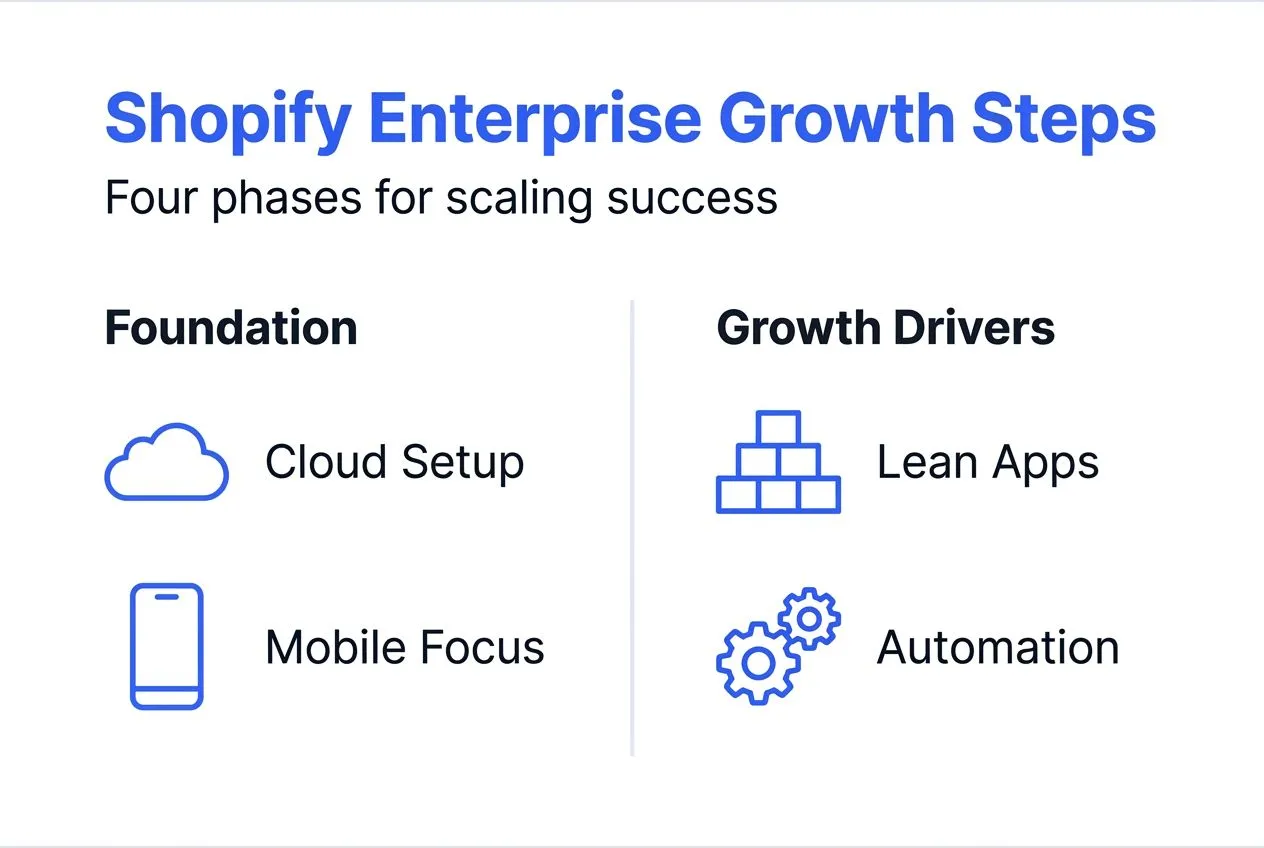
Cloud-native Shopify foundations complete implementations 20% faster compared to competitors, with better on-time and on-budget outcomes. This approach uses Shopify’s native APIs to enable seamless data integration across your tech stack. You gain real-time inventory visibility, unified customer data, and automated workflows that scale with your business.
Migration without platform modernization leads to stalled growth and technical debt. A cloud-native approach eliminates these bottlenecks from the start. Your team can focus on strategy and optimization instead of fighting infrastructure limitations.
Implementation priorities include:
“Relying solely on migration without platform modernization often leads to stalled growth and operational drag, requiring a comprehensive cloud-native Shopify growth strategy for success.”
This foundation becomes your competitive advantage. While competitors struggle with technical limitations, you’ll iterate quickly and scale efficiently.
Step 2: optimize mobile performance and core web vitals for user experience
Mobile dominates e-commerce traffic, yet many Shopify stores still treat it as secondary. This oversight kills conversions before customers even see your products.
Mobile devices accounted for over 80% of e-commerce traffic in 2025, making mobile optimization critical to reduce cart abandonment. Your Largest Contentful Paint (LCP) must stay under 2.5 seconds to prevent bounce rate spikes. Every tenth of a second matters when competing for customer attention.
Core Web Vitals including LCP, Cumulative Layout Shift (CLS), and First Input Delay (FID) directly impact user experience and conversion rates. Mobile-first theme selection, image optimization, and regular site speed audits become operational necessities, not nice-to-haves.
Critical optimization steps:
Pro Tip: Use A/B testing on mobile layouts to iterate quickly and identify conversion-killing friction points before they impact revenue.
Page Load TimeBounce RateConversion RateUnder 2 seconds15-20%Baseline (100%)2-3 seconds25-30%85-90%3-5 seconds40-50%60-70%Over 5 seconds60-70%30-40%
Brands like Souper Cubes demonstrate how mobile optimization transforms user experience and drives measurable revenue growth. Your Q4 strategy should prioritize these technical foundations before ramping marketing spend.
Step 3: leverage Shopify Plus features and a lean app ecosystem for enterprise growth
Shopify Plus unlocks enterprise capabilities, but success requires disciplined app management. Too many brands install apps reactively, creating performance issues that undermine growth.
Nearly 43,000 Shopify Plus stores operate globally, leveraging advanced automation and integrated marketing for large-scale growth. However, maintaining a lean stack of 6-15 specialized apps focused on inventory, reviews, and marketing automation scales conversion rates without complicating management.
Shopify Plus provides advanced features including wholesale channels, automation tools, and custom checkout experiences. Use these native capabilities before adding third-party apps. Every additional app introduces potential conflicts, slows your site, and creates maintenance overhead.
Prioritize apps in these categories:
Steps to maintain a lean, high-performing app stack:
Shopify Plus APIs enable custom workflows that replace multiple apps with single integrated solutions. This approach reduces complexity while improving performance and reliability.
Step 4: leverage automation and personalized marketing to drive revenue growth
Automation and personalization transform one-time buyers into loyal customers who drive predictable revenue. Manual marketing can’t scale to enterprise volumes while maintaining relevance.
Automated email and SMS campaigns increase store sales by up to 30% through enhanced retention and re-engagement. Behavior-triggered messaging based on browsing history, cart abandonment, and purchase patterns delivers personalized experiences at scale. Your customers expect this level of relevance in 2026.
Segment customers by purchase frequency, average order value, and product preferences. Use this data to trigger appropriate messaging through ecommerce email automation. Implement loyalty programs and referral incentives that reward repeat purchases and social sharing.
AI-powered tools within Shopify enable product recommendations, dynamic pricing, and personalized landing pages. These capabilities were enterprise-only features just years ago. Now they’re accessible to mid-sized brands ready to invest in growth infrastructure.
Key automation and personalization tactics:
Pro Tip: Start with three core automation workflows (cart abandonment, post-purchase, win-back) before expanding. Master these fundamentals, measure ROI, then layer in additional complexity based on data.
Your retention strategies should focus on increasing customer lifetime value, not just acquiring new buyers. These 2025 marketing tips remain relevant as foundational tactics in 2026.
Common mistakes and troubleshooting in Shopify growth strategies
Even well-planned growth strategies hit obstacles. Understanding common pitfalls helps you avoid costly setbacks and maintain momentum.
Mobile optimization neglect and excessive apps cause 60% and 45% of growth failures respectively, both harming user experience and conversions. These mistakes are preventable with consistent monitoring and disciplined decision making. Yet brands repeatedly prioritize feature additions over performance optimization.
Ignoring performance data and user behavior analytics stalls growth progression. You can’t optimize what you don’t measure. Overlooking omnichannel sales integration limits market share expansion when competitors are capturing customers across multiple touchpoints.
Common pitfalls and solutions:
“Neglecting mobile optimization leads to 60% of growth failures; excessive use of apps affects 45% of stores, both harming UX and conversions.”
Your Q4 strategy must account for these pitfalls before peak season arrives. Prevention costs far less than emergency fixes during high-volume periods.
Regular site audits, lean app management, user testing programs, and data monitoring create early warning systems. You’ll identify and fix issues before they impact revenue or customer experience.
Expected results and outcomes: Shopify growth benchmarks for mid-sized and enterprise brands
Realistic expectations prevent disappointment and help secure stakeholder buy-in for sustained investment. Growth takes time and consistent execution.
Measurable revenue increases occur within 6-12 months post-implementation with consistent execution of optimization, multi-channel marketing, and automation steps. This timeline aligns with data from successful Shopify enterprise deployments. In Q2 2025, Shopify’s GMV increased 30.7% year-over-year to $87.8 billion, demonstrating strong merchant sales growth potential with proper strategies.
Mobile optimization and automation strongly correlate with higher conversion rates across all product categories. Sustainable growth balances customer acquisition with retention strategies that maximize lifetime value. Data-driven, cloud-native foundations reduce implementation risks and support consistent scaling.
Your growth trajectory depends on execution quality, market conditions, and competitive intensity. These benchmarks represent achievable outcomes with disciplined strategy implementation.
TimelineExpected Revenue LiftConversion Rate ImprovementKey Drivers0-3 months5-10%0.2-0.5%Foundation building, quick wins3-6 months15-25%0.5-1.0%Automation deployment, mobile optimization6-12 months25-40%1.0-2.0%Full strategy maturity, channel expansion12+ months40-60%2.0-3.0%Sustained optimization, market share gains
Critical success factors:
These benchmarks assume proper prerequisites, disciplined execution, and adequate budget allocation. Brands cutting corners or expecting overnight results typically underperform these ranges.
How Nectar can help your Shopify growth journey
Implementing a comprehensive Shopify growth strategy requires specialized expertise and consistent execution. Nectar offers tailored services that transform these strategic steps into measurable results for mid-sized and enterprise brands.

Our proven track record includes successful transformations like building the perfect shopping experience and transforming Souper Cubes’ Shopify website to drive significant revenue growth. We combine data-driven strategy with high-impact creative services and sophisticated advertising to deliver profitable growth across Shopify, Amazon, and Walmart.
Partner with Nectar to achieve measurable sales growth and improved market share while minimizing implementation risk. Explore our services for profitable brand growth and discover how our proprietary iDerive analytics platform provides the granular insights needed to scale smarter and maximize long-term ROI.
FAQ
What is a cloud-native Shopify foundation and why is it important?
A cloud-native Shopify foundation means building your store using Shopify’s scalable cloud platform with native tools and APIs instead of legacy migration approaches. This architecture enables faster deployment, reduces operational risks, and supports sustainable scaling as your business grows.
How many apps should an enterprise Shopify store use for optimal growth?
Enterprise stores should maintain a lean app ecosystem with 6-15 specialized apps to avoid performance degradation and management complexity. Prioritize apps that support core functions like inventory management, marketing automation, customer reviews, and service integration while leveraging Shopify Plus native features wherever possible.
What timeline can brands expect to see measurable results from Shopify growth strategies?
Brands generally see measurable revenue growth within 6-12 months of consistent execution of Shopify growth strategies including optimization, automation, and multi-channel marketing. This timeline aligns with data-backed benchmarks from recent industry analyses and assumes proper prerequisites and disciplined implementation.
What are common pitfalls to avoid when scaling a Shopify store?
Neglecting mobile optimization causes 60% of growth failures, while overloading stores with too many apps affects 45% of brands, both harming user experience and conversions. Regular performance monitoring, quarterly app audits, and mobile-first design principles help prevent these costly mistakes and maintain growth momentum.
































































.webp)