{
"@type": "Article",
"image": {
"url": "https://csuxjmfbwmkxiegfpljm.supabase.co/storage/v1/object/public/blog-images/organization-10884/1774150733815_Marketer-reviews-digital-ad-campaign-results.jpeg",
"@type": "ImageObject",
"caption": "Marketer reviews digital ad campaign results"
},
"author": {
"url": "https://thinknectar.com",
"name": "Thinknectar",
"@type": "Organization"
},
"@context": "https://schema.org",
"headline": "What is dynamic ad targeting? Boost ecommerce growth",
"publisher": {
"url": "https://thinknectar.com",
"name": "Thinknectar",
"@type": "Organization"
},
"inLanguage": "en-US",
"articleBody": "Learn what dynamic ad targeting is and how it boosts ecommerce growth through automated personalization on Amazon, Walmart, Meta, and Google with expert strategies.",
"description": "Learn what dynamic ad targeting is and how it boosts ecommerce growth through automated personalization on Amazon, Walmart, Meta, and Google with expert strategies.",
"datePublished": "2026-03-22T03:38:56.016Z"
}
What is dynamic ad targeting? Boost ecommerce growth
.webp)

Dynamic ad targeting uses automation to personalize ads based on shopper behavior, and 76% of marketers report improved conversion rates when they implement it correctly. For ecommerce marketing managers at mid-sized to enterprise brands, mastering dynamic ad targeting on platforms like Amazon, Walmart, and Shopify can transform underperforming campaigns into high-converting revenue drivers. This article explains how dynamic ad targeting works across major platforms, shares actionable best practices for maximizing return on ad spend, and reveals expert nuances that separate top performers from average campaigns. You’ll learn how to leverage automation and customer data to deliver personalized ads that drive measurable ecommerce growth.
Key Takeaways
| Point | Details |
|---|---|
| Automation driven personalization | Dynamic ad targeting uses automation and shopper data to customize ads at scale. |
| Platform specific implementations | Amazon, Meta, Google, and Walmart offer distinct dynamic ad products tailored to their ecosystems. |
| Feed and bidding synergy | Pair dynamic ads with dynamic bidding and maintain clean up to date product feeds for best results. |
| Retarget high intent buyers | Retargeting shoppers who show high purchase intent with dynamic ads yields higher conversions. |
Understanding dynamic ad targeting and how it works
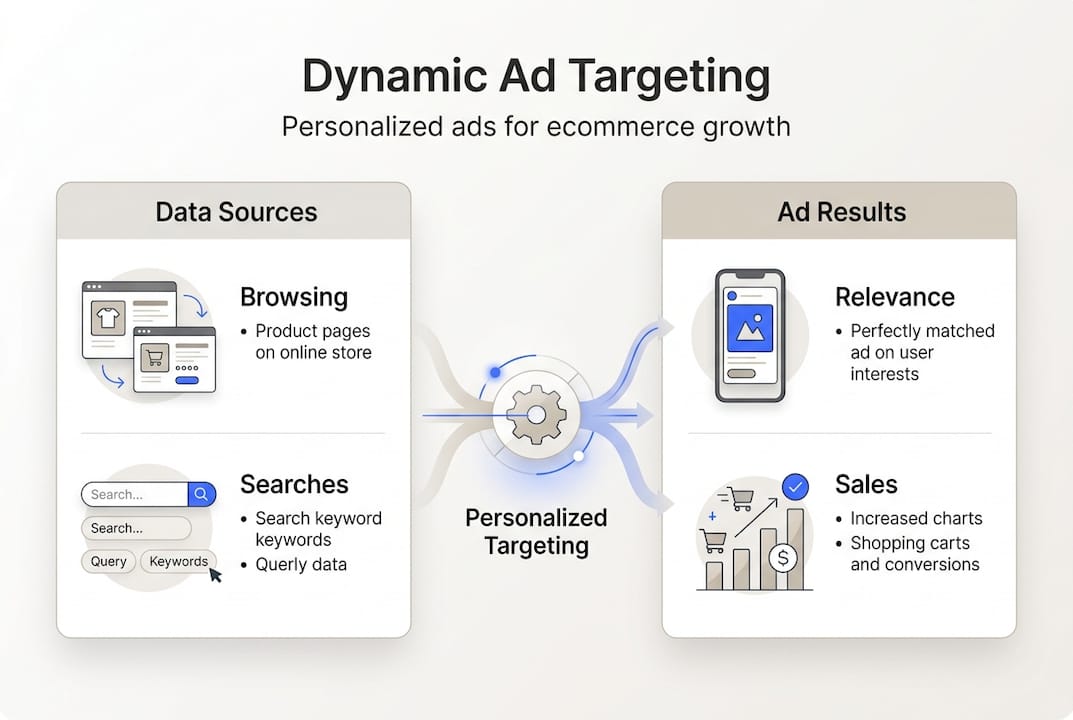
Dynamic ad targeting is an automated approach that customizes ads based on customer insights such as browsing history, preferences, and real-time actions. Instead of showing the same static ad to every user, this technology tailors creative elements, product selections, offers, and timing to match individual shopper behavior. The system pulls from customer data inputs to determine which products to display, what messaging resonates, and when to serve ads for maximum impact.

The mechanism works through continuous data processing. When a shopper browses products on your site or marketplace listing, that behavior feeds into the advertising platform’s algorithm. The system analyzes patterns like viewed items, cart additions, purchase history, and engagement signals. It then generates personalized ad experiences that reflect each user’s specific interests and stage in the buying journey. This level of customization happens automatically at scale, making it far more efficient than manual campaign management.
Key data inputs that power dynamic ad targeting include:
-
Browsing history showing which product categories and specific items users viewed
-
Shopping cart activity indicating high purchase intent for specific products
-
Past purchase behavior revealing preferences and replenishment opportunities
-
Engagement metrics like time spent on product pages or video views
-
Device and location data enabling contextual personalization
The benefits extend beyond simple personalization. Dynamic ad targeting delivers higher relevance scores on advertising platforms, which typically translates to lower cost per click and better ad placement. Compared to static ads that show identical creative to all users, dynamic ads adapt to individual preferences, resulting in higher click-through rates and conversion rates. While general ad retargeting shows ads to users who visited your site, dynamic targeting takes it further by customizing which products appear based on specific browsing behavior.
Pro Tip: Start with your highest-margin products when setting up dynamic ad campaigns. The improved conversion rates will offset learning period costs while you optimize feed quality and bidding strategies.
This automated personalization represents a shift in data-driven advertising for ecommerce growth, moving from broad audience targeting to individual-level customization. The technology handles complexity that would be impossible to manage manually, processing thousands of signals per user to deliver the right message at the right moment. Understanding this foundation prepares you to leverage platform-specific implementations effectively.
How major ecommerce platforms implement dynamic ad targeting
Each major advertising platform offers distinct dynamic ad products tailored to its ecosystem and user behavior patterns. Amazon uses Sponsored Products and Dynamic Product Ads, while Meta relies on DPAs primarily for retargeting, Google employs dynamic remarketing and display ads, and Walmart features AI-driven targeting through its demand-side platform. Knowing these differences helps you allocate budget strategically and set appropriate performance expectations.
Amazon’s Sponsored Products automatically promote individual listings based on shopper search queries and browsing behavior. The platform’s Dynamic Product Ads go further by showcasing personalized product recommendations across Amazon properties and third-party sites. These ads pull directly from your product catalog feed, displaying items that match each user’s demonstrated interests. The system continuously optimizes which products to show based on conversion likelihood and inventory availability.
Meta’s Dynamic Product Ads excel at retargeting shoppers who visited your Shopify store or engaged with your brand on Facebook or Instagram. The platform uses your product catalog to automatically generate ads featuring items users viewed but didn’t purchase. This creates highly relevant reminder ads that bring shoppers back to complete transactions. Meta’s algorithm also identifies similar products to cross-sell based on browsing patterns.
Google’s dynamic remarketing displays personalized ads across the Display Network and YouTube, showing products users previously viewed on your website. The system creates custom combinations of products, headlines, and descriptions tailored to each user’s interests. Google’s dynamic display ads extend this capability to prospecting campaigns, using machine learning to identify new audiences likely to convert based on behavioral signals.
Walmart’s demand-side platform leverages AI-driven targeting to reach shoppers both on Walmart.com and across premium publisher sites. The system analyzes purchase intent signals and shopping patterns to serve personalized product ads. Walmart’s closed-loop attribution provides detailed insights into how dynamic ads influence both online and in-store purchases.
| Platform | Primary Dynamic Ad Product | Best Use Case | Key Advantage |
|---|---|---|---|
| Amazon | Sponsored Products & DPAs | On-platform sales | Direct purchase intent targeting |
| Meta | Dynamic Product Ads | Retargeting website visitors | Cross-device reach and social proof |
| Dynamic Remarketing | Multi-touchpoint awareness | Massive display network scale | |
| Walmart | DSP Dynamic Targeting | Omnichannel campaigns | First-party retail data integration |
Feed quality directly impacts campaign effectiveness across all platforms. Inaccurate product information, missing images, or out-of-stock items create poor user experiences and waste ad spend. Inventory changes must sync quickly to prevent promoting unavailable products. Setting up your Amazon ads properly requires maintaining clean, comprehensive product feeds with accurate pricing, availability, and attributes.
Platform selection depends on your brand’s sales channels and customer journey. Amazon works best for brands with strong marketplace presence, while Meta excels for Shopify stores with visual products. Google provides broad reach for awareness campaigns, and Walmart suits brands selling both online and in physical retail. Many successful ecommerce brands use remarketing across multiple platforms to create coordinated touchpoints throughout the customer journey.
Best practices and expert nuances for effective dynamic ad targeting
Maximizing return on ad spend with dynamic targeting requires more than just turning on automation. Combining dynamic ad targeting with dynamic bidding and testing creative diversity prevents audience fatigue, while broad AI-driven targeting often outperforms manual segmentation strategies in 2026. These expert insights separate high-performing campaigns from mediocre results.
Feed quality forms the foundation of successful dynamic ad targeting. Incomplete product data, incorrect pricing, or missing attributes cause ads to display improperly or not at all. Invest time in comprehensive feed setup with detailed titles, descriptions, high-quality images, and accurate categorization. Update feeds in real time as inventory changes to prevent advertising out-of-stock items. Most platform errors trace back to feed issues, making this your first troubleshooting checkpoint.
Learning periods determine initial campaign performance, especially on Amazon and Walmart. These platforms require roughly 30 days of data collection before algorithms optimize effectively. During this window, maintain consistent budgets and avoid frequent changes that reset the learning process. Patience during the learning phase typically rewards you with improved performance as the system identifies your best-converting audiences and placements.
Follow this sequence for campaign setup and optimization:
-
Audit and optimize your product feed with complete, accurate data across all required fields
-
Start with broad targeting parameters and let AI identify high-intent audience segments
-
Implement dynamic bidding to automatically adjust bids based on conversion likelihood
-
Create multiple ad creative variations to test messaging, images, and calls to action
-
Monitor performance daily during the first two weeks, then shift to weekly optimization
-
Rotate creative assets every 3-4 weeks to prevent audience fatigue and declining engagement
-
Scale winning campaigns gradually by increasing budgets 20-30% weekly rather than doubling overnight
Creative rotation prevents ad fatigue, which occurs when audiences see the same ads repeatedly and stop engaging. Even high-performing creative loses effectiveness over time. Develop a content calendar that introduces fresh product images, lifestyle photography, and messaging angles regularly. This maintains engagement rates and prevents the performance decline that comes from overexposure.
Pro Tip: Broad targeting with AI optimization consistently outperforms narrow manual audience segmentation in 2026. Let algorithms process thousands of behavioral signals rather than limiting reach with restrictive targeting parameters.
Dynamic bidding amplifies targeting effectiveness by adjusting bids in real time based on conversion probability. When the system identifies a high-intent user, it automatically increases your bid to win the placement. For lower-intent users, it reduces bids to avoid overpaying. This optimization happens at an individual impression level, impossible to replicate manually. Pairing dynamic targeting with dynamic bidding creates a fully automated system that continuously improves efficiency.
Monitor return on ad spend closely as your primary success metric. ROAS tells you whether campaigns generate profitable revenue or waste budget. Set minimum ROAS thresholds based on your margin structure, typically 3:1 to 5:1 for most ecommerce brands. When campaigns fall below targets, investigate feed errors, creative fatigue, or bidding issues before making drastic changes. Many performance problems resolve with feed corrections rather than targeting adjustments.
Structuring your ecommerce ad budgets across platforms requires balancing testing with proven performers. Allocate 70-80% of budget to established campaigns with proven ROAS, reserving 20-30% for testing new platforms, audiences, or creative approaches. This balance maintains stable revenue while exploring growth opportunities. Apply these top ecommerce marketing tips to coordinate dynamic ad targeting with broader marketing initiatives for maximum impact.
Applying dynamic ad targeting to drive ecommerce growth: actionable tips and metrics to watch
Successful implementation requires tracking the right metrics and avoiding common pitfalls that undermine campaign performance. Mid-sized and enterprise managers should focus on product feed quality, 30-day learning periods, retargeting DPA usage on Meta and Shopify, and ROAS monitoring as keys to success. These priorities align with the strategic needs of brands operating at scale across multiple platforms.
Track these critical KPIs to measure dynamic ad targeting effectiveness:
-
Return on ad spend (ROAS) showing revenue generated per dollar spent on advertising
-
Click-through rate (CTR) indicating ad relevance and creative effectiveness
-
Conversion rate measuring the percentage of clicks that result in purchases
-
Cost per acquisition (CPA) revealing how much you spend to acquire each customer
-
Average order value (AOV) showing whether dynamic ads attract high-value customers
-
Customer lifetime value (CLV) demonstrating long-term profitability of acquired customers
Integrate dynamic targeting with retargeting strategies on Meta and Shopify for maximum impact. Use Dynamic Product Ads to re-engage cart abandoners with personalized reminders featuring the exact products they left behind. Layer in cross-sell opportunities by showing complementary products based on browsing history. This coordinated approach creates multiple touchpoints that guide shoppers toward conversion.
Common pitfalls reduce performance and waste budget. Feed errors top the list, causing ads to display incorrect products, prices, or availability. Implement automated feed validation to catch errors before they reach advertising platforms. Creative fatigue follows closely, with stale ads generating declining engagement over time. Establish creative refresh schedules to maintain performance. Budget instability during learning periods prevents algorithms from optimizing effectively, so maintain consistent spending for at least 30 days after launch.
| Metric | Target Benchmark | Expected Uplift with Dynamic Targeting |
|---|---|---|
| ROAS | 3:1 to 5:1 | 25-40% improvement vs. static ads |
| CTR | 1.5-3% | 30-50% higher engagement |
| Conversion Rate | 2-4% | 20-35% increase |
| CPA | Varies by margin | 15-25% reduction |
These benchmarks provide starting points for goal setting, though actual performance varies by industry, product category, and competitive landscape. Track performance against your own baseline rather than industry averages to measure true improvement. Focus on month-over-month trends showing whether optimizations drive sustained gains.
Implement sequential action steps to launch or improve campaigns. Start by auditing current feed quality and fixing any errors or missing data. Next, analyze existing campaign performance to identify opportunities for dynamic targeting implementation. Launch pilot campaigns on your highest-performing platform with proven best sellers. Monitor results daily for the first two weeks, then optimize based on data patterns. Scale successful campaigns gradually while testing new platforms or product categories with smaller budgets.
Develop a comprehensive Amazon advertising strategy that incorporates dynamic targeting alongside Sponsored Brands and Sponsored Display campaigns. This multi-ad-type approach creates coordinated touchpoints throughout the customer journey. Apply similar remarketing principles across all platforms to build a cohesive advertising ecosystem that reinforces your brand message and drives conversions efficiently.
Optimize your ecommerce growth with expert dynamic ad targeting support
Implementing these strategies successfully requires specialized expertise in platform algorithms, feed management, and creative optimization. Nectar’s team brings years of experience managing dynamic ad campaigns for mid-sized and enterprise ecommerce brands across Amazon, Walmart, and Shopify. Our proprietary iDerive analytics platform provides granular insights into campaign performance, identifying optimization opportunities that generic reporting tools miss.

Our comprehensive approach combines high-impact creative services with sophisticated advertising strategies to transform underperforming campaigns into revenue drivers. We’ve helped brands achieve 40-60% ROAS improvements through expert dynamic targeting implementation, as demonstrated in our DSP advertising case study. Whether you need full-service campaign management or strategic consulting to enhance your in-house team’s capabilities, our profitable brand growth services scale to meet your needs. Explore our specialized Amazon advertising services to see how we drive measurable results for brands like yours.
FAQ
What is dynamic ad targeting?
Dynamic ad targeting automatically customizes advertisements using customer data like browsing history, preferences, and real-time actions. It improves relevance by showing tailored product selections and messaging to each individual shopper based on their specific behavior and interests.
Which platforms support dynamic ad targeting for ecommerce brands?
Amazon offers Sponsored Products and Dynamic Product Ads for marketplace sellers. Meta uses Dynamic Product Ads primarily for retargeting website visitors on Facebook and Instagram. Google provides dynamic remarketing and display ads across its network. Walmart features AI-driven targeting through its demand-side platform for omnichannel campaigns.
How can I avoid common mistakes in dynamic ad targeting?
Maintain accurate, up-to-date product feeds with complete information and real-time inventory syncing. Rotate ad creatives every 3-4 weeks to prevent audience fatigue and declining engagement. Monitor ROAS daily during launch and weekly thereafter, troubleshooting feed errors immediately when performance drops.
What metrics should I focus on to measure dynamic ad targeting success?
Return on ad spend (ROAS) reveals campaign profitability and should typically reach 3:1 to 5:1 for most ecommerce brands. Click-through rate measures ad relevance and creative effectiveness. Conversion rate shows how effectively ads drive purchases, with dynamic targeting typically improving this by 20-35% versus static ads.
Recommended































































.webp)