{
"@type": "Article",
"image": {
"url": "https://csuxjmfbwmkxiegfpljm.supabase.co/storage/v1/object/public/blog-images/organization-10884/1772768345573_image.png",
"@type": "ImageObject",
"caption": "Director planning ad creative on whiteboard"
},
"author": {
"url": "https://thinknectar.com",
"name": "Thinknectar",
"@type": "Organization"
},
"@context": "https://schema.org",
"headline": "Why optimize ad creative to boost ROI in 2026",
"publisher": {
"url": "https://thinknectar.com",
"name": "Thinknectar",
"@type": "Organization"
},
"inLanguage": "en-US",
"articleBody": "Discover how optimizing ad creative with AI-powered testing and data-driven strategies increases conversion rates up to 30%, lowers CAC, and maximizes ROI for e-commerce brands in 2026.",
"description": "Discover how optimizing ad creative with AI-powered testing and data-driven strategies increases conversion rates up to 30%, lowers CAC, and maximizes ROI for e-commerce brands in 2026.",
"datePublished": "2026-03-06T03:40:36.837Z"
}
Why optimize ad creative to boost ROI in 2026
.webp)

Over 40% of digital ad spend is wasted due to inefficient creative strategies and incomplete attribution, driving up customer acquisition costs and eroding lifetime value. If you’re a marketing director or e-commerce manager navigating rising competition and tightening budgets, optimizing your ad creative isn’t optional anymore. This guide reveals how data-driven creative optimization unlocks higher conversion rates, lowers CAC, and amplifies ROI by pairing AI-powered testing with strategic human oversight across Amazon, Walmart, Shopify, and beyond.
Key takeaways
PointDetailsCreative drives conversionAI-powered multivariate testing boosts conversion rates by up to 30% by rapidly identifying high-performing variations.Personalization reduces CACData-driven personalized ad creative improves click-through rates by up to 25%, lowering customer acquisition costs significantly.Creative fatigue kills engagementStale creative can reduce ad engagement by up to 40%, requiring continuous refresh and diversification.Automation accelerates scalingBrands using AI for creative optimization report up to 3x faster testing cycles, enabling quicker identification and scaling of winning ads.Privacy demands new approachesLoss of third-party cookies requires server-side tracking and first-party data to maintain accurate attribution and ROI measurement.
Understanding why ad creative optimization matters
Ad creative is the front line of customer engagement. Before you optimize bids or budgets, your creative either captures attention or gets ignored. Optimizing ad creative driven by AI-powered multivariate testing can increase conversion rates by up to 30% by rapidly identifying which headlines, images, and calls-to-action resonate with your audience.

Yet over 40% of digital ad spend is wasted due to inefficient creative strategies and incomplete attribution, leading to inflated CAC and diminished LTV. When creative underperforms, every downstream metric suffers: lower click-through rates, higher bounce rates, and stagnant ROAS. Brands that master creative optimization gain a decisive competitive edge, transforming the same ad budget into dramatically better outcomes.
Data-driven creative strategies address this head-on. By continuously testing variations and learning from real user behavior, you stop guessing and start knowing what works. This approach is essential across platforms like Amazon Sponsored Brands, Walmart Connect, and Shopify ad integrations, where visual and messaging precision directly impacts purchase decisions.
Key reasons why creative optimization drives ROI:
Consider this case study on optimizing ad spend and profitability, where refining creative alongside strategic bidding produced measurable gains. Similarly, DSP advertising case study outcomes highlight how creative refinement amplifies programmatic success. For brands facing crowded marketplaces, improving organic rank and ad effectiveness often hinges on creative quality as much as keyword targeting. Explore this guide to dynamic creative optimization and ad spend optimization insights for deeper context.
Mechanisms behind how creative drives better ROI
Understanding why creative matters is step one. Understanding how it works unlocks practical application. Dynamic creative optimization uses automated systems to assemble and test thousands of ad variations in real time, identifying winning combinations of images, copy, and formats faster than any manual process.
Personalized ad creative driven by data analytics and AI can improve click-through rates by up to 25%, resulting in better customer acquisition costs. AI analyzes user behavior, demographic signals, and contextual data to serve tailored messaging that feels relevant rather than generic. This level of personalization at scale was impossible five years ago, but 2026 tools make it standard practice for competitive brands.
However, optimization is never finished. Creative fatigue can reduce ad engagement by up to 40%, making continuous refresh essential. Even your best-performing ad loses impact when users see it repeatedly. Frequency caps, diversified creative libraries, and scheduled rotations combat fatigue before it erodes campaign performance.
Consider the following comparison of optimization methods:
MethodSpeedPersonalizationCost EfficiencyBest ForDynamic Creative OptimizationVery HighExcellentHighLarge-scale campaigns needing rapid iterationAI Testing PlatformsHighGoodMedium-HighBrands seeking automated insights without full DCO investmentManual A/B TestingLowLimitedLow-MediumSmall budgets or early-stage testing
Dynamic creative optimization and AI platforms drastically reduce the time from hypothesis to validated insight. Manual testing remains viable for niche scenarios but cannot match the speed or scale of automated alternatives.
Pro Tip: Monitor frequency metrics and engagement rates weekly. When CTR drops 15% or more from baseline while frequency climbs above 4, pause the creative and introduce fresh variations immediately to avoid wasted spend.
Leveraging ecommerce data for higher ROI and learning to increase ecommerce ROI with data and creative provide actionable frameworks. External resources like AI ad creative tools for ecommerce 2026 and the guide to programmatic ad creative refresh offer additional depth.
Common misconceptions about ad creative optimization
Misunderstandings prevent many brands from fully capitalizing on creative optimization. Clearing these up removes barriers to success.
For practical guidance on avoiding these pitfalls, review strategies to increase ecommerce ROI with data and creative and explore common misconceptions about creative optimization.
Frameworks and tools for effective creative optimization
Applying the right frameworks and technologies transforms theory into measurable results. Start with a continuous measurement and iteration cycle: measure baseline performance, test variations, analyze results, scale winners, and repeat.
Automated creative testing platforms that blend AI-driven optimization with rapid experimentation deliver a 20-25% increase in ad performance by eliminating guesswork and accelerating learning cycles. These platforms integrate directly with ad networks, automatically generating and testing creative permutations while feeding performance data back into the optimization loop.
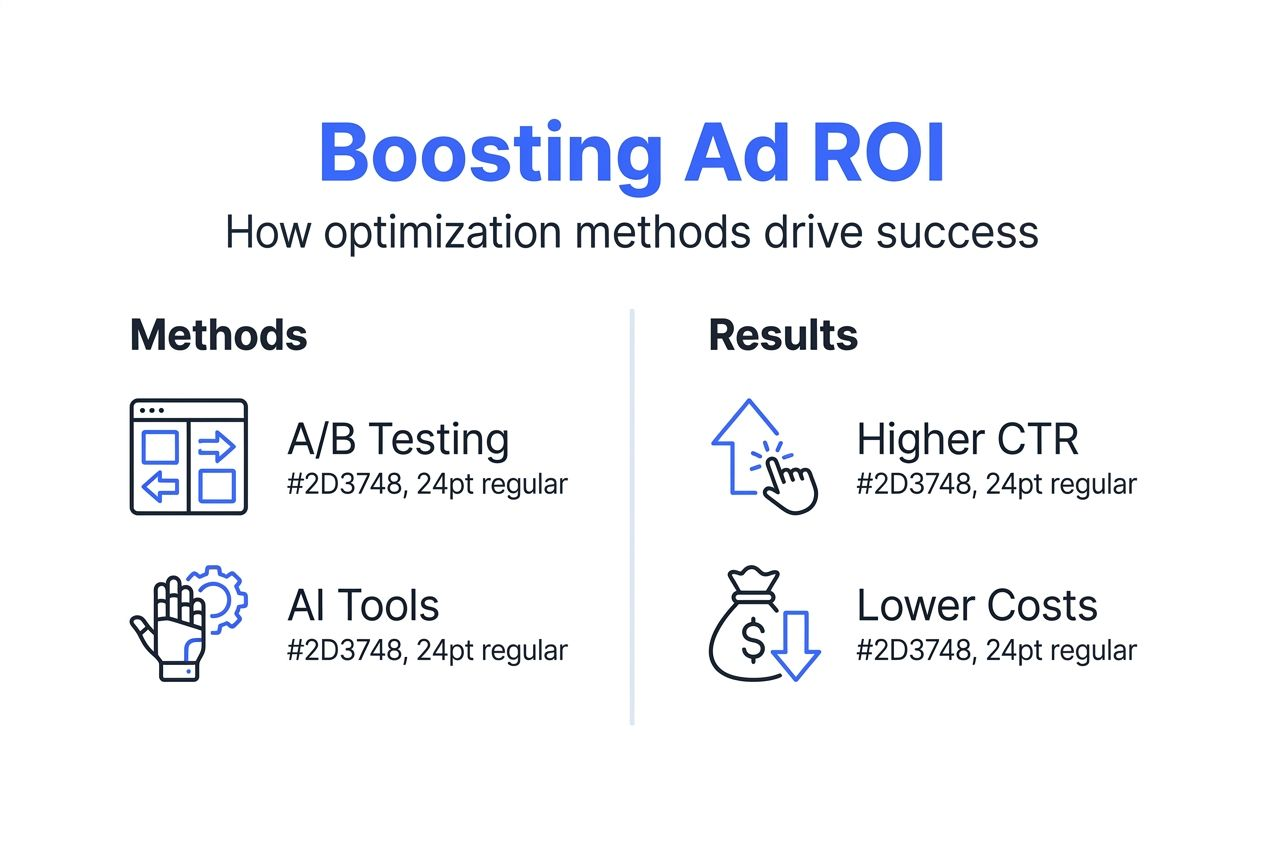
Attribution models supporting multi-channel campaigns have evolved to address privacy restrictions. The loss of traditional tracking (third-party cookies) requires creative optimization strategies that incorporate server-side tracking and first-party data to maintain accurate attribution and ROI measurement. Probabilistic models and unified customer data platforms help bridge the gaps left by cookie deprecation.
Compare your options:
ApproachSetup ComplexityData RequirementsAttribution AccuracyScalabilityManual A/B TestingLowMinimalModerateLimitedAI-Powered PlatformsMediumModerate (API access, pixel integration)HighHighDynamic Creative Optimization (DCO)HighExtensive (real-time feeds, CRM data)Very HighVery HighServer-Side Tracking + First-Party DataMedium-HighHigh (consent management, data infrastructure)HighHigh
Key features to prioritize when selecting optimization tools:
Pro Tip: Integrate first-party data from your CRM and loyalty programs into your testing platform. Combining purchase history with ad exposure data sharpens targeting and attribution, offsetting the loss of third-party cookies and improving ROI measurement accuracy.
Learn more through A/B testing in ecommerce, maximizing PPC efficiency, and techniques to drive click-through rates. External guides like automated creative testing platforms and privacy-compliant creative optimization strategies provide additional technical depth.
Implementing optimized creative in your marketing strategy
Moving from tools to execution requires clear steps. Follow this sequence to embed creative optimization into your marketing operations.
Privacy and tracking challenges demand modern solutions. Server-side tracking, consent management platforms, and probabilistic attribution models preserve measurement accuracy despite cookie deprecation and platform restrictions.
Pro Tip: Foster cross-team collaboration between creative, media buying, and analytics teams. Weekly sync meetings where media buyers share performance data and creative teams propose new concepts based on insights create a feedback loop that accelerates optimization velocity.
A framework emphasizing continuous measurement, analysis, and testing ensures marketing optimization is a cyclical process rather than a one-time project, leading to sustained ROI growth. For step-by-step guidance, see how to increase ecommerce ROI and explore the continuous marketing optimization framework.
Measuring and scaling success for long-term impact
Effective measurement separates guesswork from strategic decision-making. Track these core metrics to evaluate creative impact:
Use data to make scaling decisions. When a creative sustains strong CTR and conversion rates over multiple weeks without fatigue, gradually increase budget allocation. Conversely, pause creatives showing declining engagement or rising CAC before they erode overall campaign performance.
Brands leveraging AI and automation for creative optimization report up to 3x faster testing cycles, enabling quicker scaling of profitable ads. This speed advantage compounds over time, letting you iterate and improve while competitors remain stuck in slower manual processes.
Best practices for sustainable measurement:
Pro Tip: Resist the temptation to scale too aggressively after early wins. Incremental budget increases (20 to 30% weekly) let you validate performance stability and avoid sudden audience saturation or platform algorithm changes that can derail rapid scaling.
Deepen your approach with insights on increase ecommerce ROI with data and creative, explore creative services for ecommerce brands, and review AI acceleration of creative testing and scaling.
Summary and next steps for marketing directors and e-commerce teams
Ad creative optimization is the leverage point that transforms good campaigns into exceptional ones. By embracing continuous, data-driven testing and AI-powered personalization, you unlock higher conversion rates, lower CAC, and sustained ROAS improvements.
Key themes to carry forward:
Actionable checklist for immediate implementation:
Ongoing learning resources include industry blogs on AI creative tools, privacy-compliant attribution models, and case studies from brands successfully scaling optimization efforts. Stay current with platform updates from Amazon Advertising, Meta, Google, and Walmart Connect as they refine creative formats and targeting capabilities.
Boost your brand’s growth with Nectar’s creative and marketing expertise
Optimizing ad creative at scale demands expertise across creative production, data analytics, and multi-channel media buying. Nectar combines in-house photography, videography, and design with sophisticated, data-driven advertising strategies to transform underperforming campaigns into high-converting growth engines.
Powered by the proprietary iDerive analytics platform, Nectar delivers the granular insights and full-funnel management that mid-sized and enterprise brands need to scale smarter across Amazon, Walmart, and Shopify. Whether you’re launching new products or revitalizing established listings, partnering with an experienced agency accelerates results and maximizes ROI.
Explore services for profitable brand growth to see how integrated creative and marketing solutions drive measurable outcomes. Learn about creative services in ecommerce success and discover the role agency partners play in ecommerce success by reviewing proven strategies and client case studies.
Frequently asked questions
What is ad creative optimization and why is it important?
Ad creative optimization is the continuous process of testing, analyzing, and refining ad elements like images, headlines, and calls-to-action to improve campaign performance. It matters because optimized creative directly increases conversion rates, lowers customer acquisition costs, and maximizes return on ad spend.
How does AI enhance ad creative optimization?
AI accelerates multivariate testing by automatically generating and evaluating thousands of creative variations in real time, identifying high-performing combinations faster than manual methods. It enables personalization at scale by analyzing user behavior and contextual signals, but still requires strategic human oversight to align with brand goals and interpret insights correctly.
How can brands overcome privacy challenges in measuring ad creative performance?
Brands should adopt server-side tracking, integrate first-party data from CRM and loyalty programs, and use probabilistic attribution models to maintain measurement accuracy despite cookie deprecation. Consent management platforms ensure compliance while preserving the data flows needed for effective optimization.
What metrics should I track to evaluate ad creative optimization success?
Track click-through rate to measure attention capture, conversion rate to assess persuasive power, ROAS to quantify revenue efficiency, and customer acquisition cost to monitor spending efficiency. Also monitor audience engagement frequency to detect creative fatigue before it degrades performance.











.png)