Why Audience Segmentation Drives Real Marketing ROI
.webp)

TL;DR:
- Audience segmentation divides markets into targeted groups, reducing ad waste and boosting conversions.
- Behavioral and needs-based segmentation outperform demographic data, predicting future buying actions more accurately.
Audience segmentation is the strategic division of a broad market into smaller, well-defined groups based on shared characteristics, so you can deliver the right message to the right person at the right time. This practice sits at the core of every high-performing marketing program, and the numbers prove it. Data-driven segmentation yields a 40% reduction in customer acquisition costs and up to 14 times higher email open rates compared to non-segmented campaigns. Platforms like Mailchimp and Pulsar Platform have built entire product lines around this principle. Understanding why audience segmentation works is not a theoretical exercise. It is the difference between ad spend that compounds and ad spend that evaporates.
Why audience segmentation is the foundation of effective marketing
Audience segmentation, also called market segmentation, is the recognized industry term for grouping consumers by shared traits to make marketing more precise. The core logic is simple: people with different needs respond to different messages. Sending one message to everyone wastes budget on people who will never convert and alienates the ones who might.
The five core segmentation types each serve a different strategic purpose.
- Demographic segmentation groups by age, gender, income, or education. It is the most common starting point, but also the most overused.
- Geographic segmentation targets by location, from country down to zip code or climate zone. It works well for regional promotions and local inventory.
- Psychographic segmentation groups by values, lifestyle, and personality. It explains why someone buys, not just who they are.
- Behavioral segmentation groups by purchase history, browsing patterns, and product usage. It is the strongest predictor of future buying behavior.
- Needs-based segmentation groups by the specific problem a customer is trying to solve. It is the most commercially precise of all five types.
Behavioral and needs-based segmentation consistently outperform demographic segmentation in predicting actual buying behavior. Demographics tell you who someone is. Behavior and needs tell you what they will do next. That distinction is worth millions in wasted ad spend recovered.
The most common pitfall is treating demographic data as a proxy for purchase intent. 63% of digital ad impressions fail to reach the intended demographic target because marketers assume demographic overlap equals purchasing motivation. It does not.

Pro Tip: Combine at least two segmentation types in every campaign. Pair behavioral data with psychographic data to build segments that predict both intent and message resonance. Single-variable segments almost always underperform.
How does audience segmentation improve marketing ROI?
Segmentation improves ROI through four concrete mechanisms: lower acquisition costs, higher engagement rates, better ad efficiency, and stronger retention.
-
Lower customer acquisition costs. When you target only the people most likely to convert, you stop paying to reach everyone else. The 40% CAC reduction cited above is not a ceiling. It is an average across mature segmentation programs.
-
Higher email engagement. Segmented email campaigns show up to 14 times higher open rates than generic sends. That lift comes from matching message content to the recipient’s demonstrated behavior and preferences, not from better subject lines alone.
-
Improved return on ad spend. Mature segmentation strategies improve marketing ROAS by 20%–30%. When you layer retargeting on top of segmented audiences, ROAS climbs to 4.2x or higher. That multiplier reflects the compounding effect of reaching people who already know your brand and have shown purchase intent.
-
Precision through AI. Advanced audience targeting technology using AI and machine learning achieves 90% prediction accuracy and lifts click-through rates by 25% through dynamic creative optimization. That accuracy closes the gap between who you intend to reach and who actually sees your ad.
The ROI case for segmentation is not built on one metric. It compounds across every channel you run. A brand spending $500,000 per year on paid media that improves ROAS by 25% through better segmentation recovers $125,000 in effective media value without increasing budget. That is the importance of audience targeting made concrete.
What are best practices for implementing audience segmentation?
Knowing the benefits of audience segmentation is not enough. Execution determines whether your segments generate returns or gather dust in a spreadsheet.
Start with first-party data
First-party data, meaning data you collect directly from your customers through purchases, site behavior, and email engagement, is the most reliable foundation for segmentation. It is also privacy-compliant by default. Third-party cookie deprecation has made first-party data the only durable asset in audience targeting.
Define segments by commercial usefulness, not just description
Successful segmentation balances commercial decision-making with data insights, focusing on practical usefulness rather than comprehensive description. A segment is only valuable if it is large enough to justify a tailored campaign, distinct enough to respond differently from other segments, and reachable through channels you actually use.
Build in continuous recalibration
Segmentation requires continuous monitoring and recalibration to maintain relevance and scale. Consumer behavior shifts. A segment that converted well in Q1 may behave differently by Q3 due to seasonal patterns, competitive activity, or economic changes. Static segments decay. Build a quarterly review into your workflow.
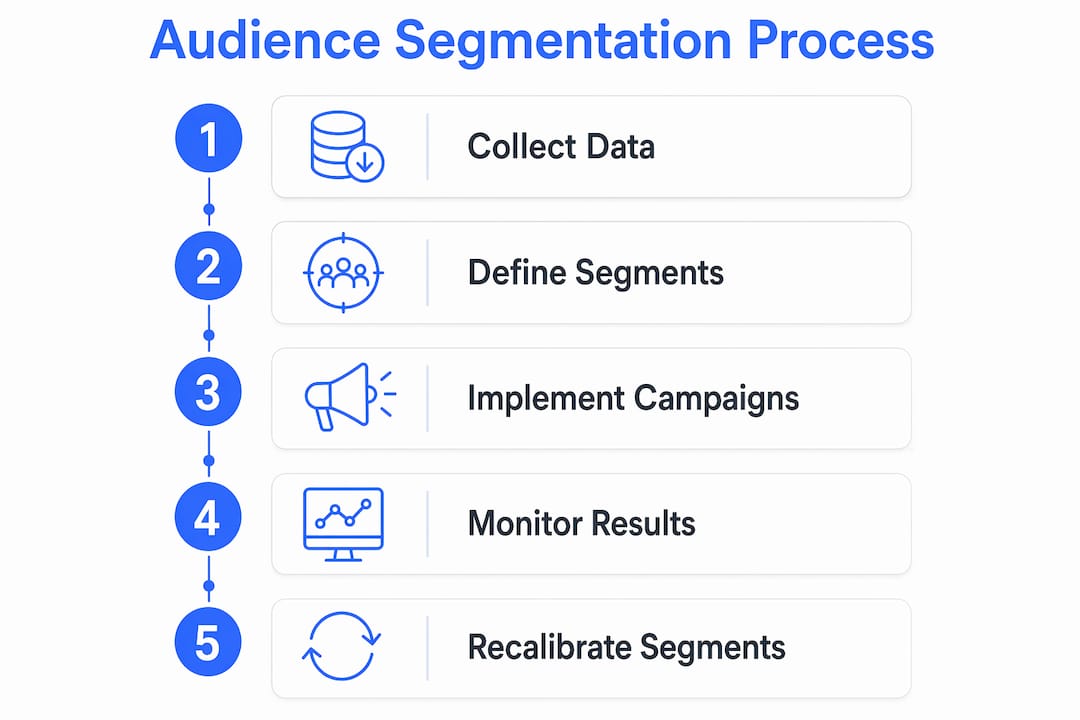
Here are the key steps to execute a segmentation strategy that holds up over time:
- Audit your existing customer data for completeness and accuracy before building any segment.
- Define 3–5 primary segments based on behavioral and needs-based criteria, not demographics alone.
- Map each segment to a specific message, offer, and channel combination.
- Set performance benchmarks per segment before launch so you can measure true lift.
- Review segment performance every 60–90 days and retire or split segments that no longer perform distinctly.
Pro Tip: Avoid over-segmentation. More than 8–10 active segments usually signals a data problem, not a targeting advantage. Too many segments fragment your budget and make cross-device behavior nearly impossible to track accurately.
How does segmentation apply across channels and industries?
Audience segmentation strategies look different depending on the channel and the business model. The underlying logic is the same. The execution varies significantly.
E-commerce on Amazon and Shopify
On Amazon, retail media advertising uses segmentation to target high-value consumer groups with Sponsored Products, Sponsored Brands, and Amazon DSP. Brands that segment by purchase recency and category affinity consistently outperform those running broad keyword campaigns. On Shopify, segmentation powers personalized product recommendations, abandoned cart sequences, and loyalty program triggers. The Shopify advertising workflow becomes measurably more efficient when audience data drives creative decisions.
Email and social media
Email segmentation by behavioral triggers, such as browse abandonment, post-purchase timing, and product category interest, produces the largest open rate lifts. Social media platforms like Meta and LinkedIn allow you to upload first-party segments as custom audiences and build lookalike models from your highest-value customers.
Paid search and Connected TV
In paid search, segmentation informs bid adjustments by audience layer. A returning customer searching for a product deserves a higher bid than an anonymous first-time visitor. Connected TV platforms use behavioral and demographic segments to serve different ad creatives to different household profiles watching the same content.
Here is how segmentation tactics differ by channel:
- Email: Segment by purchase history, engagement recency, and product category preference.
- Paid social: Use first-party custom audiences and lookalike expansion from top-converting segments.
- Paid search: Apply audience bid modifiers based on CRM data and site behavior.
- Retail media: Target by in-category purchase behavior and brand affinity signals.
- Connected TV: Use household-level behavioral data to serve relevant creative at scale.
B2B segmentation adds firmographic data, meaning company size, industry, and revenue, to the mix. B2C segmentation leans harder on behavioral and psychographic signals. Both benefit from the same core principle: the more precisely you define who you are talking to, the more relevant your message becomes.
Key takeaways
Audience segmentation works because it replaces broad assumptions with specific, data-backed targeting that reduces waste and increases relevance across every channel.
Point: Core definition Audience segmentation divides a broad market into distinct groups to deliver targeted, relevant messages that drive higher conversion.
Point: Best segmentation types Behavioral and needs-based segmentation predict buying behavior more accurately than demographic data alone.
Point: ROI impact Segmentation reduces customer acquisition costs by 40% and improves ROAS by 20%–30%, with retargeting pushing ROAS to 4.2x.
Point: Implementation rule Segments must be commercially useful, not just descriptive. Review and recalibrate every 60–90 days to stay accurate.
Point: Channel application Segmentation tactics differ by channel. Email, paid social, retail media, and Connected TV each require channel-specific segment logic to perform.
Segmentation is a process, not a project
I have worked with brands that built beautiful segmentation frameworks in a workshop, launched them once, and never touched them again. Six months later, they wondered why performance had plateaued. The answer was always the same: their segments had gone stale while their customers had moved on.
The most common mistake I see is treating segmentation as a setup task rather than an ongoing discipline. Markets shift. Consumer priorities change. A segment that was your highest-converting group in January can become your lowest-engagement group by summer if you are not watching the signals. The brands that win are the ones that treat segment performance data the way a trader treats a portfolio: checking it regularly, cutting what is not working, and doubling down on what is.
I am also skeptical of the obsession with hyper-granular micro-segments. Yes, personalization matters. But I have seen brands fragment their audiences into 40 segments and end up with budgets too thin to generate statistical significance in any of them. The discipline is knowing when to split a segment and when to consolidate. More segments is not always better targeting. Sometimes it is just more complexity with no return.
The other shift worth watching is the move toward AI-driven dynamic segmentation. Static rule-based segments are giving way to models that update in real time based on behavioral signals. That is where the next wave of targeting precision will come from. If you are not already testing machine learning-based audience models, you are building on a foundation that will need to be replaced sooner than you think.
— Dan Katona
How Nectar turns segmentation data into profitable growth
Nectar builds segmentation-driven marketing programs for mid-sized and enterprise brands selling on Amazon, Walmart, and Shopify. The agency’s proprietary iDerive analytics platform unifies marketplace data across channels, so your audience segments are built on complete behavioral signals rather than platform-siloed guesses. From Amazon growth and optimization to full-funnel retail media execution, Nectar’s team applies the same segmentation logic that drives 4x ROAS improvements for brands that have outgrown generic campaign management. If your current targeting is built on demographics and broad keywords, Nectar can show you what precision actually looks like.
FAQ
What is audience segmentation in marketing?
Audience segmentation is the process of dividing a broad market into smaller groups based on shared characteristics such as behavior, needs, demographics, or geography. The goal is to deliver more relevant messages that improve conversion rates and reduce wasted ad spend.
Why does demographic segmentation alone underperform?
63% of digital ad impressions miss their intended demographic target because demographic overlap does not equal purchase intent. Behavioral and needs-based segmentation predict actual buying behavior more accurately than age or income data alone.
How much can segmentation improve email marketing results?
Segmented email campaigns produce up to 14 times higher open rates compared to non-segmented sends. That lift comes from matching message content to the recipient’s demonstrated behavior and product preferences.
How often should you update your audience segments?
Segments require continuous monitoring and recalibration to stay relevant. A quarterly review cycle is the minimum. High-volume campaigns benefit from monthly segment performance audits to catch behavioral drift before it erodes results.
What is the difference between B2B and B2C audience segmentation?
B2C segmentation relies primarily on behavioral and psychographic signals. B2B segmentation adds firmographic data such as company size, industry vertical, and annual revenue to identify the accounts most likely to convert and retain.
Recommended

































































.webp)