TL;DR:
- Voice search optimization is crucial for marketplace brands because voice assistants prioritize direct answers over keyword-reliant listings. Improving listings with conversational answers, structured data, and outcome-focused content can recover organic visibility and reduce TACoS. Brands that adapt early, focusing on high-reorder SKUs, see measurable organic lift and enhanced reorder flows through voice commerce.
Voice search optimization is no longer optional for marketplace brands. Conversational assistants like Amazon’s Rufus return one or two spoken recommendations rather than a list of results, which means if your listing isn’t built to answer shopper questions directly, you’re invisible in that moment. Nectar’s work across Amazon and Walmart, measured through the iDerive analytics platform, consistently shows that brands treating listings as genuine product documents outperform those still chasing keyword density.
Three actions with the fastest impact:
-
Rewrite titles and bullets as conversational Q&A answers, not keyword strings
-
Add and clean Product, FAQ, and speakable schema fields
-
Populate brand-level signals: Q&A entries, A+ content modules, and short video clips
Why optimize for voice search as a marketplace brand?
The core risk is structural. When a shopper asks Alexa or Rufus for a recommendation, the assistant speaks one answer. Organic visibility collapses from ten blue links to a single named product. If that product isn’t yours, you don’t just lose the sale; you lose the reorder cycle too, because voice commerce favors repeat, replenishment purchases like coffee pods, pet food, and detergent. Those are exactly the categories where lifetime value compounds.
The TACoS implication is direct. Brands that lose organic voice share compensate with paid spend, which inflates TACoS without recovering the underlying visibility. Conversely, listings optimized for conversational answers can recover organic rank and compress TACoS, according to agency briefings and case examples.
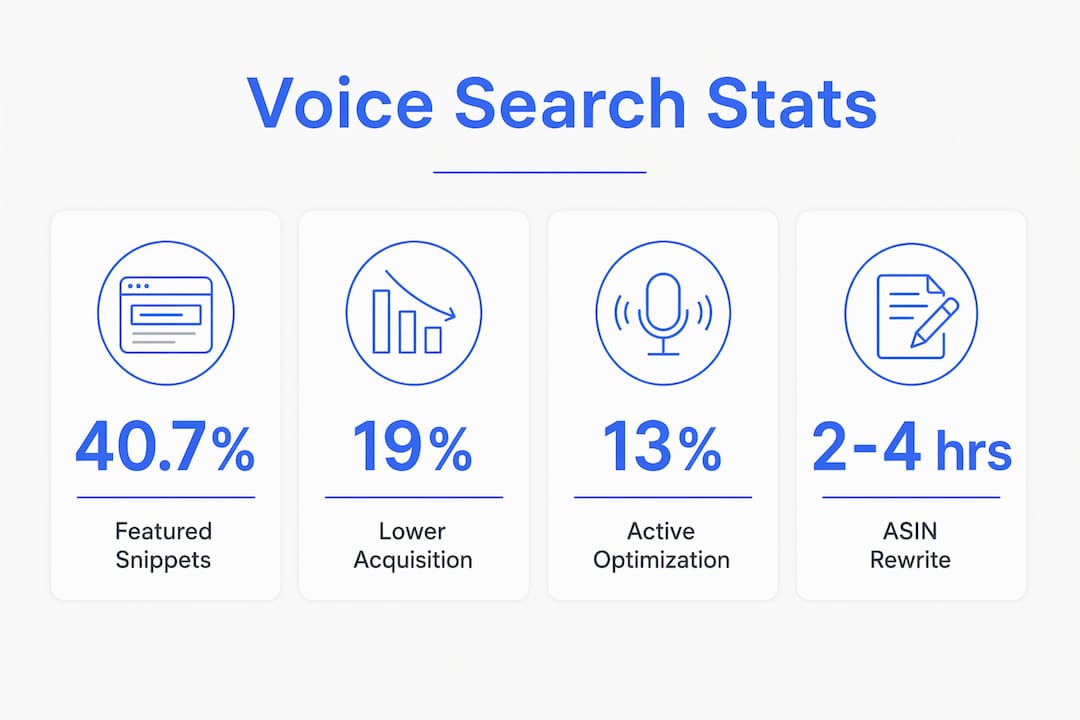
Stat: A significant share of voice search answers come from featured snippets, with most also coming from one of the top three organic desktop positions for the same query.
Pro Tip: Prioritize SKUs by reorder frequency and margin first. Replenishment items capture early voice volume; optimize those before tackling the long tail.
How do voice queries differ from typed searches on marketplaces?

The gap is wider than most teams expect. A typed search is “protein powder chocolate.” A voice query is “what’s the best chocolate protein powder that doesn’t have artificial sweeteners and mixes well with almond milk.” Voice queries average 29 words versus roughly 4 words for typed searches, and 70% are phrased as complete questions compared to just 12% of typed searches. [Voice Search Statistics 2026 — Digital Applied]
Core differences your team needs to understand:
-
Conversational phrasing: Voice queries include prepositions, qualifiers, and full sentences; typed queries are fragments
-
Question-first intent: Shoppers lead with “what,” “which,” “does,” and “how” rather than product names
-
Winner-take-all results: Voice returns one spoken answer; typed search shows ten results
-
Hands-free and mobile context: 88.1% of US voice assistant users reach the assistant through a smartphone, not a smart speaker
-
Reorder and local intent: Voice skews toward “buy again” and “near me” queries, not discovery browsing
What this means for Rufus specifically: Amazon’s LLM-based shopping assistant synthesizes listing copy, Q&A, reviews, and brand store content as documents. It doesn’t match keywords; it reads for answers. A listing with high keyword density but thin Q&A and no A+ content will lose to a listing that directly answers the top ten shopper questions, even if the latter has fewer exact-match terms. Rank-based SEO metrics still matter, but content quality and answer completeness matter more than keyword count.
What concrete changes make your listings voice-ready?
This is a content and technical SEO problem, not a paid media problem. Voice optimization requires conversational copy, semantic structure, and clean structured data working together. Here’s the prioritized sequence:
-
Rewrite titles and bullets as Q&A answers. Replace “Chocolate Protein Powder 2lb Whey Blend” with a title that names the use case and key differentiator. Bullets should answer “what does this do for me” in one sentence each.
-
Expand descriptions and A+ modules into problem-to-outcome narratives. Structure each module: problem the shopper has, how the product addresses it, expected outcome. Rufus reads these.
-
Populate Amazon Q&A with brand-answered entries. Seed the top 10 shopper questions with concise, direct answers. Outcome-focused Q&A content helps LLMs match your product to conversational queries.
-
Add Product, FAQ, and speakable schema fields. Structured data helps voice assistants extract price, availability, ratings, and concise answers directly from product pages.
-
Add short video clips and speakable-friendly copy. Thirty-second use-case videos signal content depth; speakable markup flags which text is suitable for text-to-speech.
-
Seed review language around outcomes and use cases. Reviews that describe results (“mixes clean, no clumping, tastes good with oat milk”) give Rufus the evidence it needs to recommend your product for specific queries.
-
Adapt sponsored ad copy for conversational queries. Headline copy that mirrors natural question phrasing performs better when shoppers arrive from voice-initiated sessions.
Before (keyword-stuffed bullet): *“Premium Whey Protein Powder Chocolate Flavor 2lb Muscle Building Supplement”*After (voice-ready Q&A bullet): “Mixes completely in 30 seconds with no blender needed — ideal for post-workout shakes when you’re short on time.”
Pro Tip: Treat each ASIN as a product document. Run a “Rufus audit” by feeding your listing copy into a prompt and asking whether it answers your top 10 shopper questions in under 60 words each. Any question that gets a weak answer is a rewrite priority.
For content optimization frameworks and listing refresh templates, Nectar’s content team has built repeatable processes that scale across large catalogs.
How do you measure voice search impact and validate lift?
Attribution on marketplaces is imperfect, but measurement is still possible. Nectar uses iDerive to stitch incremental signals across paid and organic touchpoints, treating impressions, click-through deltas, and conversion rate shifts as proxies when direct voice attribution isn’t available. For AI-driven Amazon analytics, the goal is catalog-level incrementality, not last-click attribution.
Core KPIs to track:
-
Featured snippet and position-zero share on target queries
-
Organic share of voice for priority SKUs
-
TACoS before and after content refresh
-
Per-SKU reorder rate trends
-
Conversion rate delta on updated versus control ASINs
Two experiment templates that work within marketplace constraints:
-
Phased SKU holdout test. Update 30–50% of priority SKUs with conversational rewrites and Q&A seeding. Hold the remainder constant. Compare cohort performance over 30–60 days, controlling for PPC changes. Early tests show measurable organic recommendation lift within that window for prioritized SKUs.
-
Geographic split test. For local or near-me voice queries, split by DMA or zip cluster. Update listings and local signals in one geography; hold the other. Useful for Walmart, where store-level inventory signals interact with voice results.
Operational notes: run experiments on SKUs with enough weekly sessions to detect a meaningful effect. Avoid launching PPC changes simultaneously with content changes, since both affect conversion rate and will confound the result.
What mistakes do teams make when optimizing for voice?
Most errors fall into one of two categories: doing the wrong thing confidently, or doing the right thing in isolation.
-
Keyword-stuffing titles and bullets instead of writing answers. This actively hurts voice performance because Rufus deprioritizes listings that read like keyword lists.
-
Ignoring brand signals. Updating listing copy without populating Q&A, A+ content, and video leaves the assistant without the evidence it needs to recommend your product.
-
Skipping the review and ratings layer. Content rewrites without parallel review quality work produce partial results. Rufus reads reviews as evidence.
-
Over-optimizing titles for voice TTS until they become unreadable to human shoppers. The goal is natural language, not robotic sentence structure.
-
Treating voice as a separate channel. Voice optimization is listing optimization. Brands that silo it from their broader Amazon SEO strategy duplicate effort and miss the compounding effect.
One-sentence QA check before any listing goes live: run the updated copy through a voice-simulation prompt and confirm it answers the top five shopper questions without sounding like it was written for a search engine.
A 90-to-180-day rollout plan for catalog, content, and ads teams
Phase 1: Days 0–30 (Audit and prioritization)
-
Pull your top 20% of SKUs by revenue and reorder rate. These are your voice-optimization priority list.
-
Run a Rufus-style listing audit on each: does the copy answer the top 10 shopper questions in under 60 words each?
-
Audit schema coverage: identify ASINs missing Product, FAQ, or speakable markup.
-
Assign owners: brand/content team owns copy rewrites; marketplace ops owns schema and backend fields; agency partner (Nectar) owns experiment design and iDerive measurement setup.
Phase 2: Days 31–90 (Content rewrites and initial experiments)
-
Rewrite titles, bullets, and descriptions for priority SKUs using the Q&A framework above.
-
Seed 25 brand-answered Q&A entries per priority ASIN. Focus on outcome and use-case questions.
-
Add short video clips and A+ module updates for the top 10 SKUs.
-
Launch the phased SKU holdout experiment. Freeze PPC changes on test ASINs during this window.
-
Track TACoS and organic share of voice weekly.
Phase 3: Days 91–180 (Scale and refine)
-
Apply the rewrite template to the remaining catalog using a templatized refresh process. For catalog-wide refresh guidance, Nectar’s team has documented resource estimates by catalog size.
-
Refine sponsored ad copy based on experiment results.
-
Run iDerive incrementality analysis on the holdout cohort. Use findings to prioritize the next SKU tier.
-
Review schema coverage across the full catalog and close remaining gaps.
Expected effort: roughly 2–4 hours per ASIN for a full conversational rewrite and Q&A seeding. Template-based refreshes for long-tail SKUs run faster, around 45–60 minutes per ASIN once the template is validated.
How voice commerce extends beyond search
Voice optimization doesn’t stop at search results. Amazon’s “Buy Again” and Alexa reorder features pull directly from a shopper’s purchase history and product data, which means listings that are voice-ready also perform better in reorder flows. Brands with clean product data, accurate availability signals, and strong review profiles get surfaced when a shopper says “Alexa, reorder my protein powder.” Walmart is building similar voice-enabled shopping cart features tied to its app and in-store experience.
The practical implication: voice commerce is a retention channel as much as an acquisition channel. Brands that win the first purchase with a well-structured listing are better positioned to capture the reorder through voice, especially in replenishment categories. Keeping product data current, including price, availability, and variant information, is the infrastructure that makes both search and reorder voice flows work.
What ROI can brands expect from voice search optimization?
Direct voice attribution is still limited on major marketplaces, but the organic and conversion signals are measurable. Agency briefings document TACoS compression and median rank improvements after conversational copy refreshes. The mechanism is straightforward: listings that answer shopper questions get recommended more often, which increases organic impressions, which reduces the paid spend needed to maintain visibility.
For replenishment categories, the compounding effect is significant. A brand that captures the first voice-driven purchase in a category like vitamins or cleaning supplies has a strong probability of owning the reorder cycle, because voice assistants default to prior purchases. That’s not a one-time conversion; it’s a recurring revenue stream that paid media alone can’t replicate at the same efficiency.
Businesses optimized for voice search report 19% lower customer acquisition costs, according to The Stacc’s 2026 data, reflecting the efficiency gains from organic recommendation lift.
How are top marketplace brands already using voice optimization?
The brands pulling ahead on Amazon are treating Rufus readiness as a listing quality standard, not a separate project. They run regular audits against the top shopper questions for each category, maintain populated Q&A sections, and build A+ content that reads as a product document rather than a brand brochure. On Walmart, the leading brands are integrating FAQ schema and voice-search keywords into their listing attributes, since Walmart’s search engine weighs listing completeness heavily for ranking and Buy Box eligibility.
The competitive gap is still wide. Only 13% of marketers actively optimize for voice search, according to The Stacc’s 2026 data. For enterprise brands with the resources to run structured experiments and template-based catalog refreshes, that gap is an opportunity that closes as more teams catch up.
Key Takeaways
Voice search optimization for marketplace brands is a listing quality problem first. Brands that structure product pages as conversational documents, populate Q&A, and maintain clean schema will be recommended by assistants; brands that don’t will pay more in paid media to compensate for lost organic share.
Point: Winner-take-all risk Voice assistants return one or two spoken recommendations. If your listing isn’t voice-ready, you’re absent from that result entirely.
Point: Content shape over keyword density Rufus reads listings as documents. Q&A entries, A+ content, and outcome-focused reviews matter more than exact-match keyword frequency.
Point: Prioritize replenishment SKUs Voice commerce favors repeat purchases. Start optimization with high-reorder, high-margin SKUs before expanding to the full catalog.
Point: Featured snippet share is the leading KPI 40.7% of voice answers come from featured snippets. [Voice Search Statistics 2026 — Digital Applied] Track position-zero share and organic share of voice alongside TACoS.
Point: Three immediate actions Run a Rufus-style audit on your top 20% of SKUs, seed 25 brand-answered Q&A entries per priority ASIN, and launch a 30–60 day holdout experiment to measure organic lift.
The practitioner’s view on voice optimization
The brands that struggle with voice optimization usually have the same problem: they’re still thinking about listings as keyword vehicles rather than product documents. When Nectar audits a catalog for voice readiness, the most common finding isn’t missing schema or slow page speed. It’s listings that can’t answer a basic shopper question in plain language. “Does this work with X?” “How long does it last?” “Is it safe for Y?” Those questions are sitting in the Q&A section unanswered, or buried in a bullet that reads like a spec sheet.
The fix isn’t complicated, but it requires a shift in how teams think about listing copy. At Nectar, we treat each ASIN as a product document with a job to do: answer the top questions a shopper would ask before buying. When we apply that framework alongside iDerive’s incrementality measurement, we consistently see organic recommendation lift within the first 30–60 days on priority SKUs. The signal shows up in impressions and conversion rate before it shows up in rank, which is why having the right measurement setup matters before you start.
The honest guidance on in-house versus agency: if your catalog is under 200 SKUs and you have a content team with bandwidth, the audit and rewrite work is manageable in-house. Above that threshold, or if you’re running simultaneous experiments across Amazon and Walmart, the coordination overhead and measurement complexity justify bringing in a partner. Nectar’s Amazon growth and optimization services are built specifically for that scale, with iDerive providing the attribution layer that makes the experiment results defensible to leadership.
Useful sources for further reading
-
Why Voice Search Optimization Is the Next Ecommerce Innovation — Audacious Commerce. Supports the winner-take-all argument and replenishment category prioritization.
-
Amazon’s Rufus AI Is Quietly Rewiring How Sellers Win Organic Rank — Ecommerce Times. Primary source for Rufus behavior, Q&A seeding tactics, and TACoS compression evidence.
-
Voice Search for Ecommerce: 5 Ways to Boost Sales — bCloud.ai. Covers the content and technical SEO components of voice optimization.
-
Voice Search Optimisation for Dominant E-commerce SEO — AcquireX. Schema markup guidance and featured-snippet optimization for voice.
-
Voice Search Statistics 2026 — Digital Applied. Source for the 29-word average query length, 40.7% featured snippet share, and 70% question-format data.
-
Voice Search Statistics 2026 — The Stacc. Source for the 19% lower customer acquisition cost finding and the 13% marketer optimization rate.
-
Ecommerce Voice Search: 7 Optimization Strategies — HI Agency. Practical implementation guide covering schema types, featured snippet targeting, and mobile optimization.
-
Nectar Voice Search and Ecommerce — Nectar blog. Strategic context on how voice shopping assistants change discovery and what brands can do about it.
Recommended
-
Nectar Blog | Voice search is transforming ecommerce: higher sales now
-
Nectar Blog | Amazon SEO Best Practices 2025 for Maximizing Visibility
-
Nectar Blog | Listing optimization checklist: Boost sales on Amazon, Walmart, Shopify
-
Nectar Blog | Walmart Marketplace best practices: optimize listings and sales

































































.webp)