A strong Prime Day advertising strategy comes down to three phases. In the lead-in, you gather data and build your baselines. During the event, you optimize in real time. Afterward, you re-engage the shoppers who nearly bought. Brands that treat Prime Day as one burst of spend tend to pay more for less. Brands that treat it as a planned operating cycle tend to get more from every dollar.
Prime Day 2026 ran June 23 to 26, according to Amazon’s Prime Day page. Prime Big Deal Days followed on October 6 and 7. Q4 is now underway, so this playbook works as a debrief on the summer event and a plan for the next one. It also applies to Black Friday and Cyber Monday, because the mechanics are the same.
TL;DR
- Use the 30 days before the event to find your best product and keyword combinations and to set baseline CPCs and sales velocity. Don’t guess once the event starts.
- Align Sponsored Products, Sponsored Brands and display. Amazon reports advertisers saw a 137% sales increase using all three during Prime Day, compared with average category growth.
- Treat the event as 96 hours of live optimization: rotate creative, shift budget to winners and adjust bids on real KPIs.
- Keep advertising after the event. Shoppers who engaged but did not buy are often a cheaper audience than new ones.
- Spend only on listings that are ready to convert. Extra traffic to a weak detail page is wasted budget.
Why Prime Day advertising has changed
Prime Day used to be a single day. It is now a multi-day event, and it overlaps with competing retail promotions. The Drum describes a 96-hour deal season in which Amazon and Walmart run overlapping promotions and some retailers ask brand partners for 25% to 50% more retail media budget. Advertising during these windows is increasingly pay-to-play.
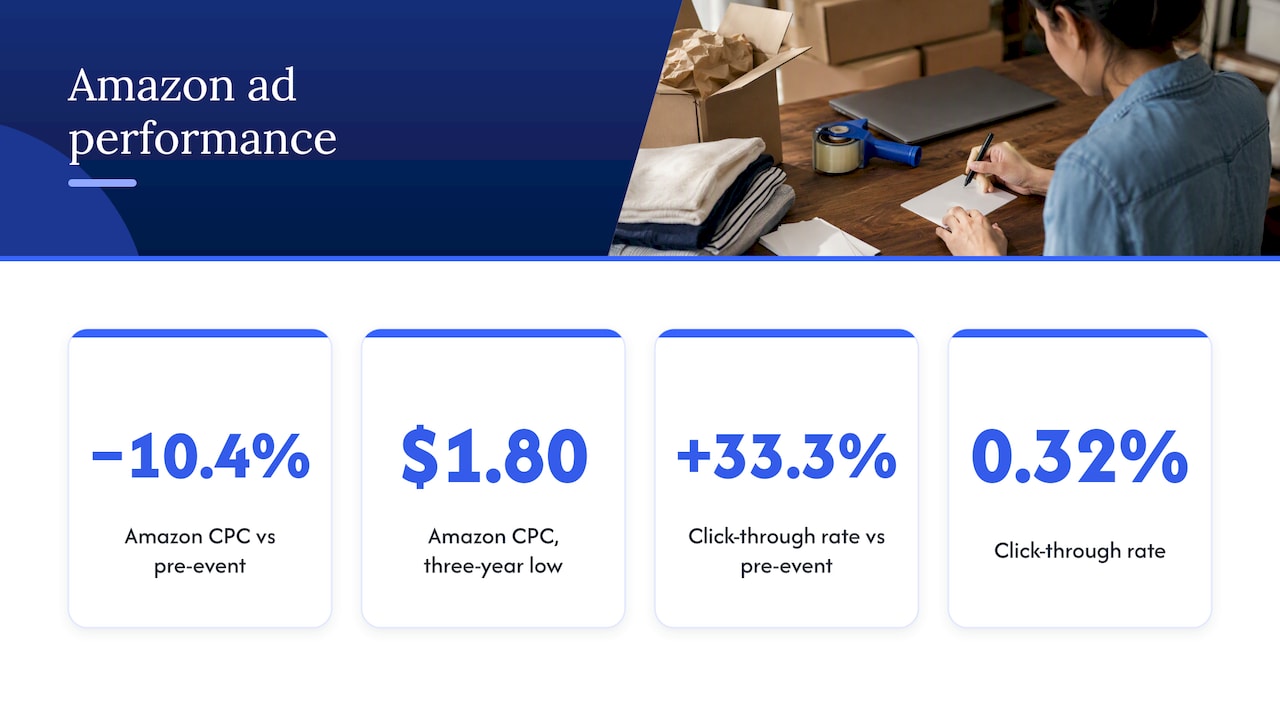
Higher competition does not always mean worse efficiency, though. Skai’s Q2 2025 data showed Amazon CPCs fell 10.4% versus pre-event levels, landing at $1.80, the lowest in three years. Click-through rate rose 33.3% to 0.32%. Shoppers arrive with high intent, so well-prepared campaigns convert more of the clicks they pay for.
The lesson: budget size matters less than preparation quality. A brand with a smaller budget, clean data and fresh creative can outperform a brand that simply raises bids.
Phase 1: The lead-in (30 to 14 days out)
This phase is where most of the outcome is decided.
Gather data before you spend big
The 30 days before the event are a data-gathering window. Use them to identify high-potential product and keyword combinations and to establish baseline CPCs and velocity. Skai’s report frames this as the way to avoid spending on unproven items once the event hits. Amazon’s own advice for smaller advertisers says the same: use learnings from the prior 30 days and, if you have no active campaigns, run test campaigns first.
Practical steps:
- Pull search term reports for the last 30 to 60 days and list the terms that convert at or below your target ACOS or TACoS.
- Rank your ASINs by contribution margin, not just revenue. Promote the ones that stay profitable at deal prices.
- Record baseline CPC, CTR, conversion rate and daily units for each priority ASIN. You will need them for mid-event decisions.
- Confirm inventory covers a realistic sales spike, with a cushion for a lift in the days after.
Start awareness early
A common recommendation in the ranking guides is to begin at least 14 days ahead, using the lead-in for top-of-funnel awareness so shoppers already know you when deals go live. Amazon’s guide recommends scaling budgets in the days before the event in measured increments so campaigns can adjust, rather than jumping budgets on day one. Sudden spikes can leave campaigns pacing badly or burning budget before the peak hours.
Fix the page before you send traffic
Traffic to a weak detail page is the most common leak we see. Before the event, check:
- Main image and image stack: does the first image make the offer clear?
- Title, bullets and A+ content: do they answer the top three buying objections?
- Reviews and ratings: any listing under your category norm needs a plan or less budget.
- Deal setup: coupons, price discounts and badges should be live and tested.
Our guides on Amazon conversion rate improvement and the listing optimization checklist cover this in detail. Amazon SEO best practices help organic rank, which compounds your paid results.
Build the Brand Store as a conversion tool
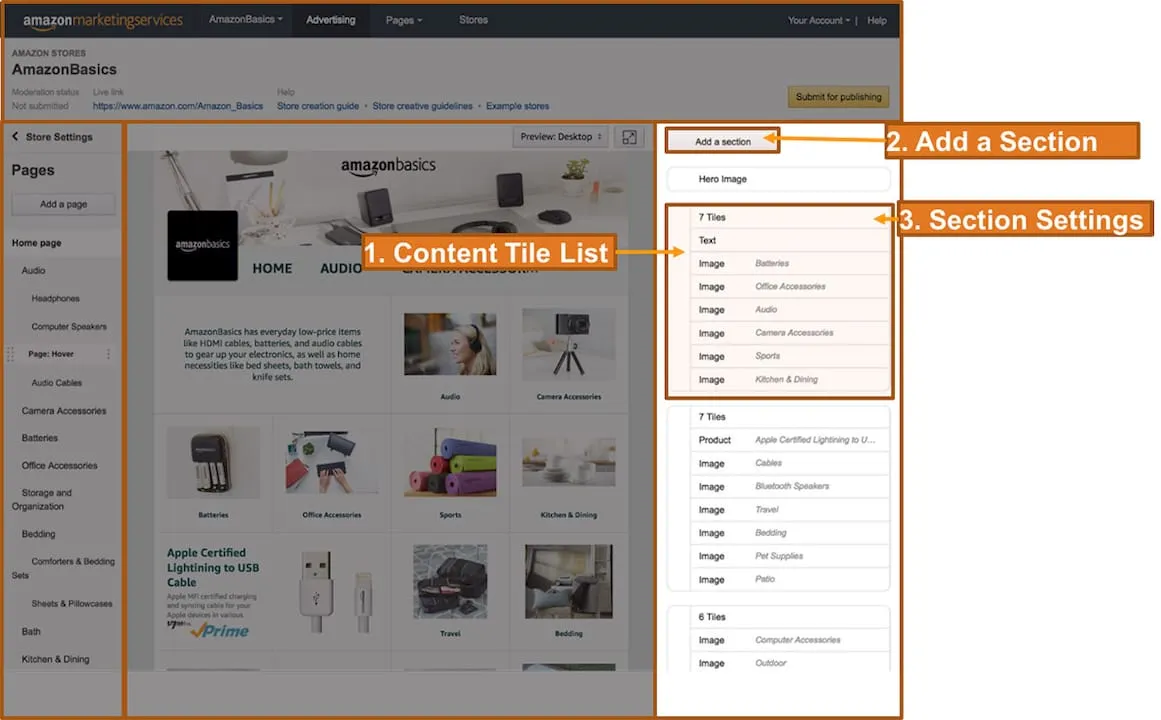
Amazon’s guidance describes Brand Stores as conversion engines during Prime Day, not static pages. It suggests deal pages and interactive tools like product selectors or quizzes to guide shoppers when traffic spikes. If you run Sponsored Brands, send shoppers to a store page built for the deal, not the home page.
Phase 2: The event (the 96 hours)
Structure campaigns across the funnel
A full-funnel structure is the backbone of the strongest approaches. Here is a simple way to organize it:
- Sponsored Products: Capture high-intent searches for your discounted items. Defend branded terms and push the best-converting non-branded keywords.
- Sponsored Brands: Build visibility on category terms and drive shoppers to the deal page or Store.
- Sponsored Display and DSP: Reach in-market audiences and retarget product page viewers.
The point of coordination is that each format feeds the others. Amazon’s reported 137% sales increase came from advertisers using all three ad types, not one.
Push money behind discounted items
A discount without ad support is invisible. Focus spend on items with live deals and prioritize Top of Search placements on your most important keywords. Treat non-deal items carefully. They can ride on halo effects, but they should not take budget from items with a visible price advantage.

Optimize while the event runs
Don’t set and forget. Amazon’s expert advice says successful teams use the extended timeline to rotate creative, reallocate spend from low-pacing to high-converting campaigns and adjust bids on real-time KPIs. Skai makes the same point: winners focus on mid-flight optimization rather than relying on the plan they built weeks earlier.
A daily rhythm that works:
- Morning check: Compare pacing and CPC to your baselines. Raise budgets on campaigns that are capping out early with strong conversion.
- Midday check: Pause or cut keywords with spend and no orders. Swap creative on ads with weak CTR.
- Evening check: Review inventory and deal status. Move budget to products still in stock and still discounted.
- End of day: Log what changed, so you can learn from it next time.
Watch the other channels
If you sell on Walmart too, you are competing for attention in the same weeks. Our guides on managing ad spend across Amazon, Walmart and Shopify and the Walmart advertising workflow show how to split budgets without starving either channel.
Phase 3: After the event
Many brands cut ads the moment the event ends. That is a mistake. Amazon’s advice describes post-event remarketing as a distinct phase: shoppers who viewed or clicked during the peak but did not convert. Reaching them with Sponsored Display and Amazon Marketing Cloud audiences often returns more than chasing new-to-brand customers.
What to do in the week after:
- Build audiences from product viewers and cart-adders who did not buy.
- Keep top keywords live while demand is still warm, then taper budgets gradually.
- Review which creative, keywords and placements beat baseline. Record them as your playbook for the next event.
- Check inventory and rank. A big event can change your sales rank and stock position for weeks.
Where the budget goes: one operating system, not silos
Skai argues the best brands run Prime Day as an operating system that shares signals across retail media, paid search and paid social, capturing intent before, during and after the event. In practice, that means one team looking at total revenue and profit, not three teams optimizing separate dashboards.
Measure what matters:
- Total sales and profit, not only attributed ad sales.
- TACoS, to see whether ads are growing the business or just buying existing demand.
- New-to-brand share, to see whether you’re finding customers or just repeating sales.
- Incrementality, where you can measure it.
One reported benchmark shows what’s possible. In 2025, Amazon’s guide reports Prime Day ad spend rose 198% while revenue rose 197% against a 30-day baseline. That is roughly proportional, which tells you that scaling spend should be tied to a plan for returns rather than assumed to improve efficiency.
Our perspective
We manage Amazon, Walmart and Shopify programs for mid-market and enterprise brands, and the pattern is consistent. The brands that win Prime Day decided what they were optimizing for long before the event. Profit-first advertising means setting a margin floor for every ASIN, then letting spend follow it.
We also see event performance decided by things that are not ad settings. Detail pages, imagery, inventory and reporting speed often matter more than a bid change. Our in-house creative studio exists because fresh creative is one of the most useful levers mid-event, and waiting days for new assets costs sales. Our iDerive analytics platform exists for the same reason: you can only reallocate spend at hour 30 if you can see what is working at hour 30, across channels, in business language rather than a pile of exports.
Our advice: write the plan, set the baselines, decide in advance what triggers a budget shift, and build the creative variants before the event starts. Then spend the four days making decisions, not scrambling for data.
— Dan Katona
Getting help with your next event
If your team is stretched across Amazon, Walmart and a D2C site, an outside partner can take on the planning, creative and live optimization. Nectar offers Amazon Growth & Optimization and Amazon sponsored ads management, backed by in-house creative and the iDerive analytics platform. You can also read our own Prime Day 2026 breakdown of what top brands did.
A readiness checklist for the next event
Use this list roughly 45 days before the next Amazon event:
- Choose the ASINs you will promote and confirm their margins at deal prices.
- Request deals early and confirm they are approved and scheduled.
- Audit the detail pages, A+ content and Brand Store for those ASINs.
- Produce creative variants: at least two image and video options for each hero product.
- Document your baselines and mid-event triggers, such as when to raise or cut a budget.
- Plan inventory with a buffer for both the event and the post-event tail.
- Set the post-event audiences and budget taper before the event starts.
FAQ
What are the top strategies for Amazon Prime Day?
The core strategies are a full-funnel campaign structure, early awareness building, spend focused on discounted items, live optimization and post-event remarketing. Preparation underpins all of them: clean data, conversion-ready listings and sufficient inventory. Amazon’s own guide highlights combining Sponsored Products, Sponsored Brands and display.
Do CPCs go up during Prime Day?
Not necessarily. Skai’s 2025 data showed Amazon CPCs fell 10.4% versus pre-event levels while CTR rose. Results vary by category and brand, so set your own baseline in the 30 days before the event and compare against it.
How early should I start Prime Day advertising?
At least two weeks before, and ideally with a 30-day data-gathering window behind you. Scale budgets gradually in the days before the event. Starting late leaves you with no baselines and forces you to make expensive guesses mid-event.
Should I keep advertising after Prime Day ends?
Yes. Shoppers who engaged but did not buy are a distinct audience, and retargeting them with Sponsored Display or Amazon Marketing Cloud audiences often returns more than new-customer acquisition. Taper budgets gradually rather than switching off.
Sources
- Prime Day 2026: Advanced advertising strategies, Amazon Ads
- Profitable Amazon Ads event strategy: Annual planning tips, Amazon Ads
- Prime Day tips for small-business owners and authors, Amazon Ads
- Quarterly Trends Report, Skai
- Prime Day 2025: How to Win With a Commerce Media Strategy, Skai
- The retail media cage match, The Drum
- Prime Day 2026, Amazon.com
- Prime Big Deal Days 2026, About Amazon
Recommended