If your listing was flagged for a pesticide claim, the cause is almost always wording or imagery that implies your product prevents, kills, or repels pests, not the product’s actual formula. A practical path back to live is to audit your title, bullets, images, and A+ content, then gather your EPA Registration or Establishment Number or exemption documentation before you open a case.
TL;DR:
- Amazon scans titles, bullets, descriptions, A+ modules, packaging photos, and lifestyle images for claims that products prevent, kill, repel, or mitigate pests.
- U.S. resident sellers must pass Amazon’s pesticide course and enter EPA numbers that match the product label or an exemption attestation in the Pesticide Marking field.
- Exempt products and pesticide devices may still require an EPA Establishment Number; support exemptions with documents and never enter a raw material’s number.
- For exemptions, include a PR Notice citation; submit the label, manufacturer letter, and EPA references together, and escalate locked fields to Compliance.
What makes Amazon classify a listing as a pesticide
Amazon and the EPA do not judge a product by its chemistry alone. They look at marketing intent: any claim that a product prevents, kills, repels, or mitigates a pest puts it under FIFRA’s definition of a pesticide, regardless of whether the label ever uses the word “pesticide.” That standard is why a cutting board marketed as “antimicrobial” or a mattress pad advertised as “dust mite resistant” can get swept into the same review queue as an actual bug spray.
Automated scans pull keywords from every part of your listing, and forum reports from sellers confirm this often produces false positives on products that are not chemically pesticidal. The highest-risk words include:
- Antimicrobial, antibacterial, or antiviral
- Disinfect, disinfectant, or sanitize
- Repel, repels, or insect repellent
- Kills germs, kills bacteria, or kills mold
- Prevents mold, prevents mildew, or fungicidal/bactericidal
Check every surface where these words might hide: the title, bullet points, the description, A+ content modules, packaging photos, and lifestyle images that show a product being used in a way that implies medical or pest-control benefits.
Amazon’s listing requirements for pesticide products
Once a product is classified as a pesticide or pesticide device, Amazon requires specific data before the listing can go live or stay active. Sellers who skip these steps, or enter the wrong values, may end up gated.
- Complete the Pesticide Marking attribute. This field in Seller Central needs an EPA Registration Number, EPA Establishment Number, or an exemption attestation, and the data must match what is printed on the actual product label.
- Confirm seller eligibility. Amazon restricts pesticide sales on Amazon.com to sellers who are U.S. residents.
- Pass the pesticide eLearning course. Amazon requires an application and a passing score on its pesticide training before granting approval to list these products.
- Keep the data current. Amazon has communicated enforcement deadlines in the past, and incorrect or incomplete entries can trigger removal or lock the field entirely, which can complicate the compliance case.
Skipping a required step may contribute to a seller’s appeal being rejected.
FIFRA and EPA basics every US Amazon seller must know
The Federal Insecticide, Fungicide, and Rodenticide Act is the law behind Amazon’s entire pesticide policy. FIFRA defines a pesticide as any substance intended to prevent, destroy, repel, or mitigate a pest, and it requires those products to carry federal registration before sale in the United States.
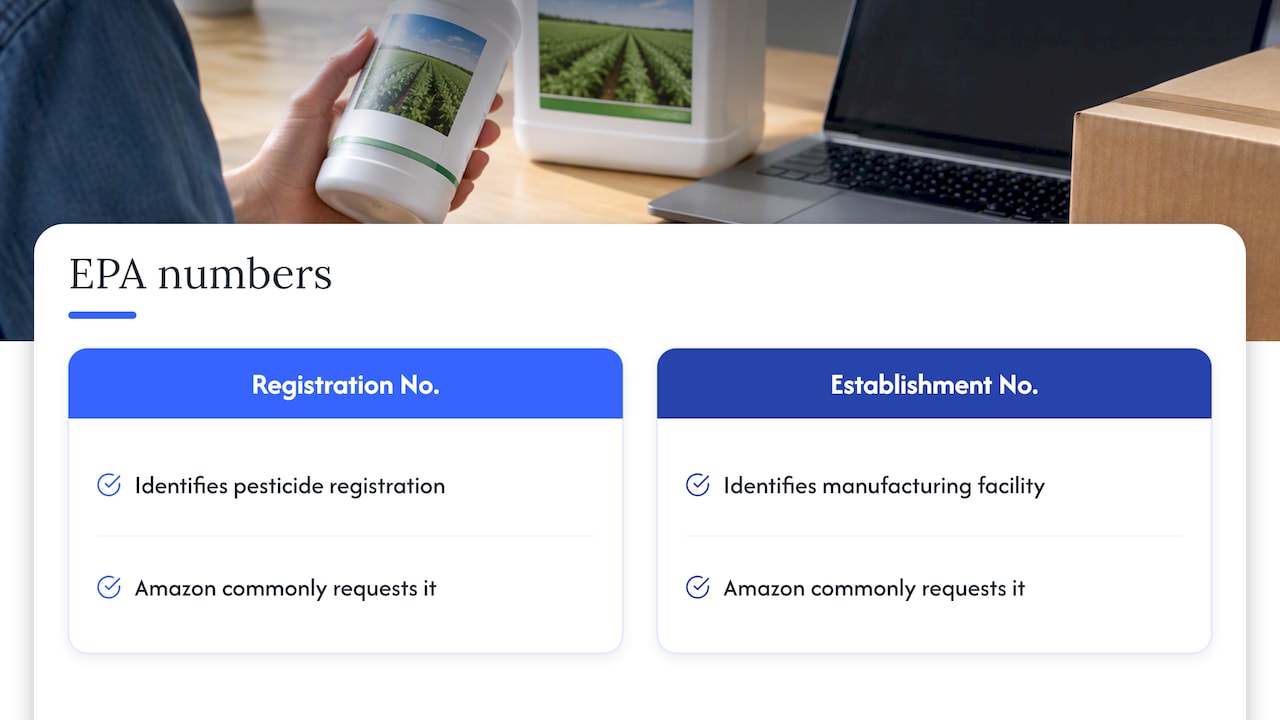
Two numbers matter most. The EPA Registration Number identifies a pesticide registration. The EPA Establishment Number identifies the facility where the product was manufactured, and Amazon commonly asks for both. This is not a theoretical requirement: the EPA has issued stop-sale orders directly to Amazon for unregistered and misbranded pesticides, including products making unapproved antiviral claims, and has publicly ordered Amazon to halt illegal pesticide sales on more than one occasion. That enforcement history is exactly why Amazon’s internal review is strict rather than arbitrary.
Exemptions and pesticide devices: what still needs paperwork
Not every product that reads as pesticidal needs full EPA registration, but “exempt” rarely means “no documentation.” Some products may qualify for an exemption from registration, but sellers should check Amazon’s requirements and have documentation supporting the exemption.
Pesticide devices fall into a separate category. Items like mechanical insect traps or UV bug zappers often do not require registration because they contain no active chemical ingredient, but forum cases show sellers still need an Establishment Number and supporting evidence to clear the gate. The two mistakes that trip up sellers most often.
- Assuming “exempt” means the Pesticide Marking field can be left blank
- Entering a raw material’s EPA number instead of the finished product’s registration or establishment details
Both errors read to Amazon’s system as missing or inaccurate data, which restarts the review clock.
Step-by-step remediation: fixing a pesticide claim or gated ASIN
Clearing a pesticide flag is a documentation exercise as much as a listing edit. Work through it in order.
- Audit and preserve. Screenshot the current title, bullets, images, and packaging, and pull the ASIN’s edit history so you have a record of what changed and when.
- Identify the classification. Determine whether the product is a registered pesticide, a pesticide device, or potentially exempt by checking the physical label and any manufacturer documentation.
- Correct or add the data. Remove unsupported pesticidal claims where you can, and enter the correct EPA Registration Number, Establishment Number, or exemption attestation in the Pesticide Marking attribute.
- Open a Compliance case with a complete bundle. Include the product label, a manufacturer letter confirming registration or exemption status, EPA reference numbers, and a PR Notice citation if you are claiming exemption, along with a short explanation of exactly what you changed.
- Follow up and escalate when needed. If Seller Support cannot access the compliance fields, ask explicitly for escalation to the Compliance team and resend the same documentation bundle rather than starting over.
Pro Tip: Keep every case ID and timestamp in one document. When a case gets reassigned, that record proves you already submitted the required evidence and often shortens the next reviewer’s response time.
For a broader look at how restricted-product cases move through Amazon’s review process, our guide on fixing hazmat review issues walks through a similar documentation-first approach.
Troubleshooting a locked Pesticide Marking field
Sellers frequently report that the Pesticide Marking field becomes locked or unreachable through the normal Edit Listing flow, usually after an earlier incorrect entry. A workaround several sellers describe is navigating from the SKU or SKU Economics page into Edit Listing rather than the standard product edit screen, which sometimes exposes the field again.
- Provide a manufacturer letter, product label scan, and PR Notice reference when the system misreads an exemption as a missing registration
- Document the full chronology of changes you made and when, with screenshots attached to each case update
- Ask directly for the Compliance team, not general Seller Support, since field unlocks usually require their intervention
Prevention checklist: avoiding the next pesticide flag
The best fix is the flag you never get. Build these checks into every new listing before it goes live.
- Replace pesticidal wording with accurate performance language: “odor-reducing finish” instead of “kills bacteria,” or “moisture-resistant fabric” instead of “prevents mold”
- Remove medical-looking icons, “kill” graphics, or disinfectant-style badges from packaging photos and A+ content modules
- Store supplier EPA documentation on file so it is ready the moment a case opens, rather than requested for the first time under pressure
Pro Tip: Run a quarterly pass on your full catalog using the same word list Amazon’s scanners use. Claims drift over time as copywriters and designers rotate, and catching it early is far cheaper than fighting a gate.
Our listing audit guide for Amazon and Walmart and image requirements checklist both cover the mechanics of this kind of recurring review.
Why compliance belongs in your regular catalog operations
Treating pesticide compliance as a one-time fire drill misses the point. The sellers who avoid repeat flags build claim review and image checks into their normal product launch process, the same way they check pricing or inventory. That alignment between what the listing says and what the label and manufacturer documents support is what actually prevents removals, not a faster appeal template.
— Dan Katona
Getting hands-on help clearing a pesticide gate for good
Chasing a Compliance case while also running ad campaigns and managing inventory stretches most internal teams thin, and a second flag on the same ASIN is often worse than the first. Our marketplace management services pair catalog audits with content remediation, so claim language, images, and A+ modules get corrected once and documented properly rather than patched repeatedly.

When the issue is imagery rather than wording, our creative and content production team rebuilds packaging shots and A+ content to drop pesticidal visuals while keeping the listing persuasive. If you want a full audit of your current catalog for compliance risk alongside growth opportunities, start with our Amazon Growth & Optimization services to see where claims, creative, and performance intersect.
FAQ
What words most often trigger a pesticide flag on Amazon?
Words like antimicrobial, antibacterial, disinfect, sanitize, repel, and mold-resistant are the most common triggers because they imply a pesticidal effect under FIFRA’s definition. These words get flagged even when they appear only in images or A+ content, not just the title or bullets.
Do I need an EPA number if my product is exempt under 25(b)?
Often yes. Minimum-risk products are exempt from full registration, but Amazon still typically expects an EPA Establishment Number and accurate label data to document that exemption.
How to file a safety claim on Amazon for a pesticide-related issue?
Pesticide exposure incidents can be reported through the EPA’s incident reporting process. Contact the National Pesticide Information Center or a healthcare provider immediately for any exposure before filing the report.
What are signs of pesticide poisoning I should know before reporting an incident?
Pesticide poisoning symptoms vary by the specific agent, route of exposure, and dose, so there is no single universal sign. Clinical guidance for recognizing and managing pesticide poisonings directs health care providers to assess exposure case by case rather than relying on a short symptom checklist.
How long does it take to get a pesticide-flagged listing reinstated?
Timelines vary by case complexity, but listings with a complete documentation bundle (label, manufacturer letter, EPA numbers or exemption attestation) in the first submission tend to clear faster than cases that go back and forth over missing evidence. Escalating directly to the Compliance team when Seller Support cannot access the Pesticide Marking field also shortens the process.
Recommended