Why Protect Brand Equity Online: A 2026 Guide
.webp)

TL;DR:
Protecting online brand equity is a vital capital investment that sustains customer trust and long-term shareholder value.
A proactive, cross-functional approach with trademark registration, AI monitoring, and measurement ensures effective defense against digital threats.
Brand equity online is the measurable value and trust your brand holds with customers, and protecting it is the single most consequential decision a brand manager makes in the digital era. For mid-sized and enterprise e-commerce businesses operating across Amazon, Walmart, and Shopify, brand equity is not a soft metric. It determines pricing power, customer retention, and long-term shareholder value. This guide explains why protecting brand equity online matters, what threatens it, and how to build a protection program that pays for itself.
Why protect brand equity online: the financial case
The financial argument for protecting brand equity is more concrete than most marketing budgets reflect. Cutting $1 of brand investment today costs $1.92 to regain lost market share, and 75% of marketers report that brand cuts are more damaging now than five years ago. That asymmetry means every dollar you fail to defend compounds into a future recovery cost that dwarfs the original savings.
The connection between brand equity and financial outcomes runs deeper than marketing spend. Trust drives purchase decisions for 68% of customers, and brands that fail to protect their identity show 10 percentage points lower total shareholder value compared to brands that maintain trust. That gap is not theoretical. It shows up in quarterly earnings, customer lifetime value, and the cost of paid media.
Brand investment acts like capital: sustained brand marketing produces compounding returns, while underfunding leads to rapid depreciation that requires costly recovery. The implication for brand managers is direct. Brand protection is not a line item to cut when budgets tighten. It is a capital allocation decision with measurable ROI.
Many organizations mistakenly treat brand protection as an operating expense rather than a capital investment, which causes them to underfund it and miss long-term value creation. Reframing protection as investment changes how finance teams evaluate it and how brand managers justify the budget.
Pro Tip: Calculate brand protection ROI using two components: “hard recovery” (the monetary value of counterfeit listings removed and revenue protected) and “soft recovery” (customer lifetime value preserved through maintained trust). Most budget justifications only count hard recovery, which systematically undervalues the program.
What digital threats most commonly erode brand equity?
The threat surface for e-commerce brands has expanded significantly. Counterfeit listings, brand impersonation, phishing, fake reviews, and content scraping are the five most damaging digital threats to brand equity, and each operates through a different attack vector.
Understanding each threat type is the first step toward prioritizing your monitoring and enforcement resources:
-
Counterfeit product listings appear on Amazon, Walmart, and third-party marketplaces, undercutting your pricing and delivering poor customer experiences that generate negative reviews attributed to your brand. A single viral complaint about a counterfeit product can suppress conversion rates across your legitimate listings.
-
Brand impersonation on social media and domains creates confusion at the point of discovery. Fake Instagram accounts, lookalike domains, and unauthorized Google Ads using your brand name intercept customers before they reach your verified storefront.
-
Phishing and spoofing attacks use your brand’s visual identity to defraud customers through fake emails, fraudulent checkout pages, and spoofed customer service channels. Each incident erodes the trust customers associate with your brand, even when your systems were never compromised.
-
Fake reviews dilute the authenticity of your product ratings and mislead purchase decisions. On Amazon specifically, coordinated fake review campaigns can suppress your organic ranking and inflate competitor visibility.
-
Content scraping copies your product descriptions, images, and brand assets for use on unauthorized reseller pages or competitor listings, weakening your intellectual property position and diluting your brand voice across the web.
Effective monitoring requires coverage across marketplaces, search engines, social media platforms, app stores, and domain registries. AI-driven monitoring tools can scan these channels continuously, flagging new threats before they scale. Nectar’s approach to e-commerce brand protection covers the full channel stack, which is where most mid-sized brands have blind spots.
How do effective brand protection programs operate?

A brand protection program that actually works is a cross-functional operation, not a legal department side project. Legal teams play a critical governance role in defining what constitutes infringement, prioritizing threats, and coordinating enforcement workflows. Without that governance layer, marketing and e-commerce teams make inconsistent decisions that create legal exposure.
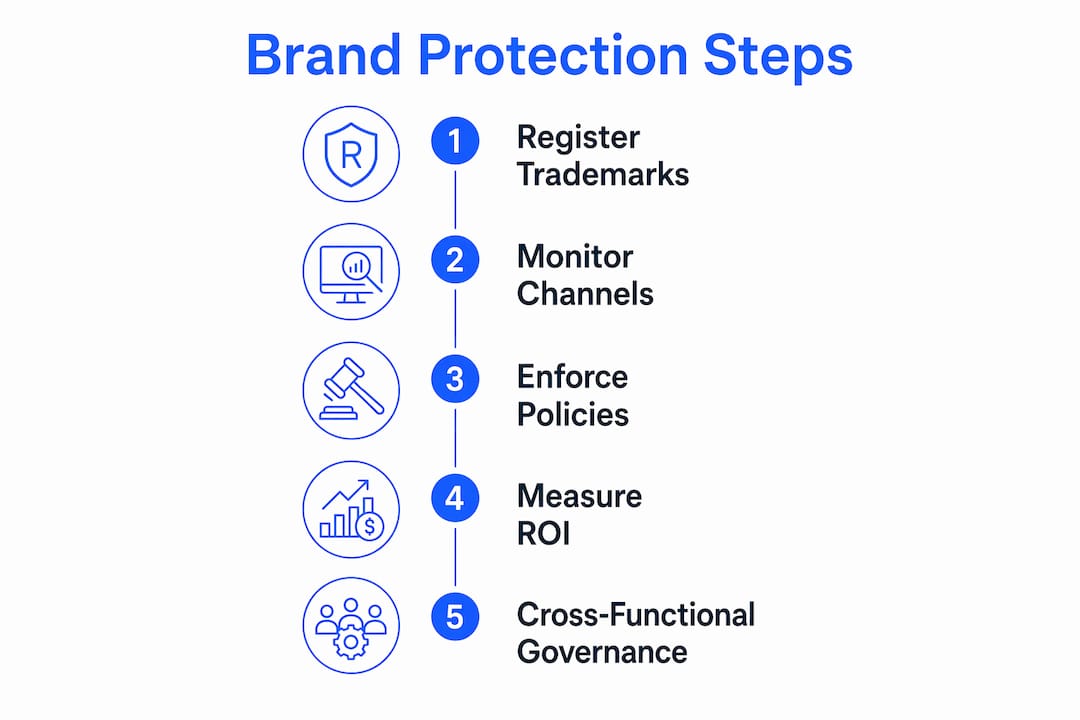
The operational structure of a high-performing program follows a clear sequence:
-
Define infringement criteria with legal. Establish documented thresholds for what triggers enforcement action, from counterfeit listings to unauthorized brand use in paid search. This prevents ad hoc decisions and creates a defensible audit trail.
-
Triage threats by business impact. Not every violation warrants the same response. A counterfeit listing on Amazon during peak season requires immediate takedown. A low-traffic lookalike domain may warrant monitoring before escalation. Prioritization by revenue impact and customer exposure is the difference between a program that scales and one that drowns in alerts.
-
Coordinate across marketing, legal, and e-commerce teams. Brand protection decisions affect advertising budgets, listing strategy, and customer communications. A siloed legal response misses the downstream commercial impact.
-
Track repeat offenders and maintain audit trails. AI-driven monitoring and legal workflows reduce noise, prioritize high-risk threats, and improve enforcement speed. Platforms like BrandShield build repeat offender profiles that accelerate future enforcement and support litigation if needed.
-
Implement technical controls at the infrastructure level. Trademark registration and controls like DMARC, BIMI, and VMC are foundational. Without trademark registration, automated protection on major marketplaces is impossible. DMARC and BIMI authenticate your email domain and display your verified logo in email clients, which directly reduces phishing success rates.
Pro Tip: Register your trademark in every market where you sell, not just your home country. Amazon’s Brand Registry, Walmart’s Brand Portal, and most major marketplace protection programs require a registered trademark in the relevant jurisdiction before they will act on your takedown requests.
What strategic steps protect and grow brand equity online?
Protecting brand equity is not a one-time project. It is an ongoing management discipline that requires the same rigor as your advertising or inventory strategy. The most effective programs combine legal foundations, proactive monitoring, channel hardening, and measurement frameworks that connect brand health to commercial outcomes.
Brands that activate online equity effectively increase conversion rates and reduce dependence on promotions, maintaining pricing power without sacrificing margin. That outcome is the direct result of consistent brand protection, not just strong creative.
The strategic priorities that deliver that outcome include:
-
Build your trademark and copyright portfolio first. Register trademarks in the US, EU, and any market generating meaningful revenue. Copyright your product photography and brand assets. These registrations are the legal prerequisites for automated enforcement on Amazon, Walmart, and Google.
-
Set up proactive monitoring across all key channels. Manual monitoring does not scale. Use AI-based tools to scan marketplaces, social platforms, domain registries, and app stores continuously. The goal is detection before customer exposure, not cleanup after damage.
-
Harden your digital channels against impersonation. Claim your brand handles on every major social platform, even those you do not actively use. Implement DMARC, BIMI, and VMC on your email domain. Register common typosquat domains and redirect them to your verified storefront.
-
Educate customers and channel partners. Publish clear guidance on where to buy authentic products. Partner with authorized resellers to maintain consistent pricing and presentation. Customer education reduces the effectiveness of counterfeit and impersonation attacks by raising awareness before a fraudulent interaction occurs.
-
Measure brand health with metrics tied to sales outcomes. Track brand search volume, review sentiment, conversion rate by channel, and pricing premium versus category average. Strong brand equity provides a buffer during crises, allowing brands to maintain pricing power even under market volatility. That buffer only exists if you are measuring it before you need it.
For brands scaling across multiple channels, data-driven e-commerce strategies that integrate brand health metrics with performance data give you the clearest signal on where equity is being created or eroded.
Key takeaways
Protecting brand equity online requires treating it as a capital investment, not an operating cost, because the financial penalty for neglect compounds faster than most budgets account for.
Point: Financial cost of neglect Cutting $1 of brand investment costs $1.92 to recover, making protection far cheaper than remediation.
Point: Trust drives shareholder value Brands that maintain customer trust show 10 percentage points higher total shareholder value than those that do not.
Point: Trademark registration is non-negotiable Without registered trademarks, automated enforcement on Amazon, Walmart, and major marketplaces is unavailable.
Point: Cross-functional governance matters Legal, marketing, and e-commerce teams must operate from a shared policy to enforce consistently and at scale.
Point: Measure both hard and soft recovery ROI calculations that include only removed counterfeits undercount the full value of brand protection programs.
The shift I keep seeing brands get wrong
Most brand managers I work with understand that brand equity matters. Where they consistently fall short is in the timing of their response. They build protection programs reactively, after a counterfeit surge or a phishing incident has already damaged customer trust. By then, the cost of recovery is already baked in.
The brands that protect equity most effectively treat it the same way a CFO treats capital. They invest before the threat materializes, they measure the return on that investment with the same discipline they apply to paid media, and they involve finance in the conversation from the start. That last point is the one most brand teams skip. When finance understands that brand equity acts as a crisis buffer that preserves customer loyalty when market conditions turn volatile, the budget conversation changes entirely.
I have also watched the AI monitoring tools mature significantly in the past two years. The noise-to-signal ratio has improved to the point where a lean brand protection team can manage enterprise-scale enforcement without a large legal headcount. The constraint is no longer technology. It is the internal alignment to act on what the tools surface. That means getting legal, marketing, and e-commerce into a shared workflow before the first alert fires, not after.
The brands that will win on Amazon, Walmart, and Shopify in 2026 are not the ones with the biggest ad budgets. They are the ones that have built brand loyalty in e-commerce through consistent identity, protected intellectual property, and customer trust that no counterfeit can replicate.
— Dan Katona
How Nectar protects and grows your brand equity
Brand equity is only as strong as the systems protecting it. Nectar works with mid-sized and enterprise e-commerce brands to build and defend brand value across Amazon, Walmart, and Shopify, combining creative excellence with data-driven performance management.
Powered by the iDerive analytics platform, Nectar gives brand managers the granular visibility to detect equity erosion early, optimize listings for conversion, and scale profitably without sacrificing brand integrity. From trademark-backed marketplace enforcement to full-funnel digital marketing strategies that build lasting brand recognition, Nectar provides the infrastructure for sustainable growth. Explore Nectar’s full service offering to see how the agency protects and accelerates brand equity for brands ready to scale smarter.
FAQ
Why is brand equity important for e-commerce businesses?
Brand equity determines pricing power, customer loyalty, and conversion rates without relying on discounts. Brands with strong equity reduce paid media costs because their organic presence does more of the conversion work.
What are the biggest risks of not protecting brand equity online?
Counterfeit listings, brand impersonation, and phishing attacks erode customer trust and suppress sales. BCG research shows that brands losing customer trust show 10 percentage points lower total shareholder value than competitors who maintain it.
How do you measure the ROI of a brand protection program?
ROI combines hard recovery (monetary value of removed counterfeits) and soft recovery (preserved customer lifetime value and brand trust). Only 34.1% of brands currently measure the economic value of counterfeit listings removed, which means most programs are underreporting their actual return.
What technical controls are most effective for online brand protection?
Trademark registration is the prerequisite for marketplace enforcement programs on Amazon and Walmart. Technical controls including DMARC, BIMI, and VMC authenticate your email domain and brand identity, directly reducing phishing attack success rates.
How often should brand managers audit their brand protection program?
Brand protection requires continuous monitoring, not periodic audits. AI-driven platforms can scan marketplaces, social media, and domain registries in real time, which is the standard for enterprise-scale programs in 2026.
Recommended






















































.webp)