TL;DR:
- Dynamic pricing adjusts product prices based on market conditions, demand signals, and competitors in real time. Most enterprise brands combine multiple models, such as time-based, demand-based, and inventory-based strategies, to optimize margins and customer trust. Success requires clean data, clear goals, cross-functional alignment, experimentation, and transparent communication with customers.
Dynamic pricing is the practice of adjusting product prices in real time based on market conditions, demand signals, inventory levels, and competitor behavior. Modern systems can recalculate prices every minute or faster, replacing the old model of fixed promotions with continuous price optimization. For e-commerce managers at mid-sized and enterprise brands, this dynamic pricing strategy guide covers the models, infrastructure, implementation steps, and ethical guardrails needed to run a pricing program that grows margin without burning customer trust.
What are the key dynamic pricing models?
Dynamic pricing models are best understood as a tool kit. No single model fits every product category. The right approach blends two or more models based on your market dynamics, product lifecycle, and margin targets.

Time-based pricing adjusts prices according to time of day, day of week, or season. Airlines and hotels pioneered this model. E-commerce brands apply it during peak shopping windows like Black Friday or back-to-school season, where demand spikes are predictable and margin capture is highest.
Demand-based pricing ties price directly to purchase velocity. When a product sells faster than forecast, the price rises. When velocity slows, the price drops to stimulate conversion. This model works best for high-turnover SKUs where real-time sales data is reliable and clean.
Inventory-based pricing uses stock levels as the primary input. As inventory falls below a threshold, prices increase to slow sell-through and protect availability. As overstock builds, prices decrease to clear units. This model is especially useful for brands managing warehouse costs on Amazon or Walmart, where storage fees compound quickly.
Competition-based pricing monitors rival listings and adjusts your price relative to a target position, such as matching the lowest price or staying within a defined band above it. Shopify distinguishes this approach from demand-based models because it reacts to external signals rather than your own sales data.
Segmented and personalized pricing sets different prices for different customer groups based on geography, loyalty tier, or browsing behavior. This model carries the highest margin potential but also the highest risk of perceived unfairness if not communicated carefully.
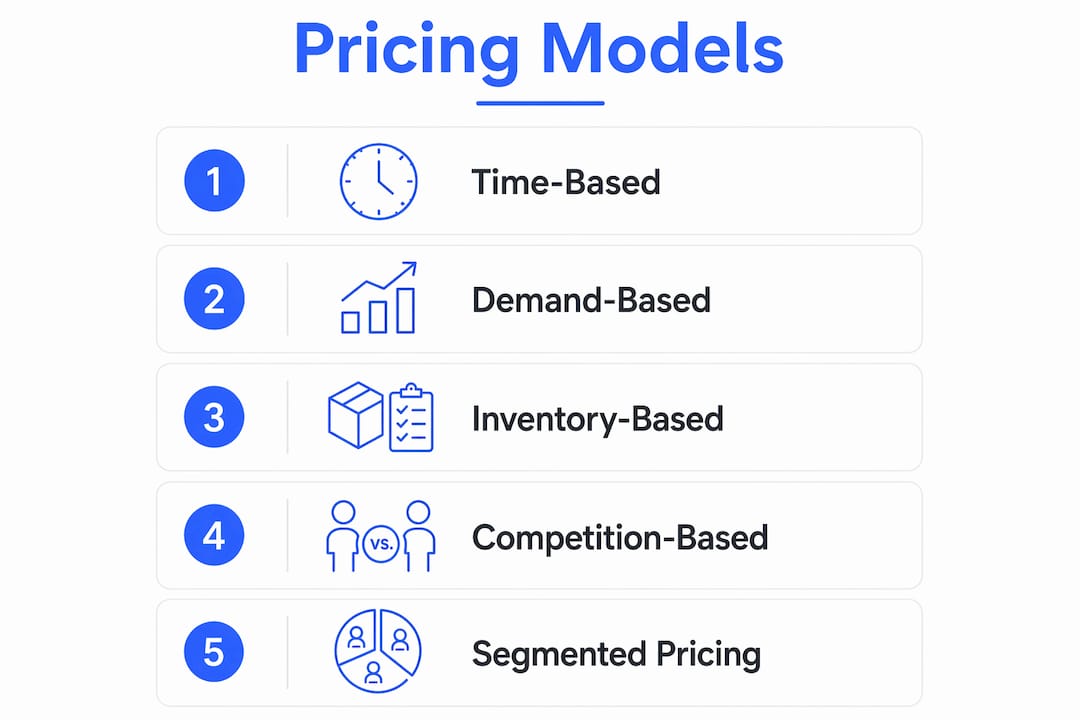
Most enterprise brands blend three or more of these models. A consumer electronics brand might use competition-based pricing as a floor, demand-based pricing to capture spikes, and inventory-based pricing to manage end-of-life SKUs. The blend is what separates a mature pricing program from a reactive one.
How to prepare your data and organization for dynamic pricing
A dynamic pricing program fails without clean data and aligned teams. Before selecting any software, address these four prerequisites.
-
Define your business goals. Margin improvement, inventory turnover, and competitive positioning are three distinct objectives. Each requires different model weights and success metrics. Mixing them without a clear priority order produces conflicting price signals.
-
Narrow your initial scope. Start with one product category or one channel. A pilot on your top 50 Amazon SKUs generates cleaner learnings than a full-catalog rollout. Stripe recommends this phased approach as part of its end-to-end deployment sequence.
-
Build connected data sources. Dynamic pricing algorithms consume historical sales data, site traffic, inventory counts, and competitor prices. Each source must be clean, current, and integrated into a single pipeline. Stale or siloed data produces prices that are wrong in ways you cannot easily detect.
-
Align your teams. Pricing decisions touch marketing, finance, operations, and customer service. Before launch, address competitive dynamics, brand impact, and communication plans across all four functions. A price change that surprises your customer service team will produce inconsistent responses to buyer complaints.
Pro Tip: Run a data audit before selecting pricing software. Map every data source your pricing engine will consume, identify gaps or latency issues, and fix them first. Software cannot compensate for bad inputs.
How to implement a dynamic pricing system step by step
Implementation follows a defined sequence. Skipping steps, especially experimentation and guardrails, is the most common reason pricing programs underperform or cause brand damage.
-
Select a pricing engine. Your engine must match your update cadence. Real-time pricing changes prices every few minutes using algorithms. Scheduled pricing applies rule-based updates on fixed cycles, such as daily or weekly. Real-time offers more agility but requires stronger analytics infrastructure. Scheduled pricing is easier to manage and audit, making it the better starting point for most mid-sized brands.
-
Set rules and constraints. Every pricing engine needs guardrails. Oracle’s Lifecycle Pricing Optimization documentation defines two types. Hard constraints are never violated: minimum margin floors, MAP (minimum advertised price) agreements, and legal price limits. Soft constraints reflect business preferences, such as staying within 5% of a competitor’s price, and can be overridden by higher-priority rules. Define both before your engine goes live.
-
Design structured experiments. Before a full rollout, run controlled tests with holdout groups. A holdout group receives static prices while the test group receives dynamic prices. The difference in conversion rate and margin between the two groups measures the true impact of your pricing changes. Stripe emphasizes formal test plans and rollback logic as non-negotiable parts of a safe launch.
-
Launch with rollback mechanisms. Your first live deployment should cover a subset of SKUs or a single channel. Build a rollback trigger into your system so that if margin drops below a threshold or conversion falls sharply, prices revert to a safe baseline automatically. This protects revenue while you tune the model.
-
Monitor and tune continuously. Dynamic pricing is not a set-and-forget system. Review price elasticity data weekly, check for competitor reactions, and adjust model weights as market conditions shift. Brands that treat launch as the finish line consistently underperform those that treat it as the starting point.
“Align frequency of price updates with operational cadence and customer tolerance. Real-time updates offer agility but increase complexity and require robust analytics, while scheduled pricing offers operational predictability.” — Shopify
How should you communicate dynamic pricing to customers?
Customer acceptance of dynamic pricing depends more on perceived fairness than on the math behind the price. Wharton research shows that framing price changes as dynamic discounting, where prices start from a fixed reference point and move down for qualifying customers, generates positive sentiment and loyalty. Framing the same price change as an opportunistic increase generates backlash.
The practical implications for e-commerce managers are direct:
-
Lead with discounts, not surcharges. Show customers the regular price and the current lower price. This frames dynamic pricing as a reward, not a penalty.
-
Be transparent about triggers. If prices rise during high demand, a brief message like “prices adjust based on availability” reduces the perception of unfairness. Customers accept scarcity pricing more readily when they understand the mechanism.
-
Protect loyal customers. Segment your pricing so that loyalty program members receive price stability or early access to lower prices. This reinforces the value of the relationship and reduces churn risk when prices rise for new buyers.
-
Avoid extreme price swings. A price that doubles overnight, even if algorithmically justified, reads as price gouging. Soft constraints in your pricing engine should cap single-event price increases at a level your brand can defend publicly.
-
Train your customer service team. Every pricing change should come with a brief internal explanation. When a customer calls about a price they saw yesterday, your team needs a clear, honest answer.
Pro Tip: Test your customer-facing price messaging with a small segment before full rollout. A/B test “limited-time price” against “price based on current demand” and measure which framing produces higher conversion and fewer support tickets.
Brands that treat flash sales and limited-time offers as a gateway to dynamic pricing often find the transition easier. Customers already understand that prices change. The step from a scheduled sale to a demand-responsive price is smaller than it appears.
Key takeaways
Dynamic pricing succeeds when clean data, explicit guardrails, structured experimentation, and transparent customer communication work together as a single system.
Point | Details
-
Define goals before models. Choose margin, turnover, or competitive positioning as your primary objective before selecting a pricing model.
-
Blend multiple models. No single model fits all SKUs. Combine time-based, demand-based, and inventory-based approaches for best results.
-
Set hard and soft constraints. Hard constraints protect margins and legal limits. Soft constraints protect brand positioning.
-
Experiment before scaling. Use holdout groups and rollback triggers to measure impact safely before a full-catalog rollout.
-
Frame pricing as value. Customers accept dynamic pricing when it reads as a discount or a fair response to scarcity, not as opportunism.
Why most dynamic pricing programs stall before they scale
I have watched pricing programs at mid-sized brands launch with real momentum and then quietly stall six months in. The pattern is almost always the same. The team nails the technology selection, builds a clean data pipeline, and runs a solid pilot. Then the program hits its first competitor reaction, or a customer complaint goes viral on social media, and leadership loses confidence. The pricing engine gets throttled back to near-static rules, and the investment never pays off.
The lesson I keep coming back to is this: dynamic pricing is not a software problem. It is a change management problem. The brands that scale successfully are the ones that built internal alignment before launch, not after the first crisis. They prepared answers to the hard questions, including how to respond when a competitor undercuts them by 20%, what the brand’s public position on demand-based pricing is, and how to measure customer lifetime value impact alongside short-term margin.
The other pattern I see is over-reliance on a single model. A brand picks competition-based pricing because it is the easiest to explain to leadership, and then wonders why margins erode every time a low-cost competitor enters the category. Blending models is not complexity for its own sake. It is the only way to protect margin while staying competitive. Pair competition-based pricing with a hard margin floor and a demand-based multiplier, and you have a system that can respond to a price war without destroying your P&L.
The brands I have seen execute this well share one habit: they treat pricing as a cross-functional discipline, not a finance function. Pricing, marketing, and analytics sit in the same room when the model is tuned. That collaboration catches problems that no algorithm surfaces on its own.
— Dan Katona
How Nectar supports your pricing and growth strategy
Pricing strategy does not exist in isolation. It works best when it connects to your advertising, creative, and channel management. Nectar builds full-funnel growth programs for mid-sized and enterprise brands on Amazon, Walmart, and Shopify, with data-driven decisions powered by the proprietary iDerive analytics platform.

Whether you are launching a pricing pilot on Amazon or building a channel-wide growth program, Nectar’s team brings the channel expertise and analytics depth to make it work. From listing optimization to advertising performance, Nectar’s e-commerce growth services are built for brands that want measurable results, not generic advice. If your pricing strategy needs a stronger foundation, Nectar is the place to start.
FAQ
What is dynamic pricing in e-commerce?
Dynamic pricing is the practice of adjusting product prices in real time based on demand, inventory, competition, and market conditions. Modern systems can recalculate prices as fast as every minute, replacing fixed promotional schedules.
What are the main dynamic pricing models?
The five core models are time-based, demand-based, inventory-based, competition-based, and segmented pricing. Most enterprise brands blend three or more models to match different product categories and margin targets.
How do you prevent dynamic pricing from damaging your brand?
Set hard constraints in your pricing engine to enforce minimum margins and MAP agreements, and use soft constraints to cap single-event price swings. Transparent customer communication and loyalty-tier protections reduce backlash risk significantly.
What data does a dynamic pricing system need?
A pricing engine requires historical sales data, real-time inventory counts, site traffic signals, and competitor price feeds. All sources must be clean and integrated before the engine goes live, as stale data produces prices that are wrong in ways that are hard to detect.
How is real-time pricing different from scheduled pricing?
Real-time pricing uses algorithms to update prices every few minutes based on live signals. Scheduled pricing applies rule-based updates on fixed cycles such as daily or weekly. Scheduled pricing is easier to manage and audit, making it the better starting point for most mid-sized brands.
Recommended



































































.webp)