TL;DR:
- Product lifecycle management unifies all aspects of a product’s journey from conception to end-of-life, improving collaboration and reducing errors. It manages five core stages with components like centralized data, BOM management, and change control, enabling cross-functional alignment. Proper organizational culture and process standardization are essential for successful PLM adoption and delivering business value.
Product lifecycle management (PLM) is defined as the strategic framework that unifies all processes, data, and people involved in a product’s journey from conception to end-of-life. Known formally as PLM, this discipline gives product managers and business leaders a single system to govern every stage of a product’s existence. Without it, teams operate in silos, decisions rely on outdated data, and costly errors compound from design through delivery. PLM fixes that by creating one connected process across engineering, marketing, supply chain, and service.
What is product lifecycle management and why does it matter?
PLM is the practice of managing a product’s entire cradle-to-grave lifecycle across five foundational stages: ideation and conception, design and validation, manufacturing and realization, service and support, and retirement or end-of-life. Each stage builds on the last. A decision made during design directly affects manufacturing cost, and a service issue in year three often traces back to a gap in the original validation process.
The importance of PLM goes beyond keeping files organized. PLM aligns supply chain, marketing, quality, and sales teams with real-time product data, eliminating outdated documentation and ensuring every decision is based on accurate information. That alignment is what separates companies that launch on time from those that spend months firefighting preventable problems.
PLM is also widely misunderstood as a tool built only for engineers. It is actually a central command hub for every stakeholder involved in a product’s lifecycle. Marketing teams use it to align launch timelines with product readiness. Supply chain teams use it to plan procurement around confirmed design specs. That cross-functional reach is what makes PLM a business framework, not just a technical one.
What are the core stages and components of PLM?
The five product lifecycle stages give PLM its structure, but the components within each stage give it its power. Understanding both is the foundation of any effective implementation.
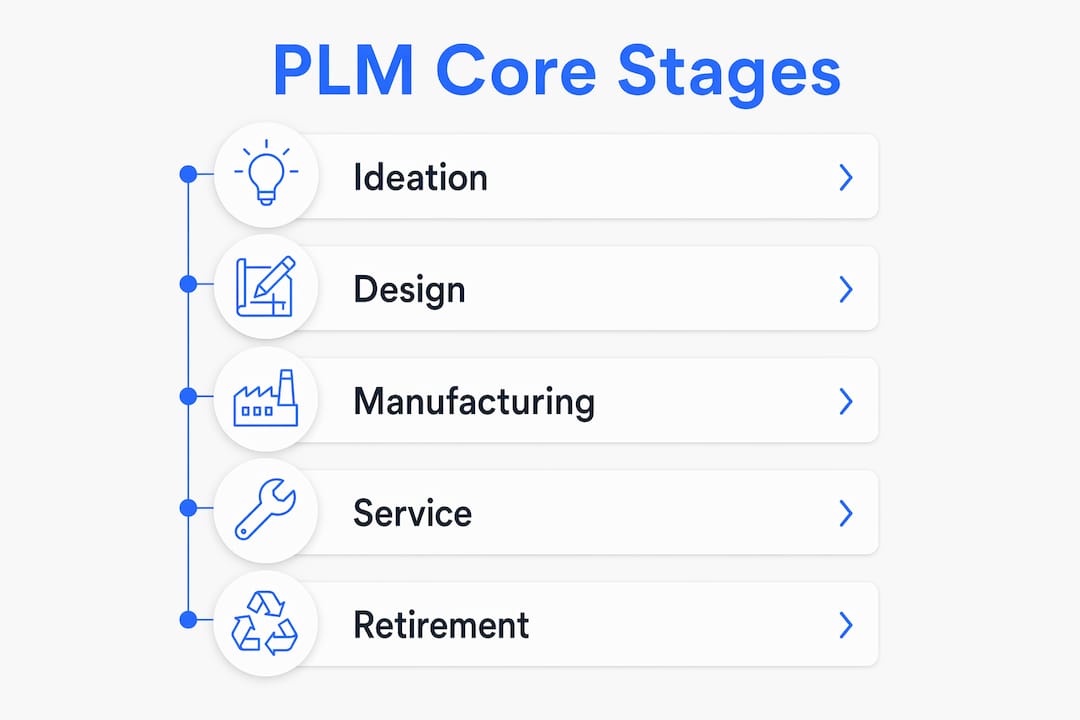
The five stages explained
Ideation and conception is where market research, customer feedback, and business goals converge into a product concept. Design and validation turns that concept into tested specifications using tools like CAD software and simulation. Manufacturing and realization moves validated designs into production, where bill of materials (BOM) management and change control become critical. Service and support covers the product’s active life in the market, including maintenance, updates, and customer feedback loops. Retirement or end-of-life addresses how a product is phased out, recycled, or replaced, a stage that directly informs design decisions for future products.
The core PLM components that run across all five stages include:
-
Centralized data vault. A single repository where all product data, documents, and specifications live. This prevents version conflicts and ensures every team works from the same source.
-
Bill of materials management. Tracks every component, material, and assembly required to build the product. Changes here ripple across procurement, cost modeling, and manufacturing.
-
Change management. Governs how design or specification changes are proposed, reviewed, approved, and communicated. Without it, unauthorized changes create quality and compliance failures.
-
New product introduction (NPI) tracking. Monitors progress from concept to launch, flagging delays before they cascade.
-
Quality control workflows. Embed quality checkpoints at each stage so defects are caught early rather than at final inspection.
Pro Tip: Map your existing product data before selecting any PLM software. Teams that catalog their current documents, BOMs, and workflows first spend far less time on data migration and avoid importing errors into the new system.
How does PLM improve collaboration and reduce inefficiency?
Data silos are the single biggest source of waste in product development. When engineering works from one version of a spec, procurement from another, and marketing from a third, errors multiply and timelines slip. PLM solves this by centralizing product data and workflows, creating one source of truth that all teams access in real time.
The practical gains from that centralization are significant. Here is how PLM reduces inefficiency across a typical product organization:
-
Eliminates duplicate data entry. When a design change is approved in PLM, it automatically updates the BOM, the manufacturing spec, and the procurement order. No one re-enters the same change in three separate systems.
-
Accelerates time-to-market. Teams stop waiting for email approvals or hunting for the latest file version. Workflows route tasks automatically, so reviews happen in parallel rather than sequentially.
-
Reduces rework costs. Quality issues caught at the design stage cost a fraction of what they cost to fix after production begins. PLM embeds review gates that surface problems earlier.
-
Improves compliance tracking. Regulatory requirements are attached directly to product records, so compliance teams always know which products are affected by a new standard.
-
Enables better supplier coordination. Suppliers access approved specs directly from the PLM system, reducing miscommunication and late-stage design surprises.
Integrating real-time market demand and customer feedback from the start maximizes PLM’s value beyond engineering. Static data repositories fail because they capture a moment in time. Dynamic workflow engines that link cross-functional teams in real time create the kind of responsiveness that actually moves the needle on launch speed and product quality.
Pro Tip: Assign a PLM process owner from outside engineering, ideally from operations or product management. This person ensures the system serves the full business, not just the technical team, and drives adoption across departments.
What practical tools and technologies support effective PLM?
The technology stack behind a well-run PLM program typically includes several categories of tools working together. Each serves a distinct purpose in the product lifecycle.
-
CAD software. Creates and stores the 3D models and technical drawings that define a product’s physical form. CAD data feeds directly into manufacturing and quality workflows.
-
Digital twins. Virtual replicas of physical products that simulate performance under real-world conditions. Teams use digital twins to test design changes without building physical prototypes, cutting both cost and time.
-
Predictive maintenance systems. Monitor products in the field and flag potential failures before they occur. This data feeds back into the design stage, informing improvements for the next product generation.
-
Workflow automation engines. Route tasks, approvals, and notifications automatically based on predefined rules. Automated workflows anticipate design impacts and compliance needs, which is critical for companies competing in global markets.
-
Digital thread platforms. Connect all product data, changes, approvals, and outcomes into a continuous, traceable record. The digital thread connecting lifecycle stages tracks every decision from ideation through retirement, making it possible to understand why a product performs the way it does.
The most common implementation mistake is what practitioners call “lift and shift.” This means taking broken or manual processes and moving them directly into PLM software without fixing them first. Successful PLM requires process standardization before digitization to produce meaningful gains. Automating a flawed process does not fix it. It locks the flaw in at scale.
For e-commerce brands managing product content alongside physical development, creative content workflows follow the same principle. Clean processes before automation, every time.

Pro Tip: Before evaluating PLM software vendors, document your current workflows in detail. Identify which steps add value and which exist only because “that’s how we’ve always done it.” Eliminate the latter before you build them into a new system.
How can businesses drive profitability and innovation through PLM?
PLM’s primary economic benefit is catching design flaws and inefficiencies before they reach production. Using CAD, digital twins, and predictive maintenance tools, companies reduce waste and prototype expenses before production scale-up. A defect found during digital simulation costs a fraction of what it costs to fix after tooling is cut or inventory is built.
The profitability gains from PLM show up in several concrete ways:
-
Fewer physical prototypes, because digital twins validate designs virtually before any material is cut.
-
Lower scrap and rework rates, because quality gates catch issues at the design stage rather than on the production floor.
-
Faster product launches, because parallel workflows replace sequential approval chains.
-
Better margin visibility, because profitability analytics tied to product data show the cost impact of design decisions in real time.
-
Stronger market positioning, because products reach shelves faster and with fewer defects than those developed without PLM discipline.
PLM also supports continuous improvement by feeding service and field data back into the design process. A product that generates high warranty claims in its second year should trigger a design review for its successor. That feedback loop is what turns a one-time launch into a compounding competitive advantage. Teams that connect retail readiness analytics to their PLM data can also align product availability with demand signals, reducing both stockouts and overstock.
What organizational shifts are essential for successful PLM adoption?
PLM adoption fails most often not because of software problems, but because of people problems. Organizations that treat PLM as a collaborative, data-driven process experience higher ROI than those that treat it as an IT deployment. The difference is cultural.
The shift required is from reactive to proactive product management. Reactive teams fix problems after they surface. Proactive teams use PLM’s workflow automation to anticipate issues before they become expensive. That shift requires clean data, defined processes, and leadership that actively supports cross-functional collaboration rather than just approving a software budget.
Many organizations underestimate the complexity of PLM adoption. Structured governance and cross-departmental buy-in are not optional extras. They are the foundation on which every other PLM benefit depends. A PLM system that only engineering uses is a file storage system with extra steps.
Pro Tip: Run a PLM pilot with one product line before rolling out company-wide. A contained pilot surfaces integration gaps, training needs, and process conflicts at a scale where they are easy to fix. It also builds internal champions who can advocate for the system across other teams.
Key takeaways
Effective PLM is the difference between a product organization that scales and one that constantly firefights the same problems at higher volume.
Point
Details
PLM spans five core stages
Ideation, design, manufacturing, service, and retirement each require distinct data and workflows to manage effectively.
Centralized data drives collaboration
A single source of truth eliminates version conflicts and keeps supply chain, marketing, and engineering aligned.
Fix processes before digitizing
Lifting broken workflows into PLM software locks in inefficiencies. Standardize first, then automate.
Early defect detection protects margin
Catching design flaws during simulation costs far less than fixing them after production begins.
Culture determines PLM success
Cross-departmental buy-in and structured governance matter more than software features in driving PLM ROI.
PLM is an organizational strategy, not a software purchase
I have watched product teams invest heavily in PLM platforms and see almost no return, and I have watched others run lean implementations that transformed how their entire business operates. The difference was never the software. It was whether leadership treated PLM as a business transformation or a technology project.
The teams that succeed treat PLM as the operating system for their product organization. They invest in data governance before the first license is signed. They assign process owners who have authority to enforce standards across departments. They measure PLM success by time-to-market, defect rates, and margin improvement, not by how many users logged in last month.
The uncomfortable truth about PLM is that it exposes organizational dysfunction. When you centralize product data, you quickly see which teams have been working from outdated specs, which approval processes have no accountability, and which suppliers have been receiving conflicting information. That visibility is uncomfortable. It is also exactly what you need to fix the problems that have been costing you money for years.
My advice: start with the question “what decisions are we making badly because we lack good product data?” The answer tells you exactly where PLM will deliver its fastest return.
— Dan Katona
How Nectar supports brands through every product stage
Bringing a product to market profitably requires more than a well-managed development process. It requires creative assets, advertising precision, and analytics that connect product data to real sales outcomes.
Nectar works with mid-sized and enterprise brands on Amazon, Walmart, and Shopify to align product launches with market demand, build high-converting creative, and manage full-funnel advertising. Nectar’s proprietary iDerive analytics platform connects profitability data directly to channel performance, giving brands the visibility they need to make faster, better decisions at every stage of a product’s commercial life. If your brand is ready to turn product development discipline into marketplace results, Nectar is built for that work.
FAQ
What is the product lifecycle definition in business?
The product lifecycle definition in business refers to the stages a product passes through from initial concept to market retirement, typically covering ideation, design, manufacturing, service, and end-of-life. PLM is the management framework that governs all of those stages.
What are the main benefits of product lifecycle management?
The core benefits of product lifecycle management include faster time-to-market, lower defect rates, reduced prototype costs, and better cross-functional alignment. Companies that implement PLM effectively also gain stronger margin visibility through earlier identification of design and process inefficiencies.
How do you implement PLM successfully?
Successful PLM implementation starts with process standardization before any software is deployed. Organizations that map and clean their existing workflows, assign cross-functional process owners, and run a pilot on one product line before scaling company-wide see the strongest results.
What is a digital thread in PLM?
A digital thread is a continuous, traceable record that connects all product data, changes, approvals, and outcomes across every lifecycle stage. It enables teams to understand the full history of any product decision and its downstream impact on quality, cost, and performance.
How does PLM differ from project management software?
PLM manages the full lifecycle of a product, including its physical data, BOMs, compliance records, and field performance, while project management software tracks tasks and timelines. PLM is product-centric and persistent across years; project management is task-centric and closes when a project ends.
Recommended












.png)