Walmart DSP gives advertisers programmatic access to Walmart’s retail-first audience data through four primary tactics: behavioral, contextual, keywords, and run-of-site, plus geoTargets that layer on top. The single best move is structural: pick one primary tactic per ad group, add geo constraints where they matter, and route every awareness impression into a retargeting pool that you can measure against actual Walmart transactions. Everything else is refinement.
TL;DR:
- Using a single primary targeting tactic per ad group is mandatory, with geo layers added separately and not combined within the same group.
- Custom audience segments rely on Walmart’s actual purchase and browsing data, making them more precise but requiring proper population checks before use.
- Linking awareness campaigns to retargeting pools immediately upon launch is critical to measuring true campaign performance and avoiding waste.
- Walmart DSP’s measurement capability directly connects digital impressions to verified Walmart transactions, emphasizing conversions and true sales over clicks or view-throughs.
- Creative assets must meet strict format specifications across placements, with hybrid strategies combining onsite, CTV, and offsite formats benefiting from consistent messaging and early testing.
What Walmart DSP Targeting Actually Supports
Every ad group in Walmart DSP runs on exactly one primary tactic. That’s not a suggestion, it’s a schema rule. You choose behavioral, contextual, keywords, or runOfSite, and the targeting object enforces it at the API level. Trying to blend two primary tactics into one ad group breaks the build.
Here’s what each tactic actually does:
- Behavioral targets shoppers based on purchase history, browse activity, or predictive propensity scores.
- Contextual places ads on pages tied to specific product categories, but negative contextual targeting isn’t supported, so you can’t exclude categories the way you can exclude keywords.
- Keywords works for search-adjacent placements and supports negative keyword lists.
- Run-of-site spreads impressions broadly across Walmart’s site inventory for reach plays.
Geo layering works differently. You can add Country (which defaults to United States), State, City, DMA, or Zip Code targeting on top of your primary tactic, but you cannot combine different geo types inside the same ad group. Pick city-level or DMA-level, not both. Behavioral and keyword tactics both allow negative targeting, which matters for excluding converted buyers or irrelevant search terms. Before launch, run a quick schema check: one primary tactic, one consistent geo type, negatives applied where the tactic allows them.
The Audience Palette: Pre-Built, Custom, and Predictive Options
Walmart Connect organizes audiences into a few functional tiers, and knowing when to use each one saves you from wasted spend on the wrong shopper pool.
- Pre-built behavioral segments cover recent buyers, lapsed buyers, and category shoppers. These refresh on a set cadence tied to purchase recency, so a “lapsed buyer” pool today looks different in 30 days.
- Personas and life-stage audiences group shoppers by lifestyle signals like new parents or pet owners, useful for brand campaigns that don’t need transaction-level precision.
- Custom rule-based audiences let you define criteria from purchase history, browse behavior, or ad exposure, with optional geo filters layered in, according to Walmart Connect’s guidance on customer insights.
- Predictive item-propensity audiences score shoppers likely to buy a specific SKU, which works well for new product launches or seasonal pushes where you have no purchase history yet.
- Lookalike or expansion audiences should stay in prospecting campaigns, not conversion-focused retargeting, since they trade precision for reach.
Sync custom audiences through the Asset Library and check population timelines before you assume a segment is live. Refresh and lookback windows vary by audience type, and launching against an audience that hasn’t finished populating is a common source of flat early performance.
Building Campaign Architecture That Actually Connects
Split your funnel into three distinct campaign types: awareness (CTV and video), mid-funnel consideration (broad display against personas), and conversion (retargeting against warm audiences). Keep them as separate campaigns, but connect them through reusable audience pools rather than treating each as an island.
The failure mode here is common enough that it’s worth naming directly: advertisers run a strong CTV push, generate real view-through interest, and never forward those viewers into a retargeting audience. The Trade Desk’s work with Walmart data points to exactly this gap. Without that handoff, you lose the ability to measure whether the awareness spend did anything.
Practical fixes:
- Capture CTV and video viewers into a dedicated retargeting list the moment the campaign launches, not after you review results.
- Use a stable naming convention across campaigns so an ad ops person six months from now can tell which pools feed which retargeting effort.
- Confirm the audience is actually populating before you shift budget from test to scale.
Pro Tip: Build your retargeting pool with a 14 to 90 day lookback window that matches your typical purchase cycle. A shorter lookback window works for impulse categories, while a longer window is generally recommended for considered purchases like appliances or furniture.
Measuring What Targeting Actually Delivers
Walmart’s closed-loop measurement links a digital impression directly to a verified Walmart transaction, whether that sale happens online or in-store. This is the mechanism that makes Walmart DSP fundamentally different from platforms working with modeled or third-party data.
Prioritize these metrics when you review campaign performance:
- Conversions and incremental sales, not just click volume.
- ROAS, measured against actual transaction data rather than estimated conversion rates.
- In-store attribution windows, since a meaningful share of retail media impact shows up offline.
- Audience lift, comparing exposed versus unexposed shoppers within the same segment.
CTV campaigns run through Walmart’s retail data can be tied to in-store purchases, giving advertisers a direct line from a video impression to a physical checkout, according to The Trade Desk’s analysis of Walmart DSP performance.
If a campaign’s reported ROAS looks disconnected from what your own sales dashboards show, check whether the upper-funnel channel actually fed the retargeting pool that gets measured. A broken handoff shows up as an underperforming campaign that was never actually tracked correctly.
Optimization Tactics That Move the Needle
Budget allocation should skew toward proof before scale.
- Set frequency caps by funnel stage. Awareness campaigns can run higher caps, since repetition builds recall. Retargeting campaigns need tighter caps, usually two to four impressions per week, or you risk fatiguing shoppers who’ve already seen your product.
- Build exclusion lists aggressively. Exclude recent purchasers from prospecting campaigns and exclude non-converters from your highest-frequency retargeting tier after a set window.
- Match creative format to tactic. CTV and video work best for broad awareness plays where you’re building recognition. Contextual placements perform better with creative that reinforces category relevance rather than brand storytelling.
- Run overlap checks between campaigns monthly. Two active custom audiences with heavy overlap just mean you’re bidding against yourself.
Pro Tip: If you’re testing a new predictive audience, run it alongside your best-performing pre-built behavioral segment for two to three weeks before reallocating budget. Predictive scores are directional, not guaranteed, and a short head-to-head test tells you more than the platform’s own confidence rating.
A Pre-Launch Checklist for Ad Group Setup
Run through this before any ad group goes live:
- Confirm one primary tactic is selected: behavioral, contextual, keywords, or run-of-site.
- Assign the correct audience and verify it has finished populating in the Asset Library.
- Set geoTargets using a single consistent geo type, never mixing State and DMA in one ad group.
- Apply exclusions where the tactic supports them (behavioral and keywords allow negatives, contextual does not).
- Set your lookback window to match the campaign’s funnel stage.
- Confirm frequency caps align with whether this is an awareness or retargeting ad group.
A quick schema note for teams building programmatic tools against the API: the Expression-Based structure offers more granular logic, while the Flattened Structure is simpler for straightforward builds. If you’re using Flattened Structure, use “exclude” rather than “not” for exclusions. The two structures aren’t interchangeable syntax.
After launch, watch three things in the first 48 hours: audience population counts, pacing against budget, and whether creative is rendering correctly across placements. Catching a rendering issue on day one beats discovering it after a week of wasted impressions.
How Nectar Applies These Rules in Client Campaigns
Nectar’s approach to Walmart DSP leans on iDerive, its proprietary analytics platform, to select audiences based on actual lift rather than platform-reported estimates alone. That means testing a predictive audience against a pre-built behavioral segment before committing budget, and tracking whether an awareness campaign’s viewers actually convert once they hit a retargeting pool.

Audience hygiene runs on a set cadence: stale or overlapping segments get pulled regularly, since overlap between custom audiences quietly drives up bidding inefficiency. Creative gets harmonized across CTV, display, and onsite placements so a shopper sees a consistent product story regardless of where the impression lands. Reporting follows a fixed cadence tied to campaign lifecycle stages rather than an arbitrary monthly check-in.
For brands managing this in-house without a dedicated retail media team, this is exactly the kind of implementation work a full-funnel Walmart DSP strategy is built to solve.
Onboarding Rules: What Brand Owners Need Before Launch
Getting into Walmart DSP isn’t the same process for every brand, and the path splits based on whether you’re running onsite or offsite campaigns. Onsite placements, the ads shoppers see directly on Walmart.com or the Walmart app, generally require an active seller or supplier relationship, since targeting draws on first-party transaction data tied to your catalog on the platform.
Offsite campaigns work differently. Walmart extends its first-party data to CTV, social, and open web placements through Offsite Media, powered by The Trade Desk’s programmatic infrastructure. Brand owners don’t necessarily need active Walmart marketplace inventory to run offsite audience-based campaigns, though most advertisers using offsite still sell on Walmart to make the closed-loop attribution meaningful.
Eligibility checks typically confirm three things: verified brand ownership of the products being advertised, an active advertising account in good standing, and, for onsite formats, an active catalog presence. Agencies managing campaigns on a brand’s behalf need proper account access provisioned, which usually means the brand owner grants agency-level permissions rather than sharing login credentials directly.
The practical takeaway: if your goal is onsite display or search-adjacent placements, get your catalog and seller account in order first. If you’re primarily chasing offsite reach through CTV or social, the barrier to entry is lower, but the attribution value drops if you don’t have Walmart sales data to close the loop against. Most mid-market and enterprise brands end up running both, since offsite awareness only pays off measurably when there’s an onsite retargeting and purchase pathway waiting on the other end.
Why First-Party Data Is the Real Targeting Advantage
Walmart’s targeting effectiveness comes down to one structural advantage: it’s built on actual purchase transactions, not modeled behavior or third-party cookie data. When you target “recent buyers of a competing brand” on Walmart DSP, that’s a real transaction record, not an inferred interest score.
This shows up in three practical ways. First, audience precision is higher because behavioral segments reflect confirmed purchases rather than browsing signals that may or may not translate to intent. Second, predictive item-propensity audiences can score shoppers against actual category purchase patterns, which is more reliable for new product launches than generic lookalike modeling. Third, and most significant, the closed-loop measurement only works because the underlying data connects an ad impression to a real checkout, whether that happens on Walmart.com or at a physical register.
The practical effect on campaign design is that you can build retargeting audiences with far more confidence than platforms relying on probabilistic matching. A “lapsed buyer” segment on Walmart DSP means someone who bought the category before and stopped, not someone whose device fingerprint suggests category interest. That distinction changes how aggressively you should bid and how tight your frequency caps need to be, since you’re working with confirmed intent rather than a guess.
The tradeoff is that this precision is largely walled to Walmart’s own ecosystem for onsite formats. Offsite campaigns extend the same first-party targeting logic to CTV and open web placements, but the attribution strength still depends on the shopper eventually converting somewhere Walmart can track. That’s why campaign architecture matters as much as the targeting data itself.
How Walmart DSP Targeting Compares to Other Programmatic Platforms
The core difference between Walmart DSP and general-purpose demand-side platforms comes down to data provenance. Most DSPs assemble audiences from third-party data brokers, device graphs, or contextual signals scraped from web content. Walmart DSP builds audiences from confirmed transaction records tied to a retailer with enormous purchase volume.
This changes what “behavioral targeting” means in practice. On a general programmatic platform, behavioral targeting usually means inferred interest based on browsing patterns. On Walmart DSP, it means a shopper actually bought or browsed a specific product category on Walmart’s properties. The predictive item-propensity audiences take this further, scoring likelihood to purchase a specific SKU based on real category purchase history rather than generic demographic modeling.
Where general DSPs still hold an edge is scale and reach outside retail contexts. If your campaign goal is broad brand awareness across the open web with no retail tie-in, a general-purpose platform’s inventory breadth may serve you better. But if the goal is connecting media spend to actual sales, Walmart DSP’s closed-loop attribution is difficult to replicate elsewhere, since most platforms can only report on click-through or view-through conversions they infer, not transactions they can verify.
For brands already selling meaningful volume through Walmart, the practical calculus favors testing Walmart DSP specifically for retargeting and mid-funnel consideration campaigns, where the first-party purchase data adds real precision, while treating broader awareness plays as a supplementary channel mix decision. Comparing major paid channels more broadly can help frame where Walmart DSP fits relative to your total media budget, particularly for brands weighing how much awareness spend to allocate outside retail-specific platforms.
Creating Custom Audiences: The Process Step by Step
Custom audience creation in Walmart DSP starts with defining the rule set, not picking a pre-built segment off a shelf. You choose criteria from purchase history (bought category X in the last 60 days), browse behavior (viewed product pages without converting), ad exposure (saw a specific campaign but didn’t click), or some combination of the three, with optional geo filters layered on for regional campaigns.
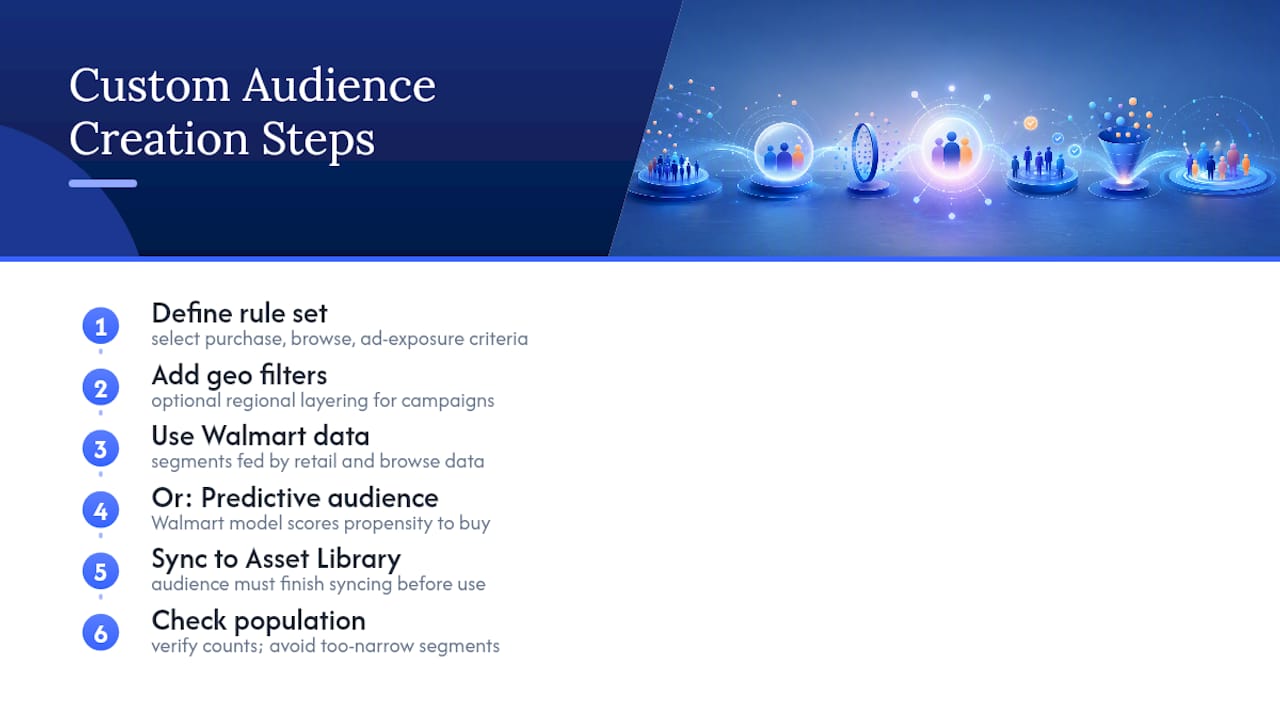
The data sources feeding these segments come directly from Walmart’s retail transaction and browse data, which is why the resulting audiences carry more confidence than third-party equivalents. Once you define the rule logic, the audience needs to sync through the Asset Library before it’s usable in a live campaign, and population doesn’t happen instantly. Check the population count before assuming the segment is ready.
Predictive audiences work through a different mechanism. Instead of a rule you define, Walmart’s modeling scores shoppers against propensity to purchase a specific item, which works particularly well when you don’t have enough historical purchase data for a new or seasonal product to build a reliable custom rule-based segment.
A few practical notes on the creation process: overly narrow custom audiences (extremely tight purchase windows combined with multiple geo filters) risk population sizes too small to spend meaningfully against. Broader rule sets, refined over a few weeks of performance data, generally outperform an overly precise segment that never fully populates. Test a custom audience alongside a comparable pre-built segment before committing significant budget, since the added specificity doesn’t always translate into meaningfully better performance, particularly for categories with less purchase data depth.
Compliance and Privacy Rules to Keep in Mind
Walmart DSP targeting operates within Walmart’s own privacy framework, which means audience data usage is subject to the retailer’s data handling policies rather than a generic advertising platform’s terms. Advertisers don’t get raw shopper-level data. Instead, targeting works through aggregated audience segments that Walmart’s system builds and applies on your behalf.
Custom audience rules should avoid criteria that could function as a proxy for sensitive categories such as health conditions or protected characteristics, even when the rule itself only references purchase behavior. A rule built around a health-adjacent product category, for instance, needs review to confirm it doesn’t inadvertently target based on inferred health status. Walmart’s platform documentation and account team should be your reference point for what’s permissible, since these boundaries get revisited periodically.
Geo-targeting rules also intersect with compliance considerations for certain regulated categories, where state-level advertising restrictions may apply regardless of the platform’s own targeting capabilities. If your brand sells anything in a regulated category, confirm state-specific advertising rules separately from Walmart’s platform constraints, since the platform allowing a geo-targeting configuration doesn’t mean every jurisdiction permits the campaign you’re planning.
Data retention and audience refresh cycles also matter from a compliance standpoint. Stale audience data used past its intended relevance window can create both performance drag and, in some cases, targeting that no longer reflects consented data use. Regular audience hygiene, pulling stale segments and confirming refresh cadence aligns with the platform’s stated policies, isn’t just an optimization habit. It’s part of staying within the bounds of how the data was meant to be used.
Creative Specs That Work Across Walmart DSP Formats
Creative performance on Walmart DSP depends heavily on matching format to placement, and getting specs wrong is one of the most avoidable ways to waste a launch window. Display creative for onsite placements needs to render cleanly across the range of standard IAB sizes Walmart supports, with particular attention to how creative displays on mobile, since a meaningful share of Walmart shopping happens on mobile devices.

CTV and video creative should be built with sound-off comprehension in mind for the first few seconds, since autoplay environments vary in whether audio starts by default. Keep branding and the core message visible early, not held for a reveal at the end. For contextual placements tied to specific product categories, creative that reinforces category relevance directly, showing the product in use or in context, tends to outperform generic brand-awareness creative that doesn’t connect to why the shopper landed on that page.
A few practical specifications to confirm before submission:
- File formats and dimensions should match Walmart’s current published specs exactly. Submissions that don’t match get rejected or delayed in review, costing launch time.
- Video creative should have a clean cut for shorter placements in addition to the full-length version, since not every CTV or video slot supports your longest asset.
- Static and video creative should carry consistent product photography and messaging, particularly if the same campaign runs across onsite display, CTV, and offsite placements simultaneously.
Nectar’s creative services team builds assets specifically to these platform constraints upfront, which avoids the review delays that come from submitting creative built for a different retailer’s spec sheet.
Where to Start If You’re Prioritizing One Thing
If you take one thing from this, it’s the audience handoff. Link every awareness campaign to a retargeting pool before you launch it, not after you review results. Validate refresh rates on whatever audience you’re using so you’re not bidding against a stale segment. Then test frequency caps deliberately instead of accepting platform defaults.
The most common execution pitfall isn’t a bad targeting choice, it’s a good campaign that never gets measured because the handoff between funnel stages breaks. An agency partnership tends to close that gap faster than solving it solo, mostly because the naming conventions and audience hygiene habits get built in from the first campaign rather than patched in after six months of messy data.
Pick one thing to test this month: build a 14 to 30 day retargeting pool from your CTV viewers and see what it does to conversion rate.
— Dan Katona
Get Walmart DSP Set Up Right the First Time
Nectar runs managed Walmart DSP campaigns for mid-market and enterprise brands that don’t have the internal bandwidth to build audience architecture, monitor schema rules, and chase closed-loop attribution reports every week. That work happens through iDerive, which unifies your Walmart performance data with creative and campaign reporting so you can see which audience actually drove an in-store sale instead of guessing.

Brands working with Nectar get audience selection built on tested performance rather than platform defaults, in-store attribution reporting that ties CTV and display spend to real transactions, and ROAS numbers you can actually defend in a budget review. Creative production runs in-house too, so your assets meet Walmart’s format specs on the first submission instead of the third.
If your Walmart DSP campaigns are live but the attribution story is fuzzy, or you haven’t launched yet and want the architecture built correctly from day one, visit Nectar’s Walmart solutions page to request a campaign audit.
Sources
- Targeting object — Walmart Developer Advertising Partners
- Walmart Connect advertising — Onsite display guide
- Drive performance with Walmart DSP and retail data — The Trade Desk
Recommended
.png)