Why Focus on Post-Purchase Strategy to Maximize ROI
.webp)

TL;DR:
- A post-purchase strategy enhances long-term loyalty, increases customer lifetime value, and reduces acquisition costs through targeted engagement. It focuses on emotional reassurance, timely communication, and personalized follow-up to maximize repeat purchases and minimize churn. Prioritizing retention over acquisition is essential for sustainable growth in competitive e-commerce markets.
A post-purchase strategy is the deliberate set of actions a brand takes after a sale to engage customers, drive repeat purchases, and build long-term loyalty. For mid-sized and enterprise e-commerce brands, this is where the real economics of growth are decided. Why focus on post-purchase strategy? Because brands with strong post-purchase experiences see customers spend 140% more over their lifetime, while 70% to 77% of shoppers never return after a poor experience. Platforms like Klaviyo and Shopify have built entire retention toolsets around this phase because the data is unambiguous: the period after the first sale is the highest-leverage moment in the customer lifecycle.
What are the primary benefits of focusing on post-purchase strategy?
The financial case for post-purchase investment is concrete and compounding. Customer acquisition costs have risen 222% over five years, which means every dollar spent acquiring a new customer costs dramatically more than it did in 2021. Retaining an existing customer costs 5 to 7 times less than acquiring a new one, and repeat customers generate 40% of revenue while representing only 8% of visitors. That ratio alone should reshape how you allocate your marketing budget.
The benefits of post-purchase strategy extend well beyond cost savings:
- Repeat purchase acceleration. Customers who make a second purchase within 30 days have a 65% higher 12-month LTV. The second purchase is the inflection point that separates one-time buyers from loyal customers.
- Churn reduction. Automated post-purchase email flows reduce 90-day churn by 14%. That is a structural improvement to unit economics, not a one-time campaign win.
- Revenue without media spend. Post-purchase email and SMS flows that layer education, social proof, and subtle offers in the first 72 hours can generate 18 to 27% of a brand’s monthly revenue with zero incremental media spend.
- CLV growth through personalization. Targeted follow-up emails referencing past purchases increase CLV by 20% to 30%. Personalized post-purchase messaging increases second-purchase rates by 45%.
- Loyalty program amplification. Loyalty programs boost retention by 10 to 25% when integrated into the post-purchase sequence at the right moment.
Pro Tip: Track your 30-day repurchase rate as a standalone KPI. Most brands obsess over conversion rate but ignore this metric, which is a far stronger predictor of long-term profitability.
Post-purchase engagement is not a soft, brand-feel initiative. It is a revenue architecture decision that directly improves LTV to CAC ratios and compounds over time.

How does post-purchase customer psychology influence strategy effectiveness?
Two-thirds of online shoppers experience post-purchase anxiety, primarily around delivery timelines, returns, and communication gaps. This psychological state is the window brands either use to build trust or lose the customer permanently. The post-purchase phase is the most emotionally activated moment in the customer lifecycle, and brands that treat it as a logistics formality are leaving loyalty on the table.
Understanding what drives post-purchase anxiety helps you design against it. The four most common triggers are:
- Delivery uncertainty. Customers who receive no proactive shipping updates default to worst-case assumptions. A single branded tracking email sent within two hours of shipment confirmation measurably reduces support ticket volume.
- Usability doubt. First-time buyers of complex or premium products question whether they made the right choice. Educational content delivered 24 to 48 hours after delivery converts doubt into confidence and advocacy.
- Returns friction. 32% of customers never shop again after a bad return experience. Proactively communicating your returns policy before a customer needs it signals confidence in your product.
- Silence after purchase. Brands that go quiet after the order confirmation email create a vacuum that competitors fill with retargeting ads. Consistent, value-driven communication keeps your brand top of mind.
“Top performers focus post-purchase messaging on customer needs and experience rather than simply pushing for the next sale, creating a support system that fosters natural repeat purchases.” — Martech
Pro Tip: Separate your reassurance messaging from your promotional messaging in the first 72 hours. Mixing a discount offer into a delivery update email signals that you care more about the next sale than the current experience.
The brands that convert transactions into relationships understand one thing: the customer’s emotional state after purchase is more malleable than at any other point in the lifecycle. Addressing anxiety first, then building brand affinity, then activating the next purchase is the correct sequence.
What are the essential components of an effective post-purchase strategy?
An effective post-purchase strategy is not a single email. It is a sequenced communication architecture triggered by customer behavior, not calendar dates. The retention clock starts at delivery confirmation, not order placement. Brands that send fixed-date promotional emails without regard to whether the product has been received or used are optimizing for the wrong trigger.
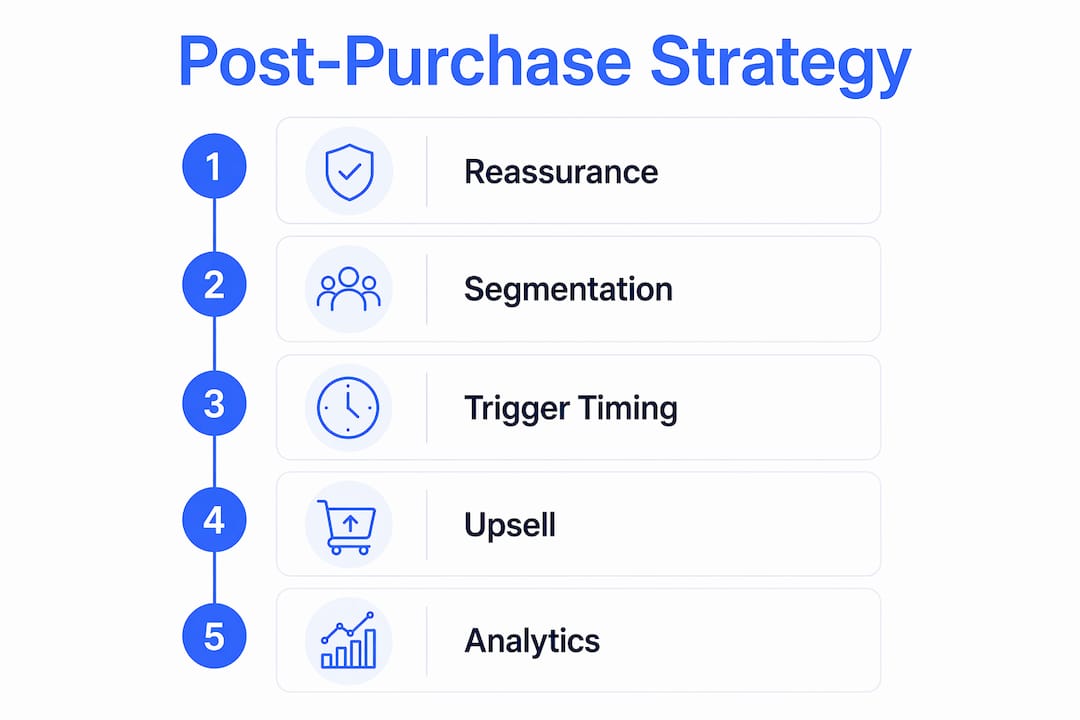
Here is the framework Nectar recommends for mid-to-enterprise brands building a post-purchase engine:
- Hours 0 to 1 (Order confirmation). Set expectations clearly. Confirm the order, provide a delivery timeline, and introduce your brand story in one sentence. This is not the moment for upsells.
- Hours 4 to 8 (Brand deepening). Send a short, non-promotional email that explains your brand’s origin or mission. This is where emotional connection begins. Brands like Patagonia and Warby Parker have built entire retention advantages on this touchpoint.
- Hours 24 to 72 (Social proof and community). After delivery confirmation, introduce user-generated content, reviews, and community channels. This is also the optimal window for referral requests placed post-delivery, which outperform delayed referral asks when product experience is fresh. Bilateral referral incentives convert at higher rates than one-sided offers.
- Days 7 to 21 (Second-purchase activation). Introduce a personalized product recommendation based on the first SKU purchased. Delay the discount. Lead with relevance and utility, not price reduction.
- Days 14 to 21 (Subscription positioning). Subscription upsells performed 14 to 21 days post-purchase convert at higher rates than at checkout and produce 2.8x longer LTV with 40% lower churn at six months. Frame the subscription as convenience and continuance, not a discount mechanism.
The metrics that matter most in this architecture are 30-day repurchase rate, post-purchase revenue as a percentage of total revenue, email and SMS open rates by sequence step, and 90-day churn rate. Brands using Klaviyo or Attentive can build behavior-triggered flows that adapt based on whether a customer opened the previous message, clicked a product link, or completed a second purchase.
Pro Tip: Segment your post-purchase flows by first SKU purchased, not just by customer cohort. A customer who bought a starter kit needs different messaging than one who bought your premium bundle. SKU-level segmentation is where personalized email engagement produces the largest lift.
Post-purchase focus vs. acquisition focus: why retention wins in 2026
The acquisition-first model is structurally broken at scale. With customer acquisition costs up 222% over five years, brands that rely on paid channels to grow are renting customers at an increasingly expensive rate. Every customer who churns after one purchase represents a full acquisition cost with zero return. The math compounds against you as you scale.
The retention-first model works differently. Acquisition rents customers while post-purchase engineering owns them. When you improve retention, you improve the denominator in your LTV to CAC ratio without increasing spend. A 5% improvement in retention can increase profits by 25% to 95%. That is not a marginal gain. It is a structural shift in unit economics.
Here is how the two models compare in practice:
Acquisition-heavy model
Brands in this model spend the majority of their marketing budget on Meta, Google, and Amazon Ads to drive first purchases. CAC is high and rising. Churn after the first purchase is often above 60%. Revenue growth requires proportionally increasing ad spend, which compresses margins as the business scales. The model works at low revenue levels but becomes unsustainable past $10M to $20M in annual revenue.
Retention-first model
Brands in this model treat paid acquisition as a necessary cost to fill the top of the funnel, then use post-purchase systems to compound the value of every acquired customer. Brands leading in 2026 view paid acquisition as a temporary cost until their post-purchase systems mature enough to own customer lifetime value. Revenue growth becomes less dependent on ad spend because a growing percentage of revenue comes from repeat purchases.
The practical implication for budget allocation is direct: every dollar shifted from acquisition to retention infrastructure produces a higher marginal return once your CAC exceeds a certain threshold. For most mid-sized brands, that threshold is already in the rearview mirror. Improving customer retention rates is now the highest-ROI lever available to e-commerce brands operating in competitive categories.
Key takeaways
Post-purchase strategy is the highest-ROI growth lever available to e-commerce brands because it compounds retention, reduces acquisition dependency, and builds customer lifetime value without incremental media spend.
Point | Details
Second purchase timing matters most. Customers who repurchase within 30 days have 65% higher 12-month LTV, making early activation the top priority.
Anxiety is the first obstacle. Two-thirds of shoppers experience post-purchase anxiety. Address delivery and usability concerns before any promotional messaging.
Trigger by delivery, not by date. Post-purchase sequences triggered by delivery confirmation outperform fixed-date calendar flows across every metric.
Subscription timing is counterintuitive. Subscription upsells at 14 to 21 days post-purchase convert better than at checkout and produce 2.8x longer LTV.
Retention beats acquisition economics. A 5% retention improvement can increase profits by 25% to 95%, while acquisition costs have risen 222% in five years.
The most overlooked growth lever in e-commerce
I have reviewed post-purchase sequences for dozens of brands across Shopify, Amazon, and Walmart, and the pattern is consistent: most brands treat the post-purchase period as an afterthought. They send one order confirmation, one shipping update, and then pivot immediately to discount-driven win-back campaigns when the customer goes quiet. That sequence is backwards.
The brands that compound growth year over year do something different. They treat the 72 hours after delivery as their highest-value marketing window. They do not open with a discount. They open with reassurance, then brand story, then social proof, then a relevant product recommendation. The discount, if it appears at all, comes last and is framed as a reward for loyalty rather than a desperate retention tactic.
The mistake I see most often is generic timing. A brand sells both a $15 consumable and a $200 premium product and sends the same seven-day post-purchase sequence to both buyers. The consumable buyer is ready to reorder in two weeks. The premium buyer needs 30 days of education and community before they are ready for a second purchase. Treating them identically destroys the effectiveness of both sequences.
Subscription positioning is another area where most brands leave significant revenue on the table. Brands that frame subscription as “never run out” or “always have it ready” outperform brands that lead with “save 15%.” The discount framing attracts price-sensitive customers who churn the moment a competitor offers a deeper discount. The convenience framing attracts customers who stay because the product is embedded in their routine.
The brands I have seen build lasting loyalty in competitive categories all share one trait: they measure post-purchase revenue as a standalone line item and optimize it with the same rigor they apply to paid acquisition. When you treat post-purchase as a revenue center rather than a customer service function, the entire organization starts making better decisions.
— Dan Katona
How Nectar helps you build a post-purchase growth engine
Nectar builds and manages post-purchase retention systems for mid-sized and enterprise brands on Shopify, Amazon, and Walmart. From behavior-triggered email and SMS sequences to SKU-level segmentation and subscription architecture, Nectar’s team designs post-purchase programs that convert first-time buyers into long-term customers. Powered by the iDerive analytics platform, every sequence is measured against real revenue outcomes, not vanity metrics. If your brand is generating revenue but losing customers after the first purchase, Nectar’s retention and growth services provide the infrastructure to fix that at scale. For Shopify brands specifically, Nectar’s Shopify-focused solutions are built to integrate directly with your existing stack.
FAQ
Why is post-purchase strategy important for e-commerce brands?
Post-purchase strategy directly determines whether a brand retains or loses customers after the first sale. Brands with strong post-purchase experiences see customers spend 140% more over their lifetime, while 70% to 77% of shoppers never return after a poor experience.
How does post-purchase engagement reduce churn?
Automated post-purchase email flows reduce 90-day churn by 14% by maintaining communication, addressing anxiety, and activating the second purchase before the customer disengages. Behavior-triggered sequences outperform calendar-based emails across every retention metric.
When is the best time to ask for a referral after purchase?
Referral requests placed 48 to 72 hours after delivery confirmation outperform delayed asks because product experience is fresh and enthusiasm is highest. Bilateral incentives, where both the referrer and the new customer receive a reward, convert at higher rates than one-sided offers.
How does post-purchase strategy compare to acquisition spending?
Retaining a customer costs 5 to 7 times less than acquiring a new one, and a 5% retention improvement can increase profits by 25% to 95%. With acquisition costs up 222% over five years, post-purchase investment produces a higher marginal return for most mid-sized brands.
What metrics should brands track in a post-purchase program?
The four metrics that matter most are 30-day repurchase rate, 90-day churn rate, post-purchase revenue as a percentage of total monthly revenue, and email or SMS open rates by sequence step. These metrics reveal where the sequence is working and where customers are disengaging.
Recommended















































.webp)