What marketplace compliance actually covers
Marketplace compliance is the operational and legal framework that governs how online platforms collect seller data, enforce consumer protections, remit taxes, and meet federal and state disclosure requirements. For compliance professionals, it is not a background function. It is the mechanism that keeps a platform legally operational, financially protected, and trusted by the buyers it serves.
The core obligations fall into three categories:
-
Regulatory adherence: Following federal statutes like the INFORM Consumers Act and state marketplace facilitator tax laws, which together define what platforms must collect, verify, disclose, and remit.
-
Seller oversight: Verifying seller identities, maintaining current records, and suspending non-compliant sellers before violations accumulate.
-
Consumer protection: Publishing transparent seller information, providing reporting mechanisms for suspicious activity, and securing the data collected under law.
The Federal Trade Commission enforces the INFORM Consumers Act at the federal level, while state Attorneys General hold concurrent authority to bring civil actions in federal court. Compliance professionals must account for both. The INFORM Consumers Act sets a floor, not a ceiling, meaning states can and do impose requirements beyond the federal baseline. That layered structure is what makes the role of marketplace compliance genuinely complex, and why treating it as a checklist exercise tends to fail.
Key regulatory frameworks governing U.S. online marketplaces
Three frameworks shape the compliance environment for U.S. online marketplaces in 2026: the INFORM Consumers Act, marketplace facilitator tax laws, and the Digital Services Act (DSA).
The INFORM Consumers Act took effect june 27, 2023. It requires online marketplaces to collect bank account information, contact details, and a Tax ID number from high-volume third-party sellers. Platforms must verify that information within 10 days of collection and re-verify any changes within 10 days of notification. Sellers meeting a minimum level of annual gross revenues on a platform trigger mandatory disclosure requirements. Non-compliance carries civil penalties of $53,088 per violation.
Marketplace facilitator tax laws now exist in most U.S. states. They shift the obligation to collect and remit sales tax from individual sellers to the platform itself, once economic nexus thresholds are crossed. Washington State, for example, requires registration when a facilitator exceeds $100,000 in combined gross receipts sourced to that state.

The Digital Services Act is a European Union regulation, but U.S. platforms with significant EU user bases face its transparency and content moderation requirements. Compliance teams at large U.S. marketplaces increasingly treat DSA obligations as part of their global compliance posture, even when their primary regulatory exposure is domestic.
Key compliance requirements across these frameworks:
-
Collect, verify, and annually re-certify seller identity and tax information.
-
Disclose seller details clearly on product listings and in order confirmations.
-
Provide consumers with a visible mechanism to report suspicious seller activity.
-
Register for sales tax permits in states where economic nexus thresholds are met.
-
Suspend sellers who fail to provide required information within the 10-day notice window.
The jurisdictional complexity here is real. A platform operating nationally faces a patchwork of state-level rules that vary in nexus thresholds, reporting timelines, and seller transparency requirements. Federal law sets the baseline; state law often exceeds it.
Pro Tip: Legal experts recommend implementing internal controls under the INFORM Consumers Act proactively rather than waiting for detailed FTC rulemaking. The statute is already enforceable, and the FTC has not indicated it will delay action while regulations are being finalized.
What marketplace operators are legally required to do
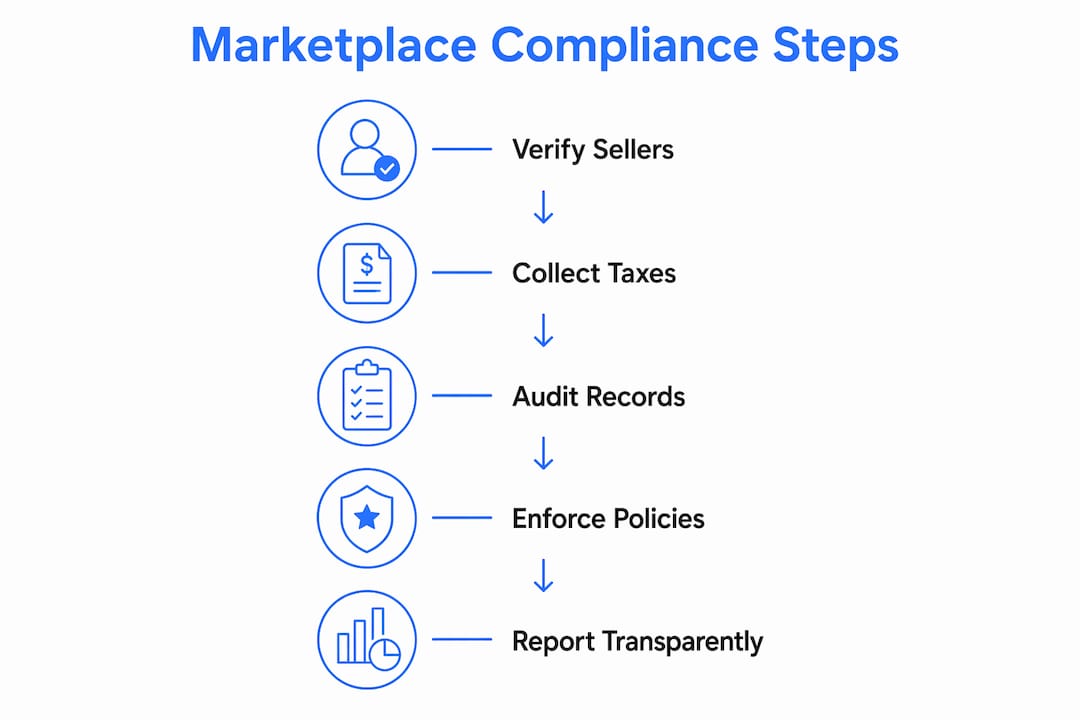
Operational compliance obligations are more granular than most platforms anticipate at launch. The INFORM Consumers Act alone generates a continuous workflow: initial data collection, 10-day verification, annual re-certification notices, and suspension enforcement for sellers who miss the 10-day response window.
Core operator obligations include:
-
Seller data collection: Bank account information, contact details, and Tax ID numbers from every high-volume third-party seller.
-
Verification: Confirming that collected information is valid, not misappropriated, and not falsified, within 10 days of receipt.
-
Annual re-certification: Notifying sellers at least once per year to certify their information is current, and requiring a response within 10 days.
-
Suspension enforcement: Suspending future sales activity for any seller who fails to provide or certify required information after written notice.
-
Data security: Implementing administrative, physical, and technical safeguards appropriate to the sensitivity of the data collected. The INFORM Consumers Act explicitly prohibits using this data for any purpose beyond compliance unless law requires otherwise.
-
Recordkeeping: Maintaining documentation sufficient to demonstrate compliance during an audit by the FTC or a state Attorney General.
Liability protection under marketplace facilitator tax laws is not automatic. Platforms must demonstrate they acted solely as an agent of the seller, not as a principal, and must fully comply with monthly reporting requirements to sellers. Missing a reporting deadline eliminates eligibility for liability relief, regardless of how well the platform performed in other areas.
Pro Tip: Build your audit readiness posture before you need it. Maintain a documented record of every verification action, every suspension notice, and every seller re-certification cycle. When a state tax authority or the FTC requests records, the platform that produces organized documentation in days fares far better than one scrambling to reconstruct a paper trail.

Documented separation between the platform and its sellers is also critical. Platforms that blur the line, by co-mingling inventory, setting prices directly, or taking on seller risk, undermine the agent-status argument that liability relief depends on.
How trust and safety policies protect consumers and the platform
Trust and safety is where compliance obligations meet day-to-day platform operations. The INFORM Consumers Act mandates a visible reporting mechanism on every high-volume seller’s product listing, allowing consumers to flag suspicious activity electronically or by phone. That requirement is not optional, and it is not satisfied by a buried “contact us” link.
Effective trust and safety programs go well beyond the statutory minimum:
-
Seller vetting at onboarding: Cross-referencing submitted identity documents against government databases before a seller goes live, not after.
-
Fraud detection systems: Automated monitoring for patterns associated with counterfeit goods, stolen merchandise, or account takeovers.
-
Product authenticity controls: Category-specific review processes for high-risk product types, including electronics, health products, and branded apparel.
-
Proactive suspension protocols: Triggering suspension workflows automatically when a seller misses a verification deadline, rather than waiting for a consumer complaint.
-
Transparent seller information: Displaying seller name, business address, and contact information clearly on product listings for sellers meeting the $20,000 annual gross revenue threshold.
The connection between trust and safety and regulatory compliance is direct. A platform that fails to display seller information conspicuously, or that delays suspending a non-compliant seller, faces both FTC enforcement and state-level civil action. The reputational cost of a high-profile counterfeit incident compounds the legal exposure.
Pro Tip: Treat your reporting mechanism as a data source, not just a compliance checkbox. Patterns in consumer-reported suspicious activity often surface seller fraud before your automated systems catch it. Build a workflow that routes flagged reports to a human reviewer within 24 hours.
Platforms that invest in trust and safety infrastructure tend to see lower rates of compliance risk from low-effort or fraudulent listings, which reduces both enforcement exposure and the operational cost of post-incident remediation.
Best practices for managing compliance and reducing liability risks
The compliance strategies that hold up under audit share one characteristic: they are built on documented, repeatable processes rather than ad hoc responses to regulatory pressure. Platforms that treat compliance as a project rather than a program tend to discover gaps at the worst possible moment.
Practical controls that reduce liability:
-
Automated data management: Use centralized systems to collect, store, and track seller information across all required fields. Manual spreadsheets fail at scale and create audit gaps.
-
Verification workflows with hard deadlines: Build the 10-day verification clock into your platform’s seller onboarding system so that no verification window is missed due to manual oversight.
-
Seller re-certification calendars: Automate annual re-certification notices and track responses. A seller who does not respond within 10 days triggers a suspension workflow automatically.
-
Suspension audit logs: Record every suspension action, including the notice date, the seller’s response (or lack of one), and the suspension date. This log is your primary defense in an enforcement inquiry.
-
Tax nexus monitoring: Track sales volume by state against current economic nexus thresholds. Thresholds change, and a platform that crossed a state’s threshold six months ago without registering has already accumulated liability.
-
Policy documentation: Maintain written compliance policies that describe each process, who owns it, and how exceptions are handled. Regulators look for evidence that compliance is institutionalized, not improvised.
-
Proactive regulatory monitoring: Assign someone to track FTC guidance, state legislative updates, and court decisions affecting marketplace compliance. Waiting for a regulation to be finalized before acting is a losing strategy.
Pro Tip: Balance automation with manual review for edge cases. Automated systems catch the obvious violations, but sellers who submit technically valid documents that do not match other data points require human judgment. Build an escalation path for flagged records rather than letting automation make the final call on suspension.
Compliance professionals who manage marketplace operations at scale know that the cost of a compliance failure, measured in penalties, remediation, and reputational damage, almost always exceeds the cost of the controls that would have prevented it.
How marketplace facilitator laws shift sales tax responsibility
Marketplace facilitator laws represent one of the most consequential shifts in e-commerce tax policy in the past decade. Before these laws, individual sellers were responsible for collecting and remitting sales tax in states where they had nexus. After South Dakota v. Wayfair (2018), states moved quickly to establish economic nexus standards, and most then extended collection obligations to the platforms facilitating sales rather than the sellers themselves.
The practical effect: if your platform meets a state’s economic nexus threshold, you are responsible for collecting and remitting sales tax on all sales made through your marketplace, including those made by third-party sellers.
How economic nexus works:
-
Thresholds vary by state but commonly trigger at $100,000 in sales or 200 transactions in a calendar year within that state.
-
Once triggered, the platform must register for a sales tax permit in that state before collecting.
-
The obligation applies to gross sales facilitated through the platform, not just the platform’s own direct sales.
Compliance process for marketplace facilitator tax obligations:
-
Monitor sales volume by state against current nexus thresholds on a rolling basis.
-
Register for a sales tax permit in each state where thresholds are met, before the next taxable transaction.
-
Configure your tax calculation system to apply the correct rate for each transaction’s ship-to address.
-
Collect sales tax from buyers at the point of sale.
-
Remit collected tax to each state by the applicable filing deadline.
-
Provide monthly reports to marketplace sellers detailing gross sales made on their behalf, as required in states like Washington.
-
Maintain documentation demonstrating that the platform acted as an agent of the seller, not as a principal, to preserve eligibility for liability relief.
Marketplace facilitator laws in most U.S. states require platform operators to collect and remit sales tax, with economic nexus criteria triggering those obligations. Liability relief, where available, is contingent on meeting all reporting requirements and demonstrating platform independence from sellers.
Transparency and reporting mandates you need to meet
Transparency obligations under U.S. marketplace compliance law are specific and non-negotiable. The INFORM Consumers Act defines exactly what must be disclosed, to whom, and where. Getting this wrong is not a technical violation. It is a per-instance civil penalty exposure.
Disclosure requirements for high-volume sellers (annual gross revenues of $20,000 or more on the platform):
-
The seller’s name, including any business name under which the seller operates.
-
The seller’s physical address.
-
Contact information: a working phone number, email address, or other direct electronic contact method.
-
This information must appear clearly and conspicuously on the seller’s product listing pages, or in order confirmation messages and account transaction histories.
Reporting mechanism requirements:
-
Every high-volume seller’s product listing must include a visible mechanism for consumers to report suspicious activity, both electronically and by phone.
-
The mechanism must be easy to find. A link buried in a footer does not satisfy the “clear and conspicuous” standard.
Annual certification cycle:
-
Platforms must notify sellers at least once per year to certify their information is current.
-
Sellers have 10 days to respond. Non-response triggers the suspension workflow.
-
Platforms must suspend sellers who fail to provide required information after the 10-day notice period.
States can layer additional requirements on top of this federal baseline. Some states have enacted their own seller transparency laws that require disclosures beyond what the INFORM Consumers Act mandates. Compliance teams operating nationally need jurisdiction-specific tracking, not a single federal checklist applied uniformly.
Expert insights on what compliance professionals get wrong
The compliance professionals who navigate marketplace regulations most effectively share a common approach: they treat the regulatory environment as dynamic, not static, and they build systems that can absorb new requirements without a full rebuild.
Several recurring challenges surface across compliance teams at U.S. online marketplaces:
-
Underestimating ongoing verification: Initial onboarding verification is only the beginning. Sellers change bank accounts, addresses, and business structures. Platforms that verify once and assume the data stays current accumulate stale records that create audit exposure.
-
Conflating liability relief with automatic protection: Marketplace facilitator liability relief requires active compliance with monthly reporting obligations. Platforms that miss a reporting deadline lose eligibility for that period, regardless of their overall compliance posture.
-
Treating the INFORM Consumers Act as a one-time project: The law’s annual re-certification requirement means compliance is a continuous cycle. Platforms that implemented controls in 2023 and have not updated their processes since are likely out of step with current FTC guidance.
-
Ignoring state-level divergence: Federal law sets the floor. States like California, New York, and Washington have enacted requirements that exceed the federal baseline in scope and specificity. A compliance program built solely around the INFORM Consumers Act will miss state obligations.
-
Manual processes at scale: Compliance experts consistently point to automated data management as the only viable approach for platforms handling significant seller volumes. Manual checks introduce human error and cannot keep pace with the volume of verification, re-certification, and suspension decisions a large marketplace generates.
Pro Tip: Build a regulatory calendar that tracks not just filing deadlines but also legislative sessions in key states. Most state marketplace compliance laws are amended annually. Knowing what is moving through a state legislature gives you lead time to adapt your systems before a new requirement takes effect.
Real-world compliance failures tend to cluster around the same root cause: a platform that built its compliance program for the regulatory environment of its launch year and did not invest in keeping it current. The cost of that gap compounds over time.
How regulators monitor and enforce marketplace compliance
Enforcement of marketplace compliance obligations in the U.S. operates on two tracks: federal and state. The FTC holds primary federal authority under the INFORM Consumers Act, treating violations as unfair or deceptive acts or practices under the FTC Act. State Attorneys General hold concurrent authority and can file civil actions in federal court independently of any FTC proceeding.
Monitoring mechanisms regulators use include:
-
Consumer complaints: The FTC’s ReportFraud.ftc.gov portal and the INFORM Consumers Act’s dedicated reporting channel aggregate complaints about non-compliant marketplaces and sellers. High complaint volume in a category or against a specific platform draws investigative attention.
-
Undercover test purchases: Regulators and state consumer protection offices conduct test purchases to verify whether seller information is displayed correctly and whether reporting mechanisms function as required.
-
Audit requests: State tax authorities issue audit requests to marketplace facilitators to verify that sales tax collection and remittance records match reported figures. Washington’s Department of Revenue, for example, requires facilitators to maintain records demonstrating compliance with monthly seller reporting obligations.
-
Civil investigative demands: The FTC can issue civil investigative demands requiring platforms to produce documents, data, and testimony related to compliance practices.
The enforcement posture has sharpened since the INFORM Consumers Act took effect in June 2023. Platforms that assumed the law would be lightly enforced have been corrected by FTC guidance making clear that the $53,088 per-violation penalty applies per instance, not per investigation. A platform with thousands of non-compliant seller listings faces aggregate exposure that can reach into the millions.
How recent legislative updates and case law are reshaping compliance
The compliance environment for U.S. online marketplaces has shifted materially since 2018, and the pace of change has not slowed. Several developments are directly relevant to compliance professionals managing 2026 obligations.
South Dakota v. Wayfair (2018) established that states can impose sales tax collection obligations on out-of-state sellers based on economic activity alone, without physical presence. That decision accelerated the adoption of marketplace facilitator laws across nearly every state and fundamentally changed the tax compliance calculus for online platforms.
The INFORM Consumers Act (2023) added a federal layer of seller verification and disclosure obligations that did not exist before. Its enforcement framework, which treats violations as FTC Act violations, gives the agency significant penalty authority without needing to pursue separate rulemaking for each enforcement action.
State legislative activity continues to expand beyond the federal baseline. Several states have enacted or proposed laws requiring marketplaces to verify seller information more frequently than the annual federal standard, disclose additional seller details, or implement specific fraud prevention controls. Compliance teams tracking only federal developments are operating with an incomplete picture.
Case law on marketplace facilitator liability is still developing. Courts in multiple states have addressed questions about when a platform’s relationship with a seller is close enough to disqualify it from liability relief. The consistent signal from these decisions is that documented separation between platform and seller operations is the most defensible position. Platforms that set seller prices, hold inventory, or guarantee seller performance face heightened scrutiny.
Staying current with marketplace expansion obligations across jurisdictions requires more than reading the final text of new laws. It requires tracking proposed legislation, agency guidance, and court decisions as they develop.
Why third-party audits and compliance certifications matter
Third-party audits serve a function that internal compliance reviews cannot fully replicate: they provide an independent assessment of whether a platform’s documented processes match its actual operations. Regulators and courts give more weight to audit findings from qualified external reviewers than to self-reported compliance attestations.
The practical value of third-party audits for marketplace compliance:
-
Gap identification: External auditors often surface process gaps that internal teams have normalized. A verification workflow that technically meets the 10-day requirement but produces unreliable results, for example, may pass an internal review and fail an external one.
-
Audit defense: When a state tax authority or the FTC initiates an inquiry, a recent third-party audit report demonstrating compliance is a meaningful defense. It shifts the burden of proof and demonstrates good-faith effort.
-
Certification programs: Several industry bodies offer compliance certifications relevant to e-commerce platforms, including SOC 2 for data security controls and PCI DSS for payment data handling. These certifications require periodic external audits and provide documented evidence of control effectiveness.
-
Vendor due diligence: Platforms that use third-party service providers for tax calculation, identity verification, or data storage benefit from auditing those vendors’ compliance controls as well. A platform’s liability does not transfer to its vendors.
The INFORM Consumers Act’s data security requirement, which mandates “reasonable security procedures and practices” including administrative, physical, and technical safeguards, aligns closely with the control frameworks that SOC 2 audits assess. Platforms pursuing SOC 2 certification are simultaneously building the security infrastructure the law requires.
Third-party audits are most valuable when conducted before a regulatory inquiry, not in response to one. An annual audit cycle, timed to coincide with the INFORM Consumers Act’s annual re-certification requirement, creates a natural rhythm for compliance review.
How marketplaces and regulatory agencies work together
The relationship between online marketplaces and U.S. regulatory agencies is not purely adversarial. Agencies like the FTC actively publish guidance, host compliance resources, and engage with industry groups to clarify requirements before enforcement actions become necessary. Platforms that participate in that process tend to build more defensible compliance programs.
Practical forms of collaboration between marketplaces and regulators:
-
FTC guidance engagement: The FTC publishes detailed compliance guidance for the INFORM Consumers Act, including Q&A documents that address specific implementation questions. Compliance teams that read and apply this guidance are better positioned than those relying on secondary interpretations.
-
State revenue authority communication: State departments of revenue, including Washington’s Department of Revenue, publish detailed guidance for marketplace facilitators on registration, reporting, and liability relief eligibility. Direct communication with state tax authorities to clarify ambiguous obligations is both permitted and advisable.
-
Industry coalitions: Trade associations representing e-commerce platforms engage with federal and state agencies during the rulemaking and legislative process. Participation gives compliance professionals advance visibility into regulatory direction.
-
Voluntary disclosure programs: Several states offer voluntary disclosure programs that allow platforms to come forward about past tax collection failures in exchange for reduced penalties and limited lookback periods. These programs are most valuable when a platform discovers a nexus obligation it missed.
-
Consumer reporting data sharing: The INFORM Consumers Act’s reporting mechanism generates data about suspicious seller activity. Platforms that analyze this data and share relevant findings with law enforcement agencies build goodwill with regulators and contribute to broader consumer protection efforts.
Regulatory agencies generally distinguish between platforms that demonstrate good-faith compliance efforts and those that appear to treat compliance as optional. That distinction shows up in enforcement discretion, penalty calculations, and the tone of regulatory correspondence. Platforms that document their compliance processes thoroughly and engage proactively with agencies are better positioned when an inquiry arises.
Working with Nectar on marketplace compliance and growth

Marketplace compliance is one dimension of running a successful e-commerce operation. The other is growth. Nectar works with mid-sized and enterprise brands across Amazon, Walmart, and Shopify to manage both, combining full-funnel advertising strategy, in-house creative production, and the proprietary iDerive analytics platform to turn compliant, well-structured listings into high-converting storefronts.
If your brand is scaling across multiple marketplaces and needs a partner who understands the operational complexity that comes with that growth, Nectar’s managed services are built for exactly that.
Key Takeaways
Marketplace compliance in the U.S. requires continuous seller verification, documented platform independence from sellers, and jurisdiction-specific tracking of both federal and state obligations to avoid penalties and preserve liability protections.
INFORM Consumers Act penalties Civil penalties reach $53,088 per violation for non-compliant online marketplaces, enforced by the FTC and state Attorneys General.
10-day verification window Platforms must verify seller information within 10 days of collection and re-verify any changes within 10 days of notification.
Liability relief is conditional Marketplace facilitator liability relief requires full compliance with monthly seller reporting and documented separation between platform and seller operations.
Annual re-certification is mandatory Sellers must certify their information at least once per year; failure to respond within 10 days triggers a mandatory suspension.
State rules exceed federal minimums States can impose seller transparency and consumer protection requirements beyond the INFORM Consumers Act’s federal baseline, requiring jurisdiction-specific compliance tracking.
Recommended











.png)