Companies that use customer analytics broadly are 23 times more likely to acquire new customers and nine times more likely to retain them than competitors who don’t. That’s not a marginal edge. That’s the difference between a brand that grows and one that guesses. Leveraging customer insights means turning raw behavioral, transactional, and attitudinal data into decisions that actually move revenue, reduce churn, and sharpen your competitive position. For marketing and sales teams at mid-sized and enterprise companies, it’s the clearest path from reactive execution to proactive strategy.
Why leveraging customer insights drives competitive advantage
Customer insights, often called customer intelligence, are the patterns and conclusions drawn from analyzing customer data across every touchpoint. The goal isn’t more data. It’s understanding why customers behave the way they do, so you can act on it before a competitor does.
The business case is hard to argue with:
-
Companies using AI-powered customer analytics report an 81% improvement in ROI, a 23% uplift in customer retention, and a 32% increase in upsell revenue.
-
Consumer-centric companies that apply superior intelligence report up to 20% revenue growth and a 40% increase in brand advocacy.
-
Intensive analytics users are twice as likely to achieve above-average profits and three times more likely to see above-average growth.
What makes insights genuinely useful is their ability to remove guesswork from decisions that used to rely on gut instinct. When your marketing team knows which customer segment is most likely to churn in the next 60 days, they don’t wait for the cancellation email. They act now, with a targeted offer or a proactive outreach sequence. Predictive analytics can cut churn by 10–15% while also accelerating how fast teams build and launch customer journeys. That speed-to-market advantage compounds over time in ways that are difficult for slower competitors to replicate.
How to collect and measure customer insights that actually inform strategy
Not all data is insight. A spreadsheet full of page views tells you what happened. Customer intelligence tells you why, and what to do next.
The main types of customer data
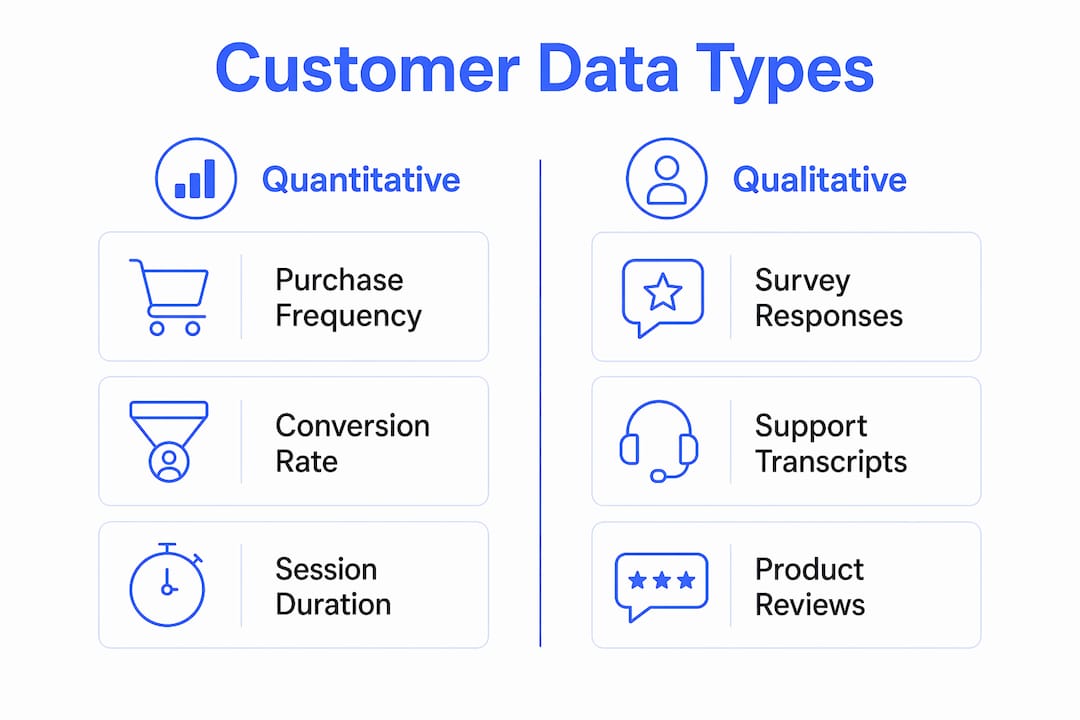
Quantitative data covers the numbers: purchase frequency, average order value, session duration, conversion rates, and churn rates. It’s fast to collect and easy to benchmark, but it rarely explains motivation on its own.
Qualitative data captures the reasoning: survey responses, support transcripts, interview notes, and product reviews. This is where you find the language customers use to describe their own problems, which is gold for messaging and positioning.
Zero-party data is what customers voluntarily share, such as preferences, interests, and purchase intentions, usually through quizzes, preference centers, or onboarding flows. It’s the highest-trust data you can collect because customers gave it to you directly.
Third-party data comes from external providers and can fill demographic or behavioral gaps, though its reliability has declined as privacy regulations tighten and cookie deprecation advances.
Measurement methods that generate real intelligence
Surveys and Net Promoter Score programs surface sentiment at scale. Customer journey analytics tools map behavior across channels. Product usage data shows where customers succeed or stall. Social listening platforms capture unsolicited feedback that customers never send directly to your brand.
The real challenge isn’t collecting data. It’s integrating fragmented sources into a unified customer view. When your CRM, e-commerce platform, ad accounts, and support system all live in separate silos, your picture of the customer is always incomplete. A customer data platform (CDP) or a unified analytics layer solves this by pulling those streams together into a single profile.
Pro Tip: Prioritize insight quality over volume. One well-sourced finding about why your highest-value customers churn is worth more than a dashboard of 40 metrics nobody acts on. Before adding another data source, ask: what decision will this help us make?
What are the real benefits of customer insights for sales and marketing?
The benefits of customer insights aren’t abstract. They show up in revenue lines, retention rates, and the speed at which your team can respond to market shifts.
Revenue and retention gains
Companies applying analytics broadly see 23x better new customer acquisition and nine times better loyalty compared to laggards. The BCG research on consumer-centric companies points to revenue growth of 10–20% and cost savings of 15–25% for organizations that build superior customer intelligence programs. These aren’t one-time wins. They compound as your models improve and your teams get faster at acting on what they learn.
Personalization at scale
Generic messaging is expensive and ineffective. When you know a customer’s purchase history, browsing behavior, and stated preferences, you can serve them content and offers that feel relevant rather than random. That relevance drives conversion. It also drives the kind of customer feedback loops that keep improving your targeting over time.
Cross-functional alignment
Sales and marketing teams often operate on different assumptions about who the customer is and what they want. Shared customer intelligence changes that. When both teams work from the same data, handoffs improve, messaging stays consistent, and go-to-market execution gets faster. The speed of acting on insights matters more than the volume of data you collect, and that speed depends on teams being aligned around the same picture of the customer.
Competitive moat through customer lifetime value
Brands that understand their customers deeply can identify their highest-value segments, protect them with proactive retention programs, and grow their lifetime value through well-timed upsell and cross-sell. The 32% upsell revenue increase reported by AI-powered customer analytics users isn’t a coincidence. It comes from knowing which customers are ready to buy more and reaching them before they go looking elsewhere.
For e-commerce brands specifically, minimizing churn is one of the highest-leverage applications of customer intelligence, because the cost of replacing a lost customer almost always exceeds the cost of retaining one.
How to implement a customer insight strategy step by step
Building a customer insight program that actually changes decisions requires more than buying a new analytics tool. Here’s how to do it in a way that sticks.
-
Define the decisions first. Start by identifying the three to five business decisions your team makes repeatedly that would benefit most from better customer data. Pricing adjustments, campaign targeting, product prioritization, and retention interventions are common starting points. Reverse-engineering your insight program from the decisions you need to make, rather than from the data you happen to have, is the single most effective way to avoid building a dashboard nobody uses.
-
Audit your data sources. Map every place customer data currently lives: your CRM, your e-commerce platform, your ad accounts, your support system, your email platform. Identify gaps and redundancies. This audit usually reveals both the fragmentation problem and the quickest wins.
-
Build a unified customer view. Integrate your data sources into a single profile for each customer. A CDP or a platform like Microsoft Dynamics 365 Customer Insights can centralize this. The Forrester Total Economic Impact study on Dynamics 365 found that organizations that centralized customer data saw a 15% increase in revenue per customer journey developed on the platform, with a three-year risk-adjusted benefit of $5.3 million for the composite organization studied and a 15% increase in revenue per customer journey developed on the platform.
-
Analyze for patterns, not just reports. Use segmentation, cohort analysis, and predictive modeling to find the patterns that explain customer behavior. Tools like Google Analytics 4, Tableau, Looker, and Salesforce Einstein Analytics each serve different parts of this stack. The goal is to move from describing what happened to predicting what will happen next.
-
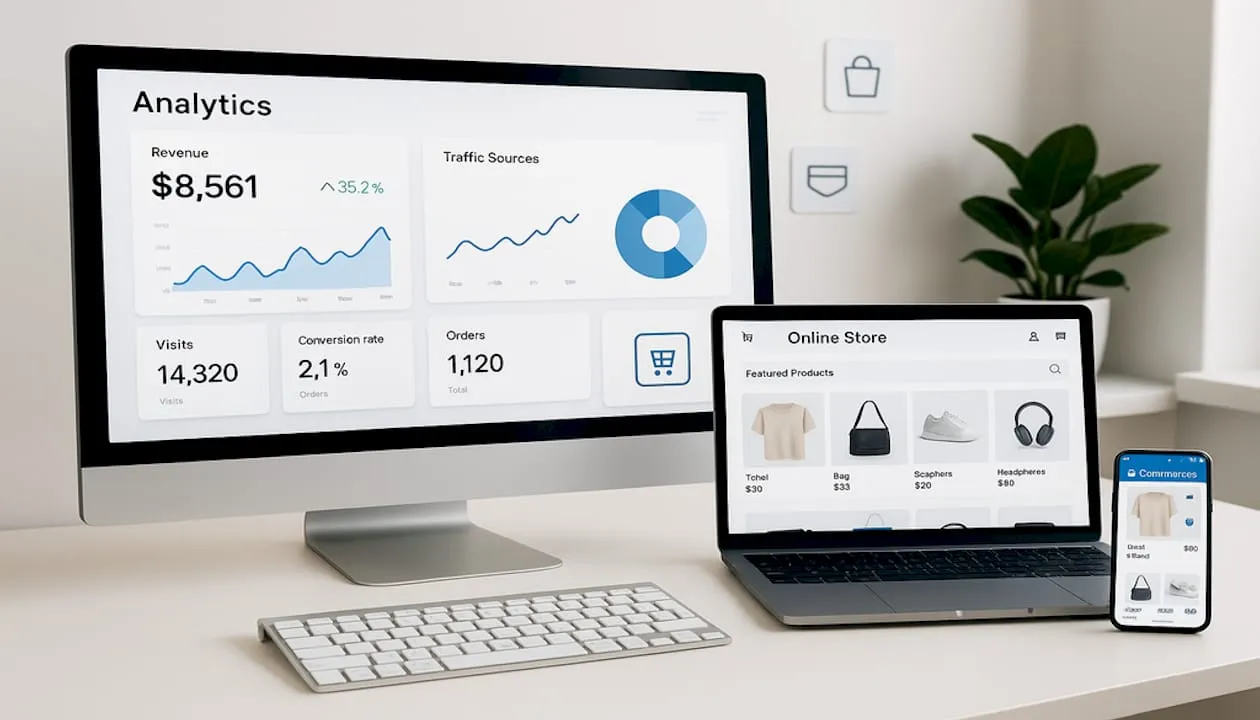
Activate insights across teams. Insights that stay in a research deck don’t drive growth. Build workflows that push findings directly into campaign targeting, sales outreach sequences, product roadmap reviews, and pricing discussions. Ecommerce data visualization tools help make this handoff faster by turning complex data into formats that non-analysts can act on immediately.
-
Create a feedback loop. After acting on an insight, measure the outcome and feed that result back into your models. Did the retention campaign actually reduce churn? Did the personalized upsell sequence lift average order value? This continuous refinement is what separates organizations that get smarter over time from those that run the same playbook indefinitely.
Pro Tip: Set a 30-day review cadence for your top three insight-driven initiatives. Short cycles force the team to ask whether the data is changing behavior, not just informing reports. If an insight hasn’t influenced a decision in 30 days, it’s a report, not intelligence.
Common pitfalls to avoid:
-
Treating insights as a one-time research project rather than an ongoing practice.
-
Letting data quality degrade by failing to audit and clean sources regularly.
-
Building insight programs that live only in the analytics team, disconnected from the people making daily sales and marketing decisions.
-
Collecting more data than you can act on, which creates noise and slows decision-making.
Best practices for sustaining competitive advantage with customer data in 2026
The companies pulling ahead aren’t just collecting more data. They’re building systems where customer intelligence feeds directly into every major decision, from product pricing to market entry timing.
AI and GenAI are changing the speed of insight
AI and GenAI technologies now cut the time required to generate insights from weeks to hours, automate pattern recognition across massive datasets, and free analysts to focus on interpretation and strategy rather than data preparation. This democratizes access to intelligence across teams that previously had to wait for a quarterly research report. A marketing manager can now pull a customer segment analysis in the time it used to take to submit a data request.
Embed insights upstream, not just downstream
Most organizations use customer data to evaluate past campaigns. The ones building durable advantage use it upstream: to set pricing, shape product roadmaps, decide which markets to enter, and determine which customer segments to prioritize for growth. When insights inform strategy before execution begins, the entire organization moves in a more coordinated direction.
Build learning loops, not just dashboards
The structural advantage that’s hardest to copy is a learning loop: a system where what your customer-facing teams learn feeds back into product and strategy decisions on a regular cadence. This isn’t a technology problem. It’s an organizational design problem. Teams need shared definitions of success, shared access to data, and a culture where acting on customer intelligence is expected, not optional.
Best practices for sustaining this advantage:
-
Assign clear ownership of insight initiatives to a named person or team, not a committee.
-
Use analytics in marketing to tie every insight initiative to a measurable business outcome before it launches.
-
Establish data governance standards that define how customer data is collected, stored, and used, so privacy compliance doesn’t become a bottleneck when you want to move fast.
-
Treat data privacy and ethics as a foundation, not an afterthought. Customers who trust you with their data give you better data. Brands that misuse it lose access to the most valuable signal they have.
-
Review your insight program against your business goals quarterly. As goals shift, the decisions you need to inform shift too, and your data collection priorities should follow.
Advanced analytics work best when they’re treated as a continuous strategic habit rather than a project with a start and end date. The “why” behind customer behavior changes as markets shift, competitors move, and customer expectations evolve. Organizations that build the muscle to keep asking that question, and keep acting on the answers, are the ones that compound their advantage year over year.
Key Takeaways
Companies that use customer analytics broadly outperform competitors on acquisition, retention, and revenue growth, making customer intelligence one of the highest-return investments a marketing or sales team can make.
Point: Start with decisions Define the business decisions you need to improve before choosing data sources or tools.
Point: Unify your data Fragmented customer data limits every downstream insight; a unified customer view is the foundation of any effective program.
Point: Act fast on findings Speed of action on insights matters more than volume of data collected; align teams around shared intelligence to move faster.
Point: Embed insights upstream Use customer intelligence to shape pricing, product, and market strategy, not just to evaluate past campaigns.
Point: Build continuous loops Treat insight generation as an ongoing habit, not a one-time project, to compound competitive advantage over time.
How Nectar turns customer intelligence into growth
Nectar’s proprietary iDerive analytics platform does exactly what this article describes: it unifies customer and marketplace data across Amazon, Walmart, and Shopify into a single view, then translates that intelligence into campaign decisions, listing improvements, and full-funnel strategies that drive measurable ROI. For mid-sized and enterprise brands that want to stop guessing and start growing, Nectar’s data-driven services cover everything from creative production to retail media management.
If you’re ready to put customer intelligence to work across your e-commerce channels, explore what Nectar builds for brands at thinknectar.com.
Recommended











.png)