Why Brands Need Unified Storefronts in 2026
.webp)
TL;DR:
- Unified storefronts unify all sales channels, inventory, payments, and customer data into one real-time system. They eliminate seams, improve personalization, and enhance operational efficiency, leading to increased revenue and customer trust. Building from inventory and order management is essential, with governance and proper measurement crucial for success.
A unified storefront is defined as a single integrated platform that connects all sales channels, inventory, payments, and customer data into one real-time operational system. This architecture is why brands need unified storefronts more urgently than ever: fragmented channel setups create friction that shoppers notice and abandon. Platforms like Shopify, Manhattan Associates, and Celigo have made unified commerce the standard replacing the old omnichannel patchwork that coordinated channels separately without sharing data. The industry term for this model is unified commerce, and it is the architecture that separates high-growth brands from those losing ground.
Why brands need unified storefronts for customer experience
The most direct benefit of a unified storefront is the elimination of what industry practitioners call “seams.” A seam is any point where the customer experience breaks: a product shows in stock online but is unavailable in store, a promotion applies on the website but not at checkout, or a return takes two weeks because the system cannot locate the original order. Cross-channel inconsistencies in stock, pricing, and service are the strongest driver of lost purchase intent, according to an empirical study of 300 apparel shoppers.
Unified commerce removes these seams by creating a shared, governed data layer with real-time order management. Every channel reads from the same inventory record, the same pricing rules, and the same customer profile. A shopper who adds an item to their cart on mobile and picks it up in store encounters zero discrepancy. That consistency builds the kind of trust that drives repeat purchases.
Personalization also improves substantially. When customer data is unified, every touchpoint reflects the same purchase history, preferences, and loyalty status. A brand running on Amazon, Walmart, and Shopify can recognize the same customer across all three and deliver relevant recommendations without manual data reconciliation.
-
Monitor cart abandonment rate by channel after implementation
-
Track CSAT scores at post-purchase touchpoints, especially returns
-
Measure repeat purchase rate as a proxy for trust and consistency
-
Watch for support ticket volume related to order status and inventory errors
Pro Tip: Set a 90-day baseline on these metrics before go-live so you have a clean comparison point. Without it, you will not know which improvements came from unification versus seasonal trends.
How does inventory unification improve operational efficiency?
Operational efficiency is where the financial case for unified storefronts becomes undeniable. A single shared inventory pool with real-time reservation logic prevents overselling, reduces stockouts, and eliminates the manual overrides that cost fulfillment teams hours every week. Brands using unified platforms achieve 45% inventory turns in EMEA and 27% in LATAM, with 62% of returns processed in-store. Those numbers reflect what happens when inventory, order management, and fulfillment all read from the same data source.
The efficiency gains compound across the order lifecycle:
-
Inventory accuracy improves immediately. Real-time stock updates across web, mobile, and POS prevent the revenue loss from canceled orders and customer service escalations.
-
Order routing becomes automatic. A unified order management system (OMS) routes each order to the optimal fulfillment location based on proximity, stock level, and cost, without human intervention.
-
Returns processing accelerates. When the OMS knows the original order details instantly, store associates can process returns in minutes rather than days.
-
Fulfillment costs drop. Fewer manual exceptions, less safety stock, and smarter routing all reduce the per-order cost of getting products to customers.
A unified supply chain operates from a single shared data platform, which cuts costs and improves coordination across all fulfillment locations. That is the operational foundation that makes buy-online-pick-up-in-store (BOPIS) and same-day fulfillment commercially viable at scale.
Pro Tip: Start your unification project with inventory and OMS before touching CRM or POS. The base layer has to be solid. Brands that skip this step end up with a polished front end sitting on a broken operational foundation.

Unified storefronts vs. traditional omnichannel: what is the real difference?
The terms unified commerce and omnichannel are often used interchangeably, but they describe fundamentally different architectures. Understanding the distinction is critical before you commit budget and organizational energy to either path.
Omnichannel coordinates channels separately by connecting systems that were built independently. Each channel maintains its own data, and integrations push updates between them on a schedule. The result is delayed synchronization, inconsistent customer records, and inventory discrepancies that require manual correction.
Unified commerce integrates all operational systems into one platform from the start. There is no synchronization delay because there is no separate system to sync. Every channel reads from the same record in real time.
Here is how the two approaches differ in practice:
-
Data architecture: Omnichannel uses connected silos. Unified commerce uses a single source of truth.
-
Inventory visibility: Omnichannel updates on a schedule, creating windows of inaccuracy. Unified commerce updates instantly across all channels.
-
Customer data: Omnichannel often produces duplicate or conflicting customer records. Unified commerce maintains one profile per customer.
-
Decision speed: Omnichannel requires data reconciliation before acting. Unified commerce enables real-time decisions.
-
Revenue impact: Unified commerce delivers nearly twice the growth rate and up to $17M incremental revenue per $1B in revenue compared to patchwork approaches.
The revenue gap is not a minor performance difference. It reflects what happens when every channel operates from the same operational truth versus when teams spend cycles reconciling data instead of serving customers.
What components are required to create unified storefronts?
Building a unified storefront requires more than selecting the right platform. The technical and organizational components must work together, or the architecture will replicate the same fragmentation it was meant to solve.
The core technology stack
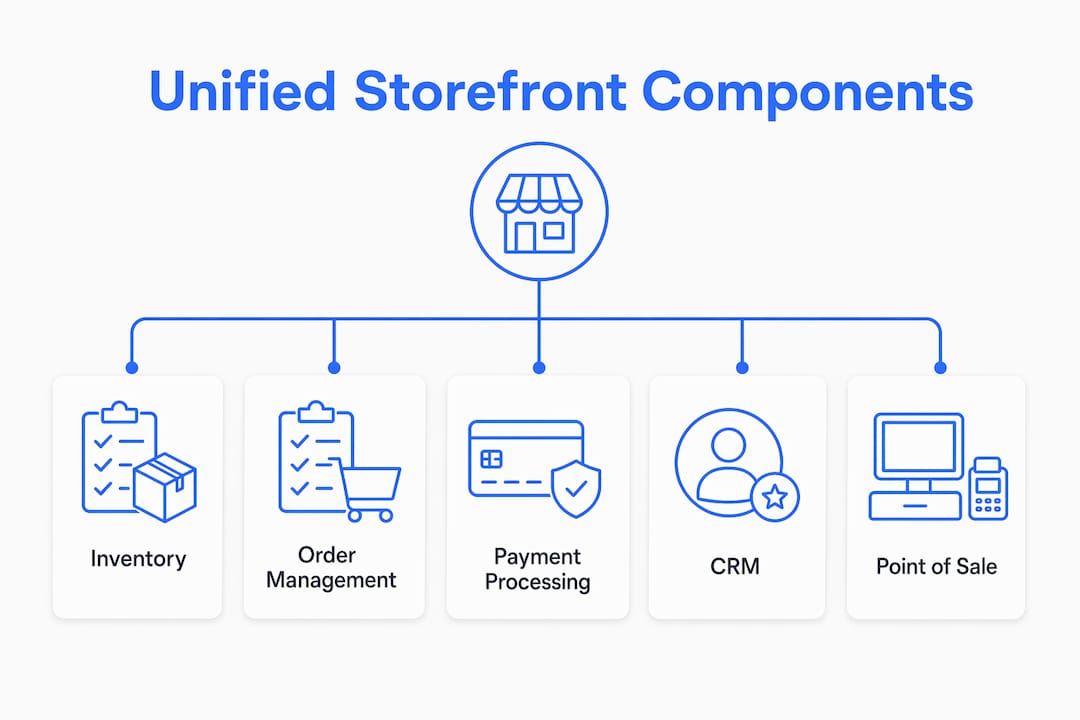
A unified platform must integrate five operational systems: inventory management, order management (OMS), payment processing, customer relationship management (CRM), and point-of-sale (POS). Each system must write to and read from a shared data layer. Product listing consistency across channels depends on centralized catalog management, which is often overlooked until pricing or description mismatches start costing conversions.
Governance and data integrity
Technology alone does not create a unified storefront. Governance does. Data silos persist without centralized management of product catalogs, pricing rules, and returns policies, even when systems are technically integrated. A brand needs clear ownership of each data domain and defined rules for how updates propagate across channels.
The execution sequence
-
Unify inventory and OMS first. This is the operational foundation.
-
Extend to POS to connect physical and digital channels.
-
Integrate CRM to build unified customer profiles.
-
Add loyalty, promotions, and personalization layers on top.
Jumping straight to CRM without the base layers leads to suboptimal results. The maturity sequence is not optional. It reflects the dependency structure of the underlying data.
Pro Tip: Before rollout, audit every customer-facing touchpoint for seams. Map the journey from product discovery to return and identify every point where two systems hand off data. Those handoffs are where the gaps will appear.
How do you measure the impact of a unified storefront?
Measuring the impact of unified commerce requires tracking metrics that span the full customer and operational lifecycle. A single-channel metric will not capture the cross-channel benefits that justify the investment.
Start by assessing your current state of data silos and integration debt. Catalog every system that holds inventory, order, customer, or pricing data. Count the number of integrations between them. That number is your baseline complexity score, and reducing it is the first measurable outcome of unification.
Prioritize these KPIs post-implementation:
-
Inventory turn rate: Measures how efficiently stock moves. Unified platforms improve this by reducing safety stock and preventing overselling.
-
Order fulfillment time: Tracks how quickly orders move from placement to delivery. Unified OMS routing reduces this by eliminating manual steps.
-
Return processing time: A direct measure of operational integration. Faster returns indicate that the OMS and inventory systems are sharing data correctly.
-
Customer satisfaction (CSAT): Captures the customer experience impact of removing seams. Expect improvement within 60–90 days of go-live.
-
Revenue per channel: Tracks whether unified visibility is driving incremental sales across previously underperforming channels.
Use an incremental rollout strategy. Start with one channel pair, measure the impact, and scale. Brands that try to unify everything simultaneously often stall on governance issues. A phased approach keeps momentum and produces early wins that build organizational support.
A practical test for unified commerce maturity is whether a store associate or customer service rep can answer any customer query from a single system without switching screens. If they cannot, the architecture is not yet unified.
Key takeaways
Unified commerce is the architecture that separates brands with consistent, profitable growth from those managing an ever-growing stack of disconnected systems.
Point | Details
Unified commerce beats omnichannel | A single source of truth for inventory, orders, and customers delivers nearly twice the revenue growth of patchwork integrations.
Start with inventory and OMS | Building the operational foundation first prevents the seams that break customer experience and inflate fulfillment costs.
Governance is non-negotiable | Centralized management of product catalogs, pricing, and returns policies is required to maintain data integrity across channels.
Measure the right KPIs | Track inventory turn rate, return processing time, CSAT, and revenue per channel to quantify the impact of unification.
Only 7% of retailers lead | The maturity gap is wide, meaning early movers gain a compounding advantage over brands that delay adoption.
The uncomfortable truth about unified commerce adoption
Most brands I work with arrive at the unified commerce conversation after a painful incident: a major stockout during a peak sales event, a returns backlog that triggered a wave of negative reviews, or a pricing discrepancy that went viral. They treat unification as a fix for a specific problem. That framing is too narrow, and it leads to underinvestment.
Unified commerce is not a feature upgrade. It is an architectural shift. The brands that treat it as a platform migration project tend to get the technology right and the governance wrong. They end up with a shiny new system feeding the same fragmented data it was supposed to replace.
The governance layer is where the real work happens. Who owns the product catalog? Who approves pricing changes before they propagate across Amazon, Walmart, and Shopify? Who resolves conflicts when two systems report different inventory counts? These are organizational questions, not technical ones. And they are the questions that determine whether a unified storefront actually delivers on its promise.
The adoption gap is striking: only 7% of retailers have reached true unified commerce leadership, while 33% remain at the basic level. That gap represents both a risk and an opportunity. Brands that move now build operational muscle that compounds over time. Brands that wait will find the gap harder to close as logistics costs rise and customer expectations keep moving up.
My advice to C-level executives: do not let your team spend six months evaluating front-end features. The omnichannel growth tactics that worked in 2020 are table stakes now. The competitive advantage in 2026 is in the operational layer, specifically in how fast your systems share data and how well your organization governs it.
— Dan Katona
How Nectar helps brands build high-converting unified storefronts
Unified commerce strategy is only as strong as its execution across each marketplace. Nectar manages full-funnel brand performance across Amazon, Walmart, and Shopify, ensuring that your storefront presence is consistent, data-driven, and built to convert. From in-house creative production to the proprietary iDerive analytics platform, Nectar gives brand executives the operational visibility and channel expertise needed to turn a unified commerce strategy into measurable revenue growth.
If you are assessing your current integration gaps or planning a unified storefront rollout, Nectar’s brand growth services are built for exactly this stage. Reach out to see how Nectar approaches unified commerce execution for mid-sized and enterprise brands.
FAQ
What is a unified storefront in e-commerce?
A unified storefront is a single platform that integrates inventory, orders, payments, CRM, and POS across all sales channels in real time. It replaces the disconnected systems typical of omnichannel setups with one shared operational source of truth.
How does unified commerce differ from omnichannel?
Omnichannel connects independent channel systems through integrations that sync on a schedule. Unified commerce integrates all systems into one platform, delivering real-time data consistency and eliminating the synchronization delays that cause inventory and pricing discrepancies.
What is the revenue impact of unified storefronts?
Unified commerce delivers nearly twice the growth rate and up to $17M in incremental revenue per $1B in revenue compared to integrated or patchwork approaches, according to commercetools research.
Where should brands start when building a unified storefront?
Start with inventory and order management system (OMS) integration. This operational foundation prevents overselling and fulfillment errors before extending unification to CRM and POS layers.
How do you know if your unified storefront is working?
A practical test is whether any store associate or customer service rep can answer a customer query from a single system without switching screens. If they cannot, the architecture still has seams to close.
Recommended





































































.webp)