TL;DR:
- Marketplace diversification reduces dependence on a single platform, protecting brands from policy changes and fee hikes. It enhances revenue stability, broadens customer reach, and safeguards margins through fee arbitrage. Proper SKU selection and an investment in management tools are essential for profitable multi-channel expansion.
Marketplace diversification is defined as the practice of selling across two or more distinct e-commerce platforms to reduce single-channel dependency and expand revenue reach. For mid-sized and enterprise brands, this is not a nice-to-have. Fee complexity on Amazon has grown from 2.8 to 4.2 fee-line items per FBA unit shipped, a 50% increase that directly compresses margins. That kind of cost inflation makes the question of why diversify marketplace presence less philosophical and more urgent. Brands that spread across Amazon, Walmart, and Shopify protect themselves from algorithm shifts, policy changes, and fee hikes that no single-platform seller can absorb without pain.
Why diversify marketplace presence: the core case
Single-platform dependence is a structural risk, not just a strategic inconvenience. Sellers who build entirely on one marketplace face a single point of failure: one policy change, one suppressed listing, or one algorithm update can wipe out months of revenue. The benefits of marketplace diversification go well beyond risk reduction, though that alone justifies the move.
Here is what multi-channel selling delivers in practice:
-
Revenue stability. A fee increase or ranking drop on one platform does not crater total revenue when other channels are generating sales independently.
-
Broader customer reach. Each marketplace attracts a distinct buyer demographic. Walmart shoppers skew toward value-conscious buyers. Shopify DTC customers often have higher brand loyalty and lifetime value. Reaching both groups from a single storefront is not possible.
-
Lower customer acquisition costs. Diversification lowers CPC on alternative platforms and improves organic discovery, which reduces paid media dependency over time.
-
Margin protection through fee arbitrage. Walmart’s fulfillment fee structure differs meaningfully from Amazon’s FBA model. Brands that run the numbers often find that certain SKUs are significantly more profitable on one platform than another.
-
Brand exposure and sales velocity. Appearing across multiple platforms signals category authority to both shoppers and search algorithms.
The importance of multi-channel selling becomes clearest when you look at what happens to brands that ignore it. A single account suspension or category restriction can halt revenue entirely. Diversification is the only structural defense against that outcome.
How should brands choose and manage SKUs across multiple marketplaces?

Not every product belongs on every platform. Margin-first catalog triage is the discipline of identifying which SKUs can survive the fee and fulfillment cost structure of a new marketplace before you list them. The rule of thumb: SKUs with net margins above 22% post-fees are the primary candidates for expansion. Everything below that threshold requires a hard look before you commit inventory and operational bandwidth.
The process for selecting and managing SKUs across channels breaks down into four steps:
-
Run a full margin analysis per SKU per platform. Factor in marketplace fees, fulfillment costs, and blended advertising spend for each channel. A product that earns 30% margin on Shopify may earn 14% on a marketplace with higher referral fees and mandatory fulfillment programs.
-
Avoid the copy-paste storefront approach. Listing the same catalog with the same content across every platform ignores the fact that each marketplace serves distinct buyer behaviors. Handmade or artisan-focused platforms favor different product presentations than general retail marketplaces.
-
Create marketplace-exclusive SKU configurations. Exclusive bundles or pack sizes per platform prevent direct price comparisons across channels. A 3-pack on Walmart and a 1-pack on Amazon are technically different products, which protects price parity and brand integrity simultaneously.
-
Align inventory and fulfillment models per channel. Walmart’s WFS (Walmart Fulfillment Services) and Amazon’s FBA have different inbound requirements, lead times, and cost structures. Managing them as identical operations creates inventory chaos.
Pro Tip: Before expanding to a new marketplace, run a 90-day demand validation on your top 20% of SKUs by margin. If those products show organic traction on the new platform without paid support, the channel is worth the operational investment.
The goal is not to list everything everywhere. The goal is to place the right products on the right platforms with the right content and fulfillment setup to generate profitable sales.
What operational tools and systems support effective marketplace diversification?
The tech stack behind multi-channel selling is where most brands underinvest. Managing listings, inventory, repricing, and performance data across Amazon, Walmart, and Shopify manually is not viable past a certain scale. The good news is that the cost of a proper SaaS operational stack is predictable.
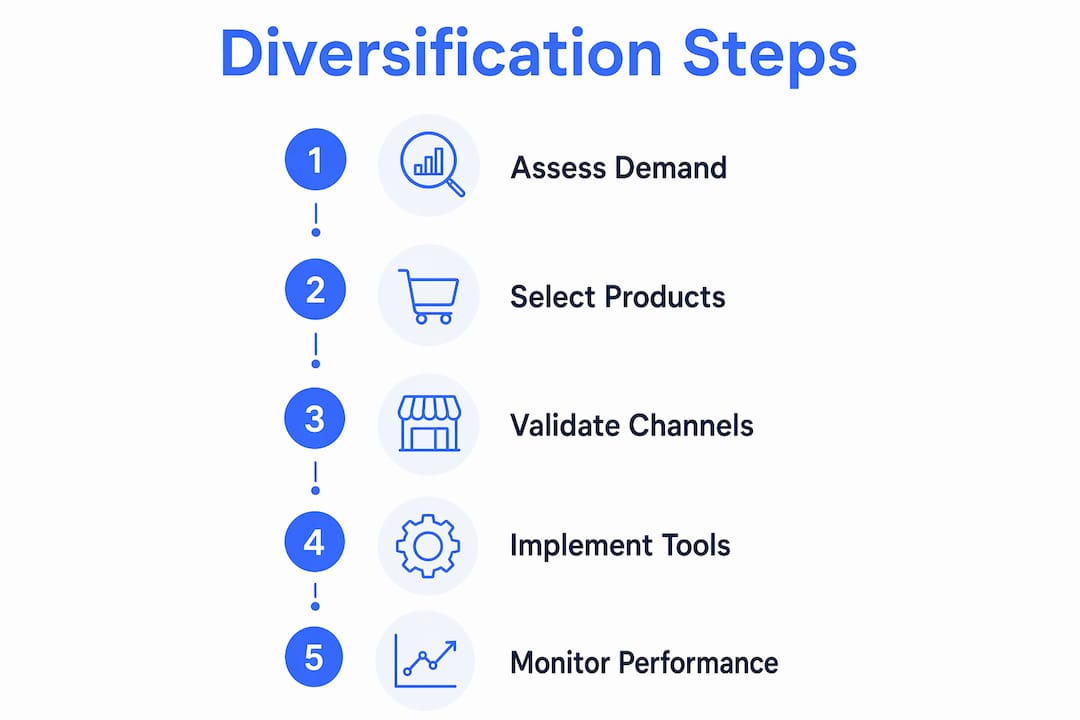
Operational costs for multichannel management typically run between 1.1% and 1.8% of total revenue at the $3M scale, which translates to roughly $2,800 to $4,500 per month. That range is considered acceptable given the risk reduction and revenue gains that multi-channel selling produces. The key is building the stack intentionally rather than layering tools reactively.
A functional multichannel stack covers four areas:
-
Listing management. A centralized tool that pushes product content to multiple platforms from a single source of truth. This prevents content drift, where listings on different platforms fall out of sync with updated images, copy, or compliance requirements.
-
Inventory synchronization. Real-time inventory sync across channels prevents overselling and the account health penalties that follow. This is non-negotiable once you are running more than two active channels.
-
Repricing and price parity monitoring. Automated repricing tools maintain competitive positioning on each platform while flagging price parity violations before they trigger MAP policy issues or marketplace suppression.
-
Performance analytics. Centralized reporting across channels lets you compare contribution margin, ad spend efficiency, and return rates by platform. Without this, you are making expansion decisions blind.
Brands that rely on platform-native tools for each marketplace end up with fragmented data and no unified view of profitability. Centralized tools solve that problem and make the role of marketplaces in retail strategy visible at the portfolio level rather than the channel level.
What common pitfalls should brands avoid when diversifying marketplace presence?
The most expensive mistake in marketplace expansion is moving too fast. Expanding to multiple marketplaces without solid operational infrastructure does not just slow you down. It multiplies every existing mistake across new channels, compounding costs and damaging account health simultaneously.
The pitfalls that consistently derail brands attempting to diversify their online presence fall into four categories:
-
Premature expansion. Launching on a new marketplace before proving demand and operational capacity on your primary channel means you are scaling problems, not scaling success. Successful expansion requires inventory sync, channel-native listing templates, and a sound 3PL model in place first.
-
Ignoring margin compression. Adding a channel without running a full cost model is how brands end up selling at a loss. Fulfillment fees, referral fees, and advertising costs stack differently on every platform.
-
Failing to maintain price parity. Listing the same product at different prices across channels triggers MAP violations, marketplace suppression, and customer trust issues. Exclusive SKU configurations are the cleanest solution to this problem.
-
Overextending without channel-specific strategies. Treating every marketplace as an identical sales channel ignores the behavioral and demographic differences between platforms. A strategy built for Amazon’s search-driven discovery model will not translate directly to Walmart’s in-store pickup audience or Shopify’s DTC loyalty mechanics.
Pro Tip: Set a hard rule: do not expand to a new marketplace until your primary channel runs at 85% or better on account health metrics. Expansion amplifies your operational baseline, good or bad.
The advantages of a diverse marketplace strategy only materialize when the operational foundation is solid. Diversification is a multiplier, not a fix.
Key takeaways
Brands that diversify marketplace presence reduce single-platform risk, access distinct buyer audiences, and protect margins through fee arbitrage across Amazon, Walmart, and Shopify.
Point
Details
Fee inflation demands diversification
Amazon’s fee complexity has grown 50%, making multi-channel selling a margin protection necessity.
Margin-first SKU selection
Only expand SKUs with net margins above 22% post-fees to avoid operational losses on new channels.
Exclusive SKU configurations protect pricing
Unique bundles per platform prevent direct price comparisons and preserve brand integrity.
Operational stack investment is predictable
Multichannel SaaS tools cost 1.1%–1.8% of revenue at the $3M scale, a justified expense for risk reduction.
Expand only when operationally ready
Premature expansion multiplies existing problems; prove demand and infrastructure before adding channels.
Marketplace diversification in 2026: what I’ve learned the hard way
The brands I see winning with multi-channel selling share one trait: they treat their marketplace portfolio as a system, not a collection of independent storefronts. Brands scaling past $25M integrate their marketplace strategy with paid media and DTC efforts from the start. They are not managing Amazon separately from Walmart separately from Shopify. They are managing a single revenue engine with multiple customer entry points.
What I have also seen is that diversification gets misread as a volume play. More channels does not mean more revenue automatically. Adding channels only when operational capacity and product demand can support them is the discipline that separates profitable multi-channel brands from chaotic ones. The brands that expand reactively, chasing platform incentives or competitor moves, almost always end up with margin erosion and account health problems within 12 months.
The uncomfortable truth is that most brands are not ready to diversify when they think they are. Their primary channel still has unresolved content gaps, inconsistent review velocity, and advertising inefficiency. Fixing those problems first makes every subsequent channel launch faster and more profitable. Diversification is a multiplier. If your foundation is weak, it multiplies weakness.
My practical advice for 2026: invest in analytics before you invest in new channels. You need to know your true contribution margin per SKU per platform before you can make a rational expansion decision. Without that data, you are guessing. And guessing at scale is expensive.
— Dan Katona
How Nectar helps brands expand profitably across marketplaces
Nectar’s marketplace expansion management service is built for mid-sized and enterprise brands that are ready to grow beyond a single platform without the operational chaos that typically follows. Nectar manages the full expansion process, from SKU triage and pricing parity strategy to listing optimization and channel-specific advertising across Amazon, Walmart, and Shopify. The proprietary iDerive analytics platform gives brands the contribution margin visibility they need to make expansion decisions based on data, not assumptions. If your brand is ready to treat multi-channel selling as a growth system rather than a side project, Nectar’s services are designed to get you there profitably.
FAQ
Why should brands diversify their marketplace presence?
Marketplace diversification reduces single-platform risk from algorithm changes, policy shifts, and fee increases. It also expands customer reach and lowers overall customer acquisition costs by accessing distinct buyer audiences on each platform.
How many marketplaces should a brand sell on?
The right number depends on operational capacity, not ambition. Brands should add a new marketplace only when their primary channel runs at strong account health metrics and their inventory and fulfillment systems can support the added complexity.
What is the biggest risk of not diversifying?
A single account suspension, listing suppression, or fee increase on your primary marketplace can halt revenue entirely. Single-platform dependence creates a structural vulnerability that no amount of optimization on that platform can eliminate.
How do exclusive SKUs help with marketplace diversification?
Exclusive bundles or pack sizes per platform prevent direct price comparisons across channels, which protects price parity and reduces the risk of MAP violations or marketplace suppression.
What does it cost to manage multiple marketplaces?
A functional SaaS stack for multichannel management typically costs between $2,800 and $4,500 per month for brands at the $3M revenue scale, representing 1.1%–1.8% of total revenue, which is considered a justified operational expense for the risk reduction it provides.
Recommended




































































.webp)