Storefront branding: boost conversions and brand value
.webp)

TL;DR:
- Investing in storefront branding transforms it from a visual project into a revenue-generating asset that reduces customer acquisition costs and enhances conversion rates. Consistent branding across all touchpoints builds customer trust, improves key metrics, and sustains long-term growth by reinforcing brand equity and competitive resilience. Treat branding as an operational system with ongoing measurement and iteration to multiply its strategic impact and drive better ROI.
Most e-commerce brand managers treat storefront design as a visual project with a start and an end date. Swap the banner, refresh the logo placement, maybe add a few lifestyle photos, and call it done. But that framing leaves serious money on the table. Branding for e-commerce shows that investing in storefront branding helps convert first-time visitors by reducing perceived risk, which directly supports lower customer acquisition costs and stronger conversion rates over time. Storefront branding is not decoration. It is a revenue lever, and this guide walks through the business case, the metrics it moves, and the practices that separate brands that scale from brands that stall.
Key Takeaways
| Point | Details |
|---|---|
| Branding drives growth | Investing in storefront branding boosts conversion rates, revenue, and market resilience. |
| Measure what matters | Track conversion and funnel metrics to prove the business impact of branding changes. |
| Trust is the conversion lever | Brand clarity and credibility mean higher sales and more returning customers. |
| Consistency multiplies results | A cohesive brand experience across all touchpoints fuels long-term ROI. |
| Iterate for ongoing impact | Treat branding as an evolving system, not a one-and-done project, for continual gains. |
The business case for storefront branding
Many marketing teams still file branding under “awareness” and measure it the same way they measure a press release: loosely and infrequently. That approach misses the full picture.
“Branding is not only ‘awareness.’ Established brand research frames it as a commercial asset that drives measurable outcomes like pricing power, customer acquisition cost reduction, and competitive resilience.”
That framing, from McKinsey, resets how you should budget, measure, and manage your storefront identity. When branding is treated as an asset, it earns a return. When it is treated as a cost, it gets cut first.
Here is how strong storefront branding creates financial and strategic value:
- Pricing power. Shoppers who recognize and trust a brand accept a price premium rather than reflexively clicking to the cheapest alternative. That gap goes directly to margin.
- Lower customer acquisition cost (CAC). A credible, consistent storefront converts a higher share of paid traffic, so you spend less per new customer. Brands that invest in lasting growth with branded content see this play out quarter over quarter.
- Competitive resilience. When a competitor runs an aggressive promotion, a brand with strong storefront equity loses fewer customers because the relationship is already built.
- Platform algorithm favor. On Amazon and Walmart, conversion rate is a key input to search ranking. A branded storefront that converts better also ranks better, making organic visibility a downstream reward of good branding.
- Repeat purchase momentum. Shoppers who had a visually coherent, trust-building first experience are more likely to return without a coupon or retargeting ad.
Following clear brand growth strategy steps can help you realize these gains systematically rather than hoping design refreshes trickle down to revenue. You can also maximize revenue in e-commerce by pairing sharp branding with smart promotional and pricing mechanics. For brands running full-funnel programs, advanced retail media strategies extend the compounding value of a strong storefront identity into paid channels.
Key metrics impacted by storefront branding
With the business case established, the next question is specific: which numbers actually move when you invest in storefront branding? The answer is broader than most managers expect.
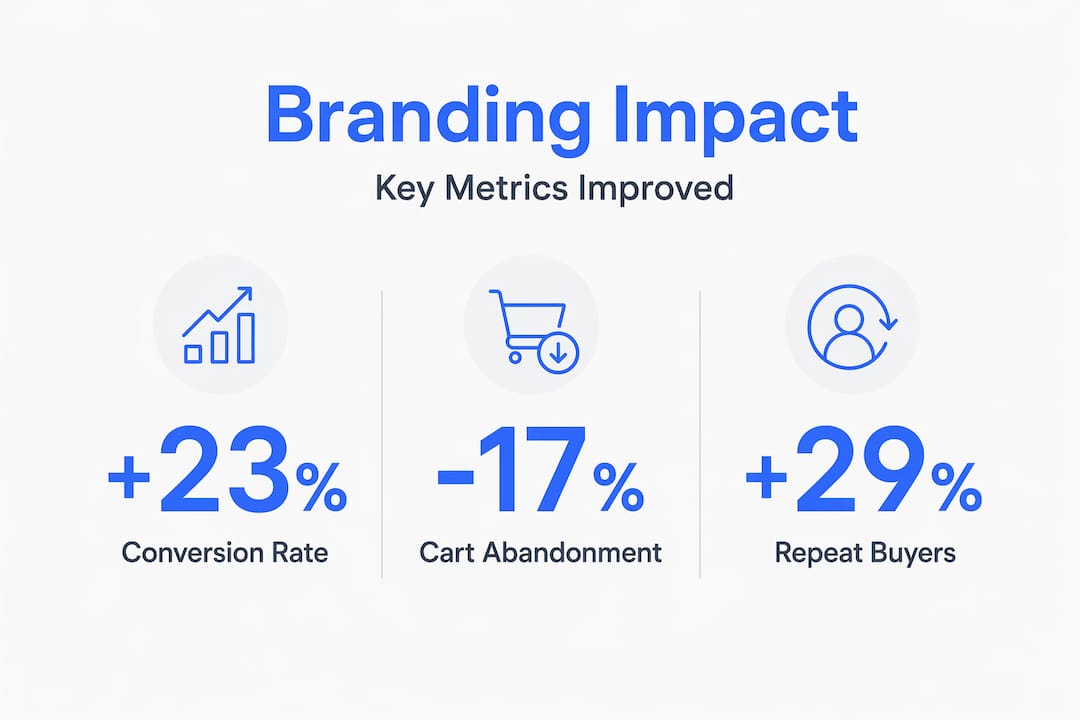
According to a digital storefront guide, storefront branding investments should be treated as a system that connects design and merchandising choices to measurable funnel outcomes, iterated as a living process rather than a one-time project.
| Metric | How branding influences it | Typical lever |
|---|---|---|
| Click-through rate (CTR) | Strong hero images and brand recognition drive more clicks from search results | Main image, brand name, visual consistency |
| Dwell time | Coherent storytelling and layout keep shoppers engaged longer | A+ content, brand store layout, video |
| Conversion rate | Trust signals and clear value hierarchy reduce abandonment | Reviews, imagery, copy tone, visual hierarchy |
| Average order value (AOV) | Cross-sell modules and branded bundle presentation lift basket size | Brand store, product imagery, bundles |
| Customer acquisition cost (CAC) | Higher conversion rates lower the effective cost per acquired customer | All of the above working together |
| Customer lifetime value (CLV) | Emotional brand connection and consistent experience drive repeat purchase | Post-purchase touchpoints, packaging, messaging |
The funnel impact follows a predictable sequence:
- Attract. Distinctive visuals and a recognizable brand identity pull clicks in a crowded search results page. A shopper scrolling past 20 similar listings stops at the one that looks authoritative.
- Engage. Once on your detail page or brand store, layout, copy tone, and imagery keep attention long enough to build desire. Poor visual hierarchy at this stage bleeds potential buyers before they ever reach the add-to-cart button.
- Convert. Trust signals, review presentation, and clear product differentiation close the sale. This is where most of the measurable lift from branding shows up immediately in the data.
- Retain. A coherent brand experience creates the emotional memory that brings shoppers back. The steps for higher storefront conversions you take today pay dividends on the second and third purchase.
For teams managing multiple SKUs and categories, a Shopify optimization checklist can anchor the process across your entire catalog. Backing branding decisions with data-driven retail decisions ensures you are not guessing which changes actually moved the needle.
Pro Tip: Allocate branding investment proportionally to the funnel stage that is leaking the most. If your CTR is strong but conversion is weak, the problem is on-page trust, not awareness. Fund accordingly.
How storefront branding shapes customer trust and buying behavior
Knowing the metrics is useful. Understanding the psychology behind them is what makes your branding decisions precise rather than intuitive.

| Storefront element | Before brand investment | After brand investment |
|---|---|---|
| Product imagery | Generic white-background shots only | Lifestyle, scale, and detail shots with consistent visual language |
| A+ content | Basic bullet points, no visual modules | Comparison charts, brand story, benefit-led visuals |
| Copy tone | Feature-heavy, generic | Brand voice, benefit-led, emotionally resonant |
| Visual hierarchy | Cluttered or inconsistent | Clear flow from hero to proof to CTA |
| Review presentation | Not highlighted | Integrated trust signals near decision points |
Each element on that table directly addresses a moment of friction or doubt in the shopper’s mind. Research on images and A+ content confirms that storefront branding elements shape clarity and trust before purchase, and those factors are what ultimately drive conversion. It is not magic. It is architecture.
“When shoppers encounter a storefront with cohesive visuals, a clear brand voice, and credible social proof, they spend less cognitive effort second-guessing the purchase. That reduced friction translates directly into higher add-to-cart rates.”
Here are the specific trust-building elements that move buying behavior in measurable ways:
- High-resolution lifestyle photography that shows the product in context, not just in isolation.
- Video content that demonstrates product features and addresses common objections in under 60 seconds.
- A+ content modules on Amazon that include comparison charts, ingredient breakdowns, or origin stories, depending on the category.
- Review volume and recency, positioned where shoppers are most likely to see them before they abandon.
- Clear visual hierarchy that guides the eye from the hero image to the key benefit to the call to action without making the shopper work.
On Amazon, this is especially consequential. A shopper who lands on a listing from a sponsored ad has already cost you money. If the listing does not convert, that spend is wasted. Investing in listing optimization for sales turns your creative spend into a permanent conversion asset rather than a one-time traffic cost.
Why consistency across touchpoints accelerates growth
Trust built on one page evaporates fast if the next page looks like it belongs to a different company. This is the problem with treating branding as a series of individual projects.
Brand consistency across touchpoints is directly linked to revenue growth, supporting a cohesive storefront identity rather than one-off design changes. When every customer interaction reinforces the same visual language, message, and emotional tone, the brand compounds in the customer’s memory.
In practical terms, consistency means:
- The same color palette and typography across your Amazon brand store, Shopify storefront, product detail pages, and email sequences.
- Aligned messaging hierarchy, so the same core benefit is front and center whether a shopper lands on a paid ad, an organic listing, or a direct-to-consumer page.
- Packaging and unboxing that match the digital brand experience, reinforcing the purchase decision after it is made.
- Consistent review response tone that signals a real brand is behind the product, not a faceless seller.
- Seasonal and campaign creative that stays on-brand rather than chasing trends that dilute the identity you have built.
The risk of ignoring this is what we call “random acts of branding”: isolated design decisions made by different team members, freelancers, or agencies without a shared system. The cumulative effect is a storefront that looks incoherent, undermines trust, and forces you to re-earn credibility with every new visitor.
Brands that invest in branded content to boost listings report not just higher conversion rates but also lower return rates, because customers arrive with accurate expectations aligned to the brand story. A well-structured brand store setup guide gives your team the shared reference point to maintain that consistency across Amazon, Walmart, and Shopify simultaneously. For retention programs, optimizing retention for growth shows how consistent brand experience feeds directly into repeat purchase rates.
Pro Tip: Set a quarterly brand audit on the calendar. Review every customer-facing touchpoint, from main images to email headers, against your core brand guidelines. Assign a single owner for each channel and make the audit findings visible to the whole marketing team.
Best practices for investing in storefront branding
Understanding why consistency matters is step one. Building a repeatable system to execute it is where most teams struggle. Here is a framework that works.
- Start with a brand and audience audit. Before spending a dollar on new creative, document what you have. What does your current storefront communicate? How do customers describe your brand in reviews? Where does the experience break down? This baseline makes every subsequent investment measurable.
- Identify the highest-leverage gaps. Use your funnel data to find where shoppers are dropping off. High CTR with low conversion points to an on-page trust problem. Low CTR points to a first-impression problem. Fund the creative that fixes the biggest leak first.
- Set clear, owned metrics for every branding investment. A new set of lifestyle images should come with a conversion rate target. A brand store redesign should track dwell time and multi-page session rates. If you cannot measure it, you cannot manage it.
- Iterate in cycles, not launches. Treat each branding update as a test, not a final state. Run A/B tests on hero images, copy angles, and A+ content modules. Let the data tell you what is working before you scale it across your full catalog.
- Scale what works systematically. When a particular visual treatment or messaging angle consistently lifts conversion, apply it everywhere it is relevant, across SKUs, channels, and markets.
The case study on redesigning a brand store illustrates how this iterative approach turns branding from a cost center into a compounding revenue driver. For the financial framework behind the approach, the steps to increase e-commerce ROI connect branding decisions to bottom-line outcomes. Brands that optimize retail offers with data alongside branding investments see faster and more durable results.
Common pitfalls to avoid:
- Cosmetic-only changes with no measurement plan, which feel productive but deliver no verifiable ROI.
- Channel-by-channel isolation, where your Amazon team and Shopify team operate with different brand guidelines.
- Launch-and-forget mentality, treating a storefront redesign as complete rather than as an ongoing iteration cycle.
- Misaligned creative and media spend, where you drive paid traffic to an unconverted listing and wonder why ROAS is falling.
Pro Tip: Connect every branding investment to one owned metric before the work starts. “We are redesigning the hero image to improve conversion rate from X% to Y% by the end of Q3” is a business decision. “We are refreshing the look” is not.
What most e-commerce managers miss about storefront branding
Here is the uncomfortable truth most teams do not want to hear: the brands winning on Amazon, Walmart, and Shopify are not winning because they did one great creative refresh. They are winning because they treat branding as an operating system, funded, maintained, and optimized like any other high-leverage business function.
Most marketing leaders we work with have gone through the same cycle. Invest in a brand store launch. See a short-term lift. Watch performance plateau. Conclude that branding “worked for a while” and shift budget back to advertising. What they missed is that the advertising could have kept compounding if the branding had kept iterating. The two reinforce each other. When your storefront converts better, every ad dollar goes further, which is exactly why branded content for growth is not a creative department priority. It is a P&L priority.
The “branding is cosmetic” myth is particularly damaging at the enterprise level, where teams are large enough that no single person owns the full customer experience. Design happens in one lane. Copy in another. Advertising in a third. Without a shared system, you end up with a storefront that looks like three companies collaborated badly. The fix is not hiring better designers. It is building the process that keeps every touchpoint aligned over time.
The winning teams we see do something different. They budget for branding as a recurring operational line item, not a project budget. They review brand performance quarterly, not annually. They assign clear ownership for every customer-facing surface. And they measure branding investments with the same rigor they apply to paid media, tracking conversion rate changes, CAC trends, and CLV by cohort. That discipline is what turns a brand store into an asset that appreciates month after month rather than a sunk cost that fades.
How Nectar accelerates ROI from storefront branding
If the principles in this guide resonate, the next question is execution. Building a consistent, measurable, iterative branding system across Amazon, Walmart, and Shopify simultaneously is a significant operational challenge, especially for mid-sized to enterprise brands managing large catalogs.
Nectar is built specifically for that challenge. Our in-house photography, videography, and design teams produce storefront creative that is built to convert, not just to impress. Our proprietary iDerive analytics platform connects every creative decision to funnel performance, so you always know which branding investments are earning their keep. Whether you need a full Amazon growth optimization program, a Shopify storefront optimization engagement, or a broader profitable brand growth strategy, Nectar gives your brand the system it needs to scale smarter and convert more.
Frequently asked questions
How does storefront branding affect customer acquisition costs?
Effective storefront branding reduces perceived risk and increases trust, which means a higher share of paid traffic converts, lowering the effective cost per acquisition over time without requiring more ad spend.
What is the most important metric for storefront branding?
Conversion rate is typically the most direct and immediate indicator of branding impact, but consistent branding also improves customer lifetime value and average order value as the brand relationship deepens.
Can one-off design changes replace systematic branding?
No. Consistent, systematized branding is tied to long-term revenue growth and competitive resilience, while one-off changes typically produce short-lived lifts with no compounding effect.
What are the biggest pitfalls when revamping storefront branding?
The biggest pitfalls are treating branding as purely cosmetic without measurement against conversion and friction metrics, and failing to maintain consistency across every customer-facing touchpoint after the initial refresh.
How does storefront branding help with pricing power?
Strong storefront branding creates a premium perception and competitive distinctiveness, and McKinsey’s research confirms it is a commercial asset that drives measurable pricing power outcomes rather than just awareness.
Recommended







































































.webp)