{
"@type": "Article",
"image": {
"url": "https://csuxjmfbwmkxiegfpljm.supabase.co/storage/v1/object/public/blog-images/organization-10884/1773796731822_Enterprise-executives-discuss-Shopify-at-glass-table.png",
"@type": "ImageObject",
"caption": "Enterprise executives discuss Shopify at glass table"
},
"author": {
"url": "https://thinknectar.com",
"name": "Thinknectar",
"@type": "Organization"
},
"@context": "https://schema.org",
"headline": "Why Shopify for enterprise brands drives scalable growth",
"publisher": {
"url": "https://thinknectar.com",
"name": "Thinknectar",
"@type": "Organization"
},
"inLanguage": "en-US",
"articleBody": "Discover why leading enterprise brands choose Shopify Plus in 2026. Learn how unified commerce, composable architecture, and proven migration strategies drive measurable revenue growth and conversion improvements.",
"description": "Discover why leading enterprise brands choose Shopify Plus in 2026. Learn how unified commerce, composable architecture, and proven migration strategies drive measurable revenue growth and conversion improvements.",
"datePublished": "2026-03-18T01:20:12.528Z"
}
Why Shopify for enterprise brands drives scalable growth
.webp)

Many decision-makers still view Shopify as a platform for small businesses, overlooking its enterprise-grade capabilities. Yet leading global brands consistently choose Shopify Plus to scale revenue, optimize conversions, and unify commerce across channels. In 2026, enterprise adoption continues accelerating as brands discover how Shopify’s composable architecture, advanced analytics, and omnichannel tools deliver measurable ROI. This guide reveals why Shopify has become the top choice for mid-sized and enterprise brands seeking profitable growth, backed by real data from successful migrations and transformations.
Key takeaways
| Point | Details |
|---|---|
| Unified commerce boosts revenue | Shopify POS integration enables seamless omnichannel experiences that drive significant revenue growth |
| Migration delivers conversion gains | Enterprise brands switching to Shopify Plus see dramatic increases in conversion rates and web sales |
| Composable architecture cuts costs | API-first design reduces total cost of ownership by 37% while accelerating time to market |
| Extensibility through ecosystem | Over 8,000 apps provide enterprise-grade functionality without custom development overhead |
| Strategic planning manages complexity | Phased migrations and middleware solutions address API limits and integration challenges |
How unified commerce with Shopify drives revenue growth
Unified commerce represents a fundamental shift from fragmented retail systems to a single platform connecting every customer touchpoint. Shopify’s approach integrates point-of-sale, inventory management, order fulfillment, and customer data into one cohesive ecosystem. This architecture eliminates data silos that plague traditional enterprise retail operations.
The impact shows clearly in real-world results. Shopify POS across 125+ stores drove 129% revenue growth for Bentley, the luxury automotive brand, while online sales increased 74% year over year. This performance stems from Shopify’s ability to synchronize inventory in real time across physical and digital channels, enabling capabilities like buy online pickup in store without overselling or disappointing customers.
Enterprise brands benefit from several unified commerce features that directly impact the bottom line:
-
Real-time inventory tracking across all locations and channels
-
Integrated POS systems that update online availability instantly
-
Buy online pickup in store (BOPIS) functionality reducing shipping costs
-
Centralized order management streamlining fulfillment workflows
-
Unified customer profiles enabling personalized experiences
The data advantage becomes particularly powerful for Shopify growth strategy for enterprises focused on maximizing customer lifetime value. When every interaction feeds into a single analytics platform, brands gain visibility into cross-channel behavior patterns that inform inventory allocation, marketing spend, and merchandising decisions.
Bentley’s implementation of Shopify POS across their retail network generated 129% revenue growth and 74% increase in online sales, demonstrating how unified commerce directly impacts enterprise profitability.
This unified approach eliminates the technical debt and integration costs that burden legacy enterprise systems. Instead of maintaining separate platforms for e-commerce, POS, inventory, and customer relationship management, brands operate from a single source of truth. The operational efficiency translates to faster decision-making and more agile responses to market changes.
Enterprise migration: Shopify Plus transformation success stories
Platform migrations carry significant risk for enterprise brands, yet the performance gains from modernizing legacy systems often justify the investment. Everlast, the iconic boxing and fitness brand, provides a compelling case study in how strategic migration to Shopify Plus accelerates growth through technical and user experience improvements.
Moving from Magento to Shopify Plus, Everlast migration increased conversions 152% and web sales 23% within just one month. This dramatic improvement resulted from custom ERP integration that streamlined order processing, combined with mobile-first design that enhanced the shopping experience across devices. The speed and stability improvements alone contributed significantly to conversion uplift.
Key benefits driving successful enterprise Shopify migration strategies include:
-
Custom ERP integration maintaining existing business processes
-
Mobile optimization delivering faster load times and better UX
-
Improved site speed reducing bounce rates and cart abandonment
-
Enhanced checkout flows minimizing friction in purchase completion
The mobile-first architecture proves particularly valuable as mobile commerce continues dominating online sales. Shopify’s responsive themes and optimized checkout process ensure consistent performance regardless of device, eliminating the fragmented experiences common with older platforms. Enterprise brands see immediate conversion improvements simply from the technical infrastructure upgrade.

Pro Tip: Plan phased migrations to reduce risk and maintain uptime during transition. Start with a pilot product category or geographic region, validate performance improvements, then expand systematically to minimize disruption while building internal confidence in the new platform.
Beyond technical capabilities, Shopify Plus offers enterprise brands the flexibility to customize without sacrificing platform stability. The combination of out-of-box functionality with extensibility through apps and APIs means brands can differentiate their customer experience while benefiting from continuous platform improvements. This balance between standardization and customization proves difficult to achieve with traditional enterprise platforms.
The speed of deployment represents another critical advantage. Where legacy enterprise implementations often require 12-18 months, Shopify Plus migrations typically complete in 3-6 months. This accelerated timeline reduces opportunity cost and allows brands to start realizing ROI faster, a crucial consideration when evaluating total cost of ownership.
Shopify Plus ecosystem and architectural advantages for enterprises
The Shopify Plus ecosystem extends far beyond the core platform, offering enterprise brands access to specialized functionality without custom development. With over 8,000 apps available, brands can rapidly add capabilities for subscription management, advanced analytics, personalization, internationalization, and countless other requirements.
This extensibility becomes particularly valuable when compared to traditional enterprise platforms requiring expensive custom development for similar functionality. The app ecosystem allows brands to test and validate new capabilities quickly, then scale what works without the sunk cost of custom code that becomes technical debt.
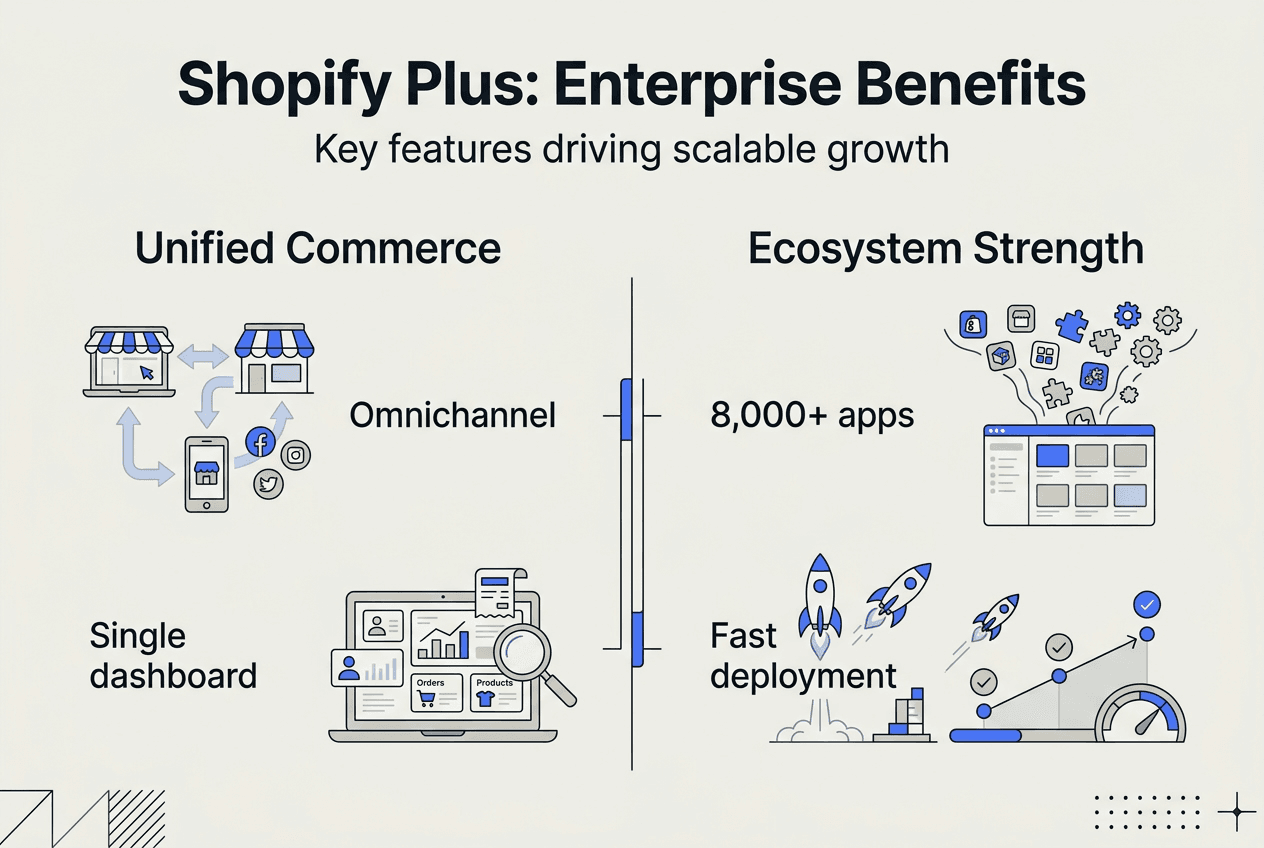
The architectural foundation enabling this flexibility centers on composable, API-first design. Composable architecture reduces total cost of ownership 37% compared to monolithic enterprise platforms, while accelerating launches 20% faster than competitors. This cost advantage compounds over time as brands avoid the maintenance burden and upgrade challenges inherent in custom enterprise implementations.
Key architectural benefits for enterprise operations include:
-
API-first composability enabling headless commerce and custom front-end experiences
-
Unified data models ensuring consistency across channels and touchpoints
-
Extensibility through apps and webhooks without modifying core platform code
-
Launch acceleration via proven patterns and pre-built integrations
When evaluating 2026 ecommerce platform comparison options, enterprise brands should consider how architectural choices impact long-term flexibility and cost. The table below contrasts Shopify Plus with BigCommerce on key enterprise requirements:
| Feature | Shopify Plus | BigCommerce |
|---|---|---|
| App ecosystem size | 8,000+ apps | 1,000+ apps |
| API rate limits | 40 requests/second | 20,000 requests/hour |
| Native B2B features | Limited, requires apps | Robust built-in capabilities |
| Multi-storefront management | Separate stores | Unified multi-storefront |
| Checkout customization | Scripts/Functions | Open checkout API |
| Total cost of ownership | Lower via composability | Higher for complex catalogs |
Pro Tip: Test API rate limits and webhook reliability carefully for high-volume brands. While 40 requests per second handles most scenarios, brands processing thousands of orders daily should validate performance under peak load conditions before committing to migration.
The phased migration methodology Shopify Plus employs further reduces risk for enterprise brands. Rather than big-bang implementations that often fail, the platform supports gradual rollouts by geography, product category, or customer segment. This approach allows brands to validate assumptions, refine processes, and build organizational confidence before full deployment.
Agile change management built into the Shopify Plus approach contrasts sharply with traditional waterfall enterprise implementations. Brands can iterate on store design, test new features, and optimize conversion flows continuously rather than waiting for major version upgrades. This operational agility translates directly to competitive advantage in fast-moving markets.
Overcoming Shopify Plus challenges at enterprise scale
While Shopify Plus offers compelling advantages, enterprise decision-makers must understand practical limitations to plan appropriately. API throttling at 40 requests per second can impact integrations for very high-volume operations, particularly during peak periods like flash sales or product launches. Brands processing thousands of simultaneous transactions need architectural strategies to work within these constraints.
Checkout customization represents another consideration for enterprises with complex requirements. While Shopify Scripts and Checkout Functions enable significant personalization, the extensibility remains more constrained than fully open checkout APIs offered by some competitors. Brands requiring highly customized checkout flows should validate their specific requirements during the evaluation phase.
ERP integration complexity varies significantly based on existing systems. Legacy enterprise resource planning platforms often lack modern APIs, requiring middleware solutions to connect effectively with Shopify Plus. The integration architecture must handle order synchronization, inventory updates, customer data, and financial reconciliation without creating bottlenecks or data inconsistencies.
Key challenges enterprise brands should address include:
-
API rate limits requiring queue management for high-volume operations
-
Checkout extensibility constraints limiting some customization scenarios
-
ERP integration complexity demanding middleware for legacy systems
-
Rigorous testing requirements validating performance under enterprise load
The testing requirements deserve particular attention. Enterprise brands cannot simply migrate and hope for the best. Comprehensive testing must validate checkout flows, payment processing, inventory synchronization, order management, and customer account functionality across devices and scenarios. Load testing becomes critical to ensure the platform performs during peak traffic periods.
Pro Tip: Implement robust automated A/B testing in ecommerce when customizing for enterprise UX improvements. What works for one customer segment may not optimize conversions for another, so continuous testing and iteration should become part of your operational rhythm.
The middleware layer often becomes the architectural linchpin for complex enterprise implementations. Rather than attempting direct integration between Shopify Plus and legacy systems, successful brands typically implement an integration platform handling data transformation, error handling, retry logic, and monitoring. This approach isolates Shopify from backend complexity while providing the flexibility to evolve systems independently.
Security and compliance requirements add another layer of complexity for enterprise brands, particularly those in regulated industries. While Shopify Plus maintains SOC 2 certification and PCI DSS compliance, brands must ensure their customizations and integrations maintain these standards. Third-party apps require careful vetting to avoid introducing vulnerabilities or compliance gaps.
Despite these challenges, most enterprise brands find the benefits significantly outweigh the limitations. The key lies in realistic planning, thorough testing, and appropriate architectural decisions that work with the platform’s strengths rather than fighting against constraints. Brands that invest in proper implementation typically see ROI within the first year through improved conversion rates and operational efficiency.
Explore Shopify enterprise solutions with Nectar
Understanding Shopify’s capabilities provides the foundation, but maximizing results requires expert execution. Nectar specializes in helping enterprise brands unlock profitable growth through tailored Shopify consulting and optimization strategies. Our approach combines technical expertise with data-driven marketing to transform underperforming stores into high-converting revenue engines.
Our track record speaks to the impact of strategic Shopify implementation. We helped build the perfect shopping trip on Shopify for a major brand, optimizing every touchpoint from discovery to checkout. Similarly, transforming Souper Cubes Shopify website demonstrates how targeted improvements drive measurable sales growth.
Partner with our team to navigate technical challenges, optimize conversion flows, and scale efficiently. Explore our comprehensive services for profitable brand growth to discover how we help mid-sized and enterprise brands maximize their Shopify investment.
FAQ
Is Shopify suitable for complex multi-brand enterprise catalogs?
Shopify Plus excels for high-volume single-brand enterprises but has limitations for native multi-brand B2B catalog management. The platform handles multiple storefronts well, but each operates as a separate instance rather than a unified multi-brand system. Brands with complex multi-brand needs, particularly in B2B scenarios, might evaluate BigCommerce as an alternative offering stronger native capabilities for this use case.
How does Shopify Plus improve online conversion rates?
Conversion improvements stem from faster site speed, mobile optimization, and integrated systems enabling seamless checkout experiences. Everlast saw 152% conversion rate increase moving to Shopify Plus with ERP integration and mobile-first design. The platform’s optimized checkout flow, combined with flexibility for personalized customer experiences through apps and customization, directly impacts conversion performance across customer segments.
What are main challenges when scaling Shopify for enterprises?
Enterprises must manage API throttling and checkout customization constraints through careful architectural planning. The 40 requests per second API limit requires queue management for very high-volume operations. Middleware solutions help integrate complex backend systems efficiently, handling data transformation and error management. Rigorous testing validates performance under enterprise load conditions before going live.
Does Shopify Plus support international expansion for enterprise brands?
Shopify Plus provides robust internationalization capabilities including multi-currency support, localized checkout experiences, and market-specific domains. The platform handles tax calculations, shipping rules, and payment methods for different regions. However, brands should validate specific requirements for markets with unique regulatory needs, as some scenarios may require additional apps or customization to fully support local compliance and customer expectations.
How long does enterprise migration to Shopify Plus typically take?
Most enterprise migrations complete in three to six months, significantly faster than traditional enterprise platform implementations requiring 12-18 months. Timeline depends on catalog complexity, number of integrations, and extent of customization required. Phased approaches allow brands to launch core functionality quickly, then iteratively add advanced features. Proper planning and experienced implementation partners accelerate timelines while reducing risk of disruption to ongoing operations.
Recommended
-
Nectar Blog | Shopify growth strategy steps for enterprise brands
-
Nectar Blog | Why Ecommerce Partners Matter for Enterprise Brands
-
Nectar Blog | Ecommerce Platforms 2026: 28% Growth Drives Selection
-
Nectar Blog | Master Shopify Advertising Workflow for Better ROI
-
Enterprise WordPress Support: Reliability for UK SMEs - WPCTO



































































.webp)