{
"@type": "Article",
"image": {
"url": "https://csuxjmfbwmkxiegfpljm.supabase.co/storage/v1/object/public/blog-images/organization-10884/1774334023621_Woman-analyzing-ecommerce-analytics-at-kitchen-table.jpeg",
"@type": "ImageObject",
"caption": "Woman analyzing ecommerce analytics at kitchen table"
},
"author": {
"url": "https://thinknectar.com",
"name": "Thinknectar",
"@type": "Organization"
},
"@context": "https://schema.org",
"headline": "Scale ecommerce brands with data-driven strategies",
"publisher": {
"url": "https://thinknectar.com",
"name": "Thinknectar",
"@type": "Organization"
},
"inLanguage": "en-US",
"articleBody": "Learn proven strategies to scale ecommerce brands profitably using data automation, retention-first growth tactics, and market-specific approaches for sustainable results.",
"description": "Learn proven strategies to scale ecommerce brands profitably using data automation, retention-first growth tactics, and market-specific approaches for sustainable results.",
"datePublished": "2026-03-24T06:34:25.508Z"
}
Scale ecommerce brands with data-driven strategies
.webp)

Scaling an ecommerce brand profitably has never been more challenging. Rising customer acquisition costs, operational bottlenecks, and margin pressure force mid-sized and enterprise brands to rethink growth strategies. The solution lies in shifting from pure acquisition tactics to retention-focused models, building unified data systems that automate profit levers, and tailoring strategies to market maturity. This guide walks you through proven, actionable steps to scale smarter, protect profitability, and sustain long-term growth in today’s competitive landscape.
Key Takeaways
| Point | Details |
|---|---|
| Retention over acquisition | Shift budgets from acquisition to retention to protect margins and extend customer lifetime value. |
| Unified data stack | Unify data across sales, ads, inventory, and service to enable real time decision making and automate profit levers. |
| Profit focused KPIs | Conduct comprehensive operational audits and establish profit focused KPIs to prevent fulfillment and margin breakdowns as scale increases. |
| Generalist teams first | Keep generalist cross functional teams in early scaling to preserve agility until headcount reaches 20 to 30. |
| Market maturity strategies | Tailor growth strategies by market maturity, pursuing acquisition in emerging markets and retention in mature markets. |
Preparing to scale your ecommerce brand: foundation and prerequisites
Before you chase aggressive growth targets, you need rock-solid operational foundations. Too many brands scale traffic before their systems can handle it, leading to fulfillment delays, inventory stockouts, and customer service meltdowns. Start with a thorough operational audit covering inventory management, fulfillment workflows, and profitability metrics across all sales channels. Identify weak points in your supply chain, payment processing, and customer data flows. Fix these before you accelerate growth.
Establish profit-first KPIs that guide every scaling decision. Focus on CAC to LTV ratios, gross margin per channel, and payback periods. Successful brands target payback periods under 6-12 months to ensure sustainable unit economics. Track contribution margin by product line and channel to understand where growth actually creates value versus where it burns cash.
Your data infrastructure determines how fast you can scale intelligently. Build or unify your ecommerce data stack to connect sales platforms, advertising channels, inventory systems, and customer service tools. This unified view enables real-time decision making and automation of critical profit levers. Without it, you’re flying blind as complexity increases.

Team structure matters more than most brands realize. In early scaling phases, retain generalist team members who can wear multiple hats and pivot quickly. Corporate hiring models that bring in narrow specialists too early kill agility. You need speed and flexibility until you reach 20 to 30 headcount, then you can start building specialized functions.
Pro Tip: Map your entire order fulfillment process from click to delivery, identifying every handoff and potential failure point. Scale these systems before scaling traffic to avoid operational collapse during peak periods.
Partner with agencies that understand end-to-end ecommerce management to fill capability gaps without bloating headcount. The right partners bring specialized expertise in areas like marketplace advertising, creative production, and analytics while you maintain focus on core business operations.
Shifting from acquisition to retention-first growth strategies
The economics of ecommerce growth have fundamentally shifted. Customer acquisition costs rose 37% year over year while platform competition intensifies and privacy changes limit targeting effectiveness. Brands that continue pouring budget into cold acquisition without balancing retention efforts watch profit margins evaporate. The math is simple: acquiring a new customer costs five to seven times more than retaining an existing one, and repeat customers spend 67% more per transaction on average.
Successful brands have already made this shift. Research tracking 42 direct-to-consumer brands found those prioritizing retention achieved 3.2x median revenue growth compared to acquisition-focused competitors. They reallocated budget from prospecting campaigns to customer lifecycle programs, improved repeat purchase rates, and extended customer lifetime value.
Implementing retention-first strategies requires specific tactical changes:
-
Build tiered loyalty programs that reward repeat purchases with exclusive access, discounts, or points that drive incremental transactions
-
Deploy personalized email and SMS campaigns triggered by purchase behavior, browsing patterns, and lifecycle stage to stay top of mind
-
Launch subscription models for consumable products to create predictable recurring revenue and increase customer lifetime value
-
Create VIP customer segments with dedicated service, early product access, and special perks to maximize high-value relationships
-
Implement win-back campaigns targeting lapsed customers with compelling offers based on their previous purchase history
The retention payoff compounds over time. While acquisition delivers one-time transactions, retention builds an expanding base of repeat buyers who require less marketing spend per purchase. This creates a flywheel effect where each cohort becomes more profitable as it matures.
Reallocating just 10% of acquisition budget to retention programs can improve overall profitability by 25% to 40% within 12 months by reducing blended CAC and increasing customer lifetime value across your entire base.
Develop comprehensive ecommerce retention strategies tailored to your product category, purchase frequency, and customer segments. Test different retention mechanics, measure impact on repeat rate and LTV, then double down on what works. The brands winning in today’s market treat retention as seriously as acquisition, with dedicated teams, budgets, and performance goals.
Leveraging data automation and predictive analytics for profit protection
As you scale, manual decision making becomes impossible. The volume of products, campaigns, customer segments, and operational variables explodes beyond human capacity to optimize. This is where unified data systems and automation become non-negotiable. Brands that build data stacks connecting all ecommerce platforms gain the foundation to automate critical profit levers.
Start by centralizing data from every source: sales platforms like Amazon, Walmart, and Shopify; advertising channels including Google, Meta, and TikTok; inventory and fulfillment systems; customer service platforms; and financial tools. This unified view reveals relationships and patterns invisible when data sits in silos. You can finally answer questions like which products drive the highest lifetime value, which channels deliver profitable customers, and where operational inefficiencies drain margin.
Once data flows into a central system, automate the profit levers that protect margins at scale:
-
Dynamic pricing optimization: Automatically adjust prices based on competitor pricing, inventory levels, demand signals, and margin targets to maximize revenue without manual monitoring
-
Predictive churn modeling: Identify customers at risk of lapsing based on behavioral patterns, then trigger automated retention campaigns before they leave
-
Inventory forecasting: Use historical sales data, seasonality patterns, and trend analysis to predict demand and optimize stock levels across warehouses
-
Campaign budget allocation: Automatically shift advertising spend toward channels and campaigns delivering the best ROI based on real-time performance data
-
Customer segmentation: Continuously update customer segments based on purchase behavior, engagement, and predicted lifetime value to personalize marketing
| Metric | Before Automation | After Automation | Improvement |
|---|---|---|---|
| Churn rate | 28% | 19% | 32% reduction |
| Pricing efficiency | 67% | 89% | 33% increase |
| Inventory turnover | 4.2x | 6.8x | 62% faster |
| Marketing ROI | 3.1x | 5.4x | 74% improvement |
Pro Tip: Start automation with one high-impact lever like dynamic pricing or churn prediction, prove the ROI, then expand to additional use cases. Trying to automate everything at once overwhelms teams and dilutes focus.
Predictive analytics takes automation further by forecasting future outcomes before they happen. Instead of reacting to churn after customers leave, you predict who will churn and intervene proactively. Instead of stockouts during promotions, you forecast demand spikes and adjust inventory ahead of time. This shift from reactive to proactive management protects profitability as complexity scales.
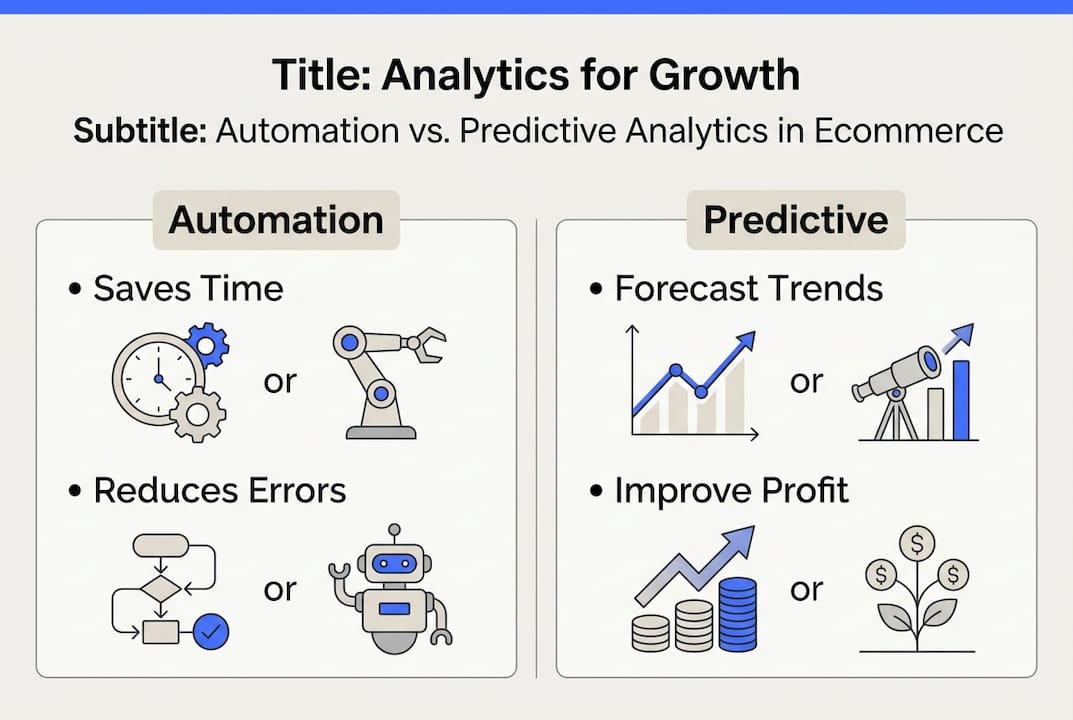
Learn how to maximize returns through leveraging ecommerce data across your entire operation. The brands that master data-driven decision making and automation gain sustainable competitive advantages that compound over time.
Adjusting strategies for different market maturity levels and team optimization
Not all markets respond to the same growth strategies. What works in mature North American markets fails in emerging regions, and vice versa. Successful scaling requires tailoring your approach to market maturity, competitive dynamics, and customer behavior patterns specific to each geography.
In emerging markets like Latin America, acquisition-driven growth still delivers strong returns. These regions show 117% growth in new user acquisition as ecommerce penetration increases and first-time online buyers enter the market. Competition remains lower, customer acquisition costs stay reasonable, and brands can profitably scale through performance marketing focused on reaching new audiences. Invest heavily in awareness campaigns, marketplace presence, and conversion optimization to capture market share during this growth phase.
Mature markets like North America tell a different story. New user growth declined 58% as market saturation increased and most potential customers already shop online regularly. Here, retention and customer lifetime value optimization drive profitable growth. Focus budget on loyalty programs, personalized remarketing, subscription models, and maximizing repeat purchase rates from your existing customer base. Acquisition still matters but requires higher efficiency thresholds to maintain profitability.
| Market Characteristic | Emerging Markets | Mature Markets |
|---|---|---|
| Primary growth driver | New customer acquisition | Repeat purchase and retention |
| CAC trend | Stable or declining | Rising significantly |
| Competitive intensity | Lower, fragmented | High, consolidated |
| Recommended LTV/CAC payback | 9-12 months acceptable | 6-9 months required |
| Budget allocation | 70% acquisition, 30% retention | 40% acquisition, 60% retention |
Target LTV to CAC payback periods between 6 and 12 months depending on market maturity. Emerging markets allow longer payback windows due to lower competition and higher growth rates. Mature markets demand faster payback to maintain profitability amid rising costs. Track this metric by channel and geography to identify where growth creates value versus where it destroys it.
Team optimization matters as much as market strategy. Early-stage scaling demands agility over specialization. Corporate hiring models fail in fast-growth ecommerce because they prioritize narrow expertise over adaptability. Retain generalist team members who can shift between functions, solve diverse problems, and maintain velocity as priorities change weekly.
Key hiring practices for maintaining scaling speed:
-
Hire for learning ability and adaptability rather than deep specialization in early growth phases
-
Keep teams small and cross-functional until reaching 20 to 30 total headcount
-
Avoid creating rigid departmental structures that slow decision making and reduce flexibility
-
Bring in specialists only after processes stabilize and volume justifies dedicated roles
-
Maintain a bias toward action and experimentation over planning and analysis
Understand the nuances of global ecommerce expansion before entering new markets. Each region requires different strategies, partnerships, and operational capabilities. Test with small budgets, learn quickly, then scale what works rather than assuming your domestic playbook transfers directly.
Grow your ecommerce brand profitably with Nectar’s expert services
Scaling profitably requires more than strategy. You need execution partners who understand the complete picture from creative to analytics to advertising optimization. Nectar specializes in driving measurable growth for mid-sized and enterprise ecommerce brands across Amazon, Walmart, and Shopify through integrated profitable brand growth services that combine data-driven marketing with high-impact creative.

Our approach harmonizes sophisticated advertising strategies with in-house creative services including photography, videography, and design to transform underperforming listings into high-converting storefronts. Powered by our proprietary iDerive analytics platform, we deliver the granular insights and full-funnel management you need to scale smarter and maximize long-term ROI. Our amazon advertising services helped brands like Epson achieve a 153% increase in ad-attributed sales through optimized campaign structures and creative testing.
How to scale ecommerce brands FAQ
How do I know if my ecommerce brand is ready to scale?
Your brand is ready to scale when you have positive unit economics with CAC payback under 12 months, operational systems that can handle 3x current volume without breaking, and at least 6 months of cash runway. You also need consistent product-market fit demonstrated by organic repeat purchase rates above 20%.
What are the best retention strategies to prioritize when scaling?
Prioritize tiered loyalty programs that reward repeat purchases, personalized email campaigns triggered by customer behavior, and subscription models for consumable products. Focus on the 20% of customers driving 80% of revenue with VIP treatment and exclusive perks. Test win-back campaigns for lapsed customers using compelling offers based on purchase history.
How can automation improve profitability at scale?
Automation protects margins by optimizing decisions faster and more accurately than manual processes. Dynamic pricing adjusts to market conditions in real time, predictive churn models trigger retention campaigns before customers leave, and automated budget allocation shifts spend toward highest-performing channels. These systems handle complexity that becomes impossible to manage manually as you scale.
When should I shift hiring from generalists to specialists?
Make the shift after reaching 20 to 30 total headcount when processes stabilize and volume justifies dedicated roles. Before this threshold, generalists maintain the agility and speed essential for fast-growth environments. Specialists become valuable once you need deep expertise in specific functions like paid search, creative production, or analytics that require full-time focus.
How should I adjust scaling strategies for international markets?
Tailor strategies to market maturity levels. In emerging markets with low ecommerce penetration, focus on acquisition-driven growth and marketplace expansion. In mature markets, prioritize retention and lifetime value optimization. Test with small budgets to understand local customer behavior, competitive dynamics, and operational requirements before scaling aggressively.
Recommended








































































.webp)