Ecommerce Margins: Driving Profitable Growth for Brands
.webp)

Profitability can feel elusive when selling on Amazon or Shopify. Margins constantly fluctuate as costs and competition intensify. For brands in the United States aiming to scale, understanding the difference between revenue and true profit is crucial. Profit margin measures the income remaining after costs are deducted from sales revenue, expressed as a percentage. This article helps you define, calculate, and strategically manage margins to maximize ROI and protect your business as you grow.
Key Takeaways
PointDetailsUnderstanding Margins is CriticalMargins determine how much cash can be reinvested and affect a brand’s ability to scale sustainably. Knowing exact product and channel margins is essential for sound decision-making.Different Margin Types Serve Distinct PurposesGross, operating, and net margins highlight different aspects of profitability—monitoring all three can reveal underlying business health issues.Scaling Requires Profitability FocusGrowing revenue without healthy margins can lead to profitability declines; businesses should prioritize optimizing margins alongside growth.Act on Margin ImprovementsStrategies such as refining pricing, controlling costs, and improving inventory management can significantly enhance margins and boost overall profitability.
Defining Margins in Ecommerce Profitability
Margin is the difference between what you sell and what it costs you to deliver that sale. Think of it as the breathing room between revenue and expenses—the money that actually stays in your business after covering costs.
In ecommerce, profit margin measures the income remaining after costs are deducted from sales revenue, expressed as a percentage. For a brand selling on Amazon or Shopify, this calculation becomes your operational lifeline.
Why Margins Matter for Your Brand
High margins signal efficiency and profitability. They show how effectively you convert sales into actual profit. A 5% margin brand and a 25% margin brand can have identical revenue, yet vastly different financial health.
When you understand margins, you stop chasing vanity metrics like total revenue and start optimizing what actually matters: profitable growth.
Understanding Ecommerce-Specific Margins
Ecommerce margins differ from traditional retail because your cost structure is different. You’re managing platform fees, shipping logistics, advertising spend, and customer acquisition costs simultaneously.
Most ecommerce brands operate on 20-40% gross margins after direct product costs. Your net margin—profit after all expenses—often lands between 5-15% for healthy, scaling brands.
Knowing your exact margins by product, channel, and customer segment transforms how you make business decisions.
The challenge many mid-sized brands face is that digital marketing and online selling improve margins by reducing costs through better targeting and efficiency. Yet most teams don’t actually measure margins at this granular level.
Margins vs. Markups: Common Confusion
Markup and margin are not the same. Markup is the percentage you add to cost; margin is the percentage of revenue that remains as profit.
If you buy a product for $10 and sell it for $20, you have a 100% markup but only a 50% margin. This distinction matters because it directly impacts how you price and forecast profitability.
Pro tip: Track margins by individual SKU, not just overall brand averages—you’ll quickly discover which products actually drive profitable growth and which ones are revenue drains.
Types of Margins and Their Strategic Roles
Not all margins are created equal. Each type reveals different information about your business, and understanding which one to focus on depends on what decision you’re trying to make.

There are three main margin types that matter for ecommerce brands. Each sits at a different level of your profit and loss statement, capturing profitability at specific operational points.
Gross Margin: Your Production Efficiency Indicator
Gross margin measures revenue minus the cost of goods sold. It shows how efficiently you manufacture and deliver products before considering overhead.
For an Amazon seller, gross margin typically ranges from 40-65% depending on product category and sourcing strategy. This is your first profitability checkpoint.
If your gross margin is declining, your problem is at the product level: either costs are rising or prices are falling. Fix this first before analyzing other margins.
Operating Margin: The Real Business Performance Metric
Operating margin factors in all business running costs—overhead, salaries, rent, utilities, and importantly for ecommerce, marketing and advertising spend. It reveals whether your core operations are actually profitable.
This is where many brands get uncomfortable. You can have healthy gross margins and terrible operating margins if you’re overspending on advertising or carrying too much overhead. Healthy ecommerce brands typically maintain 8-20% operating margins. If yours is below 5%, you’re running on razor-thin operational efficiency.
Net Margin: The Bottom Line Truth
Net margin includes everything: taxes, interest on debt, one-time expenses, all of it. It’s the percentage of revenue that becomes actual profit hitting your bank account.
This is where gross, operating, and net margins serve strategic roles by highlighting production efficiency, cost control, and overall profitability. For most profitable ecommerce brands, net margins land between 3-10%.
Net margin is your accountability metric. It’s the one that matters for actual business growth and sustainability.
Here’s a quick comparison of margin types and what each reveals about your ecommerce business:
Margin TypeKey Focus AreaRevealsTypical Range (Ecommerce)Gross MarginProduction & Product CostsManufacturing efficiency20-40%Operating MarginOverhead & Marketing ExpensesOperational effectiveness8-20%Net MarginAll Expenses & TaxesTrue profit after all costs3-10%
The three
work together—improving one without considering the others often creates hidden problems elsewhere.
Why All Three Matter
Don’t pick just one margin to monitor. They tell complementary stories about different parts of your business.
Low gross margin with healthy net margin means you’re efficient operationally but potentially vulnerable to cost shocks. High gross margin with low net margin signals that operational overhead is crushing profitability. Both require different solutions.
Pro tip: Monitor all three margins weekly by product category, not monthly in aggregate—you’ll catch problems at the source before they become business threats.
Use this reference to diagnose margin problems and where they impact business health:
Margin LevelCommon SymptomsLikely Root CauseGross MarginPrices falling, costs risingProduct sourcing or pricing issueOperating MarginRevenue grows, profit flatOverhead or inefficient marketingNet MarginHigh sales, low cash flowTaxes, debt, hidden expenses
How Margins Affect Scaling and ROI
Scaling without healthy margins is like stepping on the gas with the parking brake on. You might move forward, but you’re burning fuel and wearing out the engine.
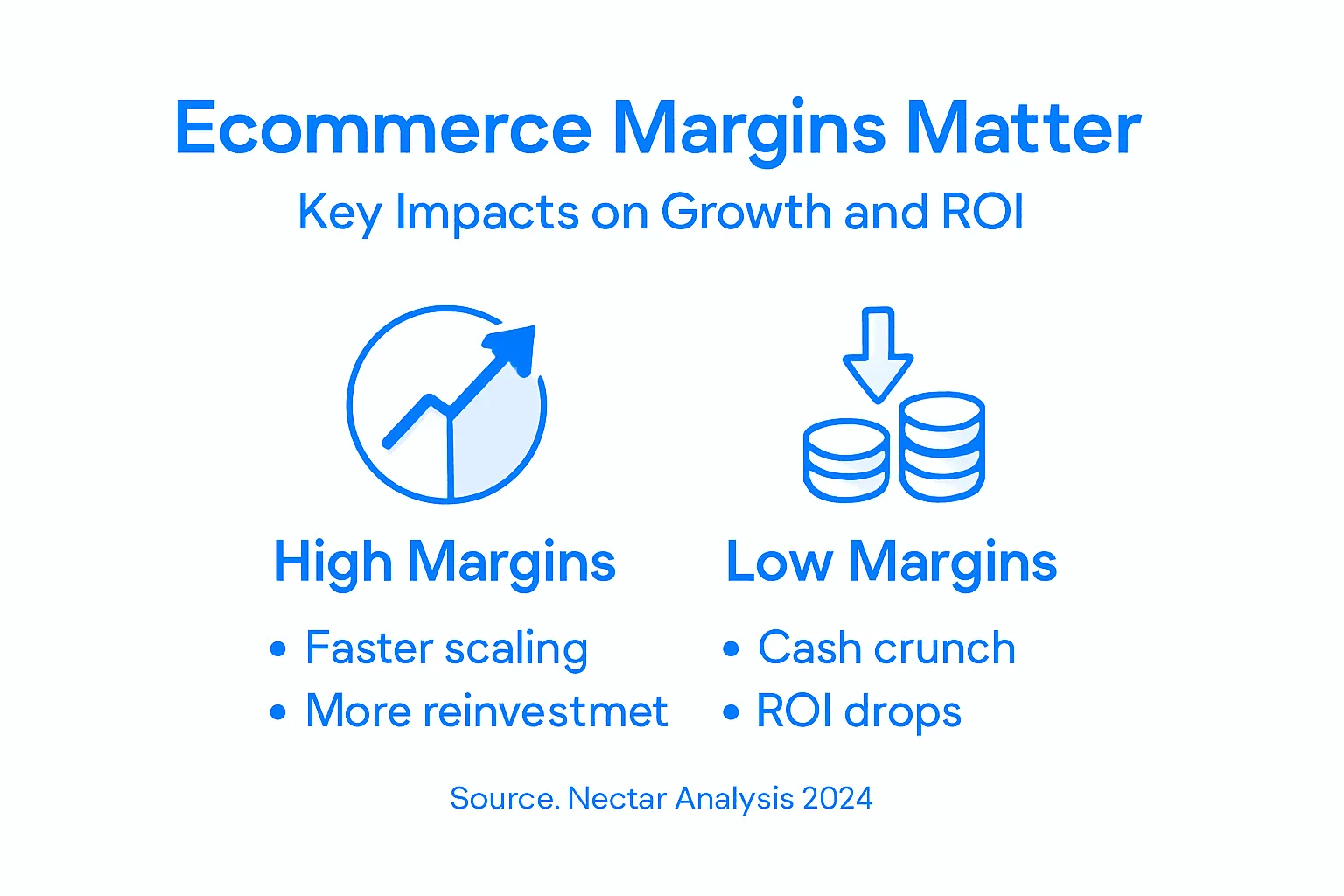
The relationship between margins and ROI is direct and unforgiving. When you scale unprofitably, your ROI crashes regardless of revenue growth.
The Scaling Paradox
Most brands face this trap: revenue grows 50%, but profits stay flat or decline. You hired more staff, increased ad spend, expanded inventory—and the margin squeeze happened quietly.
This occurs because increasing revenues without controlling costs leads to diminished profitability despite sales growth. You’re chasing top-line numbers while your bottom line quietly deteriorates.
Each of these feels necessary in the moment. None of them feels optional when competitors are growing faster.
Why Margins are Your ROI Ceiling
ROI measures how much profit you generate per dollar invested. If your margins are thin, your ROI ceiling is automatically low—no matter how efficiently you operate elsewhere.
Consider two brands with identical revenue: one with 25% net margins, one with 5%. The first brand generates $250K profit per $1M revenue. The second generates $50K from the same sales.
When you invest $100K in marketing, the first brand can reinvest profits and scale sustainably. The second brand struggles to justify the same investment because the profit returned is marginal.
Ecommerce companies face challenges scaling profitably due to complexity of balancing revenue growth and cost management. Strong margins ensure increases in sales translate into sustainable profits.
Healthy margins aren’t a luxury—they’re the foundation that makes scaling financially viable.
The Capital Efficiency Equation
Capital efficiency is how much profit you generate relative to dollars deployed. Better margins dramatically improve capital efficiency at scale.
That 10-point margin difference compounds when you’re scaling. By year two, the difference becomes $500K+ in cumulative profit.
This is why brands with stronger unit economics can outbid competitors on advertising, reinvest in product quality, and build defensible market positions.
Scaling Smarter, Not Just Bigger
Profitable scaling means growing margins alongside revenue—or at minimum, protecting them as you grow. This requires discipline most brands don’t have.
Instead of chasing every possible sale, you optimize for profitable sales. You say no to customers with high return rates. You avoid channels that don’t hit margin targets. You build processes that scale without bloating costs.
This approach feels slower initially. Eighteen months in, you’re competing against brands that grew 3x faster but are now burning cash. You’re still profitable and accelerating.
Pro tip: Before scaling ad spend or expanding operations, lock in your target unit economics—specifically, the margin you need to maintain profitability at your desired revenue level.
Risks of Overlooking Margins in E-commerce
Ignoring margins feels fine until it doesn’t. You’re growing, hitting revenue targets, hiring team members. Then suddenly you realize you’re working harder and making less money.
This is the margin blindness trap, and it’s more common than you’d think among fast-growing brands.
The Revenue Growth Illusion
Increased sales do not automatically mean increased profit. This is the core risk brands overlook. You can grow revenue 100% and watch profitability decline simultaneously.
This happens when you chase every sale without evaluating its true profitability. You offer discounts to win market share. You accept orders with high fulfillment complexity. You advertise unprofitable products to boost top-line numbers.
Ignoring margins in ecommerce risks business sustainability because increased sales do not always translate into profit. Overemphasis on revenue growth without margin control results in poor profitability and financial instability.
Nobody questions whether profit grew alongside these numbers until cash runs out.
The Profitability Paradox
Retail companies face a documented phenomenon: sales grow while profitability shrinks. Overlooking margins leads to operational inefficiencies and pricing missteps that erode profits despite revenue increases.
This happens through margin compression—the slow squeeze where costs rise faster than prices. Platform fees increase. Ad costs spike during peak seasons. Shipping rates climb. Your product costs edge upward from suppliers.
Each individual increase feels manageable. Together, they create a profitability crisis that sneaks up on you.
Hidden Costs That Destroy Margins
Most brands miss margin-killing costs because they’re not obviously attached to individual sales. These costs don’t show up on individual product profit calculations. They sit in overhead and quietly devastate your bottom line.
A brand growing revenue aggressively while ignoring margins is building a business that’s expensive to operate but cheap to sell from.
The Cash Flow Crisis
Low margins create severe cash flow problems even with strong revenue. You need cash upfront for inventory and advertising, but profits trickle in slowly.
Without healthy margins, you can’t fund growth from retained earnings. You become dependent on external capital—venture funding, loans, or lines of credit. Each of these costs money and dilutes control.
When the market shifts or funding dries up, margin-poor businesses fail suddenly. Margin-healthy businesses weather downturns because they generate cash internally.
The Competitive Vulnerability
Low margins mean you have no buffer against competition. When a competitor undercuts you by 10%, your margin disappears entirely.
Brands with strong margins can compete on quality, service, and innovation. Brands with thin margins can only compete on price—and that’s a losing game.
Pro tip: Calculate and monitor the minimum margin you need per product category to remain profitable after all direct and allocated costs; refuse orders and channels below this threshold.
Proven Strategies to Improve Margins
Improving margins isn’t about cutting corners or squeezing suppliers. It’s about working smarter—optimizing what you’re already doing to capture more profit from each sale.
The good news: margin improvement compounds fast. A 2-point margin increase on $1M revenue creates $20K in additional profit. On $5M revenue, it’s $100K.
Strategy 1: Optimize Your Cost of Goods Sold
Cost of goods sold (COGS) is where most margin improvement starts. This is your direct product cost—manufacturing, materials, packaging, inbound logistics.
Small COGS reductions directly hit your bottom line. A 5% reduction in COGS improves your gross margin by roughly 5 points, assuming stable pricing.
Most brands discover they’ve never actually negotiated with suppliers. You’re often just accepting the first quote.
Strategy 2: Refine Your Pricing Strategy
Pricing directly determines margin. Yet most ecommerce brands set prices reactively—matching competitors or using arbitrary markups.
Data-driven pricing means analyzing what customers pay for value, not what competitors charge. You might discover you’re underpriced relative to perceived value. You might find price-sensitive customer segments worth deprioritizing.
Pricing optimization works alongside product positioning. Optimizing your Amazon listing includes strategic pricing that reflects product value and quality tier, not just competitive positioning.
Strategy 3: Control Operating Expenses
Operating leverage comes from growing revenue without proportionally increasing overhead. Your marketing spend, salaries, tools, and infrastructure costs should grow slower than revenue.
Digital marketing optimization and efficient promotional activities enhance ecommerce margins significantly. Focus your ad spend on high-converting channels. Reduce CAC through better targeting and creative testing.
The difference between a 10% and 20% operating margin often isn’t revolutionary tactics—it’s disciplined execution of fundamentals.
Strategy 4: Improve Inventory and Fulfillment Efficiency
Better inventory management reduces carrying costs, obsolescence, and fulfillment errors. Dead inventory ties up cash without generating margin.
Fulfillment inefficiencies also crush margins. Every return, every pick-and-pack error, every slow-moving SKU reduces profitability. Technology and data visibility solve most of these problems.
Pro tip: Start with a margin audit by product, channel, and customer segment—you’ll likely discover that 20% of your SKUs generate 80% of your profit, and some products actively destroy margins.
Unlock Profitable Ecommerce Growth with Nectar
Struggling with thin margins and operational inefficiencies highlighted in the article Ecommerce Margins Driving Profitable Growth for Brands Many ecommerce businesses face the challenge of balancing revenue growth with maintaining healthy gross operating and net margins Without precise margin tracking and strategic execution profitable scaling becomes nearly impossible
At Nectar we specialize in transforming this struggle into sustainable success By leveraging our full suite of high-impact creative services combined with data-driven advertising powered by our proprietary iDerive analytics platform we provide brands selling on Amazon Walmart and Shopify with the granularity and insight needed to optimize product listings tighten cost controls and improve unit economics for lasting margin improvement

Partner with Nectar today to take control of your margins increase your return on investment and scale smarter Discover how our premier fully managed ecommerce agency harnesses creativity and analytics to turn underperforming storefronts into profitable growth engines Visit Nectar now and start driving your brand’s profitable growth with confidence
Frequently Asked Questions
What is the difference between margin and markup in ecommerce?
Margin is the percentage of revenue that remains as profit after all costs are deducted, while markup is the percentage added to the cost of a product to determine its selling price. For example, a product bought for $10 sold for $20 has a 100% markup but a 50% margin.
Why do ecommerce margins matter for my brand?
Ecommerce margins are crucial because they indicate how efficiently you convert sales into profit. High margins allow for reinvestment in inventory and marketing, help survive price wars, and provide flexibility during slow sales periods.
How can I improve my ecommerce profit margins?
You can improve profit margins by optimizing your cost of goods sold (COGS), refining your pricing strategies, controlling operating expenses, and improving inventory and fulfillment efficiency. Each of these strategies directly impacts the profit retained from sales.
What are the typical ranges for gross, operating, and net margins in ecommerce?
In ecommerce, gross margins typically range from 20-40%, operating margins usually fall between 8-20%, and net margins often land between 3-10%, depending on the brand’s performance and efficiency.
.png)