How to Use AI for Amazon Analytics in 2026 Like the Top Brands
.webp)
What used to take a week of cross-source reporting now takes minutes — if the AI is sitting on top of the right stack. Here's what changed in 2026, what an expert AI setup actually requires, and the workflows that separate strategic insight from confident nonsense.
Key Takeaways
- The analyst loop compressed in 2026. Reconciling five Amazon data sources to diagnose a sales change went from a week to minutes.
- Generic AI confidently misreads Amazon data. Without clean data models and framework logic underneath, two-decimal precision still produces strategic nonsense.
- An expert AI stack rests on three foundations. Unified data, validated workflows and frameworks, and persistent context — miss one and the whole thing falls apart.
- Five workflows compound the most. Sales-change diagnosis, profit-vs-revenue ranking, search-term scale-or-cut, inventory × ad spend flagging, and listing-health audits.
- Build-vs-buy is a real choice now. Building the data + AI layer in-house takes years and seven figures; partnering is the rational call for most brands.
- Speed to insight is the new competitive moat. If your team needs a week to answer a question competitors answer in 30 seconds, the gap widens every quarter.
🎥 Watch the Full Session: Want to see the complete breakdown? You can check out the full recording for our webinar session here: Winning on Amazon in 2026: How AI Lets You Answer in 30 Seconds What Used to Take a Week.
In Q1 2026, AI assistants quietly became production-grade for Amazon analytics. Hallucination rates dropped. Context windows expanded. Connection protocols — Anthropic's Model Context Protocol (MCP) chief among them — matured into something operators can actually rely on. What used to take a senior analyst a week — pulling reports across Seller Central, Vendor Central, the Amazon Ads API, AMC, DSP, and Brand Analytics, reconciling time windows, and building the narrative — now runs in minutes.
At Nectar, we've been at this since 2018. We've watched the analytics layer evolve from spreadsheet stitching, to dashboards, to AI assistants that can now reason across the whole stack. We built iDerive over four years and seven figures of investment specifically to give that AI something reliable to reason over. Here's what changed in 2026, what an expert AI setup actually looks like, and the workflows that turn raw data into strategic decisions you can defend.
Key Amazon AI Analytics Stats:
- 1 week → minutes: cross-source sales-change diagnosis compression in 2026 (Nectar partner work)
- 8 sources: Amazon-only data feeds an operator-grade analytics stack must reconcile — Ads API, AMC, DSP, SP-API, Vendor/ARA, Brand Analytics, FBA, and Listings/Catalog (Amazon SP-API docs)
- 4 years / 7 figures: what it took Nectar to build the iDerive data + framework layer underneath AI
What Changed in 2026: AI Became Production-Grade for Amazon Analytics
Through 2024 and into 2025, AI tools were promising but unreliable for analytics. They hallucinated numbers, blended incompatible date ranges, and presented all of it with total confidence. That changed materially in Q1 2026. Larger context windows, stronger reasoning, better tool-use protocols, and direct data connections via MCP made it possible — for the first time — to point an AI assistant at a clean Amazon data layer and trust the output.
"The analyses that used to require multiple people across days now run in minutes. The efficiency gain is both in speed to insight and in the cost of getting there." — Youval Peltier, Chief Strategy Officer at Nectar
This isn't a 2027 capability. The brands using it well are already six months in — running scheduled diagnostics every morning, building custom dashboards in a single prompt, and acting on insights the same day they surface. The brands that haven't started are giving up roughly a quarter of competitive ground per quarter.
The Five Sources of Amazon Truth
The Five Sources of Amazon Truth is the set of five data layers that, reconciled together, give a complete read on marketplace performance: Revenue, Margin, Advertising, Search, and Listing Health. Looking at any one in isolation misses the picture. Looking at all five in concert is what an operator-grade AI stack is built to do — and what generic AI tools, pointed at one report at a time, cannot.
Revenue
Units sold, BSR, velocity, seasonality, and category share. The headline metric most brands lead with — and the one most easily misread without the other four layers underneath it. A revenue dip can look identical whether the cause is a seasonality curve, a stockout, a suppressed listing, or a competitor's price cut. Without the other layers, you guess.
Margin
Fees, COGS, and net profitability by ASIN. In 2026, tariff exposure and inflationary pressure made margin volatility the single biggest cause of "we grew revenue but the business got worse" stories we see in audits. Top-line revenue without per-ASIN margin visibility leads to scaling SKUs that lose money on every unit.
Advertising
Spend efficiency, ACOS, TACOS, and contribution to incremental revenue. The lens where most brands have the deepest data — and where AI compresses the most time, because the Ads API surfaces enough volume that a human analyst gets lost before they get to insight. Patterns that take a day to find in a pivot table surface in seconds when the data is clean.
Search
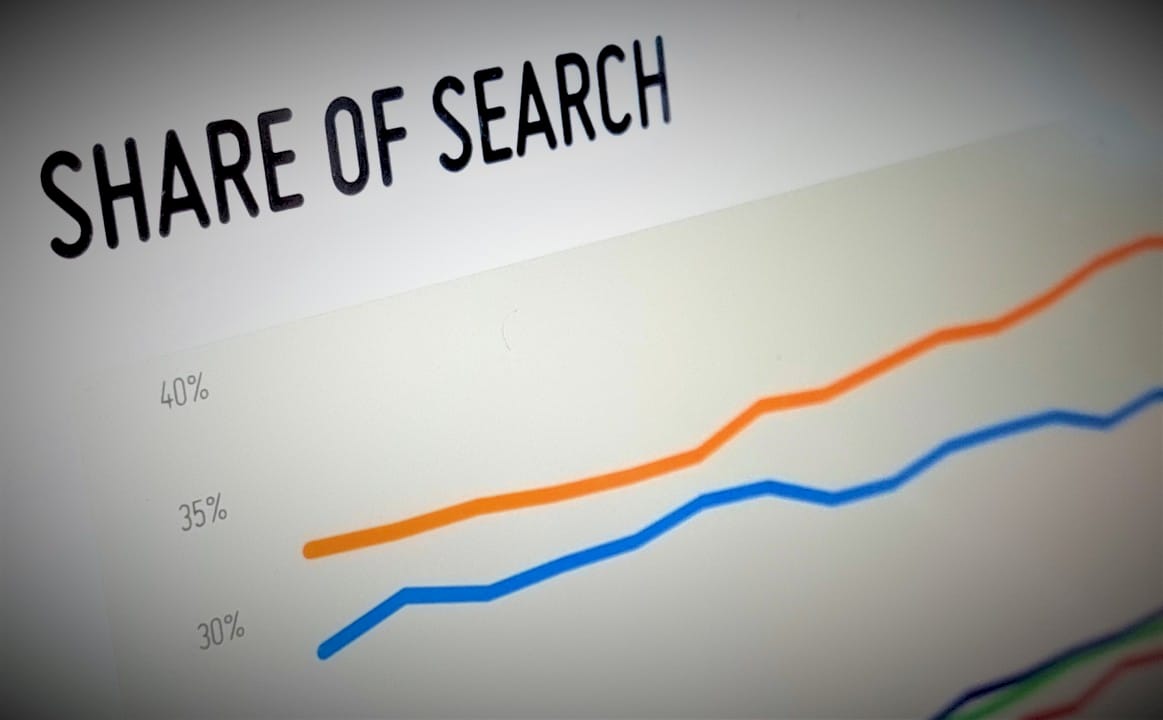
Keyword rank, share of voice, Search Query Performance (SQP) trends, and conversion gaps. The lens that tells you where market demand sits versus where your impression share captures it. When AI can trend SQP across hundreds of terms simultaneously, "which keywords should I scale and which should I cut?" stops being a quarterly exercise and becomes a weekly one.
Listing Health
Content score, image quality, suppression risk, buy-box ownership, and PDP conversion rate. The layer most brands under-monitor — because pulling it requires separate tools and is rarely in the same view as advertising spend. An AI that reads listing health alongside ad spend can flag the situation that quietly kills accounts: heavy advertising into a suppressed or out-of-stock listing.
Want to see how the Five Sources read against your catalog? Talk to our Amazon team.
The Three Foundations of an Expert AI Stack
The Three Foundations of Expert AI is the framework that separates an AI assistant that helps from one that misleads: a clean, unified data model; a workflow and framework layer; and a persistent context and memory layer. Generic AI tools have none of these. Expert AI is what's built on top of all three.
Clean, Unified Data Models
Every Amazon source — SP-API, Ads API, AMC, DSP, Vendor Central, Brand Analytics, FBA, and Listings — gets normalized into one coherent model. That means reconciling reporting windows (vendor sales lag, ads are near-real-time), harmonizing revenue definitions (shipped COGS vs. shipped revenue vs. ordered revenue), and structuring the catalog by attributes that actually matter for your business (color, size, subcategory, material, price tier). Without this, the AI is reasoning over noise — and you get answers that are confidently wrong.
Workflow and Framework Layer
The analytical logic — written by Amazon operators, not a generic AI prompt. This is what teaches the AI how to calculate ROAS the way you calculate ROAS, how to evaluate incrementality consistently across runs, what counts as "wasted spend," and how to attribute a sales delta across competing causes. Without framework logic, the AI invents a methodology every time you ask, which means different conclusions every time — the most dangerous failure mode in analytics.
"Claude is like a very smart intern from a prestigious university. It doesn't have a lot of experience in your industry. You have to give it context." — Youval Peltier, Chief Strategy Officer at Nectar
Context and Memory
The system's ability to retain what it learned last week, last month, and last quarter. An AI that doesn't remember that you had a Q1 stockout will tell you to spend more on a recovering ASIN at exactly the wrong moment. An AI that does remember layers that context into every recommendation, brick by brick, the way a human analyst would. This is the foundation most operators underestimate — and the one that turns a fast answer into a correct answer.
Generic AI vs Expert AI: Why the Difference Matters
Anyone can open ChatGPT or Claude and ask an Amazon question. The answer depends on whatever data the model can scrape, whatever assumption it makes, and whatever pattern looks plausible. The output reads with total confidence — and is often subtly wrong in ways that cost money.
| Dimension | Generic AI | Expert AI |
|---|---|---|
| Data source | Whatever it can pull or scrape on the fly | Clean, unified data model — Amazon-specific, reconciled across windows |
| Methodology | Pattern-matches plausible logic per query | Validated frameworks written by category operators |
| Consistency | Different answer every run | Reproducible answers; same inputs → same outputs |
| Context | None — every prompt is cold | Persistent memory across weeks and quarters |
| Confidence vs. accuracy | High confidence, variable accuracy | Calibrated confidence, sourced reasoning |
| Best for | Exploratory questions, brainstorming, drafting | Strategic decisions you'll defend in front of leadership |
"Very precise figures with two decimal points is not very accurate from a strategic standpoint." — Youval Peltier, Chief Strategy Officer at Nectar
The honest framing: generic AI is a productivity tool. Expert AI is decision infrastructure. Most brands need both — but only the second one earns the right to sit in a forecast, a budget review, or a board update.
Five Validated Workflows That Compress the Analyst Loop
Once the foundations are in place, the leverage compounds inside repeatable workflows. These are the five we run most often across our partner roster — pre-built, vetted, and scheduled to run on demand or on a cadence.
1. Diagnose a Sales Change
A revenue delta between any two periods, bridged across every driver — not just advertising. The workflow quantifies how much of the change came from search-volume shifts, out-of-stock impact, buy-box loss, listing-content changes, pricing deltas, and seasonality. The default narrative ("we cut ads, that's why") gets replaced with a defensible attribution chart. Most months we run this, the actual driver isn't the one the team assumed.
2. Profit vs. Revenue Ranking
Your top revenue ASINs are not always your top profit ASINs. With margin variables toggleable — COGS per unit, fee changes, tariff exposure — the workflow re-ranks the catalog by net contribution, not gross sales. Top brands run this monthly to catch the moment a hero SKU's margin profile flips and the business is technically growing while quietly bleeding.
3. Search Term: Scale or Cut
SQP trended across hundreds of search terms, layered with conversion rate, impression share, and purchase share. The workflow flags the terms that deserve more budget (high demand, low share, healthy CVR), the ones that should be cut (high spend, no purchase share lift), and the cannibalistic ones (your own brand terms being bought through Broad match). Done weekly instead of quarterly, this is a step-change in scaling efficiency.
4. Inventory × Ad Spend
Overlay weeks-of-cover with current ad spend by ASIN. Surface every product where you're spending into a stockout — or where coverage is light enough that an upcoming event (Prime Day, BFCM) will push you over the edge. The workflow ties advertising decisions to inventory reality, which is the single most expensive disconnect on most Amazon accounts.
5. Listing Health Audit
A daily sweep of every active ASIN for buy-box loss, suppression, low inventory, content-score regression, and price-related conversion drops. Each flag gets a dollar estimate of lost revenue while the issue persists. The same audit that used to take a coordinator a half-day runs in a scheduled routine before the team logs on.
Need help getting workflows running against your catalog? Talk to our Amazon team.
What AI Can and Can't Do for Amazon Analytics Today
Honest framing on capability matters — both to avoid disappointment and to avoid overreach. As of mid-2026:
| ✅ AI Does Well Today | 🚫 What AI Still Can't Do |
|---|---|
| Reconcile data across every Amazon source on a schedule | Outsource strategic judgment on competitive positioning |
| Diagnose a revenue or margin change end-to-end | Work reliably on messy, disconnected, or unmodeled data |
| Run a full analytical framework you've defined | Know which questions matter for your business |
| Draft narrative and recommendations from quantitative output | Act safely on its own without a workflow holding it together |
| Operate on a cadence without human prompting | Replace operator memory of last quarter's context |
The AI is genuinely good at the analyst loop now. It is not — and won't be soon — a substitute for the operator who decides what to do with the answer.
The Honest Build-vs-Buy Call
If your team is asking whether to build the data and AI layer in-house, the honest answer is: it depends on scope.
For a single workflow — say, automated weekly inventory reports against a clean ASIN list — building in-house is manageable. A small data engineering team can wire SP-API to a warehouse, write the report logic, and connect an AI assistant on top. That's a quarter of work, not a year.
For the full stack — every Amazon source, plus Walmart and Shopify, plus media programmatic, reconciled and ready for AI to reason over — building in-house is a different conversation. We built iDerive over four years and seven figures of investment. It required Amazon operators, data engineers, and AI engineers working together, with a permanent in-house API expert because Amazon publishes API changes inconsistently and breaks things quietly. As your brand portfolio grows, complexity compounds non-linearly.
"When you start to stitch together all these different APIs and data sources, different time frames and reporting windows, that's when the cost starts to compound exponentially." — Jason Landro, Co-Founder and Co-CEO at Nectar
For most operator-led brands, the rational call is to partner — let the data and framework layer live with a specialist, and focus your team's time on the decisions the AI surfaces. For enterprise brands with internal data engineering capacity already in place, building parts of it in-house can make sense. The mistake is assuming "we'll wire up Claude to our reports" is a weekend project. It isn't.
Glossary
- AI Agent: An AI assistant configured to run a workflow on a schedule — pulling data, applying a framework, and surfacing recommendations without per-run prompting.
- AMC (Amazon Marketing Cloud): Amazon's clean-room analytics platform for cross-funnel attribution, audience-building, and incrementality analysis.
- Context Window: The amount of information an AI model can hold and reason over in a single session. Expanded context windows in 2026 are what made multi-source Amazon analytics viable.
- DSP (Demand-Side Platform): Amazon's programmatic display platform; reaches shoppers on and off Amazon.
- Expert AI: AI configured with clean unified data, validated frameworks, and persistent context. Distinct from generic AI in reliability, consistency, and reasoning depth.
- Generic AI: AI used without an underlying data or framework layer — produces confident outputs of variable accuracy.
- Hallucination: When an AI model produces output that reads accurate but isn't — common when source data is missing, ambiguous, or mismatched across reporting windows.
- iDerive: Nectar's proprietary analytics platform — the unified data, framework, and AI-interface layer underneath Amazon analytics.
- MCP (Model Context Protocol): Anthropic's open protocol for connecting AI assistants to live data sources, tools, and workflows. Released late 2024; adopted broadly through 2025–2026.
- PDP (Product Detail Page): The product listing page where shoppers convert.
- SP-API: Amazon's Selling Partner API — the umbrella for seller-side data access, including catalog, listings, FBA, and orders.
- SQP (Search Query Performance): Brand Analytics report showing impression, click, add-to-cart, and purchase share at the search-term level.
- TACOS: Total advertising cost of sales — ad spend divided by total sales (ad + organic). The cleanest blended efficiency metric.
- The Five Sources of Amazon Truth: Revenue, Margin, Advertising, Search, and Listing Health — the five data layers an operator-grade AI stack must reconcile.
- The Three Foundations of Expert AI: Clean unified data, workflow and framework layer, and persistent context and memory — the prerequisites for trustworthy AI analytics.
Frequently Asked Questions
What Is AI for Amazon Analytics?
AI for Amazon analytics is the use of large language models — Claude, ChatGPT, Gemini — connected to Amazon's data sources to reason across sales, margin, advertising, search, and listing health. In 2026, expanded context windows and protocols like MCP made this production-grade. Done well, it compresses cross-source diagnostics from a week of analyst work into minutes.
Why Do Most AI Tools Give Wrong Answers About Amazon Data?
Because the underlying data is messy. Amazon reports sales and advertising on different reporting windows, defines revenue differently across vendor and seller, and exposes more than a hundred reports through different APIs. When AI is pointed at raw, unreconciled data, it calculates correctly on incorrect inputs — the most dangerous failure mode in analytics. Clean, unified data models are the prerequisite, not an optimization.
What Is MCP and Why Does It Matter for Amazon Analytics?
MCP (Model Context Protocol) is Anthropic's open standard for connecting AI assistants to live data sources, tools, and workflows. For Amazon analytics, it matters because it lets an AI assistant query your actual Amazon data layer — not its training data, not a one-time export — in real time. Nectar's iDerive ships with an MCP server, which is how partners connect Claude directly to their account.
How Long Does It Take to Build an AI-Powered Analytics Stack In-House?
For a narrow workflow (e.g., scheduled inventory reports), a small engineering team can get something live in roughly a quarter. For the full stack — every Amazon source reconciled, framework logic written, AI interface layered on top, plus ongoing API maintenance — Nectar's build took four years and seven figures. The cost compounds with portfolio complexity and the number of marketplaces involved.
Can ChatGPT or Claude Analyze My Amazon Data Directly?
They can analyze what you give them, but they can't reliably pull or reconcile Amazon data on their own. The Ads API, SP-API, Vendor Central, and Brand Analytics all require authenticated access and consistent transformation logic. Without a data layer underneath, you're effectively asking a brilliant intern to interpret a stack of disconnected reports — they'll produce something confident, and it will often be wrong.
What's the Difference Between iDerive and a Generic AI Dashboard?
A generic dashboard renders charts. iDerive is a unified data and analytics layer with Amazon-specific transformations, framework logic written by category operators, and an MCP interface that lets Claude reason across all of it. The difference shows up in the questions the system can answer — and in whether you can trust the answer enough to act on it.
Where Should I Start If I Want to Use AI for Amazon Analytics?
Start with one workflow that hurts most. If sales-change diagnosis takes you a week, start there. If margin volatility is the issue, start with profit-vs-revenue ranking. The mistake is trying to instrument everything before instrumenting anything — it produces a 12-month project instead of a one-month win. Pick the workflow that earns its keep first, prove it, then expand.
Run Amazon With AI Like the Top Brands
The brands pulling ahead aren't using AI for novelty — they're using it to compress decision cycles. Same data, same rigor, same sources — but actioned same-day instead of next-week. If your team is still pulling reports by hand, the gap is closable. The infrastructure, the frameworks, and the operator expertise exist.
Related Reading
- How to Scale Amazon Ads in 2026 Like the Top Brands — The 10-lever audit that reignites Amazon Ads scaling on the same budget.
- Amazon Marketing Cloud Incrementality Analysis — How Nectar uses AMC for cross-funnel attribution and NTB audiences.
- iDerive Advertising & Incrementality Analytics — Trend SQP, TACOS, and ad-attributed vs. organic sales over time.
- Strategic Consulting & Audits — When and how to layer AI into your Amazon operating system, with optional Nectar support.


























































.webp)