Amazon DSP cost breaks into two buckets: the media you buy (billed by CPM) and the demand-side fees stacked on top (tech fee, audience fees, third-party data, sometimes a managed-service fee). Amazon’s managed-service option typically requires a minimum spend near $50,000, while self-service lowers the entry point but still bills media plus fees. Budget for total advertiser cost, not media alone, and build creative and measurement into the forecast from day one.
What Drives Amazon DSP Cost: The Full Fee Breakdown
Every DSP invoice has the same architecture, even if the line items look different from campaign to campaign. Amazon spells this out directly in its own pricing transparency guide, and it’s worth understanding line by line before you commit budget.
Media, or supply cost, is the base layer. This is what you pay for the actual ad impressions, billed on a cost-per-thousand-impressions basis. Amazon DSP campaigns run on CPM rather than a per-click model, since the platform is built for reach and frequency rather than click-driven bidding. You can buy CPMs on a guaranteed, fixed basis for premium or high-demand inventory, or on a variable, auction-driven basis for standard display and video placements.
On top of media sits the demand-side fee stack:
One quirk that trips up first-time budgeters: when you combine multiple Amazon audience segments in one campaign, Amazon bills the highest CPM among them rather than stacking each segment’s fee. Layering three audiences doesn’t triple your audience fee. It caps at whichever segment costs the most.
The canonical formula Amazon itself publishes: total advertiser cost = supply cost + demand-side fees + other amounts payable to Amazon. Every budgeting exercise should start from that equation, not from media price alone.
Realistic Budget Bands and Managed-Service Minimums
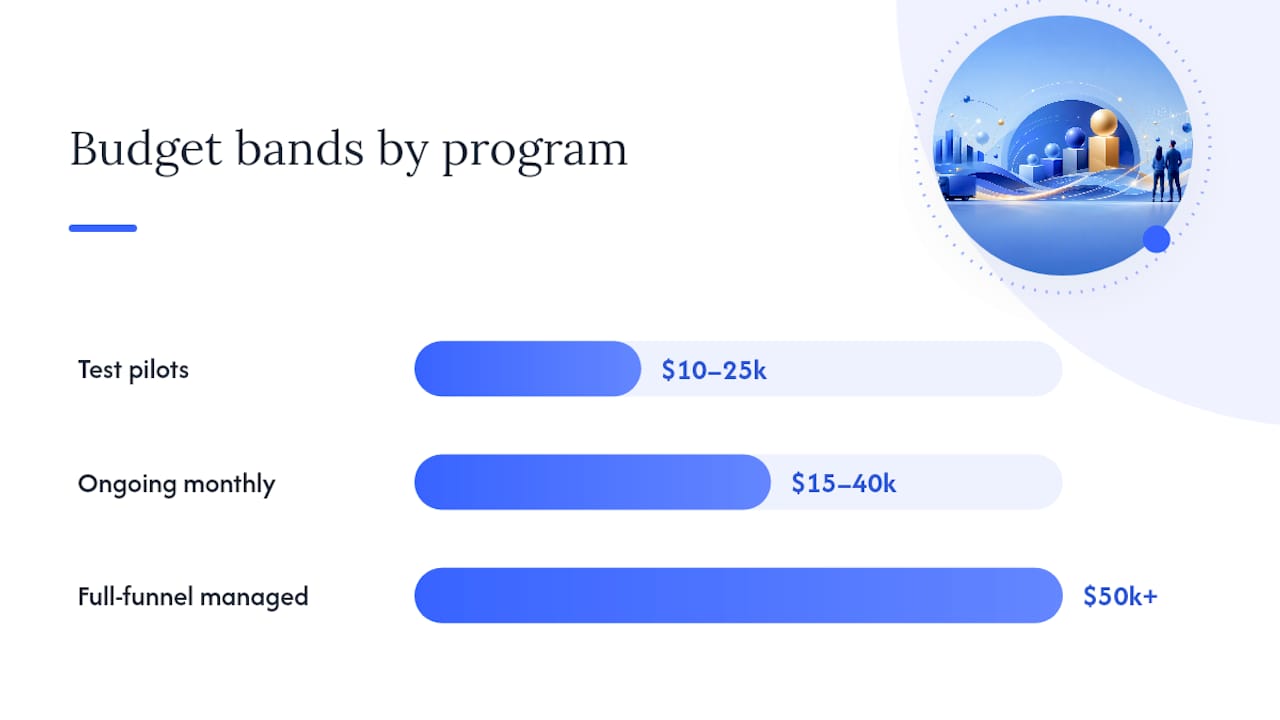
Amazon’s managed-service DSP typically sets a minimum spend around $50,000, though that figure can shift by country. Self-service access has no comparable Amazon-imposed floor, but you’ll need either an in-house programmatic team or a partner to run it, which carries its own cost.
For brands weighing where to start, a few working bands tend to hold up:
Inventory type moves these numbers more than most advertisers expect. Video and audio placements typically carry higher CPMs than standard display, and premium or highly specific audience segments push effective CPMs higher still. A campaign targeting broad shopping segments on display inventory will cost meaningfully less per thousand impressions than one targeting a narrow, high-value audience on streaming video.
Before locking a number, run this checklist: creative production cost, measurement/OCM fees, third-party audience fees, and a buffer for mid-campaign optimization.
Turning DSP Spend Into a Defensible ROAS Forecast
Different DSP objectives need different KPIs and attribution windows. Awareness campaigns should be judged on reach and frequency, not last-click sales. Consideration campaigns warrant detail-page views and add-to-cart rate. Conversion-focused campaigns are the ones where ROAS becomes the primary scorecard, typically measured over a 14 to 30 day attribution window depending on category purchase cycles.
A simple flow makes the forecast concrete:
Run each stage with a conservative multiplier first, then a stretch case, so the range reflects real uncertainty rather than a single optimistic number. Nectar’s guidance on structuring ecommerce ad budgets covers how to build these allocation rules across channels, not just within DSP.
Measurement is where a lot of advertisers under-invest. Omnichannel Measurement is billed as a percent of media, but it enables mid-flight budget reallocation toward whatever segment or placement is actually converting. Treated correctly, it’s one of the highest-return line items on the invoice, not overhead to be trimmed. The same logic applies to holdout-based incrementality testing, which tells you what sales DSP actually generated versus what would have happened anyway. Analytics-focused resources like this guide on e-commerce analytics reinforce the same point: measurement infrastructure pays for itself once spend crosses a meaningful threshold.
Skipping this step means you’ll scale on vanity metrics instead of real lift.*
As a scale trigger, look for two consecutive reporting periods where CPM efficiency holds steady or improves and conversion rate or average order value shows a statistically meaningful lift. That’s the point where shifting more budget from search into DSP, a move worth timing carefully, tends to pay off.
Managed Service vs. Self-Service: Where the Real Cost Sits
The headline fee difference is straightforward: managed-service adds a percentage-based fee on top of media, while self-service avoids that fee but requires the skill to run the platform yourself. The harder question is where the total cost actually lands once you account for everything managed service quietly covers.
Managed service earns its fee when campaigns involve complex, layered audience targeting, guaranteed premium inventory that requires negotiation, or heavy cross-channel measurement that needs dedicated setup. For a straightforward retargeting campaign on standard inventory, that complexity may not exist, and self-service is the cheaper path.
What self-service actually costs, beyond the platform fee you’re avoiding:
Whichever path you choose, negotiate transparency up front. Ask any partner or Amazon rep to itemize audience fees, third-party targeting CPMs, and measurement charges separately from media, rather than bundling them into one blended rate you can’t audit later.
A Step-by-Step Estimator With a Worked Example
Building a defensible DSP budget takes five steps, and running through them with real numbers beats theorizing about ranges.
What Actually Determines Whether DSP Pays Off
The mistake most mid-market teams make isn’t underestimating media cost. It’s treating measurement and creative as afterthoughts instead of line items that determine whether the whole program works. Nectar’s iDerive analytics platform exists precisely because raw DSP reporting tells you what happened, not what DSP actually caused, and that distinction changes budget decisions materially.
A managed partner earns its fee when it reduces wasted spend across audience selection, creative testing, and measurement design, not just campaign setup. Nectar’s approach typically starts with an audit of current retail media spend, moves into a scoped pilot with a defined measurement baseline, and only scales budget once incrementality data supports it. That sequence matches the guidance in Nectar’s own breakdown of DSP minimum spend planning for U.S. brands weighing when they’re actually ready for managed-service minimums. A documented DSP case study shows what that sequence looks like when it’s executed well.
Get a Clear Picture of Your Amazon DSP Budget
Nectar runs Amazon DSP as one part of a fully managed retail media program, not an isolated media buy, which means the tech fees, audience costs, and measurement setup get planned together instead of showing up as invoice surprises three months in.

Rather than guessing at CPMs and fee percentages on your own, you can get a scoped estimate built around your actual audience and inventory mix. Nectar’s team handles the Amazon DSP management work end to end, from audience strategy through incrementality reporting, so the ROAS number you present internally is one you can defend with data. Request a DSP audit through Nectar’s services page to see what a realistic budget and scaling plan would look like for your brand.
Sources
Recommended










.png)