Buy Box ownership means your product offer is the one Amazon displays as the default “Add to Cart” and “Buy Now” option on a shared product listing, a slot Amazon now officially calls the Featured Offer. Winning it delivers three things sellers care about immediately: default placement in the buyer’s path to purchase, a measurable lift in conversion rate, and access to the majority of sales on that listing. Roughly 82% of Amazon purchases flow through the Buy Box, which is why sellers who lose it often watch sales on that ASIN collapse overnight.
- Check your Featured Offer percentage in Seller Central weekly, not monthly.
- Treat any sudden drop in that percentage as an operational alert, not background noise.
- Fix pricing, fulfillment, or inventory gaps before they compound into a sales slide.
Key Takeaways
Buy Box ownership determines who gets the default purchase button on a shared Amazon listing, and it drives the majority of that listing’s sales.
| Point | Details |
|---|---|
| Definition matters | Buy Box ownership means your offer is the Featured Offer, Amazon’s official term for the default buy-button slot. |
| Eligibility changed in 2026 | Amazon folded performance metrics directly into Featured Offer ranking instead of using a separate pre-screening gate. |
| Price isn’t everything | Landed price only matters within a narrow tolerance band; fulfillment and metrics decide close calls. |
| Measure it weekly | Track Featured Offer percentage, conversion lift, and account health together, not in isolation. |
| Managed support scales it | Nectar coordinates repricing, fulfillment strategy, and reporting through iDerive to sustain Featured Offer share at scale. |
What Is Buy Box Ownership, Exactly?
“Buy Box” is the term sellers still use out of habit. Amazon’s own documentation calls it the Featured Offer, and that’s the name you’ll see inside Seller Central reports and policy pages. Both refer to the same thing: the single offer Amazon highlights above the fold on a product detail page, the one that gets the one-click purchase buttons while every other seller’s offer gets buried in the “Other Sellers on Amazon” link.
Location matters more than most sellers assume. On desktop, the Featured Offer sits in the buy box on the right rail. On mobile, where a growing share of Amazon traffic happens, it often occupies nearly the entire visible screen before a shopper scrolls, which means losing it on mobile costs you more attention than losing it on desktop.
Amazon has been direct about the mechanics here. The company rotates the Featured Offer among qualified sellers rather than locking it to one winner permanently, and it measures ownership through a metric called Featured Offer percentage, the share of page sessions in which your offer appeared in that slot.
Amazon states plainly that the goal of the selection process is to optimize the customer experience, weighing price, delivery promise, and seller reliability rather than rewarding the lowest price alone.
That distinction, optimizing the buyer experience rather than just the sticker price, is the single most misunderstood part of how the Featured Offer works.
Why Buy Box Ownership Matters for Sellers
The commercial case is simple, but the numbers behind it are worth sitting with. Buy Box ownership drives:
- Conversion rate lift because most shoppers never click through to compare other sellers’ offers.
- Better ad efficiency, since sponsored ads on a listing you don’t own the Featured Offer for often underperform or become ineligible.
- Predictable sales velocity, which matters enormously for demand forecasting and inventory planning.
Industry data backs the scale of this: losing the Buy Box can cut sales on an ASIN by 50% to 80% overnight, a swing large enough to blow up a quarterly forecast. That’s a strong argument for treating Featured Offer share as a core operating metric, not a vanity number.
Not every SKU deserves the same level of attention here, though. If you’re the exclusive, branded seller on a listing with no third-party competition, Buy Box ownership is close to automatic and your energy is better spent on listing optimization or content. If you’re competing against resellers or other authorized sellers on the same ASIN, it becomes the priority.
Who Can Win the Buy Box? Eligibility Rules Explained
Winning the Featured Offer starts with clearing a set of account and product checks before price or fulfillment even enter the equation.
At the account level, you generally need a Professional seller account (not Individual), and your account health has to sit above Amazon’s risk thresholds. At the product level, the item typically needs to be new (used conditions rarely qualify), and it has to be in stock, since an out-of-stock offer simply can’t be featured no matter how strong your metrics are.
Four performance metrics have historically functioned as gatekeepers:
- Order Defect Rate (ODR), which tracks negative feedback, A-to-Z claims, and chargebacks.
- Late Shipment Rate (LSR), measuring how often orders ship past the promised date.
- Pre-fulfillment Cancel Rate, tracking cancellations before shipment.
- Valid Tracking Rate, confirming you’re providing trackable shipping data.
Here’s the wrinkle every seller should know about heading into this year: legal analysis of Amazon’s July 2026 update shows Amazon removed the old binary pre-screening gate and folded these metrics directly into the Featured Offer ranking score instead. Meeting minimum thresholds no longer guarantees a spot in a qualified pool. A dip in performance now shows up immediately in your ranking, even if you’re never formally suspended from eligibility.
Pro Tip: Set a calendar reminder to check your account health dashboard every Monday morning. A single late-shipment spike from a carrier delay can quietly erode your Featured Offer share for weeks if you don’t catch it fast.
What Factors Influence Buy Box Wins?
Several factors carry real weight in how Amazon selects the Featured Offer, and understanding how they interact matters more than knowing the list itself.
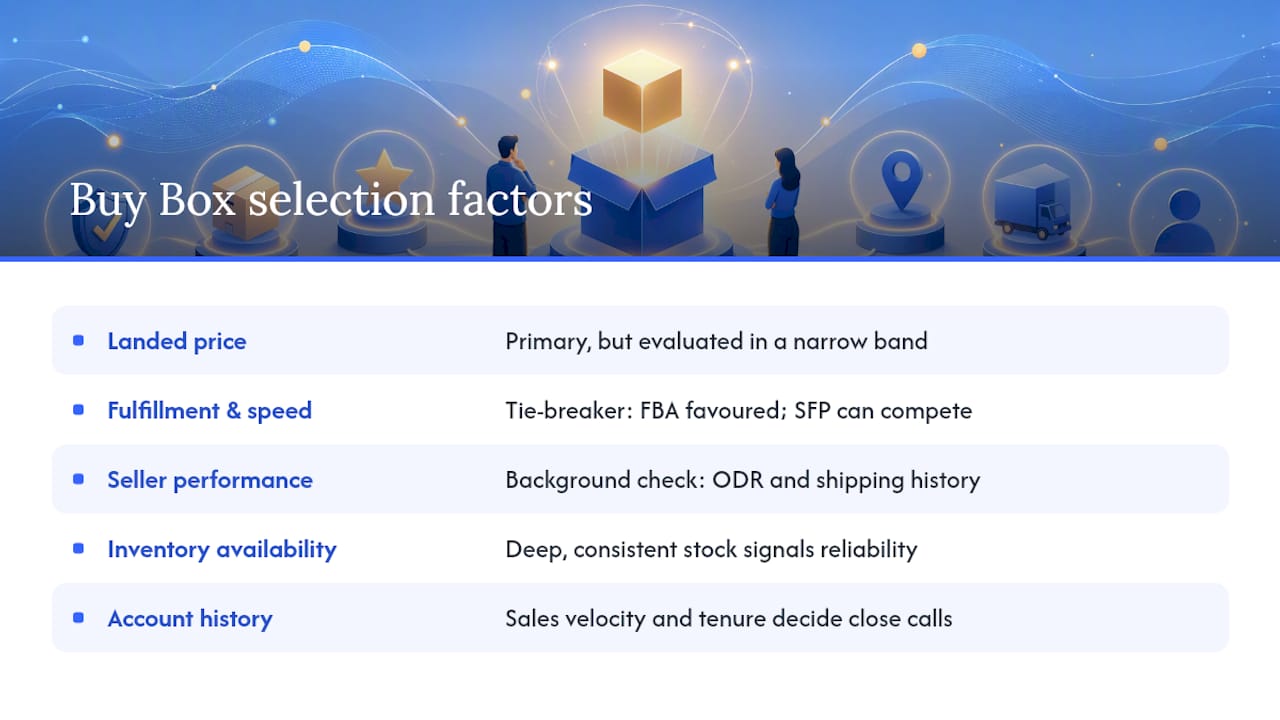
Landed price (item price plus shipping) is the factor most sellers fixate on, but it isn’t a race to the bottom. Algorithm analysis of the 2026 Buy Box system shows price is evaluated within a narrow tolerance band. If your landed price sits within that band relative to competitors, other factors decide the winner. Undercutting by a few cents beyond that band rarely helps and often just erodes margin.
Fulfillment method and delivery speed frequently break ties inside that price band. Fulfillment by Amazon (FBA) confers a structural advantage because Amazon trusts its own logistics network for delivery promises, and Prime eligibility signals reliability to the algorithm. Seller Fulfilled Prime (SFP) can compete closely when shipping speed matches FBA benchmarks. Fulfillment by Merchant (FBM) can still win, particularly for sellers with warehouses near major metro buyers, where regional delivery speed beats a distant FBA node.
Seller performance metrics act as a constant background check. A seller with a clean ODR and fast shipping history gets more benefit of the doubt than one hovering near policy limits, even at an identical price.
Inventory availability matters beyond simply being “in stock.” Deep, consistent stock signals reliability, while inventory that frequently dips low or stocks out erodes your standing even after you replenish.
Account history and sales velocity round out the picture. Newer accounts or ASINs with thin sales history often lose close calls to established sellers with a track record on that same listing.
The FBA seller holds the Featured Offer most sessions because Prime shipping trust outweighs the small price gap. Now picture a regional FBM seller with a warehouse fifteen miles from a major metro, competing against a distant FBA node during a carrier slowdown. That regional seller can win Featured Offer time for local buyers purely on delivery speed.
Pro Tip: Before slashing price to chase the Buy Box, check whether your fulfillment method or delivery estimate is the actual bottleneck. A price cut won’t fix a shipping-speed problem.
How to Win the Buy Box: A Tactical Checklist
Winning back or growing Featured Offer share comes down to executing a short list of changes in the right order.
-
Audit your delivery promise first. If your shipping estimate is slower than competing offers, fix that before touching price. Switching a slow-moving SKU to FBA or Seller Fulfilled Prime often moves Featured Offer percentage faster than any repricing move.
-
Set a price floor based on real margin, not gut feel. Calculate your cost of goods sold plus your minimum acceptable margin, and never let a repricer quote below that number. A common structural mistake: a repricer set to “match lowest price” with no floor will happily race itself into a loss.
-
Use dynamic repricing with guardrails. Tools that adjust price within your defined band, reacting to competitor moves without breaching your floor, tend to outperform static pricing and reckless auto-matching alike.
-
Build inventory buffers on your top ASINs. Running lean on your best sellers is the fastest way to lose Featured Offer share the moment demand spikes unexpectedly. A two-to-three-week buffer on your top 20% of SKUs by revenue is a reasonable starting target.
-
Choose fulfillment deliberately, not by default. FBA suits high-velocity SKUs where Prime trust and hands-off logistics justify the fees. SFP fits sellers who can match Amazon’s delivery speed independently. FBM makes sense for oversized items, regional advantages, or thin-margin products where FBA fees would erase profitability.
-
Monitor returns and defect trends weekly. A rising return rate often precedes an ODR problem by weeks. Catching it early protects both your Featured Offer standing and your margin.
-
Coordinate pricing with your ad strategy. A price change that wins the Buy Box but breaks even against your advertising cost of sale isn’t actually a win. Review both together.
Pro Tip: If you’re weighing FBA fees against a price cut, model both scenarios against your actual Featured Offer percentage history, not a guess. Often the fee is cheaper than the margin you’d give up chasing price alone.
How to Measure and Test Buy Box Ownership
Treat Featured Offer share like any other performance metric: track it consistently, change one variable at a time, and give each test enough runway to mean something.
Core metrics worth a permanent spot on your dashboard:
- Featured Offer percentage by ASIN, tracked weekly at minimum.
- Buy Box wins relative to total page sessions, to separate visibility from raw traffic.
- Conversion rate specifically while you own the Featured Offer, so you can quantify the lift.
- Account health metrics (ODR, LSR, Cancel Rate) alongside Featured Offer trends, since they move together.
A simple testing framework works better than reacting to every daily fluctuation:
- Change one variable, a repricer rule, a fulfillment method, or a price band.
- Hold that change steady for 7 to 14 days to account for normal rotation noise.
- Compare Featured Offer percentage and sales before and after, not just on the day you flipped the switch.
Report Featured Offer share weekly and pair it with daily inventory alerts so a stockout never blindsides you. Brands running this at scale across multiple marketplaces often reach a point where AI-assisted analytics makes more sense than manual spreadsheet tracking, particularly once you’re managing Featured Offer share across dozens of ASINs at once.
Pro Tip: Don’t judge a repricing test on a single day’s Featured Offer percentage. Amazon’s rotation means daily noise is normal; the 7 to 14 day trend is what actually tells you if the change worked.
Why You’re Not Winning the Buy Box (and Quick Fixes)
Most Featured Offer losses trace back to one of six causes, and most have a fast fix.
- Listing suppression, often from a pricing error or policy flag. Check your account health dashboard and pricing alerts immediately.
- Price outside the tolerance band, usually priced too high relative to competitors. Review landed price, not just sticker price.
- Low or fluctuating inventory. Build a buffer or shift the SKU to FBA for more consistent stock signals.
- A performance metric slipping, ODR or late shipments creeping upward. Pull your Seller Central health report and address the root cause, not just the symptom.
- Amazon itself is the seller of record on that ASIN, which is difficult to compete against directly. Focus effort on ASINs where you’re not competing with Amazon retail.
- A policy flag or account health warning. Escalate to Seller Support and resolve it before deploying any pricing or inventory fixes, since Amazon won’t restore Featured Offer eligibility around an open flag.
When Should Buy Box Ownership Be Your Priority?
Buy Box ownership deserves top priority when you’re competing against other authorized sellers or resellers on the same ASIN, and when your margin model depends on volume rather than exclusivity. If you’re a private label brand with no competing sellers on your listings, chasing Featured Offer share is largely wasted effort; your money is better spent on brand content and demand generation instead.
The decision comes down to your business model, not a universal rule:
- Prioritize Buy Box tactics on competitive ASINs and during high-velocity seasonal windows.
- Deprioritize them on exclusive branded SKUs where channel control and pricing integrity matter more than winning a rotation.
Get Help Sustaining Featured Offer Share
Running the checklist above manually, across dozens of ASINs, multiple fulfillment methods, and daily repricing decisions, is where most internal teams run out of bandwidth. Nectar operates as the fully managed layer for brands that need Featured Offer share treated as an operational discipline rather than a side project: coordinated repricing rules, fulfillment strategy across FBA, SFP, and FBM, and inventory forecasting built to prevent the stockouts that quietly erode your Featured Offer percentage.

Reporting runs through Nectar’s proprietary iDerive analytics platform, giving brand managers a single view of Featured Offer trends alongside ad performance and account health, instead of piecing it together from three different Seller Central reports. If your Featured Offer percentage has been sliding and you’re not sure why, request an audit through Nectar’s Amazon Growth & Optimization services and get a clear read on what’s actually costing you sales.
Frequently Asked Questions
What is Buy Box ownership on Amazon? Buy Box ownership means your offer is selected as the Featured Offer, the default listing shoppers see with active “Add to Cart” and “Buy Now” buttons, rather than being buried in the other-sellers list.
How is Featured Offer percentage different from Buy Box ownership? Featured Offer percentage is the metric that quantifies ownership. It measures the share of page sessions in which your offer appeared in the Featured Offer slot, rather than treating ownership as all-or-nothing.
Does FBA guarantee you win the Buy Box? No. FBA gives a structural advantage through Prime trust and delivery reliability, but sellers using SFP or FBM can still win, particularly when regional delivery speed or pricing outweighs that advantage.
Can a brand-exclusive seller lose the Buy Box? Rarely, since there’s typically no competing offer on that ASIN. Buy Box tactics matter far less for exclusive branded listings than for ASINs with multiple authorized or reselling sellers.
What changed with the July 2026 Amazon update? Amazon removed the separate pre-screening eligibility gate and folded performance metrics like ODR and Late Shipment Rate directly into the Featured Offer ranking score, meaning performance dips now affect ranking immediately rather than triggering a separate disqualification step.
Sources
- Amazon Seller Central — Featured Offer / Buy Box guidance
- DAM Law Firm — Amazon Featured Offer eligibility July 2026 analysis
- Nventory — Amazon Buy Box algorithm 2026 analysis
- Repricer — How to Win the Amazon Buy Box 2026 guide
Recommended
- Nectar Blog | Why invest in listing optimization: boost sales and conversion rates
- Nectar Blog | Why Use Enhanced Brand Content to Sell More
- Nectar Blog | Branded content: boost listings & cut returns by 30%
- Nectar Case Study | How Boxie Increased Amazon Canada Ordered Revenue by 55.4% on Just 0.5% More Ad Spend














































.webp)