Amazon DSP targeting groups into three core buckets: Amazon Audiences, advertiser audiences, and third-party audiences. Each one earns its place at a different funnel stage. Retargeting through advertiser audiences drives direct conversions from shoppers who already know your brand. In-market and lifestyle segments inside Amazon Audiences build consideration among people still shopping around. Contextual placements extend reach into spaces where no cookie or purchase history exists. Start narrow, then layer outward as budget allows.
TL;DR:
- Proper audience layering means retargeting should be set up first with exclusion of recent buyers, followed by scaling with lookalikes and contextual targeting for optimal ROI.
- Tightly scoped in-market segments, such as those who viewed a specific competitor ASIN in the past week, typically convert at higher rates than broader category audiences.
- Key KPIs to evaluate DSP campaigns include detail page view rate, new-to-brand percentage, and view-through conversions, rather than relying solely on ROAS.
- Campaign performance depends on integrated targeting, creative assets, and measurement working together, with sequencing of audience groups being critical for success.
- Budget thresholds around five-figure monthly spend often yield statistically significant data for optimization, especially for advanced features like Streaming TV and cross-channel coordination.
What Are the Core Amazon DSP Targeting Categories?
Every Amazon DSP campaign draws from three targeting pools, and mixing them incorrectly is the most common reason campaigns underperform.
- Amazon Audiences run on first-party signals: what people shop for, browse, purchase, and stream across Amazon properties, including Fire TV and Prime Video. These segments update constantly because they’re built from live shopping and viewing behavior rather than static lists, per Amazon’s own DSP documentation.
- Advertiser audiences come from your own data: shoppers who viewed your product page, added to cart without buying, or purchased in the past. You can also upload hashed customer lists for matching, or ask Amazon to generate product lookalikes from your existing buyers.
- Third-party audiences pull from outside data providers, useful when you need demographic or interest segments that Amazon’s retail data doesn’t capture on its own.
Most effective campaigns blend all three rather than leaning on just one.
Audience Targeting: Behavioral, In-Market, Lifestyle, Demographic, and Device
Behavioral and in-market audiences are the workhorses of consideration-stage DSP campaigns. In-market segments capture shoppers who’ve browsed a category repeatedly in a recent window, say, someone who viewed four different espresso machines in the past two weeks without buying. Behavioral audiences look further back, flagging people with a pattern of purchasing in a category even if they haven’t shopped it lately.
Lifestyle and demographic segments work differently. Instead of tracking recent shopping intent, they group people by broader traits: parents of young children, pet owners, frequent business travelers, age bands, or household income ranges. These are better suited to brand awareness pushes than to campaigns chasing an immediate sale, since the person may not be actively shopping your category at all.
Device targeting adds a layer of environmental control. Restricting delivery to Fire TV inventory makes sense for a video-first brand story. Mobile app placements fit impulse-driven categories where a scroll-and-buy moment is realistic.
- Retargeting and in-market: consideration and mid-funnel, measured on click-through and detail page views
- Lifestyle and demographic: upper-funnel awareness, measured on reach and view-through activity
- Device-based: environment control, measured alongside whichever KPI the base audience already targets
Pro Tip: Don’t default to the broadest in-market audience available. A tightly scoped segment, like “viewed a competitor ASIN in the last 7 days,” usually converts at a meaningfully higher rate than the parent category audience it sits inside.
Contextual Targeting: Products, Categories, and Keywords
Contextual targeting has quietly become one of the more durable tools in the DSP kit, mainly because it doesn’t depend on cookies or identity resolution to work.
Product (ASIN) targeting places your ads on or near specific product pages, useful for conquesting a competitor’s listing or reinforcing presence around complementary items. Category targeting, built on Amazon’s browse node taxonomy, casts a wider net across an entire product vertical rather than individual ASINs, which Amazon’s contextual targeting rollout extends across both Amazon properties and thousands of third-party publisher sites using AI to map content to retail categories.
The newer addition is keyword contextual targeting, which lets you target free-form terms instead of relying solely on ASINs or browse nodes. This matters because plenty of relevant context has nothing to do with a product taxonomy: a seasonal theme like “back to school,” an event like a holiday weekend, or a cultural moment your product fits without technically belonging to that retail category. The feature supports multi-language input and both exact and broad match types, and it currently runs across Amazon properties and third-party supply.
- Exact match keyword contextual: tight alignment for time-sensitive or brand-safety-critical placements
- Broad match keyword contextual: wider reach using semantic similarity rather than literal keyword matches
- Placement controls: restrict or prioritize inventory type (display, video, audio, Streaming TV) based on creative fit
Building Line Items: Layering, Include Groups, and Exclude Logic
Amazon DSP’s audience combination tools let you build up to ten include groups within a line item, paired with a single exclude group that applies across all of them, a structure Amazon introduced to simplify audience targeting and cut down on repetitive setup work. Instead of building five separate line items for five audience combinations, you build one line item with layered logic.
A practical build sequence looks like this:
- Retargeting first. Set a line item targeting 7 to 30 day site visitors and cart abandoners, with your exclude group set to recent purchasers so you’re not wasting spend on people who already converted.
- Near-converters second. Layer in a repeat-visitor audience, people who viewed your category two or more times in a recent window, at a moderately higher bid than pure retargeting.
- Scaled lookalikes plus contextual third. Combine an Amazon-generated lookalike audience with contextual keyword or category targeting to extend reach once the first two tiers are performing.
Pro Tip: Watch frequency caps closely once you stack multiple include groups. Overlapping audiences can quietly push frequency well past the point of diminishing returns, and that’s often what drags ROAS down before anyone notices why.
Self-Service vs. Managed Service: Which Fits Your Team?
Amazon offers both self-service DSP access and a managed-service option, and the right choice depends less on company size and more on internal bandwidth for campaign operations, creative production, and analysis.
Guidance on spend thresholds varies, but many practitioners point to meaningful monthly budgets, often in the five-figure range, as the point where DSP data becomes statistically useful enough to optimize against. Below that, campaigns often don’t generate enough signal to layer audiences effectively.
- Self-service demands in-house expertise in creative specs, bid strategy, and audience testing
- Managed service shifts that operational load, along with access to premium inventory and data integrations, onto an outside team
- Streaming TV buys, cross-channel coordination between Sponsored Ads and DSP, and clean-room measurement through Amazon Marketing Cloud are the three scenarios where outside help tends to pay for itself fastest
Budget sizing matters just as much as the access model, and getting the minimum spend threshold right before launch avoids a lot of wasted testing.
Measuring DSP Performance: The KPIs That Actually Matter
ROAS alone misreads most DSP campaigns, because a large share of DSP spend sits in the upper and mid-funnel where the sale doesn’t happen inside the attribution window you’re checking.
Detail page view rate (DPVR) tells you whether the ad actually moved someone toward the product page. New-to-brand percentage tells you whether you’re expanding your customer base or just re-serving existing buyers. View-through conversions capture the shopper who saw your Streaming TV spot, didn’t click, and purchased three days later through search instead.
- DPVR: measures ad-to-consideration movement, most useful for contextual and awareness buys
- New-to-brand %: measures customer base expansion, critical for lookalike and lifestyle targeting
- View-through conversions: captures delayed purchase behavior that click-based metrics miss entirely
Amazon’s own DSP guidance recommends combining these three metrics rather than isolating any single one, since DSP’s role is often to influence a purchase path that search or Sponsored Ads later closes. Attribution windows and incrementality testing through Amazon Marketing Cloud help separate genuine lift from purchases that would have happened anyway.
Statistic Callout: DSP spend that skews upper-funnel (Streaming TV, awareness display) should be judged primarily on DPVR and new-to-brand percentage in the first 30 to 60 days, not on same-window ROAS, since the purchase signal typically lags the impression.
How an Agency Actually Runs DSP Targeting Day to Day
Running DSP well means treating targeting, creative, and measurement as one connected system rather than three separate jobs. Nectar’s approach pairs an in-house creative studio, which produces the video and display assets that contextual and Streaming TV placements actually need, with programmatic buying built around layered include and exclude groups rather than single-audience line items.
The measurement side runs through iDerive, Nectar’s proprietary analytics platform, which pulls DPVR, new-to-brand, and Amazon Marketing Cloud data into one view instead of forcing a brand team to reconcile three separate dashboards. That combination, creative built for the placement, targeting layered by funnel stage, and measurement that doesn’t lean on ROAS alone, is what a documented DSP case study shows driving conversions at scale for brands moving past search-only strategies.
Why Most Brands Layer Targeting Wrong
Most Amazon DSP guidance treats audience selection like a menu: pick in-market, add a lookalike, maybe try contextual if there’s budget left. That’s backwards. The research on include and exclude group structures makes clear that sequencing matters more than selection, retargeting has to run first with a clean exclude list, or every other layer you add just recycles impressions against people who already converted.
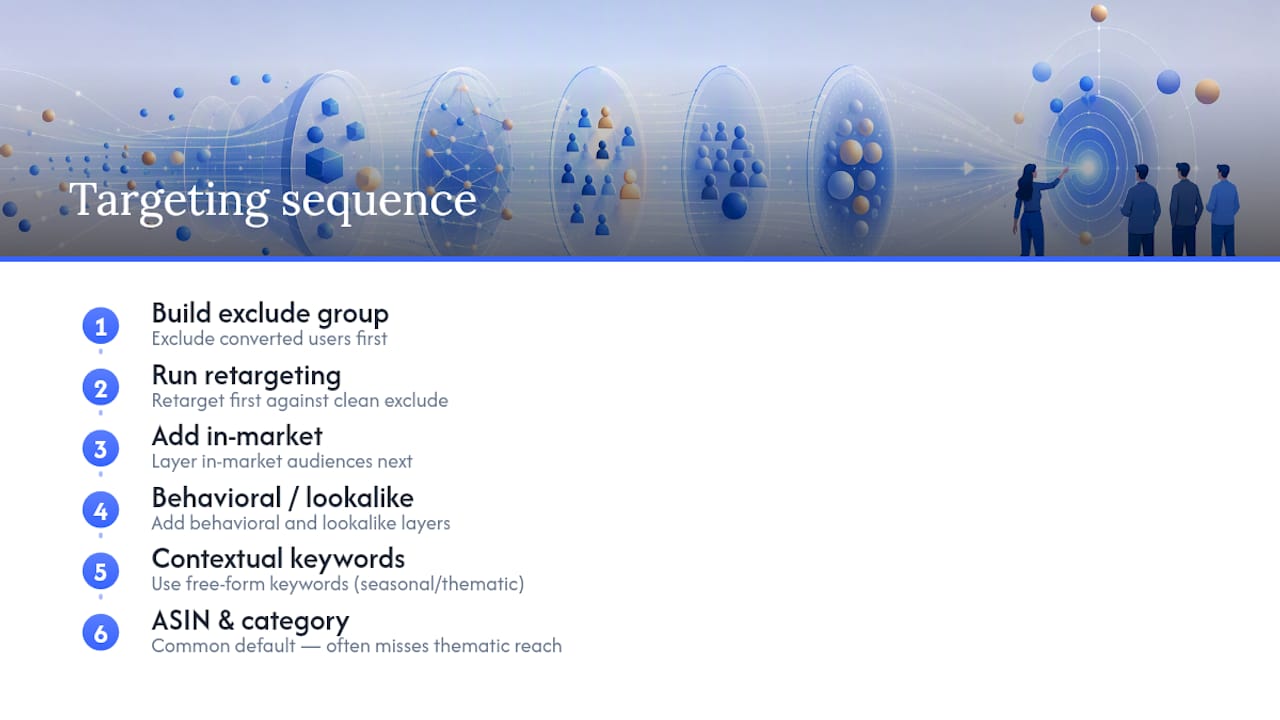
The bigger miss is measurement discipline. Brands pull DSP budget the moment ROAS dips in a 7-day attribution window, without checking whether DPVR or new-to-brand percentage moved in the right direction. That’s judging a billboard by same-day cash register receipts. Contextual keyword targeting deserves more attention than it gets too. Most advertisers still default to ASIN and category targeting purely out of habit, missing the seasonal and thematic reach that free-form keywords unlock.
If there’s one priority to fix first, it’s sequencing: build the exclude group before you build anything else. Everything downstream depends on it.
— Dan Katona
Ready to Put Layered DSP Targeting to Work?
Building the sequencing, exclude logic, and measurement stack described above takes real operational muscle, creative production, campaign management, and analytics working together, not a single hire trying to do all three. These functions can be run as an integrated service including an in-house creative studio for video and display assets, hands-on programmatic buying with include and exclude group management, and analytics that tie DPVR, new-to-brand, and incrementality data into a single view.

A first engagement typically starts with a review of your current Sponsored Ads and DSP setup to spot where retargeting waste or misaligned exclude groups are already costing you conversions. From there, a layered targeting plan can be built matched to your funnel stage and budget. If you’re managing programmatic spend in-house and want a second set of eyes, or you’re ready to hand the whole operation to a team that does this daily, explore Nectar’s Amazon growth and optimization services and start the conversation about what a managed DSP setup would look like for your brand.
Recommended



























































.webp)