An adult product flag on Amazon means the catalog has classified an ASIN as an adult item, and that pulls it out of normal search. If your product is not an adult product, you can usually contest the flag through Seller Support, but you will get further with a clean diagnosis, a documented fix to the listing, and evidence that ties the product to Amazon’s written policy. This guide walks through each step for brands selling physical products in the US.
The people who search this phrase fall into two groups. Shoppers see flags, banners and novelty products in the results. Brand managers see a hero ASIN vanish from search and revenue drop overnight. This article is for the second group.
TL;DR
- Amazon’s US policy defines adult products as items designed for sexual activity or sexual wellness, so a flag on a stationery item, toy or apparel piece is almost always a classification error you can contest.
- Amazon does not publish the exact signals that trigger the flag, so diagnosis means auditing your title, bullets, keywords, category and images for anything ambiguous.
- Confirm the flag in Seller Central Inventory Reports, fix the listing first, then open a case with the ASIN, screenshots, and a policy-based explanation.
- Prevent repeat flags with a pre-publication compliance check and neutral, clinical wording across every content field.
What the adult flag actually means
Amazon’s US Adult Products and Explicit Sexual Imagery Guidelines define covered products as those designed for sexual activities or sexual wellness. The same policy says sexually suggestive products may be allowed when they comply with the policy and applicable law.
The policy is also explicit about what does not need adult classification. Condoms, lubricants, spermicides, toy cleaners, desensitizing sprays and enemas are listed as exceptions, as are images of non-sexualized nudity used for art, medical or educational purposes. That list matters for your appeal: if your product sits in or near an exempt example, you can say so by name.
The flag is a catalog attribute, not a policy violation notice. A product can carry it without any warning email, which is why many brands find out only when sales fall.
Why a non-adult product gets flagged
Amazon generally does not disclose the specific signals that cause a product to be identified as adult. Its US forum guidance says disclosure could compromise detection accuracy, which is the same reason enforcement systems everywhere stay vague. You will not get a list of trigger words from support.
What you do have is a pattern from seller reports and policy text. Treat these as the likeliest suspects, not confirmed causes.
Wording that reads differently out of context
In one US seller-forum case, support attributed an adult flag to listing wording combined with a particular category, and removing the problematic word from the title restored visibility. A word that is harmless in your product’s context can be a strong adult signal for a classifier that reads the text without context.
Amazon’s own forum response to sellers in this situation is to review listing keywords and remove terms that might trigger adult identification. Backend search terms count as much as the visible copy.
Imagery
The US policy prohibits explicit sexual imagery in listings and detail-page images. It names sexual-wellness products but also posters, artwork, apparel, sculptures and figurines. Skin-heavy lifestyle shots, suggestive poses on swimwear or body-care products, and packaging with nudity can all push an ASIN toward review.
For intimate clothing, Amazon’s guidance, as quoted in a seller-forum response from Amazon’s Singapore store, says images must not be sexually explicit or obscene, as determined by Amazon. Check the US clothing image requirements before relying on that wording for a US listing.
Category and attribute mismatches
A product placed in a category it does not belong to, or carrying attributes copied from a different product type, can look wrong to automated systems. Variation families are another common source: one child ASIN with an odd image or attribute can affect how the whole family is read. Our walkthrough of the Amazon variation policy audit shows how to check families before an appeal.
Algorithm errors and outside reports
One seller on Amazon’s US forum describes repeated false adult flags on children’s toys and suspects algorithm errors or competitor reports. That is seller testimony, not a cause Amazon has confirmed, so do not build an appeal around it. Do keep it in mind: if you fix the copy and the flag returns, document each recurrence with dates.
How to confirm the flag
Do not rely on a search that returns nothing. Your ASIN may be suppressed for other reasons, such as a stranded inventory issue or a different compliance block. Check the attribute directly.
An Amazon forum moderator says current ASIN attributes can be checked in the Custom, All Listings or Category Listings reports in the Inventory Reports dashboard in Seller Central. That thread comes from Amazon’s Italian forum, so confirm the report names in your own US Seller Central account.
Work through it in this order:
- Pull the report for the affected ASINs and look for the adult-product attribute.
- Export it and save it with the date. This is your “before” evidence.
- Search the ASIN in the Sexual Wellness category. Amazon says adult products are not searchable outside that category by design, but can be found by searching the ASIN inside it. If it appears there, the classification is real.
- Check whether sibling ASINs, other variations or the same brand’s similar products share the flag.
What happens to a flagged listing
The practical effect is lost visibility. In its July 26, 2022 policy update, Amazon told sellers that listings could be suppressed or restricted in search if images were not brought into compliance by September 26, 2022. That update set the template: image and content violations lead to search suppression, not just a warning.
Seller reports describe the experience. One US forum post covers ten ASINs misclassified as adult that disappeared from search, with Seller Support submitting removal requests and quoting a wait of up to 72 hours. Treat that timeline as one seller’s experience, not a service commitment.
The damage goes beyond organic rank:
- Sponsored ads may stop serving or lose relevance on affected ASINs, so you pay to promote a listing that shoppers cannot find.
- Brand Store traffic and external traffic still land on the detail page, but conversion suffers if the page is partly hidden or under review.
- Repeated violations can escalate. Amazon has sent account-level notices for adult-policy enforcement, so a recurring flag is not something to leave in a queue.
How to fix it, step by step
Sequence matters. Appealing with an unchanged listing is the most common reason these cases go nowhere.
1. Audit every content field
Read the listing as an automated system would, with no knowledge of your brand. Check:
- Title, bullets and description
- Backend search terms and subject matter fields
- Main and secondary images, including infographics and A+ modules
- Packaging photos and any text printed on the product
- Category, product type and variation attributes
Remove anything ambiguous or unnecessary. Replace slang, double meanings and competitor-style keyword stuffing with plain product descriptions. If your image set needs a rework, our Amazon image requirements checklist covers the technical rules, and the guide on fixing Amazon creative mistakes helps you prioritize.
2. Correct the attributes in bulk if needed
Amazon’s forum guidance says listing-attribute errors can be corrected in bulk with a flat file or the bulk-edit tools. For catalogs with dozens of affected SKUs, this beats editing each page by hand and leaves a clean change record.
3. Log what you changed
Record the exact copy, image, category and keyword changes with dates and before and after screenshots. This log is the core of your case.
4. Contest through Seller Support
Amazon’s US guidance says a seller who believes an adult flag is erroneous can contest it through Seller Support. Open a case under the listing or catalog issue category, not a general inquiry, and keep the request to one issue per case.
If the matter has reached account level, the US deactivation notice says sellers who believe enforcement was erroneous should submit evidence through the appeal process in Account Health.
5. Follow up with the same evidence
If the first reply is a template, reply on the same case with the same attachments rather than opening a duplicate. Escalate with the documented timeline of recurrences if the flag returns after a fix.
What evidence to send
The strongest cases are short, factual and tied to the policy text. Include:
- The ASIN or ASIN list and the report export that shows the classification
- The complete current listing and all images, as screenshots
- A precise explanation of why the product falls outside Amazon’s definition of products designed for sexual activity or sexual wellness, or inside an expressly exempt example
- Product and packaging photos, plus intended-use or technical documentation where relevant
- The log of copy, image, category and keyword changes already made
For formal appeals, Amazon’s US guidance asks for a factual root cause, the corrective measures taken and preventive measures. Corrective measures include removing noncompliant images or keywords. Preventive measures describe the policies and validation process you will use going forward.
A sample structure that fits on one page:
- Root cause: “The title included a term that can be read as adult-related. The product is a [plain description] with no sexual function.”
- Corrective action: “We removed the term from the title, bullets and backend keywords on [date] and replaced the lifestyle image.”
- Prevention: “Every new listing now goes through a written review of category, wording and imagery against the current US policy before publication.”
Keep emotion and accusations out. Do not blame a competitor unless you have proof.
Prevent the next flag
The cheapest fix is a listing that never trips the classifier. Build a pre-publication check that covers category, intended use, title, bullets, description, backend terms, images, packaging and variations, and keep it on file as part of your documented review process.
Rules that work in practice:
- Write neutrally. Amazon’s forum guidance says permitted adult products should be described in clinical or business-like language and presented without explicit imagery or nudity on the product or packaging. Non-adult products benefit from the same discipline.
- Cut keywords you cannot defend. If you would struggle to explain a term to a policy reviewer, remove it.
- Review images as a set. Check crops, poses, packaging art and text overlays, not only the main image. Our guide to making every product image count covers the set as a whole.
- Keep the catalog consistent. Audit category and attributes at the same time as content. A step-by-step content optimization process makes the review repeatable.
- Monitor after every edit. Re-run Inventory Reports and check search visibility after any change, and set a recurring review for your top ASINs.
- Watch your ad targeting. Overly broad matching can attach your product to adult queries. Shared negative keyword templates keep your ads away from terms you do not want to be associated with.
Other compliance flags work in a similar way. If your product also touches pesticide claims or hazmat review, the evidence-first approach is the same, as shown in our guides on clearing EPA-related flags and the hazmat review fix plan.
Our perspective: treat it as a catalog governance problem
We see adult flags as a symptom, not a one-off. When a brand has hundreds of ASINs across several marketplaces, wording and imagery drift. Agencies, freelancers and internal teams each add content, and nobody owns the final read-through against policy.
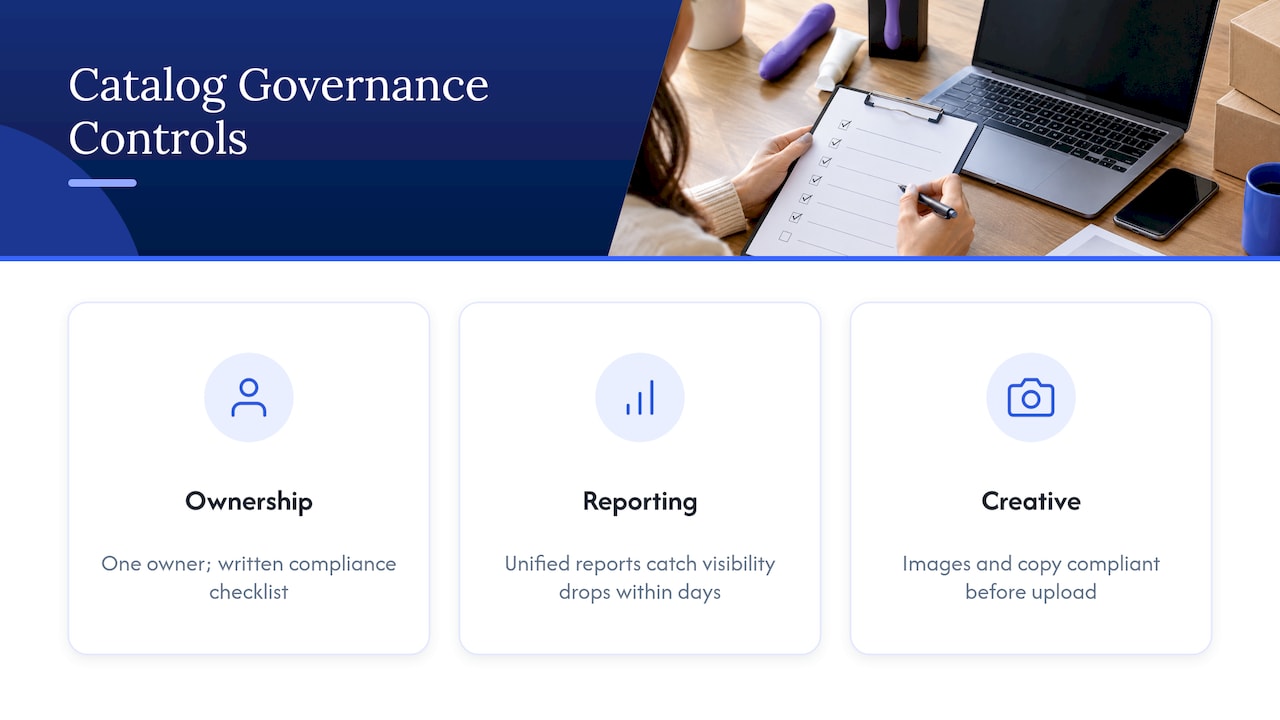
Our view is that the fix has three parts. First, one owner for catalog compliance with a written checklist. Second, unified reporting so a visibility drop on one ASIN is noticed within days, not at the end of the month. Third, creative produced with marketplace rules in mind, so images and copy are compliant before upload instead of repaired after suppression.
That is why we keep photography, video, design, advertising and marketplace operations under one roof. When the same team shoots the image, writes the copy and watches the data in our iDerive platform, a flag gets traced to its cause quickly. Appeals are also stronger when the root cause and the preventive process are specific, and a documented process is something we can show.
The lesson for any brand: do not argue with the classifier, give it nothing ambiguous to classify.
— Dan Katona
When to bring in help
A single flagged ASIN is manageable in-house. A pattern across a catalog, a flagged hero product during peak season, or flags that return after fixes call for a wider audit of content, categories, variations and ads.
Our Amazon Growth & Optimization team handles listing audits, compliance cleanup and ongoing catalog health for mid-market and enterprise brands, and our Creative & Content Production studio rebuilds images and copy to marketplace standards. If you want a second set of eyes on what is suppressing your listings, talk to Nectar.
FAQ
Can I see exactly why Amazon flagged my product as adult?
Usually not. Amazon’s US guidance says it generally does not disclose the specific signals, because that could compromise detection accuracy. Your best route is to audit the title, bullets, backend keywords, images and category for anything ambiguous, then fix and document it.
How long does it take to remove an incorrect adult flag?
There is no guaranteed timeline. One US seller reported Seller Support submitting removal requests with a stated wait of up to 72 hours, but results vary by case. Fix the listing first and include a clear evidence package so the case does not bounce between agents.
Will an adult flag hurt my sponsored ads?
It can. If the ASIN is suppressed in search, shoppers have a harder time finding it, and ads sending traffic to it waste budget. Pause or reduce spend on the affected ASINs while you resolve the case, and monitor visibility after the fix.
Does a flag on one ASIN affect my whole account?
Not necessarily, but repeated or serious adult-policy violations can lead to account-level action. Amazon’s US notice tells sellers who believe enforcement was wrong to submit evidence through the appeal process in Account Health. Treat recurring flags seriously and keep your documentation current.
Do I need approval to sell an actual adult product?
Amazon’s forum guidance says permitted adult products should be listed in the Sexual Wellness category, sold new, shown without explicit imagery or nudity on the product or packaging, and described in clinical language. Check the current US policy page before listing, since the rules can change.
Sources
- Amazon US Adult Products and Explicit Sexual Imagery Guidelines
- Amazon forum: contesting adult product identification
- Amazon forum: product incorrectly flagged as adult
- Amazon forum: seller report of repeated false flags on toys
- Amazon forum: ASINs incorrectly identified as adult products
- Amazon forum: adult product listing ASIN is not searchable
- Amazon policy update: adult products and explicit sexual imagery
- Amazon forum: product restricted from search visibility
- Amazon forum: account deactivated under adult product policy
- Amazon forum: ASIN incorrectly marked as adult product
- Amazon forum: approval to sell adult products
- Amazon forum: underwear products tagged as adult
Recommended