How to Craft Winning Ad Copy in 2026
.webp)

TL;DR:
- Effective ad copy in 2026 must stop scrolling, deliver a clear claim, and prompt action within platform constraints. Success relies on a modular, research-backed system focused on specific, standalone hooks, proven claims, and structured testing of patterns over surface phrasing. Writers must prioritize angle research, craft short attention-grabbing hooks, and ensure every sentence makes sense independently to optimize automation and scalability.
Winning ad copy is defined by a single, non-negotiable standard: it stops the scroll, delivers a clear claim, and moves a reader toward action before they have time to think. Knowing how to craft winning ad copy in 2026 requires more than clever phrasing. It demands a structured, modular approach built around platform mechanics like Meta Advantage+, consumer psychology research, and systematic multi-variant testing. The brands scaling profitably on Shopify, Amazon, and Meta are not writing better sentences. They are running smarter systems. This guide gives you that system.
How to craft winning ad copy: the proven workflow
The most reliable process for writing effective ad copy follows a specific sequence: research the angle, build the hook-claim-proof-CTA chain, generate variants, and test before scaling. Skipping any step produces copy that feels creative but converts inconsistently.
Here is the workflow in order:
-
Research the angle first. Use tools like adlibrary.com to scan competitor ads in your category. Identify which hook patterns are already saturated. Category saturation with certain patterns can be spotted via in-market ad scans and avoided for better test outcomes. A fresh angle in a crowded market outperforms a polished version of what everyone else is already running.
-
Build four hook variants. Cover four distinct patterns: pattern interrupt, specificity, outcome-first, and direct address. Each hook must work as a standalone statement because platform algorithms may display it without the body copy beneath it.
-
Write two body variants. One body should be proof-heavy, leading with data, testimonials, or named results. The second should be mechanism-heavy, explaining how the product delivers its outcome. This gives you eight live test combinations from four hooks and two bodies.
-
Make every sentence modular. Each text component must stand alone as a micro-argument because Meta Advantage+ recombines sentence order during delivery optimization. A sentence that depends on the one before it will break when the platform reshuffles the copy.
-
Launch in dynamic ad sets and read the data structurally. Do not look for a single winning ad. Building a library of modular ingredients measured at an aggregate level improves scalability far more than chasing one perfect execution.
Pro Tip: When reviewing test results, focus on which hook pattern won, not which exact sentence won. Structural patterns transfer across campaigns. Exact phrasing does not.
How do platform constraints shape ad copywriting in 2026?
Platform mechanics are not a footnote. They are the primary constraint that determines whether your copy gets read at all. Meta, in particular, has specific rules that most copywriters still underestimate.
The critical constraints to internalize:
-
The 40-character rule. Only the first 40 characters of your primary text are guaranteed to display across every Meta placement. That is roughly six to eight words. Your hook must deliver its full punch within that window, not warm up to it.
-
The 125-character truncation threshold. Meta ad copy specs recommend primary text up to approximately 125 characters before truncation cuts the message on mobile. Text beyond that limit disappears behind a “See more” tap that most users never take.
-
Modular independence is mandatory. Meta’s delivery optimization swaps text fields for best performance, meaning your headline could appear as primary text or your description could surface where the headline was. Every element must make sense without context from the others.
-
Placement-specific copy length. Reels, Feed, and Stories each have different attention windows. Use placement asset customization to write shorter, punchier copy for Reels and slightly longer proof-driven copy for Feed placements where users are more likely to pause.
-
Visual independence. Never write copy that depends on a specific image to make sense. If your primary text says “Look at that texture,” it fails the moment the platform pairs it with a different creative asset.
Pro Tip: Write your hook in a notes app with a character counter visible. Stop at 40 characters and ask: does this sentence already earn attention on its own? If not, rewrite it before adding anything else.
For a deeper look at how Shopify ad placements affect copy length decisions, Nectar’s workflow guide covers primary text, headline, and description lengths across retail placements in detail.
What are the best practices for hooks, claims, proofs, and CTAs?
Each component of an ad serves a distinct psychological function. Treating them as interchangeable paragraphs is the most common structural mistake in ad copywriting.

Hooks must be specific, relevant, and designed to stop scrolling immediately. Vague hooks like “Tired of feeling tired?” are so overused they register as noise. A specific hook like “Most founders waste 11 hours a week on this one task” creates immediate relevance and curiosity. Specificity signals credibility before the reader has processed a single claim.
Claims must be singular and concrete. Winning ads often derive their power from one specific proof point rather than multiple claims, increasing recall by 23%. That statistic reflects a real cognitive principle: the brain encodes one strong idea more reliably than three competing ones. Your claim should answer the question “What does this product actually do?” in one sentence, with a measurable or observable outcome attached.
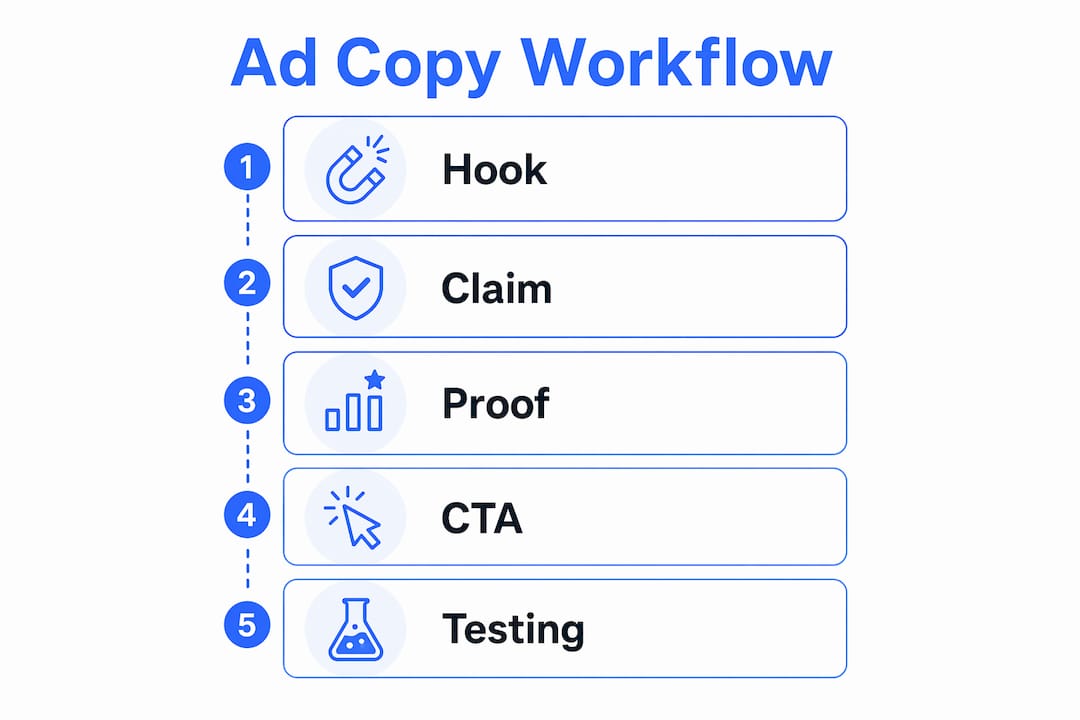
Proof is not a testimonial dump. It is the highest-trust evidence you own, presented as a single, named result. “Our customers reduced churn by 34% in 90 days” outperforms “Thousands of happy customers” because it is falsifiable and specific. Proof should be treated as a reusable asset that can be rotated across hook patterns without rewriting from scratch.
CTAs fail when they are generic. “Shop now” tells a reader what to do but not why to do it right now. “Book a 20-minute demo and see your first report live” combines a precise action verb, a time commitment, and an immediate outcome. That specificity reduces friction because the reader knows exactly what happens next.
Pro Tip: Use the PAS framework (problem, agitation, solution) from Shopify’s persuasion guide to structure your body copy. It answers the “so what?” question that most feature-focused copy never gets to.
For more frameworks on crafting compelling e-commerce ads, Nectar’s resource on click-through rates and conversions covers hook-to-CTA construction with retail-specific examples.
How can consumer psychology improve ad copy effectiveness?
The science behind attention is not abstract. Consumers decide in one to three seconds whether an ad merits attention, which means your copy must land its core message before most readers have consciously registered they are looking at an ad. This is the “1-second strategy” from consumer neuroscience: be visually and textually salient before the brain’s filtering system dismisses the stimulus.
Several psychology-driven practices translate directly into copy decisions:
-
Front-load the emotional trigger. The first word of your hook should activate a feeling or a recognition. “Frustrated,” “Finally,” and “Warning” each trigger an emotional response before the reader processes the rest of the sentence.
-
Use consumer-focused language, not product-focused language. “You’ll stop losing leads by Friday” outperforms “Our CRM has automated follow-up features.” The first speaks to an outcome the reader already wants. The second requires the reader to do translation work you should be doing for them.
-
Refresh proof assets on a regular cycle. Retail ad creatives perform better when proof layers are refreshed periodically while keeping the hook mechanism stable. Ad fatigue hits the proof layer before it hits the hook, because readers remember claims they have already believed.
-
Test for structural patterns, not surface phrasing. Structural pattern testing enables iterative refinements across campaigns rather than one-off copy tweaks. When you know that “outcome-first hooks outperform pattern-interrupt hooks for your audience,” that finding applies to every future campaign you run.
“Ad copy success depends disproportionately on the hook’s ability to grab attention within the platform’s attention window, outweighing the importance of clever phrasing.” — Ad Copy Attention Window Reality
For a structured approach to testing creative variants and interpreting results at scale, Nectar’s guide for marketing directors covers the full testing investment rationale with actionable frameworks.
Key takeaways
Winning ad copy is built on a modular, research-backed system where the hook carries disproportionate weight, every sentence stands alone, and testing reveals structural patterns rather than lucky phrasing.
Hook specificity beats cleverness Write hooks under 40 characters that deliver a complete idea without relying on the body copy below them.
Modular copy is non-negotiable on Meta Every sentence must make sense independently because Meta Advantage+ recombines text fields during delivery optimization.
One proof point outperforms many claims Single concrete proof points increase recall by 23% compared to stacking multiple generic claims in the same ad.
Test structure, not surface phrasing Focus test results on which hook pattern won, then apply that structural insight across future campaigns for compounding returns.
Refresh proof assets on a cycle Keep the hook mechanism stable while rotating proof elements to combat ad fatigue without rebuilding copy from scratch.
Why most copywriters are still writing ads the wrong way
I have reviewed hundreds of ad accounts across e-commerce brands, and the pattern is consistent: copywriters spend 80% of their time on the body and 20% on the hook. The data says that ratio should be reversed.
The shift from linear copywriting to modular, algorithm-friendly construction is not a trend. It is a structural response to how platforms actually deliver copy in 2026. Meta Advantage+ does not care about your narrative arc. It cares about which text combination drives the lowest cost per result. If your copy only works as a sequence, the platform will break it.
What I find most underused is the practice of scanning in-market ads before writing a single word. Copywriters who skip angle research produce technically competent copy that lands in a saturated pattern. The hook sounds familiar, the claim feels expected, and the reader scrolls past without registering why. Originality at the angle level is worth more than originality at the sentence level.
The combination of art and data that actually moves conversion rates is not glamorous. It is four hooks, two bodies, eight live tests, and a spreadsheet of structural findings. The brands that treat that process as creative work, rather than mechanical work, are the ones building scalable copy systems instead of one-off wins.
Watch the unsaturated angles in your category. They are always there. The market reveals them to anyone willing to look before writing.
— Dan Katona
Scale your ad performance with Nectar
Crafting high-converting ad copy is one part of the equation. Deploying it across Amazon, Walmart, and Shopify with the right creative assets, placement strategy, and analytics infrastructure is where most brands leave money on the table. Nectar’s full-service growth solutions combine in-house creative production with the iDerive analytics platform to give your campaigns the structural testing and optimization they need to scale profitably. If your ad copy is ready to perform but your campaign infrastructure is not, that gap is exactly what Nectar is built to close.
FAQ
What makes an ad hook effective in 2026?
An effective hook delivers its complete message within the first 40 characters and works independently of the body copy. Platform algorithms like Meta Advantage+ display only the opening line in many placements, so the hook must earn attention on its own.
How many ad copy variants should I test?
The proven approach is four hook variants combined with two body variants, producing eight live test combinations. This volume generates enough data to identify which structural hook pattern performs best for your audience.
What is modular ad copy and why does it matter?
Modular ad copy means every sentence functions as a standalone statement without depending on surrounding text for context. Meta’s delivery optimization swaps text fields across placements, so copy written as a linear narrative breaks when the platform recombines it.
How often should I refresh my ad copy proof assets?
Proof assets should be refreshed on a regular cycle while keeping the hook mechanism stable. Ad fatigue typically hits the proof layer first, so rotating testimonials, data points, and named results sustains engagement without requiring a full copy rebuild.
Does overlay text on video ads actually improve conversions?
Yes. Overlay text on video ads on Reddit increases conversion by 8.2%, primarily because captions retain viewers watching with audio off. The same effect does not apply to static image overlays, which generally reduce conversion unless the overlay communicates urgency.
Recommended











.png)