TL;DR:
- Cross-channel attribution assigns credit to multiple marketing touchpoints, providing a complete view of what drives conversions. It allows brands to optimize budgets effectively by understanding which channels truly influence customer purchases. Relying solely on last-click models can mislead marketers and cause budget waste in multi-channel campaigns.
Cross-channel attribution is the practice of assigning credit to multiple marketing touchpoints across a customer’s journey, giving brands a true picture of what drives conversions rather than rewarding only the last ad clicked. 52.5% of conversion journeys span multiple channels, and 25% follow repeatable multi-channel paths such as connected TV combined with display ads. That reality makes single-touch measurement not just incomplete but actively misleading. Marketers who reach advanced attribution maturity report up to 26% higher ROI by reallocating budget based on true channel contribution. The role of cross-channel attribution, then, is not a reporting exercise. It is a budget decision engine.
What is the role of cross-channel attribution in e-commerce?
Cross-channel attribution connects the dots between every ad impression, email open, search click, and social interaction that precedes a purchase. Without it, brands operate on incomplete data and reward the wrong channels with more spend. The result is budget waste at scale, especially for mid-sized and enterprise brands running simultaneous campaigns across Amazon, Google, Meta, and Walmart.

Last-click attribution, the default in many platforms, gives 100% of the credit to the final touchpoint before conversion. That model ignores every awareness and consideration touchpoint that built the customer’s intent. A shopper who saw a sponsored video on Amazon, clicked a Google Shopping ad three days later, and then converted through a retargeting ad on Meta would, under last-click, make Meta look like the only channel that mattered.
The importance of cross-channel marketing measurement comes down to one question: which channels actually move buyers, and which ones just happen to be nearby at the moment of purchase? Answering that question correctly changes where you put your money.
How do attribution models assign credit across channels?
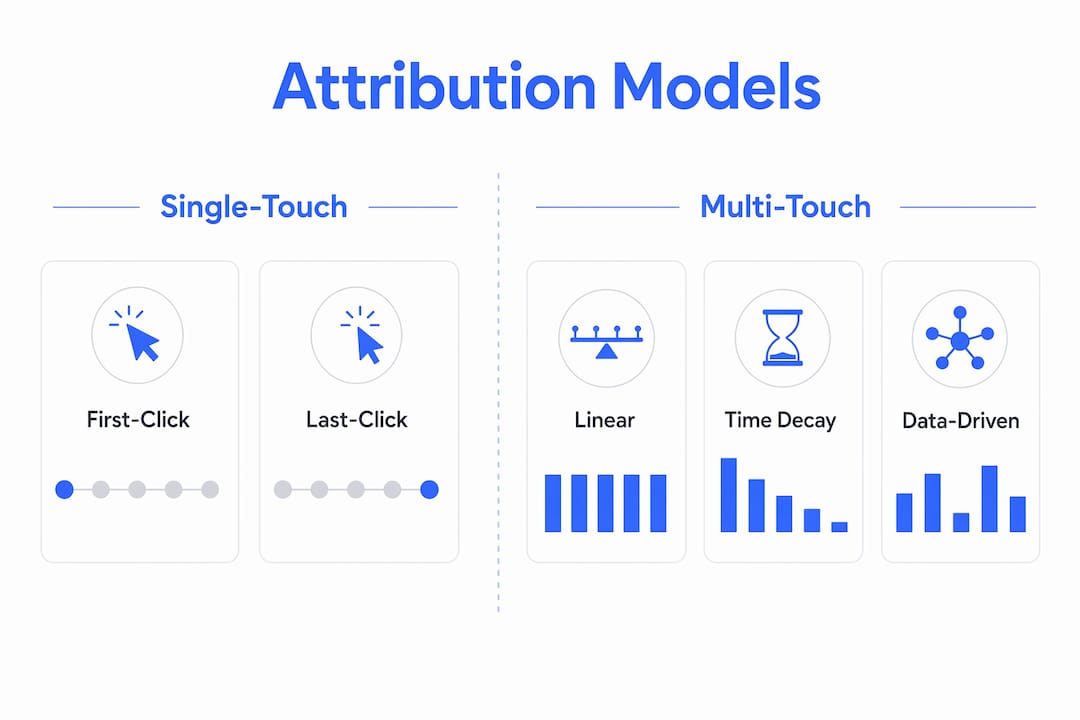
Attribution models are the rules that determine how credit gets distributed among touchpoints. Each model tells a different story, and understanding their differences is the foundation of sound cross-channel analytics strategy.
Single-touch models
First-click attribution gives all credit to the channel that first introduced the customer to the brand. Last-click gives all credit to the final touchpoint. Both are fast to implement and easy to read, but they ignore everything in between. Google deprecated first-click and linear models in 2023 because legacy models covered under 3% of total conversion paths. That figure alone explains why rule-based single-touch models are no longer a credible default.
Multi-touch rule-based models
Linear attribution splits credit equally across every touchpoint. Time decay gives more credit to touchpoints closer to the conversion. Position-based, sometimes called U-shaped, assigns the largest shares to the first and last touches and distributes the remainder across the middle. These models are more nuanced than single-touch, but they still apply fixed, human-defined rules rather than learning from actual conversion data.
Data-driven attribution
Data-driven attribution uses machine learning to analyze which combinations of touchpoints actually produce conversions. It compares converting paths against non-converting paths and assigns credit based on statistical contribution. This approach removes the guesswork of rule-based models and reflects real buyer behavior. For brands with sufficient conversion volume, data-driven attribution is the most accurate model available. Understanding multi-channel performance at this level requires both the right model and the right data infrastructure to feed it.
What makes cross-channel attribution so difficult to implement?
Accurate attribution is hard because the data environment is fragmented, privacy-constrained, and commercially biased. Most marketing teams underestimate how many of these problems compound each other.
-
Data silos across platforms. Each ad platform, Google, Meta, Amazon, TikTok, reports conversions using its own attribution window and logic. A single sale can appear in all four dashboards simultaneously, making total reported revenue look far higher than actual revenue.
-
Overlapping attribution windows. Platforms claim credit for the same conversion by using different lookback windows. Meta may use a 7-day click window while Google uses a 30-day window, so both platforms count the same purchase.
-
Privacy restrictions. Apple’s App Tracking Transparency framework and the ongoing deprecation of third-party cookies have reduced the signal available to pixel-based tracking. Cross-device journeys are especially hard to stitch together without persistent identifiers.
-
Walled gardens. Amazon, Walmart, and retail media networks do not share raw user-level data with advertisers. You see aggregated reports, not the full path.
-
Offline and external factors. Seasonality, competitor promotions, and in-store activity all influence online conversions but never appear in a digital attribution model.
Server-side tracking and hashed PII for compliance are now the baseline requirements for any team serious about accurate measurement. They require ongoing developer support and are far more complex to maintain than client-side pixels.
Pro Tip: Before investing in a new attribution platform, audit your existing data collection. Gaps in server-side tracking or CRM integration will corrupt any model you layer on top.
What advanced methods improve cross-channel measurement accuracy?
Rule-based attribution and even data-driven platform models have limits. The most accurate measurement programs combine multiple methods to triangulate the truth.
-
Media mix modeling (MMM). MMM uses aggregate statistical regression to measure the contribution of each channel, including offline channels like TV and print, while controlling for seasonality and competitor activity. It does not rely on user-level tracking, which makes it resistant to privacy restrictions. Enterprises managing both offline and online sales channels find MMM especially useful because it captures the full picture that digital-only models miss. Retailers exploring offline and online channel models benefit from MMM’s ability to account for in-store lift alongside digital spend.
-
Incrementality testing. Incrementality testing uses controlled experiments, such as geo holdouts or audience splits, to prove the causal impact of a channel rather than just its correlation with conversions. A geo holdout test turns off advertising in one region while maintaining it in another, then compares sales lift. This is the closest thing to a scientific proof that a channel actually drove revenue.
-
Marketing Efficiency Ratio (MER). MER equals total revenue divided by total ad spend across all channels. It is less sensitive to attribution bias than any platform-reported metric because it ignores how individual platforms claim credit. MER gives a high-level read on whether the overall marketing program is healthy, even when individual channel reports contradict each other.
-
Unified analytics platforms. AI-powered platforms that ingest data from all channels into a single reporting layer can surface patterns that no single platform dashboard reveals. Nectar’s proprietary iDerive analytics platform does exactly this, combining cross-channel data with full-funnel performance metrics to give brands a single source of truth for budget decisions.
Pro Tip: Run incrementality tests on your highest-spend channels first. The results often reveal that one or two channels are taking credit for conversions that would have happened anyway, freeing up significant budget.
How should marketers apply cross-channel attribution in practice?
Understanding the models and methods is only half the work. Applying them correctly requires process changes, not just technology.
-
Unify your data before you model it. Connect your CRM, ad platforms, and e-commerce backend through server-side tracking. Without a unified data layer, every attribution model you run will produce unreliable outputs.
-
Run multiple models in parallel. Compare last-click, data-driven, and MER side by side. Where they agree, you have high confidence. Where they diverge, you have a signal worth investigating.
-
Use MER as your north star. Platform-reported ROAS will always flatter the platform reporting it. MER cuts through that noise by measuring total revenue against total spend at the business level.
-
Rebalance budget based on multi-touch insights. If data-driven attribution shows that a mid-funnel channel like display advertising contributes significantly to conversions that last-click assigns to paid search, shift budget accordingly. Cross-channel advertising insights consistently show that mid-funnel investment is undervalued when last-click is the default.
-
Prioritize first-party data. Email lists, CRM records, and loyalty program data are not subject to third-party tracking restrictions. Build your attribution foundation on data you own.
-
Validate with incrementality. Use geo holdout tests or platform-level lift studies at least quarterly to check whether your attribution model’s conclusions hold up under experimental conditions.
-
Avoid over-relying on any single model. Attribution models are correlation-based. They identify associations between touchpoints and conversions but do not prove causation. Treating any single model as the definitive truth leads to poor budget decisions.
The benefits of multi-channel attribution compound over time. Teams that build measurement discipline early make better budget calls every quarter, while teams that rely on platform-reported numbers keep funding channels that look good on paper but underperform in reality.
Key Takeaways
Accurate cross-channel attribution requires combining multiple measurement methods, including data-driven models, MER, and incrementality testing, because no single model captures the full picture.
Point | Details
-
Attribution model selection matters. Data-driven attribution outperforms rule-based models because it learns from actual conversion paths rather than applying fixed rules.
-
Platform data is biased by design. Overlapping attribution windows cause multiple platforms to claim the same conversion, inflating reported performance across every channel.
-
MER is your most reliable metric. Total revenue divided by total spend gives a bias-immune view of marketing health that no single platform dashboard can match.
-
Incrementality testing proves causation. Geo holdout experiments confirm whether a channel actually drives revenue or just correlates with purchases that would have happened anyway.
-
First-party data is the foundation. Server-side tracking and CRM integration are prerequisites for any attribution program that will hold up under privacy restrictions.
Why most attribution programs fail before they start
The uncomfortable truth I have seen repeatedly is that most brands invest in attribution technology before they fix their data collection. They buy a sophisticated multi-touch platform, connect it to leaky pixel-based tracking, and then wonder why the outputs contradict their business results. The model is not the problem. The data feeding it is.
The second failure mode is organizational. Attribution findings only change outcomes if the team has the authority and process to act on them. A data analyst who identifies that display advertising drives 30% of assisted conversions but gets ignored in budget meetings has done useful work that produces zero business impact. Attribution has to be connected to budget governance, not just reporting.
Privacy trends are making this harder, not easier. Apple’s ATT framework and cookie deprecation are permanent structural changes, not temporary inconveniences. Brands that build measurement programs around first-party data and server-side tracking now will have a durable advantage over those that keep patching client-side pixels. The future of attribution belongs to teams that treat measurement as infrastructure, not as a quarterly report.
My honest recommendation: start with MER, add incrementality testing on your top two channels, and use data-driven attribution as a directional guide rather than a definitive answer. That combination is imperfect, but it is far more reliable than trusting any single platform’s reported ROAS.
— Dan Katona
How Nectar approaches cross-channel measurement for growing brands
Brands running campaigns across Amazon, Walmart, and Shopify face the full complexity of cross-channel attribution every day. Fragmented data, overlapping attribution windows, and platform-reported metrics that rarely agree make budget decisions harder than they should be.

Nectar’s full-service e-commerce solutions are built around this exact challenge. The iDerive analytics platform consolidates cross-channel performance data into a single view, while Nectar’s retail media team manages sponsored ads and retail media across platforms with attribution discipline built into every campaign. If your current measurement program is producing more questions than answers, Nectar has the infrastructure and expertise to change that.
FAQ
What is cross-channel attribution?
Cross-channel attribution is the practice of assigning conversion credit to multiple marketing touchpoints across a customer’s journey rather than crediting only one channel. It gives brands a more accurate view of which channels actually drive revenue.
Why is last-click attribution a problem?
Last-click attribution ignores every touchpoint before the final interaction, which misrepresents how most customers actually convert. Since 52.5% of conversion journeys span multiple channels, last-click systematically underfunds the channels that build awareness and consideration.
What is the Marketing Efficiency Ratio?
MER equals total revenue divided by total ad spend across all channels. It is less sensitive to attribution bias than platform-reported ROAS because it measures overall business performance rather than individual channel claims.
How does incrementality testing differ from attribution modeling?
Attribution modeling identifies correlations between touchpoints and conversions. Incrementality testing uses controlled experiments, such as geo holdouts, to prove that a channel caused a conversion rather than just coincided with it.
How do privacy changes affect cross-channel attribution?
Apple’s App Tracking Transparency framework and third-party cookie deprecation reduce the user-level signal available to pixel-based tracking. Server-side tracking and first-party data are now the most reliable foundations for any attribution program.
Recommended