What Is Shopify Plus? A Guide for Enterprise Brands
.webp)

TL;DR:
- Shopify Plus is an enterprise ecommerce platform designed for brands with high transaction volumes and complex operations. It offers native features like fully customizable checkout, B2B tools, multi-store management, and automation, replacing the need for many third-party apps. The monthly cost starts at $2,300, often resulting in lower overall expenses through app and development savings for brands earning over $1.5 million annually.
Shopify Plus is Shopify’s enterprise-grade ecommerce platform, built for mid-market and high-volume brands that have outgrown standard plans. Where regular Shopify handles the basics well, Shopify Plus adds Checkout Extensibility, native B2B tools, multi-store management, Shopify Flow automation, and higher API rate limits. These are not incremental upgrades. They are the operational infrastructure that brands generating $1.5M or more in annual revenue need to run complex, global commerce without stitching together dozens of third-party apps. This article breaks down every major capability, the real cost of ownership, and exactly when the investment makes sense.
What is Shopify Plus and how does it differ from standard Shopify?
Shopify Plus is the top tier of Shopify’s platform, designed specifically for brands with complex operations, high transaction volumes, and multi-market ambitions. Standard Shopify plans serve early-stage and growing brands well. Shopify Plus serves brands that need more control over checkout, more automation, and the ability to manage multiple storefronts from one admin.

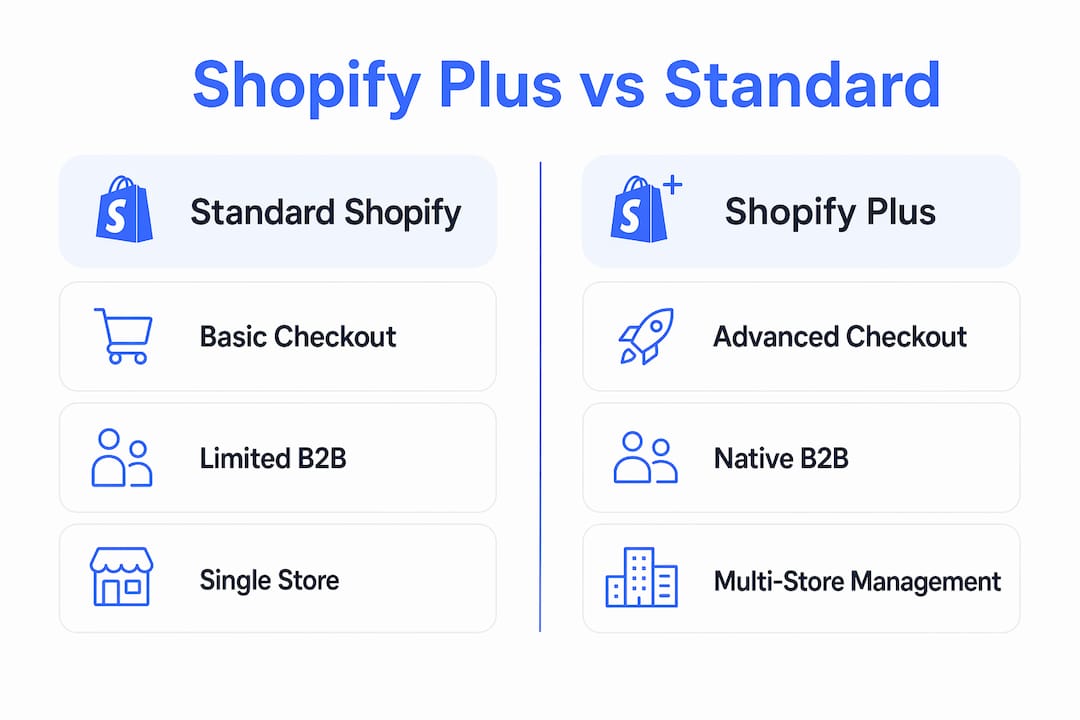
The clearest way to understand the difference is to look at what standard Shopify locks away. Checkout customization on standard plans is limited to basic theme edits. Checkout Extensibility on Plus allows brands to build fully custom checkout flows using API-based UI extensions, add post-purchase upsells, and match the checkout experience to their brand identity. That capability alone drives measurable conversion gains for high-volume stores.
B2B is another hard wall on standard plans. Running wholesale alongside direct-to-consumer typically requires a separate app stack. Shopify Plus includes native B2B features such as company profiles, custom price lists, catalog segmentation, payment terms, and buyer role management, all inside one admin. That eliminates a significant layer of app cost and operational complexity.
Support is also different. Shopify Plus merchants get a dedicated merchant success manager, priority support, and access to the Shopify Plus Partner Program. Standard plans rely on general support queues.
Core Shopify Plus features that justify the premium
The features below are what separate Shopify Plus from every plan below it. Each one addresses a specific operational problem that scaling brands face.
- Checkout Extensibility: Build custom checkout experiences using UI extensions. Add branded elements, custom fields, loyalty integrations, and post-purchase offers without touching Shopify’s core checkout code.
- Native B2B channel: Manage wholesale and DTC from one admin. Set company-specific catalogs, price lists, minimum order quantities, and net payment terms without third-party apps.
- Multi-store management: Run up to nine expansion stores under one organization admin, each with its own domain, theme, language, and currency.
- Shopify Flow: Build automated workflows triggered by store events. Flag high-risk orders, restock inventory, send internal alerts, or tag customers based on behavior, all without writing code.
- Launchpad: Schedule product launches, price changes, and promotional campaigns in advance. Launchpad executes them automatically at the set time.
- Higher API rate limits: Shopify Plus provides significantly higher GraphQL Admin API call limits. This matters for brands integrating ERPs, tax platforms like Avalara, or headless commerce architectures.
Pro Tip: Before signing with Shopify Plus, audit your current app stack. Most brands discover they are paying for three to five apps that Plus replaces natively. That audit often changes the cost-benefit math significantly.
How does Shopify Plus support international expansion?
Shopify Plus is built for brands that sell across borders. The platform supports up to nine expansion stores for international markets, each configurable with a unique domain, localized theme, regional currency, and native language. All nine stores are managed from a single organization admin. That centralization is the operational advantage most global brands underestimate before they experience it.
Each expansion store can carry localized pricing, region-specific product catalogs, and market-appropriate content. A brand selling in the United States, Germany, and Japan can present three entirely different storefronts while managing inventory, orders, and analytics from one place. That is not possible on standard Shopify without significant workarounds.
- Localized currency and pricing per storefront
- Region-specific domains and themes
- Language-native content and product descriptions
- Centralized order management and reporting across all stores
- Unified customer data across markets
Pro Tip: Use Shopify Markets alongside your expansion stores to handle currency conversion, local tax rules, and language detection automatically. The combination reduces the manual configuration needed for each new market.
For brands planning global Shopify expansion, the multi-store architecture on Plus removes the biggest technical barrier: maintaining consistency across markets while still localizing the experience.
What does Shopify Plus actually cost, and when is it worth it?
Shopify Plus pricing starts at $2,300 per month. That number stops many mid-market brands before they run the actual math. The flat fee model includes features that brands on Advanced Shopify pay for separately through app subscriptions, custom development, and additional transaction fees.
The cost comparison looks different once you account for what Plus replaces:
- Native B2B channel eliminates wholesale app subscriptions
- Launchpad replaces campaign scheduling tools
- Shopify Flow replaces basic automation apps
- Higher API limits reduce the need for middleware platforms
- Checkout Extensibility removes the cost of custom checkout development
Switching to Shopify Plus can save $200–$500 per month in app costs alone. That reduction narrows the real price gap between Advanced Shopify and Plus considerably.
Transaction fees add another layer. Shopify Plus merchants using Shopify Payments pay lower transaction rates than Advanced Shopify users. At high order volumes, that difference compounds quickly.
A full Total Cost of Ownership analysis consistently favors Shopify Plus for brands generating $2M–$25M or more annually, once automation labor savings and app reductions are factored in.
Brands typically upgrade around $1.5M–$2M in annual revenue, when the operational complexity of checkout customization, B2B, or global expansion starts creating real friction. Below that threshold, standard Shopify plans handle most needs without the overhead.
How does Shopify Plus improve operational efficiency through automation?
Shopify Plus is more than a high-traffic solution. Its automation tools reduce the manual work that quietly drains operations teams at growing brands.
Shopify Flow on Plus runs with higher execution limits than on standard plans. Brands use it to automate order tagging, fraud flagging, inventory reorder triggers, customer segmentation updates, and internal team notifications. A workflow that would require a staff member to check a dashboard and take action manually instead runs the moment the triggering event occurs.
Launchpad handles campaign execution. A brand launching a new product line can schedule the price change, the theme update, the inventory release, and the promotional banner to go live simultaneously at midnight, without anyone staying up to click publish. That kind of precision reduces launch errors and frees up team time.
- Automated order risk management and fraud flagging
- Inventory restock triggers based on threshold rules
- Customer tag updates based on purchase behavior
- Scheduled campaign launches with Launchpad
- ERP and tax platform sync via higher API rate limits
Pro Tip: Start with three to five high-frequency manual tasks your team performs daily. Build Shopify Flow workflows for those first. The time savings become visible within the first month and build the internal case for deeper automation.
The API enhancements on Plus also matter for integration-heavy operations. Brands connecting Shopify to NetSuite, SAP, or Avalara for tax management need higher call limits to keep data synchronized in real time. Standard Shopify API limits create bottlenecks at scale that Plus removes.
Shopify Plus vs Shopify: which plan fits your operation?
The decision between Shopify Plus and standard Shopify plans comes down to operational complexity, not just revenue. Here is how the two compare across the dimensions that matter most to mid-market and enterprise brands.
Checkout customization
Standard Shopify allows theme-level edits to checkout. Shopify Plus unlocks Checkout Extensibility, which means full UI control, custom fields, loyalty program integrations, and post-purchase upsell flows. For brands where checkout conversion rate is a primary KPI, this difference is significant.
B2B and wholesale
Standard Shopify requires third-party apps to run wholesale. Shopify Plus includes a native B2B channel with company profiles, custom catalogs, and payment terms built in. Brands running both DTC and wholesale on standard plans typically manage two separate systems. Plus consolidates them.
Multi-store and international
Standard Shopify supports one store per account. Shopify Plus supports up to nine expansion stores under one admin. For brands in multiple international markets, that centralization is not optional. It is the only way to manage global operations without a fragmented tech stack.
Automation and API access
Shopify Flow is available on some standard plans, but Plus provides higher execution limits and more complex workflow capabilities. API rate limits on Plus are significantly higher, which matters for ERP integrations and real-time data sync.
Support and account management
Standard plans use general support channels. Shopify Plus includes a dedicated merchant success manager and access to the Shopify Plus Partner Program, which connects brands with vetted development and agency partners.
For brands with straightforward single-market operations under $1.5M in revenue, standard Shopify plans handle the workload without the Plus overhead. The upgrade decision becomes clear when checkout customization, B2B, or multi-market management creates operational friction that apps cannot solve cleanly.
Key takeaways
Shopify Plus is the right investment for mid-market and enterprise brands when operational complexity, B2B needs, or global expansion outpaces what standard Shopify plans can deliver natively.
Point | Details
What Shopify Plus is: Shopify’s enterprise platform with advanced checkout, B2B, automation, and multi-store tools built in.
Pricing reality: At $2,300 per month, Plus often costs less than Advanced Shopify plus the app stack it replaces.
Upgrade trigger: Brands typically move to Plus around $1.5M–$2M in annual revenue when operational complexity increases.
Automation value: Shopify Flow and Launchpad reduce manual work and lower headcount costs for operations teams.
International scale: Up to nine expansion stores managed from one admin make global operations practical without a fragmented tech stack.
Why the “too expensive” objection usually misses the point
The most common mistake I see brands make when evaluating Shopify Plus is treating the $2,300 monthly fee as the total cost comparison. They line it up against their current Advanced Shopify bill and stop there. That analysis ignores the app subscriptions, the custom development hours, the middleware costs, and the staff time spent on tasks that Plus automates natively.
I have watched brands run that full accounting and discover they were already spending close to the Plus price, just distributed across a dozen line items they never added up. The difference is that Plus delivers those capabilities in one integrated system instead of a patchwork of tools that break when Shopify updates its core.
The other misconception worth addressing: Shopify Plus is not primarily a traffic solution. Standard Shopify handles high traffic well. Plus earns its cost through operational efficiency, checkout control, and B2B infrastructure. Brands that upgrade expecting a performance boost often miss the real value, which shows up in reduced manual work, lower app costs, and faster market expansion.
My honest advice for decision-makers: if your team is spending meaningful hours each week managing workarounds for checkout limitations, B2B complexity, or multi-market operations, that time has a dollar value. Add it to your cost comparison. The upgrade to Shopify Plus almost always looks different after that calculation.
— Dan Katona
How Nectar helps enterprise brands get more from Shopify Plus
Shopify Plus gives enterprise brands the infrastructure. Getting full value from it requires knowing which features to prioritize, how to configure automation for your specific workflows, and how to connect the platform to your broader growth strategy. That is where Nectar comes in.
Nectar works with mid-market and enterprise brands to implement, configure, and scale on Shopify Plus. From migration and checkout customization to multi-market setup and Shopify Flow automation, Nectar’s team handles the operational complexity so your team can focus on growth. Powered by the iDerive analytics platform, Nectar brings data-driven decision-making to every stage of your Shopify Plus build. Explore Nectar’s Shopify services to see how the team supports brands at every stage of the Plus journey.
FAQ
What is Shopify Plus used for?
Shopify Plus is used by mid-market and enterprise brands that need advanced checkout customization, native B2B tools, multi-store management, and workflow automation beyond what standard Shopify plans offer.
How much does Shopify Plus cost per month?
Shopify Plus starts at $2,300 per month. The total cost of ownership is often lower than it appears once app subscriptions and custom development costs replaced by native Plus features are factored in.
When should a brand upgrade to Shopify Plus?
Brands typically upgrade around $1.5M–$2M in annual revenue, when checkout limitations, B2B complexity, or international expansion create operational friction that standard plans cannot resolve natively.
Does Shopify Plus support B2B and wholesale?
Shopify Plus includes a native B2B channel with company profiles, custom catalogs, price lists, and payment terms, eliminating the need for third-party wholesale apps.
How many stores can you run on Shopify Plus?
Shopify Plus supports up to nine expansion stores, each with its own domain, language, currency, and theme, all managed from a single organization admin.
Recommended


































































.webp)