The fastest path from an underperforming listing to a top-ranked one is a repeatable process, not a one-time fix. Step by step content optimization means systematically improving every element of a product listing — title, bullets, description, images, structured data, and reviews — so each piece earns its place in search results and pushes buyers toward the cart. On Amazon, Walmart, and Shopify, the brands winning market share are the ones running this process on a schedule, not scrambling after a ranking drop.
Here is the core sequence:
-
Define your core messaging and key buyer benefit claims before writing a single word.
-
Conduct platform-specific keyword research tailored to each marketplace’s algorithm.
-
Write unique, benefit-driven titles, bullet points, and descriptions that address real buyer objections.
-
Optimize every image with proper sizing, descriptive file names, alt text, and the right format.
-
Implement structured data and backend search terms to expand discoverability.
-
Collect and display customer reviews and Q&A to generate fresh, keyword-rich content.
-
Test title and copy variations, then monitor conversion and ranking metrics.
-
Refresh listings regularly to maintain relevance and authority.
Common mistakes that kill product listing performance
Most listing problems trace back to a handful of avoidable errors. Catching them early saves weeks of lost ranking.
-
Generic manufacturer descriptions. Copying supplier copy means your listing competes on identical text with dozens of other sellers. Google indexes one version and the rest disappear from results.
-
Ignoring buyer objections. A description that lists features without addressing “will this fit my use case?” loses buyers at the decision point. Separate features (facts) from benefits (what changes for the buyer) throughout your copy.
-
Keyword stuffing. Forcing exact-match phrases into every sentence damages readability and can suppress rankings. One primary keyword, supported by semantic variants, is the right balance.
-
Duplicate variant pages without canonical tags. A single product in five colors can spawn near-identical URLs that split your ranking signals. Canonical tags consolidate authority on one page and protect crawl budget.
-
Neglecting image optimization. Uncompressed files with generic names like “IMG_0423.jpg” tell search engines nothing and slow page load. Descriptive file names, alt text, and WebP format are the baseline.
-
Skipping structured data. Without Product, Offer, and AggregateRating schema in JSON-LD, your listing misses price, availability, and star-rating rich results entirely.
-
Ignoring customer-generated content. Reviews and Q&A are the only content on your page that updates itself with fresh, unique keywords. Leaving them unstructured wastes a ranking asset.
-
Burying conversion content. Above the fold is for buying decisions: price, availability, trust signals, and the primary call to action. SEO depth belongs below the fold.
How customer reviews and Q&A sharpen your listings
Reviews do something manufacturer copy never can: they add fresh, unique, keyword-rich content that updates on its own and signals recency to search algorithms. Buyers searching non-brand terms often land on listings because a review used the exact phrase they typed.
-
Encourage authentic reviews by sending follow-up emails 7–14 days after purchase.
-
Display reviews prominently, ideally above the fold or reachable with minimal scroll, so buyers see social proof before hesitation sets in.
-
Add a Q&A block that answers the questions buyers actually ask before committing. These blocks capture long-tail queries and reduce pre-purchase friction.
-
Make sure review and Q&A content is crawlable. Content hidden behind lazy-loaded JavaScript widgets may never render for search crawlers.
-
Monitor review velocity and recency, because a listing with recent reviews consistently outperforms one with an older, static rating.
-
Use negative review patterns to identify return drivers, then update your description to set accurate expectations and reduce those returns.
Pro Tip: Respond to reviews, especially critical ones, with specific, helpful answers. Those responses add indexed text to your listing and signal to both buyers and algorithms that the brand is active and credible.
How to adapt your content for Amazon, Walmart, and Shopify
Each platform runs a different algorithm and enforces different format rules. Content that converts on one marketplace often needs structural changes before it performs on another.
-
Audit each platform’s character limits. Amazon product titles allow up to 200 characters in most categories; Walmart caps many titles at 75 characters. Shopify has no hard limit but titles beyond 60 characters truncate in Google search results. Write to the tightest constraint first, then expand for platforms with more room.
-
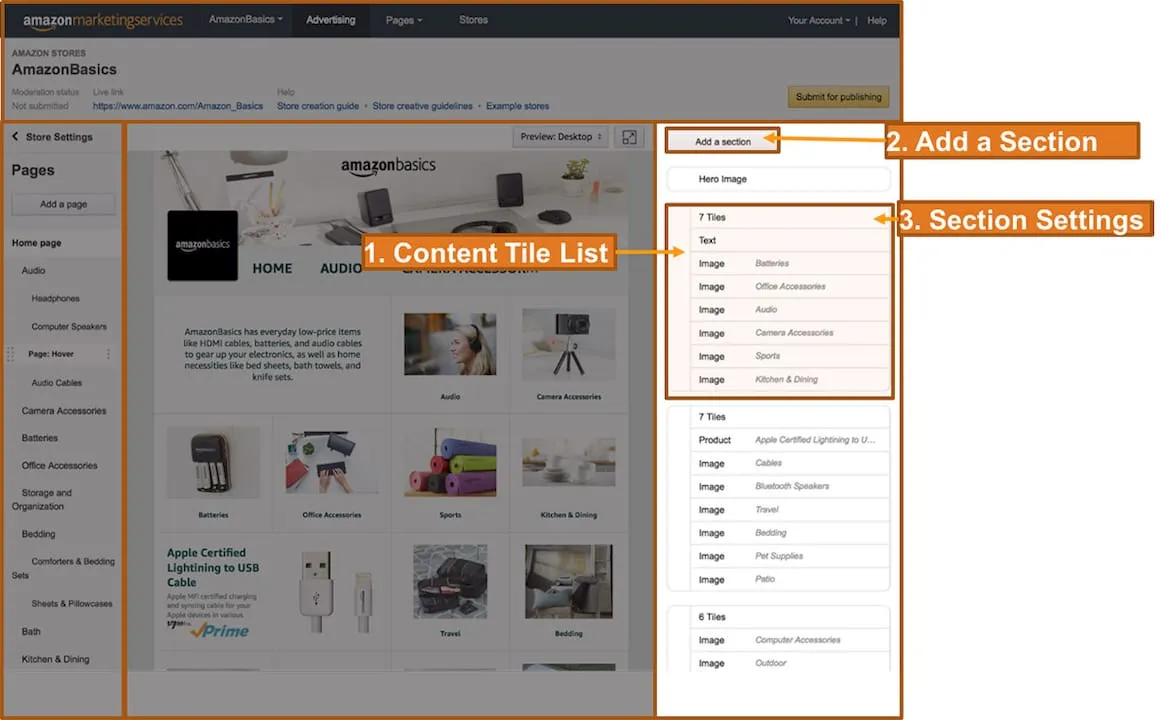
Use Amazon A+ Content for storytelling. A+ modules let you add comparison charts, lifestyle imagery, and brand narrative below the standard description. This content improves conversion and gives crawlers additional indexed text.
-
Fill Walmart’s structured attribute fields completely. Walmart’s algorithm weights taxonomy accuracy and attribute completeness heavily. Missing a required field like “material” or “age group” can suppress a listing regardless of title quality.
-
Adapt Shopify product pages for both UX and organic search. Shopify pages compete on Google, not a walled marketplace. That means internal linking from category pages, buying guides, and related products matters as much as on-page copy.
-
Match image counts and sizes to each platform’s guidelines. Amazon requires a pure white background on the main image and recommends at least six additional images. Walmart and Shopify have different dimension requirements. Serving the wrong size wastes the slot.
-
Load backend search terms strategically. Backend keywords on Amazon and Walmart let you capture long-tail and latent semantic terms without cluttering visible copy. Use synonyms, common misspellings, and use-case phrases your title cannot fit.
-
Test every listing on mobile before publishing. A title that reads cleanly on desktop often truncates to an unreadable fragment on a phone screen. Mobile-first review catches those problems before they cost you clicks.
-
Apply a “test once, optimize everywhere” workflow. Define your five to seven core benefit claims, test which messaging resonates on one platform, then adapt the proven copy to each marketplace’s format. This avoids running separate experiments on every channel simultaneously.
For a detailed checklist covering all three platforms, Nectar’s listing optimization checklist walks through every required field and format rule.
How Nectar and iDerive turn content data into ranking gains
Nectar’s approach to listing optimization starts with a full-funnel audit, not a title rewrite. Every listing gets evaluated on keyword coverage, image quality, structured data completeness, review velocity, and conversion rate before a single word of copy changes.
-
Full-funnel listing audits. Nectar maps each listing’s current search rank, click-through rate, and conversion rate to identify where the biggest gap sits, whether that is a weak title, missing schema, or thin description.
-
In-house creative services. Photography, videography, and graphic design are produced internally, so image quality and messaging stay aligned with the data rather than drifting through a third-party handoff.
-
iDerive analytics platform. Nectar’s proprietary iDerive platform surfaces keyword and content decisions grounded in real marketplace data, not generic search volume estimates. It identifies which terms are driving impressions without converting and flags where competitors are outranking with weaker products.
-
Data-driven advertising integration. Listing optimization and paid media run together at Nectar. A better listing earns a higher quality score on Amazon Sponsored Ads, which lowers cost per click and improves return on ad spend.
-
Agile content refresh cycles. iDerive tracks performance weekly, so listings get updated when ranking signals shift rather than on an arbitrary quarterly schedule.
-
Cross-platform expertise. Nectar manages Amazon, Walmart, and Shopify simultaneously, which means the “test once, optimize everywhere” workflow described above runs with real data across all three channels at once.
For brands running large catalogs, Nectar’s content optimization approach prioritizes high-revenue, high-potential listings first, so the work compounds fastest where it matters most.
Nectar puts your listings where buyers are looking
Most brands optimizing listings on their own hit the same ceiling: the process is clear in theory but slow and fragmented in practice. Nectar removes that ceiling. As a fully managed e-commerce agency, Nectar handles the audit, the creative production, the keyword strategy, and the ongoing performance monitoring as one integrated system, not a series of disconnected tasks handed off between teams.

The iDerive platform gives Nectar’s clients the kind of granular, real-time insight that most brands cannot build internally. Combined with in-house photography and copy, it means a listing goes from underperforming to high-converting without the back-and-forth that slows most optimization projects down.
Mid-sized and enterprise brands selling on Amazon, Walmart, or Shopify can explore Nectar’s full range of e-commerce growth services or request a listing audit directly to see exactly where revenue is being left on the table.
Key Takeaways
Effective product listing optimization is a repeatable, data-driven process that compounds over time when applied consistently across titles, images, structured data, and reviews.
Point | Details
-
Start with core messaging | Define five to seven key benefit claims and test which resonate before adapting copy to each platform’s format.
-
Canonical tags protect rankings | Set correct canonical tags on variant pages to consolidate ranking signals and avoid crawl budget waste.
-
Reviews generate ranking fuel | Fresh, keyword-rich review content updates automatically and helps listings rank for non-brand search terms.
-
Backend search terms expand reach | Use backend keywords on Amazon and Walmart to capture long-tail queries without cluttering visible copy.
-
Nectar’s iDerive platform | Nectar uses its proprietary iDerive analytics platform to identify keyword gaps and content weaknesses, then closes them with in-house creative and full-funnel management across Amazon, Walmart, and Shopify.
Recommended











.png)