The single highest-impact thing you can do to improve product reviews is ask the right customer at the right moment through a low-friction channel. Brands that shift from passive collection to active, timed requests see submission rates jump from low single digits to mid double digits. The tactics that move the needle fastest fall into five pillars: timing your request to the delivery window, removing every friction point from the submission flow, using multi-channel outreach, running FTC-compliant incentive programs, and monitoring reviews daily to respond and extract product intelligence.
Immediate next steps you can act on in the next 24–72 hours:
Pro Tip: Pick SKUs that already convert well but lack review volume. A product with a strong conversion rate and fewer than 10 reviews will see a disproportionate sales lift from even a small batch of early reviews compared to a product that already has 200.
Key Takeaways
The single most effective way to improve product reviews is to ask at the right moment, remove every friction point, and treat the program as a daily operational habit rather than a periodic campaign.
Send review requests 24–72 hours after confirmed delivery.
Use in-mail star ratings, direct links with no login wall, and mobile-first forms. One broken step in the flow kills completion rates.
The FTC’s Consumer Review Rule requires disclosure for any incentivized review and prohibits conditioning rewards on positive sentiment. Non-compliance carries enforcement risk.
Set alerts for reviews below 3 stars and respond within 24 hours. A rating distribution of roughly 4.2–4.7 stars reads as more credible than a perfect score.
Nectar operationalizes review programs across Amazon, Walmart, and Shopify with post-purchase automation, UGC creative production, and iDerive analytics to measure impact.
Why product reviews move the needle more than most brands realize
Reviews are not a marketing checkbox. They are a compounding revenue asset. Research from Spiegel Medill at Northwestern shows that star ratings lift click-through rates in search results and that each new review signals fresh content to search engines, helping product pages capture long-tail keyword traffic over time.
The conversion impact is front-loaded at low review counts. A product going from zero to five reviews sees a sharper conversion lift than the jump from 50 to 100. That means early volume on new SKUs matters more than most brands budget for.
Beyond conversion, reviews feed three other revenue channels:
Statista data on consumer review preferences confirms that verified-buyer badges, photo reviews, and filtering options are the features U.S. consumers value most. Building those into your display strategy compounds the trust signal reviews already carry.
How to improve product reviews with post-purchase request tactics
The 24–72 hour window after confirmed delivery is the sweet spot. The product is in the customer’s hands, the experience is fresh, and they have not yet moved on mentally. Requests sent outside this window, especially before delivery or weeks after, see sharply lower response rates.
Channel priority for response rates:
A simple automation sequence that works:
For phrasing, keep it low-effort and specific: “It takes 30 seconds — just tap a star and add one line about your experience.” Personalization (first name, product name, order date) lifts open rates. Generic “Please leave a review” messages perform significantly worse.
Ecommerce testing data from WiserReview confirms that multi-channel, timed requests are what separate 15–30% submission rates from the 1–3% brands get by doing nothing.
Removing friction is where most brands leave money on the table
The most common reason customers abandon a review form is not indifference. It is friction. Login walls, five-step forms, and broken mobile layouts kill completion rates before a customer types a single word.
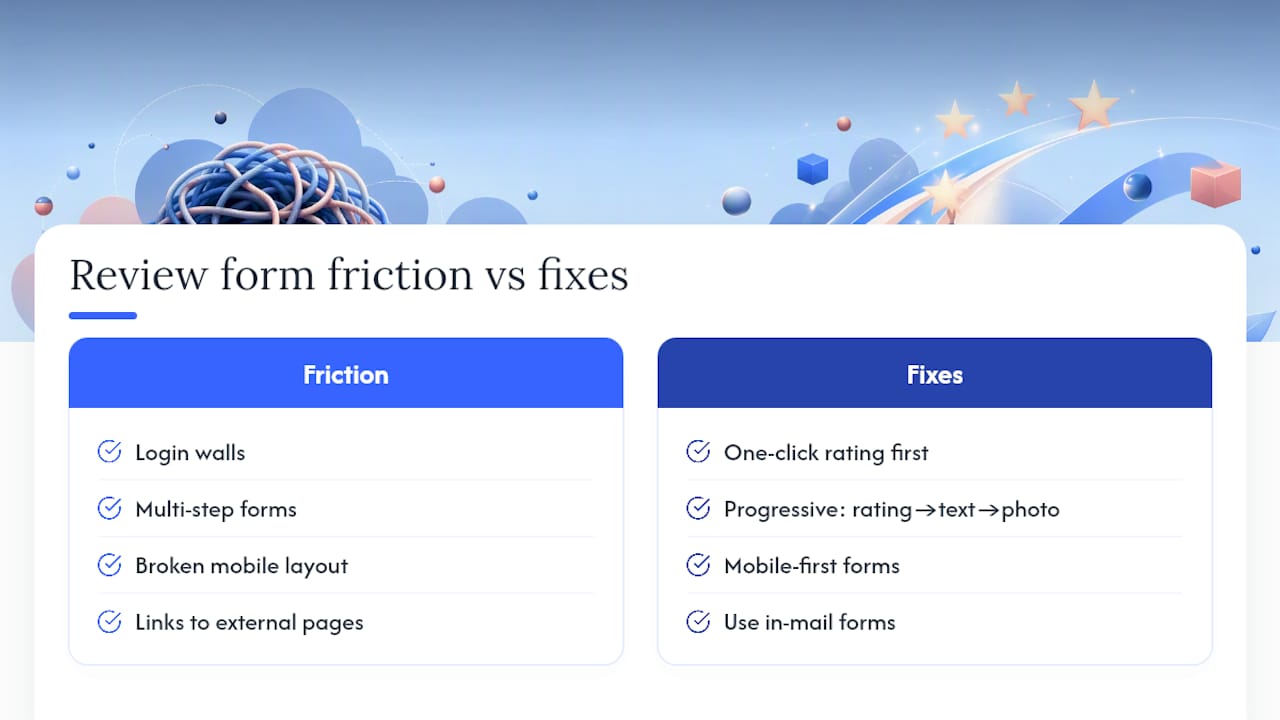
The fixes are straightforward:
One-click rating first. Show five stars and let the customer tap one. Only after they tap do you ask for text. This progressive approach (rating → short text → optional photo) reduces abandonment at each step because the customer has already committed to the first micro-action.
Mobile-first form design. Statista’s social media usage data underscores how dominant mobile is for daily digital activity. If your review form requires pinching, zooming, or switching to desktop, you are losing the majority of your potential submissions. Test every form on iOS and Android before launching.
Placement matters. In-mail forms (interactive star ratings embedded directly in the email) outperform links to external pages. Post-checkout flows, product page widgets, and category grid overlays each serve a different moment in the customer journey. Use in-mail for the primary request and product page widgets to capture buyers who return to browse.
Pro Tip: Before sending any review request campaign, send yourself a test email and open it on your phone. Click through the entire flow. If you hit a login wall or a form that does not render correctly on mobile, fix it before the campaign goes live. One broken flow can waste an entire segment.
How to use incentives without triggering FTC violations
Incentives work. They also carry real legal risk if you run them carelessly. The FTC’s Consumer Review Rule (16 CFR Part 465) codifies the requirements: you may offer incentives for reviews, but only when the offer is available for any honest review regardless of sentiment, and only when the incentivized nature of the review is clearly disclosed to readers.
The Consumer Review Rule Q&A from the FTC is direct: conditioning a reward on a positive review, or suppressing negative reviews from incentivized buyers, violates the Rule. Disclosure must be unavoidable — a buried footnote does not qualify. The FTC has already warned 10 companies about potential violations of the Consumer Review Rule, signaling active enforcement.
Compliant incentive types:
Operational checklist to stay compliant:
We welcome all feedback."
How to monitor, moderate, and respond to reviews effectively
Review management is a daily operational task, not a quarterly audit. The brands that protect their ratings and extract the most product intelligence treat moderation the way they treat inventory: something that needs attention every day.
Monitoring checklist:
Red flags for inauthentic reviews: generic text that does not reference the product specifically, reviewer profiles with no purchase history, clusters of reviews submitted within hours of each other, and reviews that describe a product feature you do not sell.
Response principles that build trust:
For negative reviews, acknowledge the issue in the first sentence, offer a resolution path (email, phone, replacement), and avoid defensive language. A response like “We’re sorry the sizing ran small — please reach out to [email] and we’ll make it right” does more for your brand than silence. WiserReview’s testing data supports the finding that a healthy rating distribution around 4.2–4.7 stars appears more credible to buyers than a page of only 5-star ratings, and that professionally handled negative reviews often build more trust than a perfect score.
For positive reviews, a brief, specific thank-you (“Glad the grip held up on your trail runs!”) signals that a real person is behind the brand.
Pro Tip: Tag every review by theme (sizing, durability, packaging, shipping speed) in a shared spreadsheet or your review platform’s tagging system. Route sizing and durability tags to your product team weekly. Packaging and shipping tags go to ops. This turns your review queue into a structured product feedback loop.
Where to surface reviews so they actually drive conversions
Collecting reviews is half the job. Where you display them determines how much conversion lift you actually capture. Spiegel Medill research confirms that star ratings and review content influence purchase decisions at multiple points in the funnel.
High-impact placements:
Display best practices:
For product listing optimization on marketplace PDPs, syndicate reviews to retail partners and Google Seller Ratings where your platform supports it.
Pro Tip: Pull your top three photo reviews into a paid social ad set and run them against your standard studio creative. In most categories, UGC photo ads win on cost-per-click within the first two weeks. The review text becomes the ad copy.

Choosing the right tools to collect, manage, and display reviews
No single platform does everything well. The smarter approach is to evaluate tools by capability category and match each to your operational needs.
Collection tools
Look for in-mail interactive forms (star ratings embedded in the email body), SMS integration, and direct review links that bypass login walls. The essential features: mobile-first rendering, verified-buyer enforcement so only confirmed purchasers can submit, and photo/video upload support.
Moderation and AI filtering
Enterprise brands need automated spam detection that flags velocity anomalies and generic text patterns before they publish. Manual moderation alone does not scale past a few hundred reviews per month. Evaluate SLA commitments for moderation turnaround — 24 hours is a reasonable benchmark for mid-market brands.
Display and UGC galleries
Widgets that render correctly on mobile, support filtering by rating and photo, and pull verified-buyer badges are the baseline. For brands running paid social, look for platforms with an API that lets you pull approved UGC directly into your ad creative workflow.
Analytics and sentiment tagging
The most underused capability in most review platforms. Sentiment tagging by theme (product quality, shipping, sizing) lets you route feedback to the right internal team and track whether product changes actually move your average rating over time. Pair this with a unified analytics platform to connect review trends to conversion and revenue data.
Syndication
For brands selling on Amazon, Walmart, and their own Shopify store, syndication pushes reviews collected on one channel to retailer partner pages and Google Seller Ratings. Evaluate whether a platform’s syndication API covers your specific retail partners before committing.
Evaluation criteria for mid-market and enterprise brands: prioritize platforms with documented SLAs for moderation, API access for syndication and ad creative, and a track record of verified-buyer enforcement. Scale matters — a tool that handles 500 reviews per month gracefully may not handle 50,000.
How to collect and legally reuse customer photos and influencer content
Photo and video reviews lift purchase likelihood materially.
Campaign ideas that generate visual UGC:
Rights management — the part most brands skip:
Before reusing any customer photo or video in ads or on your product page, obtain explicit written permission. A checkbox in your review submission form (“I grant [Brand] permission to use this photo in marketing materials”) is the minimum. For influencer content, the FTC’s endorsement guidance requires clear disclosure of any material connection (free product, payment, affiliate relationship) in the content itself, not just in a bio link.
The distinction matters: organic customer UGC and influencer endorsements are governed by different disclosure standards. A customer who bought your product and posted a photo without any incentive does not need an #ad tag. An influencer who received free product does, every time they post.
Do/don’t list for reusing UGC:
Pro Tip: Build a UGC rights request into your review thank-you email. After a customer submits a review with a photo, send an automated follow-up: “We love your photo — may we feature it on our site and social channels?” A simple yes/no reply gives you documented consent and a warm touchpoint.
Metrics, timelines, and budget guidance for review programs
Set a baseline before you run any campaign. Pull your current review submission rate (reviews submitted divided by orders shipped), average rating per SKU, share of reviews that include a photo, and average response time to negative reviews. These four numbers tell you where you are starting from.
Core metrics to track:
Realistic timelines:
Budget checklist:
For a post-purchase strategy that compounds over time, treat review collection as an always-on program, not a one-time campaign. Brands that automate requests and run moderation as a daily operation accumulate review volume that compounds month over month.
How a managed ecommerce partner operationalizes review programs at scale
Running a review program across Amazon, Walmart, and Shopify simultaneously is an operational challenge most brand teams underestimate. The channel rules differ, the moderation queues multiply, and the syndication logic between platforms requires API management that most in-house teams do not have bandwidth for.
An agency-driven implementation typically follows this sequence:
Nectar’s iDerive analytics platform connects review program data to conversion, revenue, and market share metrics so you can see exactly which SKUs are benefiting and where the next opportunity sits. Review-driven intelligence feeds back into advertising creative and lifecycle email flows, compounding the return from every review collected.
Pro Tip: Integrate your review program with your advertising creative workflow from day one. Every approved photo review is a potential ad asset. Every negative review theme is a targeting insight — if customers keep mentioning sizing, your next ad should address it directly. The brands that treat reviews as a creative and intelligence input, not just a rating metric, get the most compounding return.
The mistakes brands keep making with review programs
Three patterns show up repeatedly with brands that come to an agency after struggling with their review programs.
The first is waiting too long to ask. Brands send review requests two or three weeks after delivery, when the customer has moved on and the product experience is a memory. The 24–72 hour post-delivery window is not a suggestion — it is where the response rate lives.
The second is over-incentivizing without disclosure. Offering a $20 gift card for a review sounds generous until the FTC sends a warning letter. The issue is never the incentive itself. It is conditioning the reward on a positive rating, or failing to disclose the arrangement to readers. Both are violations of the Consumer Review Rule, and enforcement is active.
The third is ignoring negative reviews publicly. A one-star review with no response signals to every future buyer that the brand does not care. A professional response that acknowledges the issue and offers a resolution often converts a frustrated customer and reassures the next ten who read the thread. Negative reviews handled well are a trust asset, not a liability.
The fix for all three is the same: build a repeatable operational system with defined triggers, compliant templates, and a daily moderation habit. Ad hoc review programs produce ad hoc results.
Nectar helps brands build and scale compliant review programs
Running a review program that actually moves conversion metrics requires more than a platform subscription. It requires post-purchase automation tuned to your catalog, UGC creative production that turns customer photos into ad assets, and analytics that connect review volume to revenue outcomes.

Nectar’s managed ecommerce services cover the full stack: post-purchase automation flows, in-house creative studio for UGC production, moderation operations, and syndication across Amazon, Walmart, and Shopify. The iDerive analytics platform ties review program performance to conversion and market share data so you always know what is working. If you are ready to build a review program that compounds, see what Nectar’s services cover and get in touch with the team.
Sources
The sources below are the primary references used throughout this article. Each covers a distinct aspect of review program strategy and compliance.
The FTC’s guidance on reviews and endorsements is the authoritative U.S. legal reference for any brand running an incentivized review program. Read the rule text, the Q&A, and the enforcement press release before launching any incentive campaign.
Recommended




































































.webp)