TL;DR:
Walmart Marketplace offers brands access to over 120 million monthly U.S. shoppers with minimal upfront costs. It has lower fees and less competition compared to Amazon, making it a valuable multichannel growth platform in 2026.
Fast onboarding, reliable shipping, and strict pricing policies help sellers succeed by building trust and visibility. Strategic focus on pricing, content, and advertising maximizes growth on the platform.
Walmart Marketplace is a third-party selling platform that gives independent brands and e-commerce businesses direct access to over 120 million monthly U.S. shoppers with no monthly subscription fees. That reach, combined with a seller base a fraction of Amazon’s size, makes the question of why sell on Walmart Marketplace one of the most important strategic decisions a brand manager can face in 2026. The platform charges only category-specific referral fees on completed sales, which keeps upfront costs near zero. For brands serious about multichannel growth, Walmart is no longer optional.
What are the core benefits of selling on Walmart Marketplace?
Walmart Marketplace’s cost structure is its most immediate advantage. The platform charges referral fees of 6–20% plus a 1.9% payment processing fee on seller-fulfilled orders, with no monthly or listing fees. That means a brand can list thousands of SKUs without paying a cent until a sale happens.

The customer base is equally compelling. Walmart’s shoppers are loyal, price-conscious, and already conditioned to trust the Walmart name. A new seller benefits from that trust immediately. Walmart’s selective vetting process creates a “trust shortcut” for approved sellers, granting them credibility with shoppers who might otherwise hesitate to buy from an unfamiliar brand.
The competitive density is far lower than on Amazon. Fewer sellers competing for the same product categories means faster visibility, lower advertising costs, and a better shot at winning the Buy Box without a massive ad budget. Brands in home goods, pet supplies, health, and outdoor categories have found Walmart particularly open for growth.
Walmart Fulfillment Services, known as WFS, adds another layer of advantage. WFS onboarding completes in under 5 business days, and two-day delivery coverage reaches over 90% of the U.S. population. That fast shipping badge directly improves Buy Box eligibility.
Key benefits at a glance:
-
No monthly fees. Only pay referral fees when you make a sale.
-
Massive reach. Over 120 million monthly U.S. visitors browse Walmart.com.
-
Lower competition. Far fewer sellers than Amazon across most categories.
-
Brand trust transfer. Walmart’s name lends credibility to approved sellers.
-
WFS logistics. Fast onboarding and two-day delivery for most of the country.
-
Transparent fee structure. Fees are straightforward with no hidden subscription layers.
Pro Tip: List your top 20 SKUs first on Walmart rather than your full catalog. A focused launch lets you build sales history quickly, which strengthens your account standing and Buy Box eligibility before you scale.
How does Walmart Marketplace compare to Amazon for sellers?
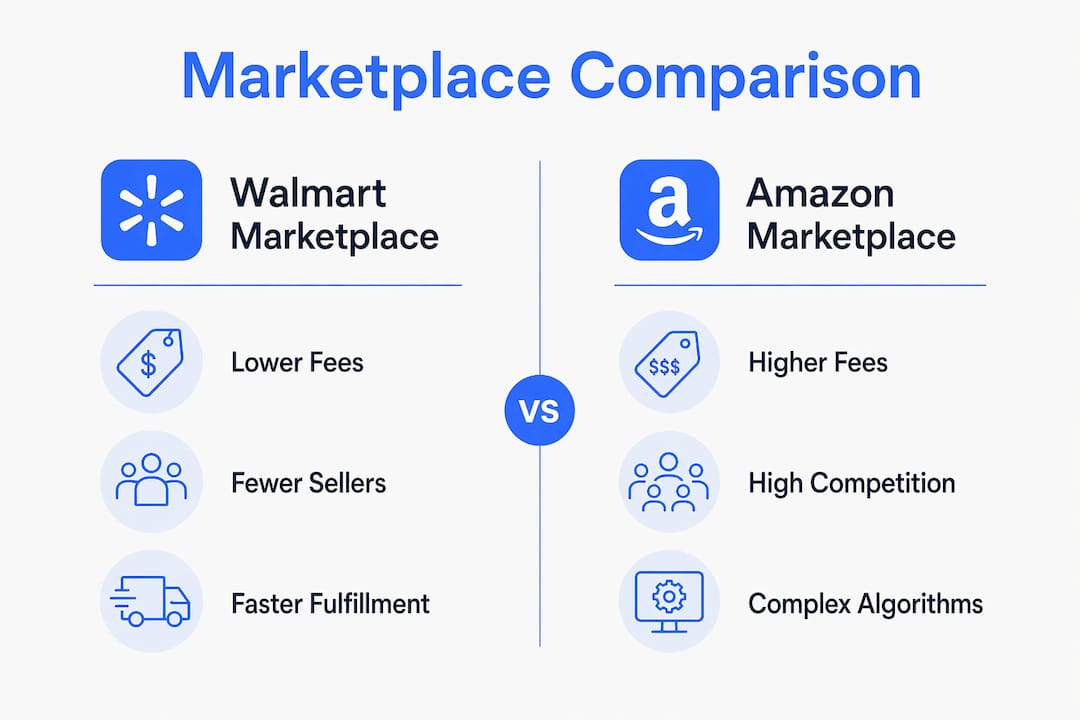
The seller count difference alone tells a significant story. Walmart’s seller base grew 36% year-over-year entering 2026, yet the platform still hosts roughly 200,000 active sellers compared to Amazon’s nearly 2 million. That tenfold gap means far less competition for any given product category on Walmart.
Fee comparison
Amazon’s fee structure layers referral fees, FBA fulfillment fees, monthly storage fees, and a $39.99 per month Professional seller subscription. Walmart charges referral fees and WFS fulfillment costs with no monthly fee. Walmart’s total fee structure reduces seller costs by 40–60% versus Amazon. That margin difference compounds quickly at scale.
Algorithm and Buy Box dynamics
Amazon’s Buy Box algorithm weighs seller metrics, fulfillment method, price, and review history in a complex, often opaque way. Walmart’s algorithm is more direct. It prioritizes competitive pricing and fast delivery above almost everything else. A seller who maintains price parity across channels and uses WFS will win the Buy Box consistently. That predictability is a real operational advantage.
Strategic category opportunities
Amazon’s most profitable categories are saturated. Walmart’s are not. Brands in tools, sporting goods, and baby products face significantly fewer direct competitors on Walmart. For brands earning over $500,000 annually on Amazon, Walmart offers lower customer acquisition costs and fees that make it worth testing as a second channel even if Amazon remains the volume leader.
Pro Tip: Run a side-by-side fee calculation using your actual Amazon FBA costs against WFS rates for your top 10 products. Most brands find Walmart saves them 2–4 margin points per unit, which adds up fast on high-volume SKUs.
What are the operational requirements for Walmart Marketplace sellers?
Walmart does not accept every applicant. The platform vets sellers based on 12 months of consistent marketplace performance and verified supply chain legitimacy. Approval timelines range from a few days to several weeks depending on the strength of the application. Sellers with an established Amazon or Shopify track record have a clear advantage.
The application and onboarding process
-
Submit your application. Provide your business tax ID, marketplace history, and product catalog details through the Walmart Marketplace seller registration portal.
-
Pass the vetting review. Walmart evaluates your sales history, fulfillment reliability, and product quality. Incomplete or thin applications are rejected.
-
Complete onboarding. Once approved, set up your seller account, configure tax settings, and connect your product feed.
-
Optimize your listings. Upload product titles, bullet points, images, and attributes that meet Walmart’s content standards before going live.
-
Enroll in WFS. Ship inventory to Walmart’s fulfillment centers to unlock two-day delivery badges and improved Buy Box standing.
Pricing and listing policies
Walmart’s pricing algorithm actively suppresses listings priced significantly higher than competitors. That is not a soft guideline. Listings with poor price parity risk suppression and removal from search results entirely. Sellers must maintain competitive pricing across Amazon, their own website, and any other channel where the product appears.
Returns management and customer service also carry weight. Walmart expects sellers to respond to customer inquiries within 48 hours and maintain low defect rates. Falling below Walmart’s performance thresholds can result in account suspension.
Key listing requirements to meet before launch:
-
High-resolution product images on a white background
-
Keyword-rich titles under 75 characters
-
At least three bullet points covering key product features
-
Accurate category and attribute mapping
-
Competitive pricing relative to other channels
How can sellers maximize growth on Walmart Marketplace?
Growth on Walmart comes from mastering three levers: pricing discipline, content quality, and advertising. Brands that treat Walmart as a copy-paste of their Amazon strategy consistently underperform. Walmart rewards sellers who treat it as its own ecosystem.
Pricing discipline is non-negotiable. Walmart’s algorithm checks prices across the web. A product priced $2 higher on Walmart than on your own site can trigger suppression. Use a repricing tool that monitors cross-channel pricing in real time to stay within Walmart’s acceptable range.
Content quality drives conversion. Walmart’s search algorithm favors listings with complete attributes, strong titles, and detailed descriptions. Follow Walmart listing optimization tips to build listings that rank and convert. Brands that invest in professional photography and video see measurably higher conversion rates.
Walmart Connect, the platform’s advertising system, offers Sponsored Products, Sponsored Brands, and display ads. The Walmart advertising workflow differs from Amazon’s in important ways. Cost-per-click rates on Walmart are generally lower, and the auction is less competitive. That makes Walmart advertising a high-return channel for brands willing to learn the system.
Pro Tip: Brands that manage pricing control and distribution tightly perform better on Walmart’s price-sensitive algorithm than those relying on brand loyalty or ad spend alone. Lock down your authorized reseller list before launching on Walmart to prevent third-party sellers from undercutting your listings.
An omnichannel growth strategy that integrates Walmart with Amazon and Shopify gives brands the best long-term position. Walmart captures a different buyer demographic than Amazon. Running both platforms simultaneously expands total addressable market without cannibalizing existing sales.
Key takeaways
Walmart Marketplace gives e-commerce brands access to 120 million monthly U.S. shoppers, lower fees than Amazon, and far less seller competition, making it the strongest multichannel expansion opportunity available in 2026.
Cost advantage
Walmart’s fee structure costs 40–60% less than Amazon’s total fees, which directly improves seller margins on every unit sold.
Competition gap
With roughly 200,000 active sellers versus Amazon’s 2 million, Walmart offers faster category authority and easier Buy Box wins for new entrants.
Fulfillment speed
WFS onboards in under 5 business days and delivers to over 90% of the U.S. in two days, which is the single biggest driver of Buy Box eligibility.
Pricing discipline
Walmart’s algorithm suppresses listings priced above competitors, so cross-channel pricing control is the most critical operational requirement for sellers.
Growth levers
Pricing management, content optimization, and Walmart Connect advertising are the three primary drivers of sustainable growth on the platform.
Walmart in 2026: what I’ve learned from watching brands succeed and fail
I’ve watched dozens of brands approach Walmart Marketplace the wrong way. They port their Amazon catalog over, set prices slightly higher to protect their Amazon margins, and then wonder why their listings disappear from search within 30 days. Walmart’s algorithm is not forgiving about that.
The brands that win on Walmart treat it as a fundamentally different business. They think about landed cost and fast shipping first, and advertising second. That is the opposite of how most Amazon sellers operate. On Amazon, ad spend can paper over weak organic rank. On Walmart, if your price is off or your shipping is slow, no amount of ad spend saves you.
The early-mover advantage on Walmart is real and shrinking. The seller base grew 36% in one year. Categories that feel wide open today will look like Amazon in three years. Brands that establish sales history, reviews, and Buy Box dominance now will be very hard to displace later.
The psychological dimension of Walmart’s brand trust also gets underestimated. Walmart shoppers extend trust to approved sellers in a way that Amazon shoppers, who are more skeptical of third-party listings, simply do not. That trust is worth real money in conversion rate terms, and it costs nothing extra to access once you are approved.
My honest advice: if your brand does over $300,000 a year in e-commerce revenue and you are not on Walmart, you are leaving margin on the table. The fees are lower, the competition is thinner, and the customer base is enormous. The window to enter as an early mover is still open, but it will not stay open indefinitely.
— Dan Katona
How Nectar helps brands grow on Walmart Marketplace
Selling on Walmart requires a different playbook than Amazon, and most brands do not have the internal bandwidth to build it from scratch.
Nectar’s Walmart Marketplace solutions cover the full seller lifecycle: listing optimization, pricing strategy, WFS setup, and Walmart Connect advertising management. The agency’s proprietary iDerive analytics platform gives brands the data they need to make decisions based on actual margin and market share, not guesswork. For brands already scaling on Amazon, Nectar’s marketplace expansion services integrate Walmart into a broader multichannel strategy that grows total revenue without disrupting existing operations.
FAQ
What fees does Walmart Marketplace charge sellers?
Walmart charges category-specific referral fees ranging from 6–20% plus a 1.9% payment processing fee on seller-fulfilled orders, with no monthly subscription or listing fees.
How many sellers are on Walmart Marketplace?
Walmart Marketplace has approximately 200,000 active sellers, compared to nearly 2 million on Amazon, which means significantly less competition across most product categories.
How long does Walmart Marketplace approval take?
Approval timelines range from a few days to several weeks. Walmart evaluates 12 months of marketplace performance history and supply chain legitimacy before granting access.
Is Walmart Marketplace worth it for Amazon sellers?
For brands earning over $500,000 annually on Amazon, Walmart offers lower customer acquisition costs and a less competitive environment, making it a strong second channel to test.
What is Walmart Fulfillment Services?
Walmart Fulfillment Services (WFS) is Walmart’s managed logistics program. It onboards sellers in under 5 business days and provides two-day delivery to over 90% of the U.S. population, directly improving Buy Box eligibility.
Recommended

































































.webp)