TL;DR:
- Building and maintaining high-quality Walmart listings depends on continuous optimization based on the Listing Quality Score. Sellers must meet strict eligibility criteria, use Walmart Seller Center effectively, and optimize titles, images, and descriptions for better ranking and conversion. Ongoing monitoring, competitive pricing, and proper variant grouping are essential for sustained success on Walmart Marketplace.
Walmart product listing optimization is the structured process of building and maintaining product pages that rank well, convert browsers into buyers, and meet Walmart Marketplace’s algorithm requirements. At the center of this process sits the Listing Quality Score (LQS), a metric Walmart uses to measure content completeness and reward high-scoring listings with better organic placement. Brands that treat listing creation as a one-time task consistently underperform against those who treat it as an ongoing discipline. This walmart product listing guide covers everything from setup prerequisites to advanced maintenance habits that separate top sellers from the rest.
What do you need before creating Walmart listings?
Getting your account and assets in order before you build a single listing saves significant time and prevents costly errors later. Walmart’s approval process is selective, and sellers must meet specific eligibility standards before gaining access to Seller Center.
Eligibility and business credentials
Walmart requires a U.S. business tax ID, a verified business address, and a history of marketplace or e-commerce sales. You will also need UPC codes for every product you plan to list. Walmart does not accept ASIN numbers or proprietary codes in place of valid GTINs. Without these, your items cannot be published.
Tools for listing creation and management
Walmart Seller Center is the primary interface for creating and managing listings. Three methods exist for uploading products:
-
Single item setup works for small catalogs or test launches with fewer than 10 SKUs.
-
Bulk upload via spreadsheet is the standard method for brands with dozens or hundreds of products.
-
API integration suits enterprise sellers who need automated, real-time catalog management.
Walmart also enforces strict performance standards from day one. Sellers must maintain a tracking upload rate of at least 99% and high on-time delivery rates to avoid account suspension. That threshold is not a soft guideline. Falling below it triggers account health warnings and can lead to termination.
Pro Tip: Before uploading your catalog, audit every product for a valid UPC, a clean product image, and a confirmed in-stock status. Launching with incomplete data forces you to fix listings under live conditions, which risks early ranking penalties.
How do you create high-quality product listings on Walmart Marketplace?
Building a listing that ranks requires more than filling in required fields. Walmart’s algorithm reads content depth, image count, and structural accuracy as signals of listing quality. Each element below directly affects your LQS.

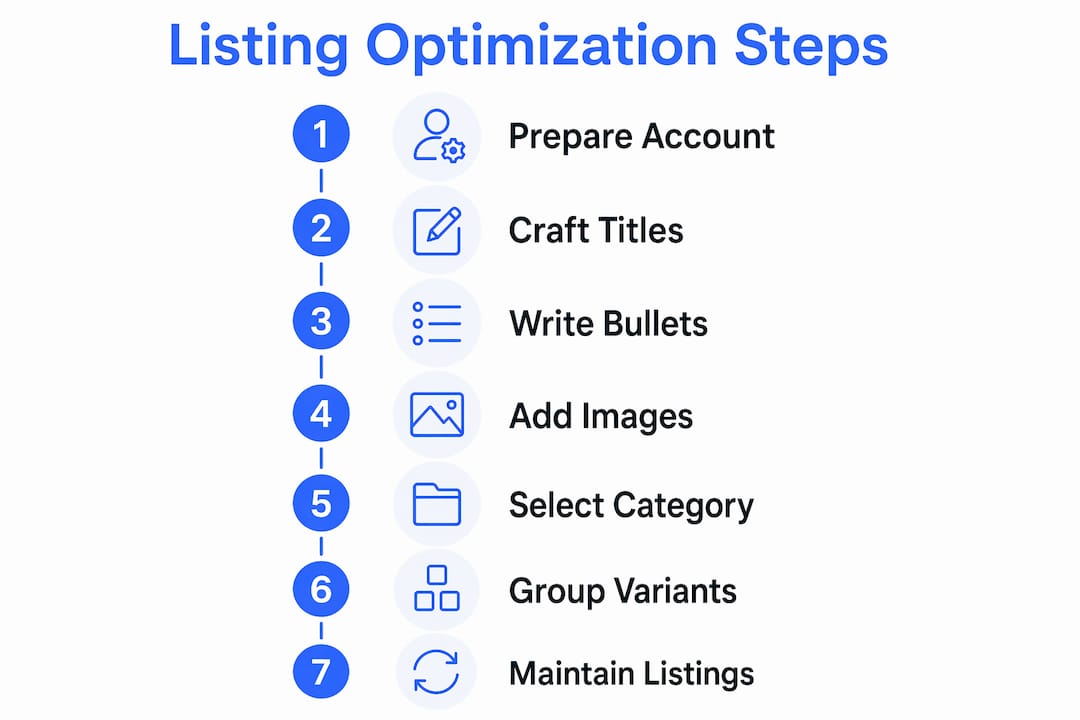
1. Write a title that follows Walmart’s structure
Walmart’s recommended title format is Brand + Product Name + Key Feature + Size or Count + Pack Count. Titles should run 50–75 characters. Anything longer gets truncated on mobile search results, which is where a growing share of Walmart shoppers browse. A title like “BrandX Stainless Steel Water Bottle 32oz 2-Pack” hits every required element cleanly.
2. Write bullet points that exceed 150 characters each
Bullet points are not a place for vague feature lists. Each bullet should state a specific benefit, include a relevant keyword, and exceed 150 characters. That length threshold is one of the key drivers of a high LQS. A bullet that reads “Durable construction” fails. One that reads “Built with 18/8 food-grade stainless steel that resists rust, odors, and dents through years of daily use” passes.
3. Write a description of at least 500 characters
Product descriptions should be clear, helpful, and at least 150 words, though many categories reward longer copy. The description is where you address buyer questions that bullet points cannot fully answer. Write for a shopper who is comparing your product against three others and needs one more reason to commit. Avoid filler sentences that repeat what the bullets already said.
4. Add at least six high-quality images
Listings with six or more images meet the minimum LQS image threshold. The main image must show the product on a white background. Secondary images should cover multiple angles, lifestyle context, and scale references. Walmart also supports rich media modules like embedded video, which increases conversion rates by 12%–18% compared to static listings. Rich media requires enrollment in the Walmart Brand Portal.
5. Select the correct category manually
Walmart expects sellers to manually choose the most accurate and specific category for each product. The system may suggest a category automatically, but auto-suggestions are often too broad. Misclassification reduces search visibility and signals to Walmart’s algorithm that the listing is poorly managed.
6. Group variants correctly
If your product comes in multiple sizes, colors, or configurations, group them under a single parent listing. Listing each variant as a separate SKU fragments your review count, splits your conversion signals, and slows ranking velocity across the board.
Pro Tip: Use Nectar’s listing optimization checklist to verify every element before publishing. A single missing attribute can drop your LQS below the 80-point threshold that separates high-ranking listings from buried ones.
How do you optimize and maintain Walmart listings for better visibility?
Publishing a listing is the starting point, not the finish line. Walmart’s algorithm continuously re-evaluates listings based on live performance data, and rankings shift accordingly.
Use the Listing Quality Dashboard regularly
The Listing Quality Dashboard gives item-level reports that identify specific attribute gaps hurting your visibility and Buy Box performance. Experts recommend reviewing it daily or weekly. Most sellers check it once at launch and never return. That habit leaves ranking points on the table every week.
Maintain competitive pricing and price parity
Walmart’s price parity enforcement is near real-time. If your product is listed at a lower price on another channel, Walmart will suppress your listing until you correct it. Dynamic pricing tools that monitor your prices across channels are not optional for brands selling on multiple platforms. They are a baseline requirement.
Protect your in-stock rate and fulfillment speed
Walmart’s algorithm has a long memory for stockouts. Ranking penalties from going out of stock can last weeks or months after you restock. Fast fulfillment can boost rankings by 5–20 positions, which is a meaningful swing in competitive categories. Brands using Walmart Fulfillment Services (WFS) gain a structural advantage here because WFS listings display a two-day delivery badge that directly influences purchase decisions.
Build your review base systematically
Listings with more verified reviews rank higher and convert better. Use Walmart’s review syndication program to pull existing reviews from other platforms where eligible. Respond to negative reviews with factual corrections and offer resolution. A pattern of unaddressed negative feedback signals poor seller quality to the algorithm.
Pro Tip: Connect your Walmart product visibility strategy to your LQS score. Every point you gain above 80 compounds over time as the algorithm rewards consistent, high-quality listings with more organic impressions.
What are the most common Walmart listing mistakes?
Most listing failures are preventable. The same errors appear repeatedly across seller accounts, and each one carries a measurable cost to visibility and sales.
-
Misclassifying the product category. Choosing a broad or incorrect category reduces your appearance in filtered search results. A kitchen knife listed under “General Merchandise” instead of “Cutlery” will miss every shopper using category filters.
-
Writing short or vague titles. Titles under 50 characters miss keyword opportunities. Titles over 75 characters get cut off on mobile. Both outcomes hurt click-through rates before a shopper ever sees your product.
-
Listing variants as separate SKUs. Fragmented variant listings split your review count and conversion velocity across multiple pages. A product with 200 reviews on one grouped listing outranks the same product split into five listings with 40 reviews each.
-
Ignoring shipping and inventory performance. Sellers who let their tracking upload rate fall below 99% risk account health warnings. Consistent late shipments trigger the same outcome. Both are avoidable with proper fulfillment processes or WFS enrollment.
-
Never revisiting the Listing Quality Dashboard. The dashboard is the most direct feedback loop Walmart gives you. Ignoring it means you are optimizing blind while competitors who check it weekly pull ahead in rankings.
Pro Tip: Set a recurring calendar reminder to audit your five lowest-LQS listings each week. Small, consistent improvements compound faster than a single large overhaul done once a quarter.
Key takeaways
A Walmart listing that scores above 80 on the Listing Quality Score, maintains price parity, and stays in stock consistently will outrank and outsell listings that ignore any one of those three factors.
Listing Quality Score drives rankings
Listings scoring above 80 on LQS rank significantly higher. Key drivers include titles of 50–75 characters, six or more images, and bullet points over 150 characters.
Price parity is enforced in real time
Walmart suppresses listings priced higher than on other channels. Dynamic pricing tools are necessary for brands selling across multiple platforms.
Stockouts carry long-term penalties
Walmart’s algorithm penalizes out-of-stock listings for weeks or months after restocking. Inventory management is a ranking factor, not just an operational one.
Variant grouping protects conversion signals
Listing variants as separate SKUs fragments reviews and slows ranking velocity. Group all sizes, colors, and configurations under a single parent listing.
The Listing Quality Dashboard is underused
Most sellers check the dashboard once and move on. Weekly reviews of item-level attribute gaps are the fastest path to consistent ranking improvements.
What I’ve learned from watching brands get Walmart wrong
What I’ve learned from watching brands get Walmart wrong
Most brands approach Walmart like a second Amazon. They upload their existing catalog, copy their Amazon titles, and wait for sales. That approach fails almost every time, and the reason is structural.
Walmart’s algorithm rewards conversion velocity above almost everything else. A focused launch of 15–30 top SKUs builds performance signals faster than flooding the catalog with 500 products that each convert slowly. I have seen brands with smaller catalogs outrank established competitors simply because they concentrated their traffic and reviews on fewer, better-optimized listings.
The other mistake I see constantly is treating the Listing Quality Dashboard as a setup tool rather than an ongoing management tool. The dashboard tells you exactly which attributes are dragging your score down. That information is free, specific, and updated regularly. Brands that check it weekly and act on what they find consistently outperform those that rely on gut instinct.
My honest advice: pick your 20 best products, build each listing to a score above 80, keep them in stock, and price them competitively across every channel. Do that for 90 days before expanding. The algorithm will reward the consistency, and you will have real performance data to guide your next moves.
— Dan Katona
How Nectar approaches Walmart listing performance
Brands that want to compete seriously on Walmart Marketplace need more than a checklist. They need a system that covers content quality, pricing discipline, inventory management, and ongoing performance monitoring at the same time.
Nectar builds and manages that system for mid-sized and enterprise brands. From in-house product photography that meets Walmart’s six-image standard to data-driven copy that pushes LQS above 80, Nectar handles the full listing lifecycle. The agency’s proprietary iDerive analytics platform monitors performance signals across your catalog and flags issues before they become ranking penalties. If your Walmart listings are underperforming, explore Nectar’s Walmart marketplace solutions to see what a fully managed approach delivers.
FAQ
What is a Listing Quality Score on Walmart?
The Listing Quality Score (LQS) is Walmart’s measure of content completeness for a product page. Listings scoring above 80 rank significantly higher in organic search results.
How many images does a Walmart listing need?
Walmart requires at least six high-quality images to meet the minimum LQS image threshold. Additional images showing lifestyle context and scale improve conversion rates further.
How long should a Walmart product title be?
Walmart titles should be 50–75 characters, following the format Brand + Product Name + Key Feature + Size or Count. Longer titles get truncated on mobile search results.
Why does price parity matter on Walmart?
Walmart suppresses listings priced higher than on other sales channels, and enforcement happens in near real time. Brands selling across multiple platforms need dynamic pricing tools to stay compliant.
How do stockouts affect Walmart rankings?
Walmart’s algorithm penalizes listings that go out of stock, and those penalties can last weeks or months after inventory is restored. Consistent in-stock availability is one of the strongest ranking signals on the platform.
Recommended



































































.webp)