TL;DR:
A creative brief translates marketing goals into clear, strategic guidance for creative teams and prevents guesswork.
It should be written after a stakeholder kickoff, with all inputs collected, reviewed, and signed off before production begins.
A creative brief is a concise strategic document that translates marketing objectives into clear creative direction for your team. Done right, a step by step creative brief eliminates guesswork, aligns stakeholders before production begins, and gives creative teams the boundaries they need to do their best work. Tools like Asana for project tracking, Rock.so for template management, and Grammarly for copy review all support the process, but the brief itself remains the single most important document in any campaign. This guide walks marketing professionals and brand managers through every stage, from preparation to sign-off.
What do you need before writing a creative brief?
The biggest mistake brand managers make is opening a blank document before they have the right inputs. A creative brief written in isolation produces vague direction and forces revisions later.
The right starting point is a stakeholder kickoff meeting. A 45–60 minute session with all relevant decision-makers gives you the raw material to write a complete, accurate brief. Skipping this step guarantees gaps.
Collect these inputs during the kickoff:
-
Project background: What prompted this project? What has been tried before?
-
Objectives: What does success look like in measurable terms?
-
Audience information: Who is the customer, and what do they care about?
-
Competitive context: Which brands are you competing against, and what are they doing?
-
Budget and timeline: What are the hard constraints?
-
Approval process: Who has final sign-off authority?
After the meeting, organize your notes immediately. Waiting 24 hours means details fade. Document management tools like Notion or Google Docs work well for capturing raw notes before you structure them into a formal brief.
Pro Tip: Never write “TBD” in a creative brief section. If you do not have the information yet, delay the brief until you do. Placeholders during creative production waste time and cause confusion.
What are the essential sections of a creative brief?
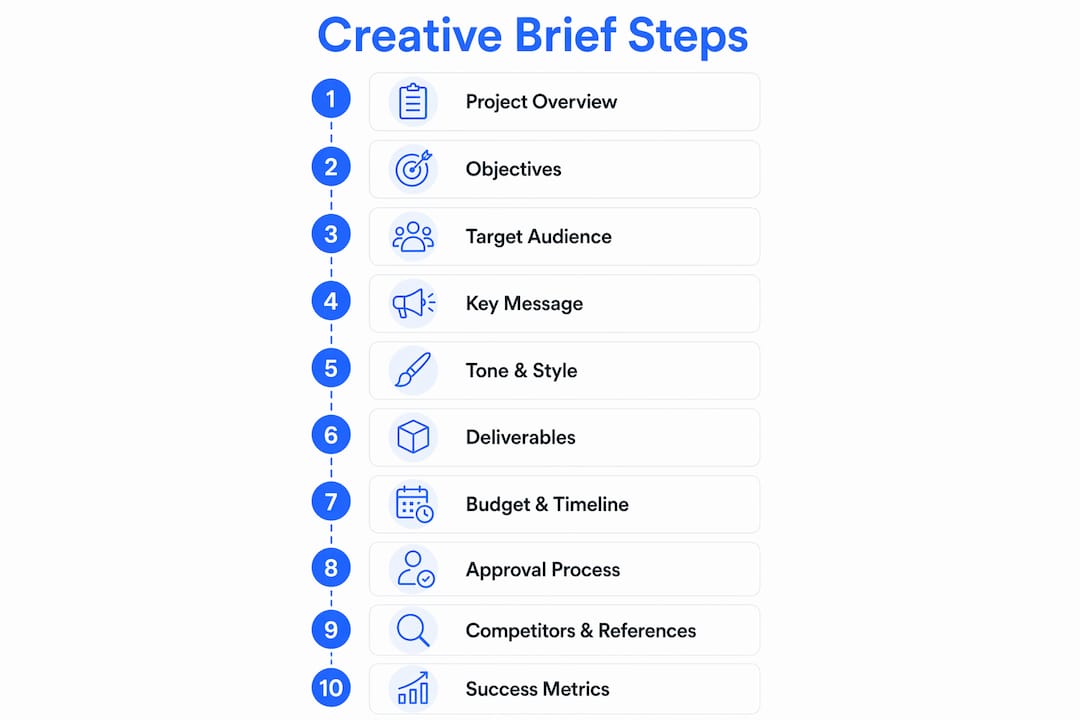
A foundational creative brief includes nine to ten core sections. Each section serves a specific purpose, and leaving any one out creates a gap that creative teams will fill with assumptions.
Project overview
This section names the project, the brand, and the campaign context. It answers: what are we making and why does it exist right now? Keep it to three to five sentences.
Objectives
State what the project must achieve. Use specific, measurable language. “Increase product page conversion by 15% during the Q3 launch window” is useful. “Raise brand awareness” is not.

Target audience
Describe the primary customer in behavioral and psychographic terms, not just demographics. Age and gender are starting points. What the customer believes, fears, and wants from this product category is what actually guides creative decisions.
Key message
This is the single most important thing the audience should take away. Write it as one sentence. If you cannot summarize the message in one sentence, the strategy is not clear enough yet. Write this section last, after all other sections are complete, because it emerges from the full picture.
Tone and style
Define the emotional register of the creative work. Words like “confident,” “warm,” or “direct” are useful. Reference existing brand guidelines or approved examples. Avoid contradictory descriptors like “professional but edgy.”
Deliverables
List every asset required: formats, sizes, quantities, and file specifications. For digital ad campaigns, platform-specific requirements for Meta or TikTok should include hook types, variant counts, and aspect ratios. Vague directions like “create something eye-catching” produce poor results.
Budget and timeline
State the budget range and all key dates: draft delivery, review period, revisions, and final delivery. Hard deadlines belong here, not in a separate project plan.
Approval process
Name the specific people who must approve each stage. Ambiguity here is the leading cause of scope creep in enterprise campaigns.
Competitors and references
List two to four competitor campaigns or reference pieces that illustrate the creative territory. This section tells creatives what to avoid as much as what to pursue.
Success metrics
Define how you will measure whether the creative work performed. Click-through rate, conversion rate, brand recall scores, or sales lift are all valid metrics depending on the campaign goal.
Pro Tip: Some campaigns need additional sections. A product launch may require a positioning statement. A promotional campaign may need a mechanics section explaining the offer structure. Add sections when the project genuinely requires them, not by default.
A well-structured creative brief runs one to two pages. Briefs longer than three to four pages typically contain project management details that belong in a separate document, not in the brief itself.
How to write the creative brief step by step from draft to sign-off
The drafting process matters as much as the content. Follow this sequence to produce a brief that holds up through the entire production cycle.
-
Complete the kickoff meeting first. Do not open the brief template until you have all inputs from stakeholders. Incomplete information at this stage creates a brief that cannot guide creative work.
-
Write the first draft in one sitting. Writing the full brief in one uninterrupted session after the kickoff produces a more coherent document. Drafting in fragments over several days creates inconsistencies in tone and logic.
-
Fill every section completely. Work through each section in order: Project Overview, Objectives, Target Audience, Tone and Style, Deliverables, Budget and Timeline, Approval Process, Competitors and References, and Success Metrics.
-
Write the key message last. The key message crystallizes from everything you have written above it. Writing it first forces you to guess at the strategy before you have fully articulated it.
-
Send the draft for review with a one-day deadline. A one-day turnaround for stakeholder feedback maintains momentum and keeps the project on schedule. Open-ended review windows stall campaigns.
-
Collect feedback and revise once. Consolidate all feedback into a single revision pass. Multiple rounds of minor edits signal that the brief was not ready to share in the first place.
-
Obtain explicit sign-off from all decision-makers. Explicit sign-off before creative production begins prevents drifting goals and scope creep. A verbal “looks good” is not sign-off. Use a written confirmation or a formal approval workflow.
-
Brief the creative team in person or via live presentation. Sending the document alone is not enough. Walk the team through the brief, answer questions, and confirm shared understanding before work begins. This step is where the creative content workflow formally begins.
Pro Tip: Keep project management details out of the creative brief entirely. Milestone dates, task assignments, and vendor contacts belong in your project management tool, not in the brief. Mixing the two dilutes the creative focus of the document.
Common mistakes that weaken a creative brief
Even experienced brand managers repeat the same errors. Knowing them in advance saves hours of rework.
-
Writing the brief before the kickoff meeting. A brief written from memory or assumptions produces vague direction. The kickoff meeting is not optional.
-
Leaving sections incomplete. Filling gaps during creative execution wastes time and causes confusion. Every section must be complete before the brief is shared.
-
Overloading the brief with workflow details. Including project plan details in the creative brief is a common mistake. The brief should remain focused on creative requirements and strategy, not internal logistics.
-
Prescribing execution instead of direction. A creative brief should focus on what to communicate, not how to execute it. Telling a designer exactly which colors to use or a copywriter which words to pick removes the creative judgment that produces strong work.
-
Skipping formal sign-off. Missing sign-off leads to stakeholders revisiting decisions mid-production. This is especially damaging in fast-paced enterprise environments where teams are working in parallel.
-
Writing a vague key message. “We want people to feel good about our brand” is not a key message. It is a wish. The key message must be specific enough that a creative director can brief a designer from it alone.
A brief that tries to please everyone ends up directing no one. The best briefs make clear choices and commit to them.
The creative services checklist for e-commerce teams offers a practical reference for verifying that objectives, audience, deliverables, and success metrics are all accounted for before production starts.
Key takeaways
A complete creative brief, written after a thorough stakeholder kickoff and signed off by all decision-makers, is the single most effective way to prevent wasted creative production.
| Point | Details |
|---|---|
| Run a kickoff meeting first | A 45–60 minute session with stakeholders gives you the inputs needed to write a complete brief. |
| Write the draft in one sitting | A single uninterrupted drafting session produces a more coherent and consistent document. |
| Write the key message last | The key message emerges from all other sections and should be written after the full brief is drafted. |
| Require explicit sign-off | Written approval from all decision-makers before production begins prevents scope creep. |
| Keep the brief to 1–2 pages | Briefs longer than two pages typically contain project management details that dilute creative focus. |
What I have learned from briefs that actually worked
The briefs that saved the most time were never the longest ones. They were the ones where someone had the discipline to make hard choices before the document was shared.
The most underrated function of a creative brief is surfacing hidden assumptions. A solid brief clarifies vague client needs and aligns expectations before anyone opens a design file. The assumptions that never get written down are the ones that cause three rounds of revisions.
Sign-off discipline is where most enterprise teams fall apart. I have watched campaigns lose two weeks because a VP was “looped in” after the brief was approved but before production finished. The fix is simple: identify every decision-maker during the kickoff meeting and get their name on the sign-off list before drafting begins.
One area where I see briefs consistently fail is digital ad creative. Writing “create a thumb-stopping video” for a Meta campaign is not a brief. It is a hope. Platform-specific briefs for Meta and TikTok need to specify hook formats, the number of variants required, and platform-specific aspect ratios. That level of specificity is what separates a brief that produces a winning ad from one that produces a mediocre one.
The brief is not a contract you file away after sign-off. Treat it as a live reference document throughout the production cycle. When a creative direction question comes up mid-project, the brief should answer it. If it cannot, the brief was not complete enough to begin with.
— Dan Katona
How Nectar supports creative brief development for brand growth
Brand managers running campaigns across Amazon, Walmart, and Shopify face a briefing challenge that generic templates do not solve. Platform-specific creative requirements, retail media ad formats, and multi-channel asset libraries all demand briefs built for e-commerce realities.
Nectar’s fully managed creative services cover the entire process, from stakeholder alignment and brief development through in-house photography, videography, and design production. The team integrates retail media advertising strategy directly into the briefing process, so creative assets are built to perform in the channels where your customers buy. For brands ready to move from scattered briefs to a repeatable, high-performing creative process, Nectar’s services provide the structure and execution capacity to make it work.
FAQ
What is a creative brief?
A creative brief is a one to two page strategic document that defines the project goals, target audience, key message, deliverables, and success metrics for a creative project. It translates marketing objectives into clear direction for creative teams.
How long should a creative brief be?
A creative brief should be one to two pages. Briefs longer than three to four pages typically include project management details that belong in a separate document and dilute the creative focus.
What are the core elements of a creative brief?
The core elements include Project Overview, Objectives, Target Audience, Key Message, Tone and Style, Deliverables, Budget and Timeline, Approval Process, Competitors and References, and Success Metrics.
When should you write the key message section?
Write the key message last. It emerges from all other sections of the brief and should summarize the single most important thing the audience needs to take away from the creative work.
Why does sign-off matter before creative production begins?
Explicit sign-off from all decision-makers prevents scope creep and drifting goals during production. Missing or informal sign-off is one of the most common causes of costly revisions in enterprise campaigns.
Recommended





































































.webp)