Market Share Growth Guide for E-Commerce Brand Managers
.webp)

TL;DR:
- Genuine market share growth requires diagnosing root causes, combining multiple strategies, and focusing on retention. Building a multi-strategy plan and executing channel-specific tactics ensures durable, profitable share increases. Regular, data-driven reassessment and cross-functional alignment sustain long-term growth momentum.
Most mid-sized and enterprise brands in e-commerce pour budget into awareness campaigns and new product launches, then wonder why their market share barely moves. The reality is that gaining meaningful, durable share requires more than marketing spend. It demands a structured market share growth guide that addresses root causes: misdiagnosed barriers, disconnected sales channels, and growth strategies that prioritize volume over profitability. This guide walks you through assessment, strategic planning, execution, and measurement so you can build share that actually sticks.
Key takeaways
Point | Details
-
Diagnose before you act | Skipping root cause analysis is why most market share tactics fail to produce lasting results.
-
Combine multiple strategies | Brands using multi-strategy approaches are twice as likely to hit 10% annual share growth.
-
Retention is a growth lever | Existing customers cost far less to grow than new ones, yet most brands underinvest here.
-
Measure beyond share | Retention rates, net revenue retention, and conversion metrics tell you whether growth is real and profitable.
-
Test markets digitally first | Expansion into new segments or geographies succeeds when you test online before committing capital.
Assessing your current market position
Before you apply any growth tactic, you need an honest picture of where you stand. Brands that skip this step end up running awareness campaigns when their real problem is friction at checkout, or cutting prices when the actual issue is poor product-market fit. This is where a serious market share growth guide starts.
Measuring share accurately
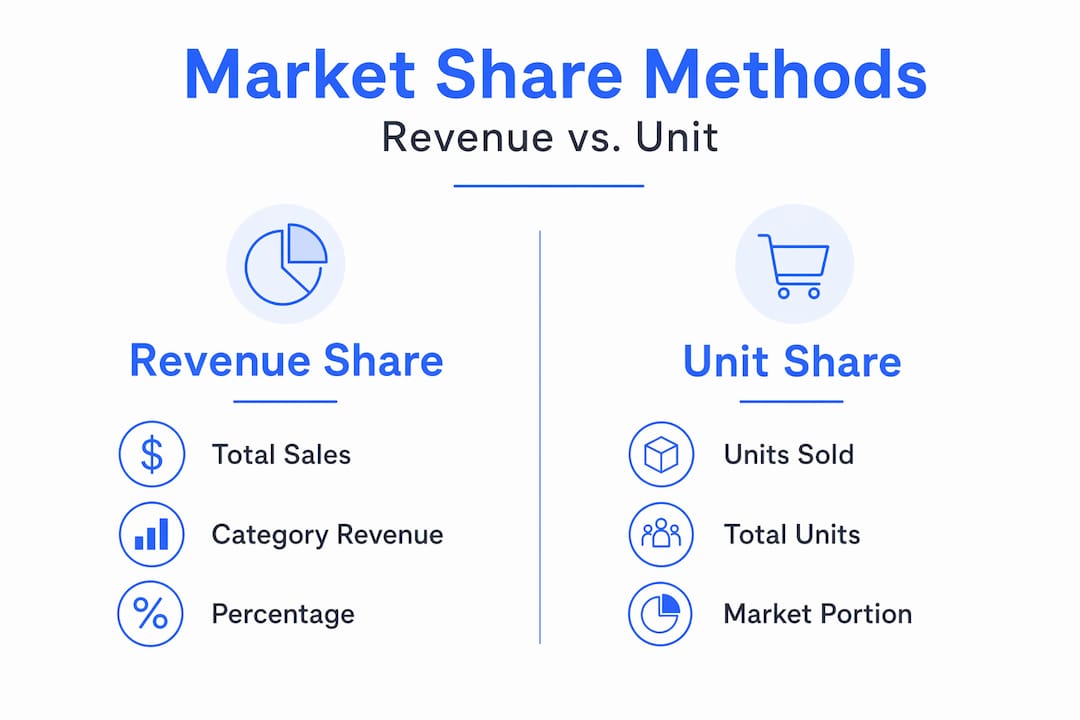
Market share is typically calculated two ways: revenue share (your revenue divided by total category revenue) and unit share (your unit sales divided by total category unit sales). Both matter, and they often tell different stories. A brand can hold strong unit share while losing revenue share to a competitor with higher average order values.
Beyond top-line share, you should analyze wallet share within your existing customer base. What percentage of a customer’s total spend in your category is going to you? That number is often more actionable than category-wide share because you already have the relationship.
Diagnosing why share is stagnant
A structured penetration strategy requires diagnosing why share is being lost before selecting tactics. The most common barriers fall into four categories:
-
Awareness gaps: Potential buyers don’t know you exist or don’t associate you with their specific need.
-
Preference gaps: Buyers know you but choose a competitor due to perceived differences in quality, features, or trust.
-
Friction barriers: Buyers prefer you but encounter obstacles at listing pages, checkout, or delivery.
-
Inertia: Buyers default to incumbents simply because switching feels like effort, even when you’re the better option.
Each of these requires a completely different response. Treating an inertia problem with more advertising is a fast way to burn budget.
Tools and data sources worth using
Nectar’s proprietary iDerive analytics platform gives brand managers segment-level visibility into performance across Amazon, Walmart, and Shopify. Beyond that, retail media platforms provide share of voice data, and category reports from your retail partners can surface where you’re winning and losing on a SKU-by-SKU basis.
Pro Tip: Run a quarterly share audit broken down by product line and customer segment, not just total brand. Category-wide numbers hide the sub-markets where you’re actually losing ground.
Building a multi-strategy growth plan
Most brand managers pick one growth strategy and commit fully to it. That’s a mistake. Using multiple growth strategies simultaneously makes you twice as likely to achieve over 10% annual market share growth compared to single-strategy approaches.

The Ansoff Matrix gives a useful starting framework. Your two most relevant quadrants in e-commerce are market penetration (selling more of what you have to people who already buy in your category) and market development (reaching new segments or geographies with your existing product). The matrix also includes product development and diversification, but those require longer runways and higher risk tolerance.
Here’s how to sequence a multi-strategy plan that actually holds together:
-
Identify competitive displacement opportunities. Map the specific reasons your target customers stay with competitors. Price, habit, and perceived risk are the three most common. Effective displacement requires low-friction switching paths and proof mechanisms like social proof, trial offers, or money-back guarantees.
-
Maximize existing customer revenue. Existing customers represent your lowest-cost growth lever through cross-sell, upsell, increased purchase frequency, and advocacy. Most enterprise brands systematically underinvest here in favor of acquisition.
-
Test new segments digitally before scaling. Successful expansion strategies start by testing online market presence before committing to localized inventory or physical operations. A targeted paid search campaign in a new geography costs a fraction of opening a regional warehouse and tells you whether demand is real.
-
Adapt your product or positioning for new segments. Entering a new demographic or international market without adaptation is where expansion plans break down. Language, cultural preference, and price sensitivity all shift the value equation.
-
Align cross-functional teams around shared share targets. Growth plans fail when product, marketing, pricing, and sales all optimize for different metrics. A unified share target creates the accountability structure that makes multi-strategy execution work.
Pro Tip: Don’t try to run all five of these simultaneously at launch. Pick two or three, execute them well for a quarter, measure, then layer in the rest. Trying to do everything at once fragments focus and makes attribution impossible.
Executing sales and marketing tactics that move share
Strategy without execution is just planning. Here’s where you translate the growth plan into specific moves at the channel and campaign level.
Building the right sales channel mix
Customers expect a mix of traditional, remote, and self-service buying options. No single channel dominates in e-commerce, and brands that force buyers through one path leave significant revenue on the table. Hybrid sales teams that coordinate across direct sales, marketplace listings, and self-service DTC channels consistently outperform single-channel approaches.
For mid-sized and enterprise brands, this translates to a few specific priorities:
-
Marketplace presence: Amazon and Walmart are not optional for most categories. Optimized listings with high-quality creative and retail media advertising are the floor, not the ceiling.
-
DTC channel development: A Shopify storefront gives you direct customer data, higher margins, and brand control that marketplace channels don’t offer.
-
Sales outsourcing for rapid expansion: 79% of outsourcing users report faster market expansion, with cost reductions exceeding 60%. For brands entering new geographies or categories, outsourced sales teams reduce ramp time dramatically.
Pricing strategy done right
Penetration pricing attracts new buyers, but it only works when price is genuinely the barrier and your unit economics can absorb margin compression with a clear path to price recovery. Penetration pricing attracts price-sensitive buyers who churn the moment a cheaper alternative appears. If your product has differentiated value, a value-based pricing approach protects margin while communicating quality.
Digital marketing for share acquisition
Digital marketing and DTC growth programs drive omnichannel presence beyond the marketplace. Sponsored ads capture in-market demand. Off-platform content and social campaigns build the brand equity that makes switching friction feel worth it. The combination is what creates durable share gains rather than temporary sales spikes.
Pro Tip: Your retail media spend and your brand marketing spend should be coordinated, not siloed. When a customer sees a sponsored product ad and a brand video on the same day, conversion rates improve significantly compared to either touchpoint alone.
Measuring and sustaining share growth
Getting to a higher market share number is only half the work. The other half is making sure that growth is profitable, defensible, and capable of compounding over time.
Metrics that actually matter
Share percentage is a lagging indicator. By the time it moves meaningfully, the underlying dynamics have already shifted. Track these leading indicators alongside share:
-
Net revenue retention (NRR): Are existing customers growing their spend with you or contracting? NRR above 100% means your base is compounding even before you add new customers.
-
Customer retention rate and churn by segment: Churn concentrated in a specific customer segment often reveals a product or experience problem that will eventually suppress share.
-
Conversion rate by channel: If share of voice is rising but conversion stays flat, the problem is downstream of awareness.
-
Competitive win/loss ratio: In B2B and higher-consideration categories, tracking why you win and lose deals is direct insight into where share is moving.
Setting realistic growth targets
Build three scenarios: conservative, base, and optimistic. Conservative assumes no significant competitive response and modest execution. Base assumes reasonable execution with some friction. Optimistic assumes strong cross-functional alignment and favorable market conditions. Planning against all three keeps your team from over-committing to a single growth path.
Re-evaluating product-market fit quarterly is now the recommended standard in fast-moving markets, replacing the traditional annual review. Consumer preferences and competitive dynamics shift fast enough that a 12-month review cycle leaves you responding to conditions that are already six months stale.
Leaders can lose up to 6% market share in a week due to new competitive entrants. That statistic should recalibrate how frequently you review your position and how quickly your team can respond when the data changes.
My perspective on what actually drives lasting share gains
I’ve worked with enough brand managers to know that the most common mistake isn’t a bad strategy. It’s a good strategy applied to the wrong problem. I’ve seen brands increase ad spend by 40% to fix a share problem that was actually caused by a returns rate three times the category average. More visibility just accelerated the churn.
What I’ve learned is that cross-functional alignment is not a soft skill. It’s the actual mechanism of growth. When your product team, pricing team, and marketing team are each optimizing for different metrics, your growth plan has structural holes that no budget increase can fill. The brands that compound share over time are the ones where those functions share a common scorecard.
The other thing I’d push back on is the impulse to treat market share growth as a milestone. Brands often run a big push, gain two or three share points, and then quietly shift focus to other priorities while that gain erodes. Rapid erosion is a real risk. New entrants can disrupt a position faster than most teams expect.
My honest take: the brands that win long-term treat share growth as an ongoing operational discipline, not a campaign. They measure constantly, adapt quickly, and never confuse a good quarter with a durable position.
— Dan Katona
How Nectar accelerates your market share growth
If you’re working through this guide and recognizing that execution is where your plan loses momentum, Nectar is built for exactly that gap. Nectar’s fully managed e-commerce programs cover Amazon growth and optimization, Walmart marketplace, and Shopify brand development, giving you omnichannel coverage without the overhead of building specialized teams in-house.
Powered by the iDerive analytics platform, Nectar delivers the granular share and performance data that turns monthly reviews into weekly decisions. From high-impact creative production to full-funnel retail media management, Nectar’s team handles the execution so your brand can grow share profitably, not just fast.
FAQ
What is a market share growth guide?
A market share growth guide is a structured framework that helps brands assess their current competitive position, select growth strategies, execute across sales and marketing channels, and measure progress over time. It covers the full cycle from diagnosis to sustained growth.
How do you measure market share in e-commerce?
Calculate revenue share by dividing your category revenue by total category revenue, and unit share by dividing your unit sales by total category unit sales. Supplement both with wallet share analysis within your existing customer base to find your most cost-efficient growth opportunities.
What is the most effective strategy to increase market share?
Using multiple growth strategies simultaneously is twice as likely to produce 10% or more annual market share growth compared to relying on a single approach. Combining competitive displacement, retention investment, and new segment testing yields more durable results than any one tactic alone.
How often should brands reassess their market share strategy?
Quarterly reviews are now recommended for brands in fast-moving e-commerce categories, replacing the traditional annual review cycle. Consumer preferences and competitive entries shift fast enough that longer review windows leave you reacting too late.
Why do market share growth strategies fail?
Most failures occur because brands skip the diagnostic step and apply tactics that don’t address the actual root cause of stagnant share. Strategies fail when diagnosis is skipped and execution is misaligned with the specific barrier preventing growth.
Recommended
.png)