MAP enforcement is the operational process of monitoring advertised prices across every sales channel, detecting violations, and applying consistent consequences when a retailer advertises below your minimum advertised price. Without it, a MAP policy is just a document. With it, you have a deterrent that actually protects margin, channel trust, and brand equity.
The enforcement lifecycle runs in a loop: publish the policy, monitor listings, detect violations, send notices, remediate, escalate if needed, and document everything. Brands that run this loop consistently see measurable results. Those that run it selectively invite exactly the price erosion they were trying to prevent.
Three indicators tell you enforcement is working:
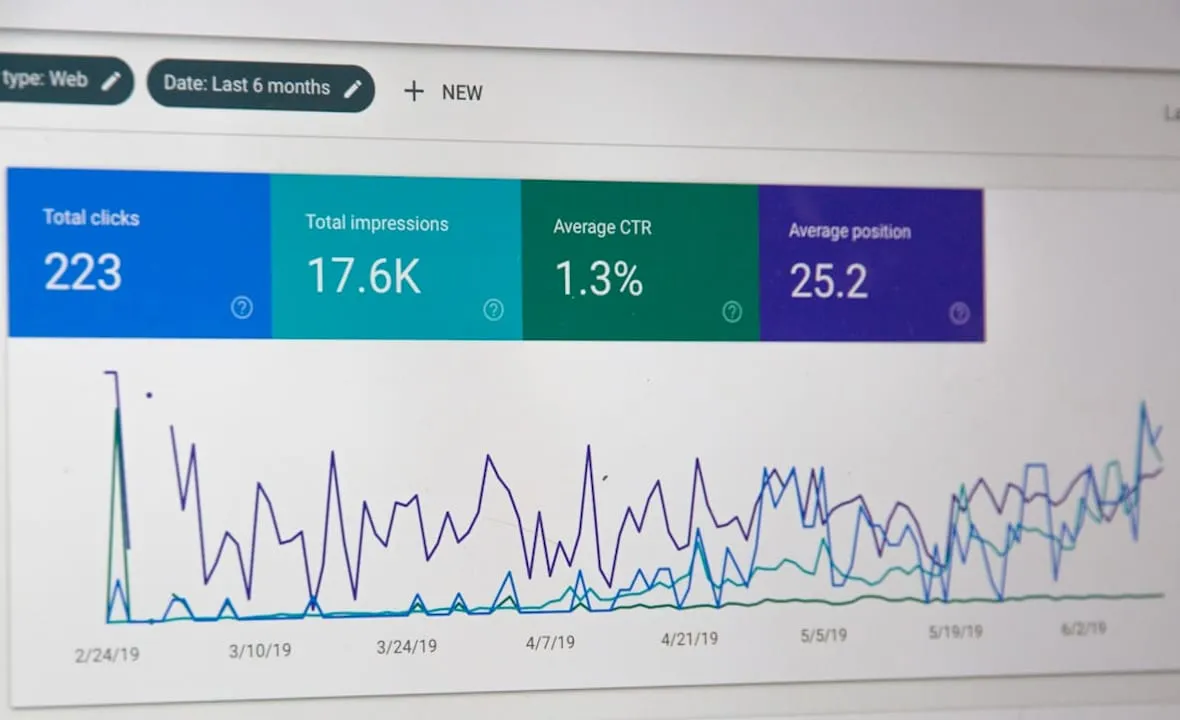
Brands with persistent MAP violations can experience significant declines in average advertised prices over time. Once discounted pricing spreads, compliant partners start matching it to stay competitive, and the erosion compounds. That is the business case for enforcement in a single figure.
What Is MAP Enforcement and How Does It Work Day-to-Day?
MAP enforcement is not a one-time action. It is a repeatable operational cycle that runs continuously across your distribution network. Here is how the stages connect in practice.
The enforcement lifecycle, step by step
Who owns each step
Roles matter as much as process. Brand managers typically own policy publication and retailer communication. Channel operations teams run monitoring and violation logging. Legal counsel reviews escalation decisions and any termination actions. When brands outsource to a managed agency, the agency handles monitoring, first-notice outreach, and evidence packaging, then hands off to legal for anything beyond a second-tier escalation.
The critical separation: whoever sends enforcement notices should not be the same person managing the sales relationship with that retailer. Account pressure and enforcement consistency do not mix well.
U.S. Legal Framework: What You Must Know Before Enforcing
MAP enforcement is legal in the United States under federal antitrust law, but the legal safety depends entirely on how the policy is structured and how enforcement is conducted. Get either wrong and you are no longer running a MAP program. You are running something that looks like price-fixing.
The Colgate doctrine and unilateral policy
The foundational principle is the Colgate doctrine: a manufacturer may unilaterally announce the prices at which it will sell its products and refuse to deal with retailers who do not comply. The moment you negotiate MAP levels with a retailer, solicit their input on where MAP should be set, or ask them to report competitors who are violating, you have crossed from a unilateral policy into something that looks bilateral. Bilateral pricing agreements between manufacturers and retailers are subject to antitrust scrutiny under the Sherman Act.
The Supreme Court’s Leegin Creative Leather Products v. PSKS decision moved vertical minimum resale price maintenance from automatic illegality into rule-of-reason analysis, which gives manufacturers more room than the old per se rule. But rule-of-reason analysis still means your policy can be challenged. The FTC has previously challenged MAP policies where they were applied so broadly that they prevented retailers from advertising discounts even on ads the retailer paid for entirely. Scope matters.
State-law cautions
Federal rule-of-reason tolerance does not automatically translate to every state. California and Maryland are among the states that maintain stricter statutes or enforcement positions on vertical price restraints. A policy that passes federal scrutiny can still create exposure under state law. If your distribution network includes retailers in those states, or if your brand is headquartered there, get state-specific counsel review before you publish.
Concrete red lines
Pro Tip: Have legal counsel review your policy language specifically for phrases like “the retailer agrees to” or “by accepting this policy, retailer acknowledges.” Those phrases can make a unilateral policy look contractual. The policy should read as a manufacturer announcement, not a mutual commitment.
This article is general information, not legal advice. Consult antitrust counsel for your specific policy language and state-law questions.
What a Defensible MAP Policy Actually Includes
A MAP policy that cannot be enforced is worse than no policy at all. It signals to resellers that violations are acceptable. Here is what a defensible policy needs, and the operational practices that keep it enforceable.
Policy checklist
Sample clause language patterns
A unilateral statement might read: “This policy is issued unilaterally by [Brand] and is not subject to retailer acceptance, negotiation, or modification. Retailers who continue to sell [Brand] products following the effective date are presumed to have received notice of this policy.”
A violation consequence clause might read: “First violation: written notice with a 48-hour correction window. Second violation: suspension of new-product allocations for 30 days. Third violation: termination of authorized-retailer status.”
Operational best practices
Linking cooperative advertising benefits and marketing allowances to MAP compliance is one of the most effective ways to reinforce the policy without relying entirely on punitive measures. Compliant retailers get early SKU access, co-marketing support, and priority inventory allocation. Non-compliant retailers lose those benefits first, before you ever pause a purchase order.
Distribute the policy simultaneously to all authorized resellers. Document delivery: email with read receipts, or a distribution log. Do not send it to some partners before others, and do not follow up with individual retailers to “discuss” the terms.
Pro Tip: Never request a signature or a formal acknowledgment that reads like acceptance. Retailers may confirm receipt, but that confirmation should say only “I received this document,” not “I agree to these terms.” The distinction keeps your policy unilateral.
How to Monitor MAP: Methods, Tools, and Realistic Cadence
You cannot enforce what you cannot see. Manual spot-checks are unsustainable beyond small catalogs, and enterprise programs can run from several hundred to tens of thousands of dollars per month depending on scope and channel coverage. The right monitoring approach depends on your SKU count, channel mix, and how fast violations tend to spread in your category.

Monitoring approaches
Manual spot-checks work when you have fewer than roughly ten retail partners and a small SKU count. A team member checks key listings on a set schedule. The limitation is obvious: you will miss violations between checks, and you have no timestamped evidence unless you capture it manually.
Automated crawlers scan retailer websites, marketplace listings, and price comparison engines continuously. They match detected prices against your MAP price list and flag violations in real time. For brands with more than a handful of SKUs across multiple channels, automation is not optional. Detection speed matters because marketplace platforms do not enforce MAP on your behalf, and a below-MAP listing can be copied by other sellers within hours.
Third-party managed services combine automated crawling with human review and violation management. They handle false-positive filtering, evidence packaging, and first-notice outreach. For brands without dedicated channel operations staff, this is often the most practical path.
What to prioritize in a monitoring tool
A defensible monitoring program links a master SKU-to-MAP database to an authorized reseller directory. When a violation fires, the system knows immediately whether the seller is authorized or unauthorized, which determines the enforcement path.
Setting monitoring frequency
For high-velocity SKUs on Amazon or Walmart, daily crawls are the floor. For slower-moving products on smaller retailer sites, weekly may be sufficient. The general rule: the more volatile the channel, the higher the crawl frequency. Seasonal peaks (Q4, major sale events) warrant temporarily increased monitoring cadence.
Pro Tip: Watch for “Add to Cart for Price” tactics, where a retailer hides the below-MAP price behind a cart action. Whether this constitutes an advertised price violation depends on your policy language and, increasingly, on how courts have treated cart-pricing in recent case law. Validate before sending a notice, and have counsel weigh in on your policy’s cart-pricing language.
Enforcement Actions, Escalation Ladder, and Notice Language
Consistent enforcement is both the legal and commercial defense of a MAP program. Brands that apply the same escalation uniformly reduce legal risk and preserve channel relationships. Selective enforcement, where you go hard on some retailers and ignore others, creates exactly the discrimination claims you want to avoid.
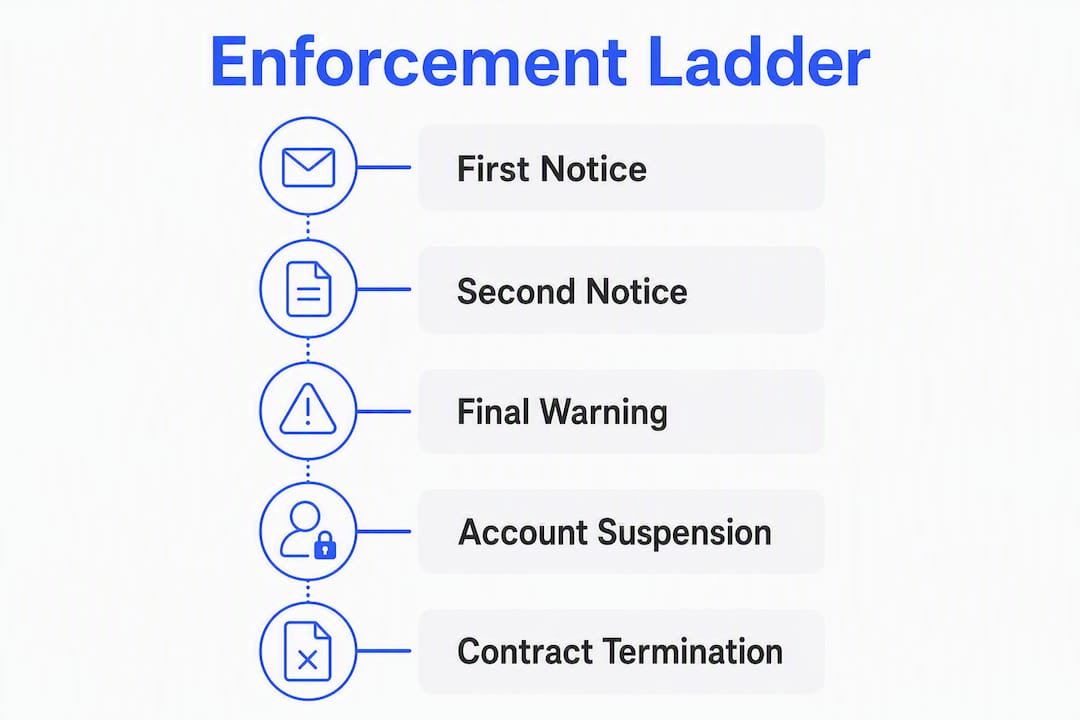
The escalation ladder
Typical enforcement tiers used by manufacturers:
For repeat offenders, document the full sequence before escalating. A retailer who has received three notices and corrected twice before violating again needs a different response than a first-time error. The escalation ladder should account for recidivism explicitly.
Sample notice language patterns
A first notice might read: “[Brand] has detected that [Retailer] is advertising [Product Name, SKU] at $[price], below the MAP of $[MAP price]. This listing must be corrected to $[MAP price] or higher by [date/time]. Please confirm correction by replying to this notice.”
A second notice might read: “This is a second MAP violation notice for [Retailer]. Per [Brand]'s MAP policy, [Retailer]'s access to [benefit/allocation] is suspended effective [date] for 30 days. Continued violations may result in further action under the policy.”
Documentation checklist
Keep the following for every enforcement action:
This audit trail is your primary defense in any later dispute, and it is what makes enforcement legally defensible rather than arbitrary.
Marketplace Realities: Amazon, Walmart, and Unauthorized Sellers
Marketplace enforcement is where most MAP programs run into their hardest problems. Marketplace platforms do not enforce your MAP policy for you. Amazon and Walmart provide tools that help with some issues, but systematic MAP compliance on those platforms is entirely your responsibility.
Amazon
Amazon’s third-party marketplace means dozens of sellers can list your product, many of whom you have never authorized. Repricing algorithms compound the problem: one seller drops below MAP, a competitor’s repricer matches it, and within hours the price floor has collapsed across the ASIN. Amazon Brand Registry helps with counterfeit and IP issues, but it does not enforce MAP.
Practical steps for Amazon:
Marketplace-specific operational playbooks reduce risk and speed remediation because Amazon and Walmart have different seller-identification and takedown mechanisms. A single generic process does not work across both.
For deeper Amazon operations support, Nectar’s Amazon growth and optimization services include ASIN-level monitoring and marketplace operations as part of full-channel management.
Walmart and other marketplaces
Walmart Marketplace has its own seller verification and listing-control tools. Partner program avenues exist for brands with established Walmart relationships. The same principle applies: you need marketplace-specific monitoring coverage, not just a general web crawl.
For Walmart marketplace operations, Nectar manages listing compliance and seller oversight as part of its managed services.
Unauthorized sellers: a different enforcement path
You cannot enforce MAP contractually against a seller who has no relationship with you. The policy only binds authorized resellers. For unauthorized sellers, the tools are different: IP takedown requests through marketplace programs, cease-and-desist letters based on trademark rights, and distributor audits to identify how product is leaking into unauthorized channels. If unauthorized sellers keep appearing, that is a distribution control problem at its root, not just a MAP enforcement problem.
Pro Tip: Repricing cascades are predictable. When one authorized seller drops below MAP, automated repricers from other sellers often follow within 24 hours. The tactical response is to send the first notice immediately and monitor the ASIN hourly until the price corrects. Delayed enforcement on Amazon gives the cascade time to spread and get copied.
KPIs and Reporting Routines That Show Enforcement Is Working
Enforcement without measurement is just activity. The importance of MAP enforcement shows up most clearly in the numbers over time, not in any single corrected listing.
Core KPIs
Reporting routine
Daily monitoring alerts go to channel operations. Weekly exception reports summarize open violations, time-to-remediation, and any escalations in progress. Monthly trend analysis goes to brand management and, where relevant, executive review. The monthly report should include before/after price spreads on key SKUs and a recidivism trend line.
For board-level snapshots, keep it to three numbers: compliance rate, active violations, and estimated revenue preserved. Those three tell the story without requiring the audience to understand the operational details.
Attributing impact
The cleanest attribution method is a before/after comparison on specific SKUs where enforcement action was taken. Pull the average advertised price for the 30 days before a violation was detected and the 30 days after it was corrected. The difference, multiplied by estimated sales volume, gives you a rough revenue-preservation figure. It is not a perfect measure, but it is defensible and easy to explain.
How Nectar Supports MAP Enforcement for Mid-Market and Enterprise Brands
Building and running a MAP enforcement program in-house requires monitoring infrastructure, dedicated channel operations staff, legal coordination, and marketplace-specific expertise across Amazon, Walmart, and other channels. For brands managing hundreds of SKUs across multiple marketplaces, that is a significant operational load.
Nectar’s fully managed e-commerce services include MAP monitoring, violation verification, retailer outreach, escalation management, and marketplace-specific remediation as part of broader channel operations. The iDerive analytics platform provides unified reporting across channels, so enforcement KPIs sit alongside advertising performance and sales data in a single view.
In practice, Nectar’s team handles daily monitoring and first-notice outreach, packages timestamped evidence for any escalation that requires legal review, and manages marketplace-specific remediation on Amazon and Walmart. Brand managers set the policy and approve escalation decisions above a defined threshold. Legal counsel handles terminations and any formal dispute.
When does outsourcing make sense over building in-house? Generally, when your SKU count exceeds what a single person can monitor manually, when you are active on more than two marketplaces, or when your internal team does not have dedicated channel operations bandwidth. The cost of a managed program typically compares favorably to the margin erosion from a single season of unchecked violations.
Key Takeaways
MAP enforcement works when it is consistent, documented, and legally structured as a unilateral manufacturer policy applied equally across every authorized reseller.
MAP enforcement definition
MAP enforcement is the operational process of monitoring, detecting, and acting on below-MAP advertised prices. A policy without enforcement has no deterrent value.
Legal structure is non-negotiable
Set MAP unilaterally, never negotiate levels with retailers, and never require signatures. The Colgate doctrine protects you only as long as the policy stays unilateral.
Automation is necessary at scale
Manual monitoring is unsustainable beyond small catalogs. Automated crawlers with timestamped screenshots are the standard for any brand with meaningful SKU count or marketplace presence.
Escalation must be uniform
Apply the same ladder to every retailer. Selective enforcement creates discrimination claims and signals to the channel that violations are negotiable.
Unauthorized sellers need a different playbook
MAP only binds authorized resellers. For unauthorized sellers, use IP takedowns, cease-and-desist letters, and distributor audits, not the standard escalation ladder.
Nectar’s role
Nectar manages monitoring, violation outreach, evidence packaging, and marketplace remediation for mid-market and enterprise brands, with iDerive analytics providing unified enforcement reporting.
Consult antitrust counsel before drafting or materially changing your MAP policy, particularly if your distribution network includes California, Maryland, or other states with stricter vertical-restraint statutes.
The Operational Shortcuts That Actually Matter
Most MAP enforcement failures are not legal failures. They are operational ones. The policy is fine. The escalation ladder is documented. But enforcement is inconsistent, documentation is spotty, and the sales team keeps making exceptions for their best accounts. That is where programs fall apart.
The first 30 days after publishing or updating a MAP policy are the most important. Every retailer is watching to see whether you actually enforce. Send violation notices within 24–48 hours of detection, every time, for every retailer. If you let the first few violations slide because the timing is inconvenient or the account is important, you have told the entire channel that MAP is negotiable. That perception takes months to reverse.
By 90 days, you should have a compliance trend line. If recidivism is high, the problem is usually one of two things: your escalation consequences are not meaningful enough, or your monitoring is too slow to catch violations before they spread. Both are fixable, but you need the data to diagnose which one it is.
At 180 days, the program should be running on documented process, not individual judgment calls. That means internal governance checkpoints: legal reviews escalation decisions above first notice, channel ops owns the monitoring log, and brand management approves any policy exceptions in writing. Cross-functional checkpoints are not bureaucracy. They are what keeps enforcement legally defensible when a retailer pushes back.
One more thing that gets overlooked: mixing MAP language with resale price maintenance (RPM) language in the same document is one of the most common drafting mistakes. MAP governs advertised prices. RPM governs actual transaction prices. They are legally distinct, and conflating them in your policy language creates exactly the antitrust exposure you were trying to avoid. Keep them in separate documents, or at minimum in clearly separated sections with distinct definitions.
Nectar Manages MAP Enforcement So Your Team Can Focus on Growth
Brands that manage MAP enforcement manually across Amazon, Walmart, and their own retail networks spend more time chasing violations than building the channel strategy that prevents them. Nectar’s fully managed approach handles the operational load: daily monitoring across your authorized seller network, violation verification with timestamped evidence, first-notice outreach, escalation management, and marketplace-specific remediation on Amazon and Walmart.

Powered by the iDerive analytics platform, Nectar gives brand managers a unified view of compliance rates, active violations, and price trends alongside advertising performance and sales data. You see the full picture, not just a list of flagged listings. For mid-market and enterprise brands managing significant SKU counts across multiple channels, that visibility is what turns enforcement from a reactive fire drill into a proactive channel management function.
If your MAP program needs a stronger operational foundation, or if you are building one from scratch, talk to Nectar’s team about how managed enforcement fits into your broader marketplace strategy.
Authoritative Sources and Further Reading
These are the primary sources used in this article. Each is worth bookmarking for policy drafting, legal review, and operational planning.
Consult antitrust counsel before finalizing any MAP policy or making material changes to an existing one, especially if your distribution network spans states with stricter vertical-restraint laws.
Recommended








































































.webp)